- 268 pages
- English
- ePUB (mobile friendly)
- Available on iOS & Android
eBook - ePub
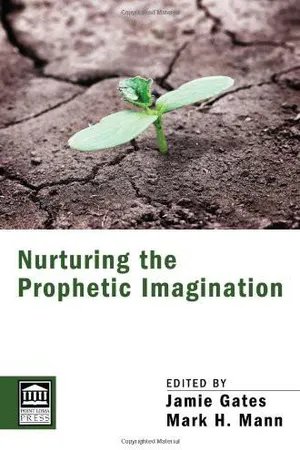
Nurturing the Prophetic Imagination
About this book
Nurturing the Prophetic Imagination searches through biblical scholarship, theology, economics, sociology, politics, ecology, and history to discern the strands of God's justice and reconciliation at work in the contemporary world. Nurturing the Prophetic Imagination challenges Christians to engage the most troubling social problems of our time by first drinking deeply from the well of the historic prophetic traditions. Nurturing the Prophetic Imagination witnesses to a God that raises up prophets to speak at critical moments in every time, and to what it might look like for the Church to nurture the soil from which such prophetic voices spring. Rarely do such a wide variety of authors from such different backgrounds and vocations get together to name what the prophetic work of God looks like in our midst. The radical justice and reconciliation of God can be found in every corner of life, if we know where to look for it; Nurturing the Prophetic Imagination provides some guidance in this direction.
Nurturing the Prophetic Imagination celebrates and seeks to build upon the legacy of eminent biblical scholar Walter Brueggemann's seminal work The Prophetic Imagination, first published in 1978, by assessing the core insights and themes he develops through a number of different lenses. These include contemporary biblical scholarship, theology, economics, sociology, politics, ecology, and church history. Nurturing the Prophetic Imagination also discusses the extent to which the Christian prophetic tradition continues to speak meaningfully within the contemporary world and thereby seeks to be a source for inspiring future generations of Christian prophets to do likewise.
Information
Topic
Theology & ReligionSubtopic
Christian ChurchPart I: Primer on the Prophets
Jamie Gates
In the opening essay of our introductory section, Dr. Brad Kelle invites us to reflect on the contribution of renowned Old Testament scholar Walter Brueggemann to our understanding of what it means to be prophetically engaged in the world. While this book is not specifically built around his scholarship, nor should Dr. Brueggemann take any of the blame for the direction we have taken this work, his 1978 work The Prophetic Imagination stands as a roadsign pointing the church in a direction the authors of this book follow, a movement toward a much deeper and richer engagement with the prophetic traditions of the past for the sake of the active, liturgical life of the church.
As Dr. Kelle reminds us:
By bringing together elements of social-scientific exegesis, rhetoric, and liberationist perspectives, Brueggemann’s The Prophetic Imagination constructed a way of reading that engages in social criticism of both the political, cultural, and economic dynamics in the texts and those at work in the contemporary circumstances and dominant discourses into which the texts may speak, especially the church’s liturgical life and practices in the industrial West.
The present volume assumes we are to draw on the best of social-scientific research for understanding both the ancient and contemporary worlds. It assumes the power of rhetoric to generate not only new ideas, but new behaviors and new social realities. And consistently the essays assume and most often articulate the same prophetic moral concern for justice and care for those on the margins, i.e., the widow, orphan and stranger.
Dr. Maria Pascuzzi helps to ground our understanding of the prophetic imagination in the lives and activities of the Old Testament prophets. She bridges the hermeneutical gap between the ancient worlds of the Old Testament prophets and the pressing social issues of our time. She points out that “the history of the kingdoms of Israel and Judah is, with few exceptions, a litany of ineffective monarchs who abused their power and were responsible for the conditions that generated serious social inequity.” Goods and resources were monopolized for the prosperity of some at the expense of others. Often forgotten in the prophetic concern for the marginalized, Pascuzzi reminds us that “the social and economic injustices went hand in hand with the disregard for the land and the environment.”
The arc of the ancient prophetic imagination is seen to carry into the New Testament most directly in the life, teachings and actions of Jesus of Nazareth. Theologian Michael Lodahl helps to distinguish the prophetic imagination from the apocalyptic imagination, which “tends to operate on the strong assumption that the world can only get worse.”
But as Lodahl explores the prophetic imagination in the Gospel of Matthew, he leads us to a vision of the prophetic imagination grounded in the words of God through the prophet Hosea, “I desire mercy and not sacrifice.” The prophetic imagination “reveals a divine yearning ... a longing of God for the world to be different, to be a place where compassion flows toward human suffering and need, where the hungry have plenty to eat and health care truly is provided for all.”
Theologian and pastor Rebecca Laird examines the life of a 20th century figure whom she believes embodies the prophetic imagination as well as any other contemporaries. Dorothee Soelle, Protestant German liberation theologian of the late 20th century, lived “bewildered by a larger question: How could her family, society and the world at large act as if the existing structures that lead to educational success and religious propriety nourish a full adult life for her if they also bred the silences that allowed six million people to die at the hands of educated, civilized people who were formed by those selfsame structures?” Her faith was formed on the anvil of her own suffering, the suffering of her family and the suffering of countless others during World War II. All of her writing, indeed her theology and living, were done remembering the ashes of Auschwitz.
Laird describes Soelle’s contribution to the prophetic imagination as one that “[Soelle] did not wait for a new heaven in some immaterial future; she wanted it to be ‘on earth as it is in heaven.’ She understood the way to bring heaven to this earth was by ‘embedding this vision’ in her daily life and in her social interactions.”
Tilling the Soil with Care
Kelle, Pascuzzi, Laird and the authors in this volume recognize that the prophetic work of God’s people is fraught with possible missteps and dangerous paths down which other reportedly prophetic voices have led. Avoiding these dangerous paths is as important as finding the more fruitful ones.
A common misconception is to confuse the prophets with soothsayers, seers or futurists. Prophets are sometimes thought to look into a crystal ball to give some secret information about the future that only they possess. But the prophets of Christian and Jewish tradition were more commonly reading the signs of the times as interpreted through lessons from the past (scripture and tradition) that everyone in the community should already have known. Isaiah and Jeremiah speak to the reality of a people under siege, taken into exile under the Babylonians, interpreting their troubles as a function of their unfaithfulness to their historic covenant with God. While nurturing the prophetic imagination does lead to reflection on what the future might look like if the unfaithful continue down the destructive path, it is not principally about predicting the future. We’ll learn more about these contrasts from Dr. Lodahl in Chapter 3 of this volume.
Those who consciously stand in the prophetic traditions must be on guard for the temptation of self-righteousness. The temptation to self-righteous moralizing always hangs over those who claim to be counter-cultural. How can we be sure that in saying “Thus Sayeth the Lord!” we are not just baptizing our own concerns and proclivities with the waters of divine authority? This temptation is particularly strong when those speaking are from the dominant culture, already vested with power that others do not share. This temptation is particularly strong when we are embedded in a dominant culture that prizes the power of the heroic individual.
Guarding against the temptation to self-righteous moralizing requires that we speak confessionally in community with those we are challenging, and from among those whose suffering is breaking the heart of God. Before pointing the finger at the surrounding culture and calling it evil, have we confessed the corruption from within? Have we examined the role that we play in others’ suffering? Have we examined the faithfulness of those that call themselves the people of God, or followers of Christ? In fact, most of the prophets’ energies are spent on correcting and cajoling the people of God—those that claim faith—not those that don’t.
Contemporary prophets amplify the voices of the proverbial widow, orphan and stranger in our midst, but doing so from the seats of power and not the periphery can itself be a sign of self-righteousness, even hypocrisy. While the prophets speak on behalf of the poor and marginalized, rarely can they speak for those who are suffering if they are not also amidst and among those who are suffering. Christ models this in the incarnation as he lived, suffered and died in solidarity with all of humanity.
The prophetic traditions often model speaking truth to power (“prophet versus King”). At times Christians from the dominant culture may need to take advantage of their citizenship to speak in the halls of power (rarely do people on the margins have this privilege). But when such is required, we are to guard even more carefully against the temptation to self-righteous muckraking. We do not go into the halls of power hoping to take hold of the reigns of power, or with our ultimate hope in their solutions, for that would be idolatry. But prophets recognize that God may use the powers-that-be for God’s purposes, often even despite their lack of faith.
At times Christians may need to be less like Amos directly confronting Amaziah (Amos 7:10–17) and more like Jesus subtly and non-violently confronting the Pharisees and Pilate with humor and sarcasm, prophetic interpretations of scripture and faithful obedience that may likely include suffering. But prophets are rarely nice … not the kind of people you want to take home to the family. Prophets speak difficult truth into difficult situations.
In the end, it is God who raises up prophets when the time is right. While God raises up prophets, we can create a social environment that will be much more hospitable to the emergence of prophetic communities. Jesus raised up disciples; the prophets of biblical history were trained in prophetic schools. We can do our part to remove the weeds and nurture the soil from which the prophetic imagination springs. This book is just such an attempt.
1
Prophecy, Canon and Imagination: Walter Brueggemann’s The Prophetic Imagination and the Contributions of Biblical Interpretation to the Prophetic Project
Brad E. Kelle
The conference at which many of the essays in this volume were originally delivered—and, indeed, the larger ethos and project in which they participate—stand in a legacy formed, in part, by Walter Brueggemann’s brief work of biblical scholarship first published in 1978 entitled, The Prophetic Imagination.15 As a work of biblical hermeneutics, Brueggemann’s volume was noticeably brief and focused on a particular corpus of Old Testament (OT) material and a specific mode of interpretation. Its contribution, however, has proven to be paradigmatic, especially for defining the nature of “prophetic” engagement between church and culture. The book appeared at a time in the late 1970s when the kinds of conversations about a theology of culture, politics and economics now so well-known to the contemporary church and academy were underway in varying degrees.16 No doubt those developing conversations within theology and ecclesiology partially evoked Brueggemann’s volume—both consciously and otherwise. Within the field of biblical scholarship in the late 1970s, however, the perspectives and issues associated with theological reflection on society, politics and economics had yet to be substantially integrated into the interpretive practices of biblical scholars. And therein may be the most significant legacy of Brueggemann’s initial and later work as a biblical interpreter. In a distinctive way, Brueggemann, beginning in earnest with his 1978 treatment, made the biblical texts, especially the OT prophets, available in new and profound ways to those struggling to articulate a theology of critical Christian engagement with culture, politics and economics. He “gave back” the prophetic texts in particular to theologians, ministers, sociologists and others who perhaps sensed that such ancient texts had little, if anything, constructive to offer to their critical and hermeneutical project. Moreover, he did so by helping to solidify an understanding of prophets and prophecy that moves beyond common (mis)conceptions of prophets and brings the prophetic texts into the church’s liturgical life and practice in ways that can nourish and evoke new types of engagement with the dominant culture.
The purpose of this essay is to illustrate briefly the elements of the legacy that Brueggemann, particularly in The Prophetic Imagination, has created concerning biblical scholarship, the notion of the “prophetic” and the potential of biblical interpretation to contribute to the conversation represented by the present volume. While much more could be said about this scholar’s lasting impact upon issues touching social justice, liberationist hermeneutics, ecclesial theology and ministerial practice,17 Brueggemann’s initial and continued work offers a method of engagement with the OT prophetic texts in particular that centers on rhetoric and imagination. This approach moves beyond both popular (mis)conceptions of prophets and prophecy and merely historicist or decontructivist options to make the biblical texts available in new ways to fund the church’s struggle with a theology of culture, politics and economics.
Rhetoric and Imagination
The Prophetic Imagination stands as one representative of the large body of work that has established Brueggemann as arguably the most significant American OT scholar in the second half of the twentieth and early part of the twenty-first centuries. Impressively, his more than 50 books and numerous other articles demonstrate a tenacious cohesiveness. Each in its own way, Brueggemann’s works give voice to a type of engagement with the biblical texts that combines literary and sociological modes of reading, featuring a theological interpretation involved with sociological and ideological concerns of both the texts and their past and present reading communities. The mode of interpretation is dialogical and dialectical. He reads diverse biblical texts in dialogue with one another, holding various theologies and ideologies expressed in different texts in tension and connecting them with the social and ideological forces in the ancient contexts that shaped them.18 At the same time, he moves the biblical texts toward engagement with contemporary social and theological situations in ways that establish a dialogue between the theological impulses in the texts and the social and economic realities tha...
Table of contents
- Title Page
- Foreword for Point Loma Press Series
- Acknowledgments
- Introduction
- Part I: Primer on the Prophets
- Chapter 1: Prophecy, Canon and Imagination: Walter Brueggemann’s The Prophetic Imagination and the Contributions of Biblical Interpretation to the Prophetic Project
- Chapter 2: The Prophets and the Social and Ecological Consequences of the Monarchy
- Chapter 3: Prophetic Imagination in the Gospel of Matthew
- Chapter 4: “As if We Lived in a Liberated World”132: The Prophetic Vision of Dorothee Soelle
- Part II: Open our Eyes, Open our Ears
- Chapter 5: It’s Hard Out Here for a PIMP (a Prophet who Imagines Moral Possibilities)
- Chapter 6: The Assassin of Prophetic Imagination: Imperialistic Rhetoric in Ancient Rome and Contemporary America
- Chapter 7: Appropriating the Prophetic Visions of Du Bois and Thurman: Considerations for the Academy
- Chapter 8: Unmasking the Gods of the Marketplace: God’s Economy as a Counter to the Religious Functions of Prevailing Economic Models
- Chapter 9: Seeing Beyond the Economy of Appearances: Fair Trade as Phantasm of Justice
- Part III: Refuse To Be Consoled
- Chapter 10: A Voice is Heard at Ramah: Lament as the Form and Shape of the Prophetic Imagination
- Chapter 11: When Beauty Speaks, Truth Answers
- Chapter 12: Rumours of Glory: The Prophetic Music of Bruce Cockburn
- Chapter 13: Walking Humbly
- Part IV: A Eucharistic People
- Cjapter 14: The Eucharistic Imagination of Hope and Martyrdom: The Kingdom of God
- Chapter 15: In Solidarity With the World: The Holiness of the Missionary Community
- Chapter 16: Prophets Turning Profits: The Transforming Impact of Women’s Savings Groups in Sub-Saharan Africa
- Chapter 17: Interview with Bill McKibben: An Environmental Prophet Crying in the Wilderness
- Chapter 18: Nurturing a Prophetic Imagination: Missiology as Ecclesiology
- Contributors List
Trusted by 375,005 students
Access to over 1.5 million titles for a fair monthly price.
Study more efficiently using our study tools.
Frequently asked questions
Yes, you can cancel anytime from the Subscription tab in your account settings on the Perlego website. Your subscription will stay active until the end of your current billing period. Learn how to cancel your subscription
No, books cannot be downloaded as external files, such as PDFs, for use outside of Perlego. However, you can download books within the Perlego app for offline reading on mobile or tablet. Learn how to download books offline
Perlego offers two plans: Essential and Complete
- Essential is ideal for learners and professionals who enjoy exploring a wide range of subjects. Access the Essential Library with 800,000+ trusted titles and best-sellers across business, personal growth, and the humanities. Includes unlimited reading time and Standard Read Aloud voice.
- Complete: Perfect for advanced learners and researchers needing full, unrestricted access. Unlock 1.5M+ books across hundreds of subjects, including academic and specialized titles. The Complete Plan also includes advanced features like Premium Read Aloud and Research Assistant.
We are an online textbook subscription service, where you can get access to an entire online library for less than the price of a single book per month. With over 1.5 million books across 990+ topics, we’ve got you covered! Learn about our mission
Look out for the read-aloud symbol on your next book to see if you can listen to it. The read-aloud tool reads text aloud for you, highlighting the text as it is being read. You can pause it, speed it up and slow it down. Learn more about Read Aloud
Yes! You can use the Perlego app on both iOS and Android devices to read anytime, anywhere — even offline. Perfect for commutes or when you’re on the go.
Please note we cannot support devices running on iOS 13 and Android 7 or earlier. Learn more about using the app
Please note we cannot support devices running on iOS 13 and Android 7 or earlier. Learn more about using the app
Yes, you can access Nurturing the Prophetic Imagination by Jamie Gates,Mark Mann, Gates, Mann in PDF and/or ePUB format, as well as other popular books in Theology & Religion & Christian Church. We have over 1.5 million books available in our catalogue for you to explore.