eBook - ePub
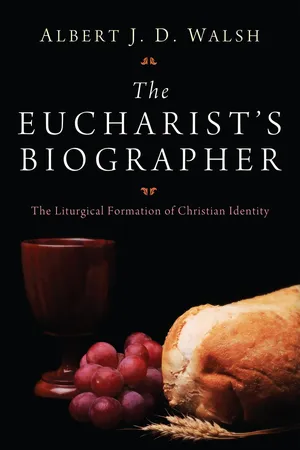
The Eucharist's Biographer
The Liturgical Formation of Christian Identity
- 140 pages
- English
- ePUB (mobile friendly)
- Available on iOS & Android
eBook - ePub
About this book
Christians are not just called to be transformed into something "better" or even "good," but to be transfigured into a "new creation"--ceasing to be what they are in order to become what they are not. In The Eucharist's Biographer, Albert Walsh proposes that the path to this "distinctive Christian identity" is through the power of the Holy Spirit, as revealed in the unity of Word and Sacrament. With this premise, he unites two powerful traditions: the Proclamation of the Word of the Protestant tradition and the Power of God's Grace in the Eucharist of the Roman Catholic and Eastern Orthodox traditions. It is in what Walsh calls the eucharistic-evangel as a whole that the individual and community are subject to the "real presence" of the Christ, who, in the power of the Holy Spirit, is the force behind the transformation and maintenance of Christian identity.
Information
Topic
Theology & ReligionSubtopic
Christian Rituals & Practiceone
The Emmaus Narrative as Paradigm, Part 1
Beloved in Christ,
the Gospel tells us that on the first day of the week
Jesus Christ was raised from death,
appeared to Mary Magdalene,
on that same day sat at table with two disciples,
and was made known to them in the breaking of the bread.1
We open this chapter with an exposition of a biblical pericope from the Gospel according to St. Luke, chapter 24, verse 13 to the end of the chapter. Although this particular text is familiar to most Christians, my interpretation is essentially related to the concern of this essay; to that extent I deem this pericope to be illustrative or paradigmatic. The rationale underlying such exposition of this text is (1) my judgment that one of the fundamental characteristics of this passage is the provocative description, in narrative style, of the essential liturgical unity of Word and Sacrament in Christian worship;2 and (2) the narrative in its present form portrays initial dismay and confusion concerning the correct identity of Jesus as Christ and the impact of Word and Sacrament upon correct identification and the consequent transformation and maintenance of a distinctive Christian identity made evident, initially, in the change of disposition in the two disciples from one of despondency to one of delight, followed by renewed energy to share with others (in particular the other followers) the reality of the crucified and risen Christ whose true identity was disclosed in his exposition “of the Scriptures” (Luke 24:32b) and his being “made known to them in the breaking of the bread” (Luke 24:35b). One can comprehend this portrayal through an exploration of the various levels of personal interaction and intricate literary texture located in this pericope. Acknowledgement of the validity of the two observations listed above leads to the conviction that this narrative is illustrative of both the form and content which Christian worship should assume as indicative of its own distinctive liturgical style and reverential character.
The exposition will be guided by the following outline; even though I will not be making specific reference to these headings, they remain the directing principles throughout the process of interpretation of the passage:
1. The unknown presence (Luke 24:16)
2. Expectations in conflict (Luke 24:21a, 27b)
3. The presence and identity disclosed; greater expectations (Luke 24:29–31)
4. Recognition, acknowledgment, and confession (Luke 24:31–33a)
5. The transformation of identity, personal and communal (Luke 24:38–53)
Clearly, my intent is not to argue for the historicity of the “Emmaus road” experience; rather, my interest is with the Sitz im Leben of Luke and the community to which his gospel is primarily addressed, and in particular the liturgical Sitz im Leben!
The narrative opens by telling of two disciples who “that same day” (that is, “the first day of the week”) were traveling from Jerusalem to a village named Emmaus. As they traveled together, they were apparently discussing the events of the past several days, including the arrest, condemnation, and death of their master, Jesus of Nazareth. We can surmise from verse 17b (“they stopped walking and looked discouraged”) that this conversation was fraught with despair and disappointed expectations. The two disciples traveled away from the gates of the holy city of Jerusalem, where death and despair now prevailed among the followers of Jesus who “were hoping that He was the One who was about to redeem Israel” (v. 21a). From the outset, the narrative creates an atmosphere of disillusionment and a deepening sense of discontent among the followers of Jesus. The words “were hoping” suggest both expectation and disappointment! We should not overestimate, but just as importantly, not underestimate the investiture of expectations in Jesus as the promised Messiah—as these early followers understood the identity of the Messiah of God—and the way in which their expectations would impact their own sense of identity as individual disciples and as a community of believers in transition.
The redemption of Israel had been forth-told by prophets and apocalyptic sources of inspiration. The recorded expectations were as multifaceted as were the sources; yet one of the prevailing images throughout such material was that of the messianic expectation. Though even here one must be cautious so as not to give the impression that these messianic expectations were somehow monolithic:
It has been rightly pointed out that the OT exhibits no clear developments of the messianic expectation . . . the expectation of a Davidic messiah represented only one type of messianism in the period between the exile and A.D. 135. Altogether it took a variety of forms. It was influenced not only by Moses (cf. Deut. 18:15f.) and Elijah (Sir. 48:10) but also in apocalyptic texts and traditions (Eth. Enoch, 2 Esd.) by the idea of a son of man (cf. Dan. 7:13ff.) as a bringer of salvation who was also thought of as preexistent. Even the expectation of a messianic high priest is not lacking . . . no doubt . . . the messianic hope with which Jesus and the primitive church were faced was anything but unified and unambiguous.3
Cognizant of such diversity in messianic expectation, it can still be maintained that the dominant perception of the promised Messiah appears to have been that of one who would arrive on the historical scene with power, might, and wisdom, bringing about the restoration of the glory Israel once had known.4 Although the developing streams of messianic expectation also appear to have included both the spiritual and political dimensions of Israel. As Oscar Cullman concludes: “In the New Testament period the prevailing Messiah type was of course more and more that which we roughly designate the ‘political Messiah,’ or simply the ‘Jewish Messiah’ . . . but we must not forget that the expression ‘Messiah’ was not a terminus technicus for this one conception, but was only in the process of becoming that.”5
The line between the spiritual and political dimensions of messianic expectation was fluid, allowing for some overlap.6 Nevertheless, the observation I wish to make is (1) the development of messianic expectation (including the themes of redemption and restoration) suggested that with the advent of the Messiah both political and spiritual dimensions of Israel’s existence would undergo a transformation; and (2) the political dimension of messianic expectation played a central role in the thought of the disciples regarding the identity of Jesus:
Jesus knew very well that all his disciples had the secret hope that he would assume the political Messiah’s glorious kingly role. . . . The argument of the sons of Zebedee concerning their rank in the future kingdom is enough to show what thoughts were in the heads of the disciples. Their desertion of their master when he was arrested and their flight was not only the result of understandable human cowardice, but also the result of the disappointment that Jesus did not resemble in the slightest the expected Messiah-king.7
It has been contended that, in the context of Luke’s narrative, the two disciples “represent all followers of Jesus.”8 Therefore Luke addresses similar messianic expectations in the community of faith through these representative voices of the two disciples when he has them say, “But we were hoping that He was the One who was about to redeem Israel” (24:21). “In the mouth of the disciples on the Emmaus road it is just as much the writer’s attempt to understand Jesus as are the other attempts in the tradition (cf. Mark 6:14ff.; par. Matt 14:1f.; Luke 9:7f.).”9 I would simply make the observation that the “writer’s attempt to understand Jesus” is also and at the same time his attempt to address a similar conundrum in the life of the community of faith to which his gospel is written.
This Jesus of Nazareth, in whom these two disciples (and as representative of similar expectations in the wider community of faith) had placed such great store as the promised Messiah, had by all outward appearances failed to fulfill the content of a particular strain of messianic expectation.10 The description of Jesus as “a Prophet powerful in action and speech” (24:19) would imply that, at best, the impression Jesus had made on these two disciples was mere...
Table of contents
- Title Page
- Preface
- Introduction
- Chapter 1: The Emmaus Narrative as Paradigm, Part 1
- Chapter 2: The Emmaus Narrative as Paradigm, Part 2
- Chapter 3: Anamnesis and “Real Presence”
- Chapter 4: Anamnesis and the “Open-Telling” of Redemptive History
- Chapter 5: Transformation and Maintenance of a Distinctive Christian Identity
- Chapter 6: The Contribution of John Williamson Nevin
- Chapter 7: The Transformational Process and Summation
- Chapter 8: Final Comments and Personal Observations
- Postscript
- Bibliography
Trusted by 375,005 students
Access to over 1.5 million titles for a fair monthly price.
Study more efficiently using our study tools.
Frequently asked questions
Yes, you can cancel anytime from the Subscription tab in your account settings on the Perlego website. Your subscription will stay active until the end of your current billing period. Learn how to cancel your subscription
No, books cannot be downloaded as external files, such as PDFs, for use outside of Perlego. However, you can download books within the Perlego app for offline reading on mobile or tablet. Learn how to download books offline
Perlego offers two plans: Essential and Complete
- Essential is ideal for learners and professionals who enjoy exploring a wide range of subjects. Access the Essential Library with 800,000+ trusted titles and best-sellers across business, personal growth, and the humanities. Includes unlimited reading time and Standard Read Aloud voice.
- Complete: Perfect for advanced learners and researchers needing full, unrestricted access. Unlock 1.5M+ books across hundreds of subjects, including academic and specialized titles. The Complete Plan also includes advanced features like Premium Read Aloud and Research Assistant.
We are an online textbook subscription service, where you can get access to an entire online library for less than the price of a single book per month. With over 1.5 million books across 990+ topics, we’ve got you covered! Learn about our mission
Look out for the read-aloud symbol on your next book to see if you can listen to it. The read-aloud tool reads text aloud for you, highlighting the text as it is being read. You can pause it, speed it up and slow it down. Learn more about Read Aloud
Yes! You can use the Perlego app on both iOS and Android devices to read anytime, anywhere — even offline. Perfect for commutes or when you’re on the go.
Please note we cannot support devices running on iOS 13 and Android 7 or earlier. Learn more about using the app
Please note we cannot support devices running on iOS 13 and Android 7 or earlier. Learn more about using the app
Yes, you can access The Eucharist's Biographer by Albert J.D. Walsh in PDF and/or ePUB format, as well as other popular books in Theology & Religion & Christian Rituals & Practice. We have over 1.5 million books available in our catalogue for you to explore.