- 228 pages
- English
- ePUB (mobile friendly)
- Available on iOS & Android
eBook - ePub
About this book
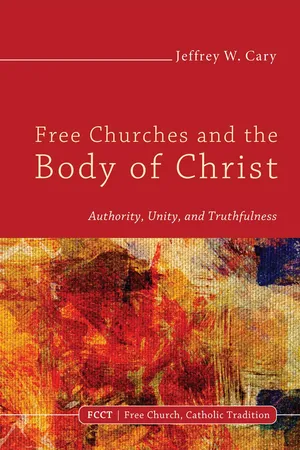
Those within the free church tradition have often appealed to the notion of the invisible church to account for the unity of the Body of Christ. A growing number of free church theologians, however, are giving increased attention to the importance of visible ecclesial unity, which immediately raises the perennial problem of the authorities by which unity is maintained. There is also a growing recognition among free church theologians of the need to recognize the authority of tradition in tandem with the authority of Scripture. In this book, Cary affirms these recent developments but then inquires whether a turn toward visible unity, together with an embrace of the authority of tradition, can eventually be coherent without also embracing the authority of an extra-congregational teaching office.
To guide his study, Cary engages the work of two theologians from outside the free church tradition: Robert Jenson and Rowan Williams. He then brings them into contact with the prominent free church theologian James McClendon in order to supplement some of the deficiencies Cary perceives in McClendon's groundbreaking work. Once these deficiencies are addressed, however, the question intensifies whether the free church tradition, as such, can remain a coherent ecclesial option over time.
Information
Topic
Theology & ReligionSubtopic
Christian Church1
Introduction
Theologians from free church1 traditions have long struggled to articulate from within their ecclesial contexts the importance of the unity of Christ’s body. This is not to suggest that free church traditions have been unconcerned about Christian unity. It is only to say that an ecclesiological outlook that is fundamentally “free” in character poses certain problems with respect to speaking coherently about ecclesial unity.
The state of the church in the wake of the Reformation has fixed ecclesial unity as a perennial topic of theological concern. The solution to the problem of apparent disunity has sometimes been sought in the notion of the “invisible church.” For example, Luther, Calvin, and Zwingli followed Augustine in distinguishing between the visible and invisible church. This move allowed them to contest the Roman Catholic equation of the true church with the visible Roman institution centralized in the Roman pontiff. There followed, then, a tendency to associate the true church with the invisible church in the theology of the early Reformers, yet without downplaying the importance of its visible marks such as the preaching of the Word and the proper administration of the sacraments. These visible marks created a crucial link between the visible and invisible church.2
Modern Protestant heirs have often made heavy use of the concept of the invisible church to address the obvious fact of ecclesial division. Paul Tillich criticized the way many Protestant theologians had tended to draw so freely upon the distinction between the visible and invisible church.3 Nonetheless, this distinction remained central to his own ecclesiology. He argued that Protestants understand that unity, when predicated of the church, has a paradoxical character. The predicate of unity applies not to actual churches but to the “unity of their foundation, the New Being which is effective in them.” Sociologically speaking, the church cannot avoid divisions. No matter how much ecumenical efforts may accomplish in reuniting actual churches, new divisions will always arise because of the “ambiguities of religion.” Thus, the church’s essential unity is not to be sought in the existence of actual churches. Rather:
The predicate [of unity] is independent of these empirical realities and possibilities. It is identical with the dependence of any actual church on the Spiritual Community as its essence in power and structure. This is true of every particular local denomination and confessional church which is related to the event of the Christ as its foundation. The unity of the church is real in each of them in spite of the fact that all of them are separated from each other.4
Or to highlight more clearly Tillich’s point about the paradoxical character of the church’s unity, “It is the divided church which is the united church.”5 Within this kind of essentialistic ecclesiology, there is no pressing theological need for visible unity, as desirable as it may be, because the visible is merely a sociological reality. It is the invisible, essential quality of unity that is real and that is given by God.
A heavy dependence upon the idea of the invisible church is not limited to mainline Protestants. Stan Grenz contends that the distinction between the visible and invisible church has been the “operative principle of evangelical ecclesiology.”6 For example, in his discussion of the nature of the church, Wayne Grudem, a self-described conservative evangelical, states, “In its true spiritual reality as the fellowship of all genuine believers, the church is invisible.” He then proceeds to define the invisible church as “the church as God sees it.” Grudem acknowledges the visibility of the church but only as an aspect of the true church, which is invisible. The visible church is “the church as Christians on earth see it” and that will always include unbelievers.7 Similarly, Millard Erickson, a significant voice among Baptist and other free church theologians, maintains the distinction between the visible and invisible church, the latter of which is the “true church” and contains only true believers. He asserts that Scripture gives priority to the individual believer’s spiritual condition and in doing so gives precedence to the invisible church over the visible.8
Visible Unity and Authority: Emerging Free Church Voices
In recent years, especially in the light of twentieth-century ecumenical efforts focused on visible unity, a growing number of theologians from within the free church tradition have become decreasingly satisfied with discussing Christian unity primarily with reference to the invisible church. Yet, there is a certain tension that presents itself for those theologians within the free church tradition who are increasingly highlighting the importance of the visible church. How is one to speak intelligibly about the visible unity of the body of Christ from within a free church perspective?
The struggle over the visible unity of the church continues to revolve largely around the vexed issue of authority. Those from within the free church tradition have (in theory) typically located authority primarily, if not solely, in Scripture. Whereas much of the Christian tradition has recognized that authority is manifested through a constellation of distinct but not mutually exclusive loci (especially Scripture, tradition, and a teaching office), the free church tradition has been notable for transforming the Protestant sola scriptura principle into a radical biblical reductionism funded by rapidly eroding modern modes of thought, modes of thought that were eventually capable of buttressing visible ecclesial fragmentation.
In the wake these collapsing modes of thought, there is an emerging cadre of scholars within the free church tradition, especially Baptists, who are now pressing for a deeper engagement with the church’s wider theological and liturgical tradition as an important source of authority in the life of the church. Such calls for free church Christians to recognize tradition as authoritative to one degree or another are often designed to unmask the myth of the sola scriptura doctrine as it has come to be understood by many within the free church tradition. These free church scholars are arguing in various ways that Scripture must be read consciously within the context of the church’s tradition.
To argue that the church should read Scripture in the light of the church’s theological tradition opens the door for some serious questions for those within the free church tradition, especially regarding their relationship to the broader Christian tradition. These fresh voices from within the free church tradition are now saying that they are participants in and inheritors of the “one, holy, catholic and apostolic” church and that this catholic tradition belongs to all Christian traditions (including the free church tradition) that make up the one living body of Christ that spans time and place. While there is much here that is ecumenically promising, there also remain difficult questions to consider with regard to visible unity for these free church scholars who are heavily emphasizing the visible church while also turning to the resources of the catholic tradition. Most pressingly, how is unity with this one church to be visibly demonstrated within a free church context and its traditional construals of authority?
Why This Book?
The primary purpose of this study is to build on the recent turn to tradition among free church theologians primarily by pressing the question of visible ecclesial unity and its relationship to the issue of authority. In his foreword to Steven Harmon’s book that urges Baptists to account more fully for their relationship to the larger Christian tradition, Paul Avis congratulates Harmon on his “Baptist Catholicity” but then offers this observation:
The threefold ministry is a topic related to tradition that is not addressed in this book. I am aware that some earlier Baptist pastors were titled “bishop” and that local self-governing congregation [sic] can be seen as a diocese in miniature. But I do not think that those factors entirely answer to the concern for unity of particular churches one with another, for teaching authority, for the pastoring of pastors and for the thickly textured fabric of visible unity—in all of which the bishop has traditionally had a pivotal role.9
My aim is to naturally extend the recent discussion among these free church theologians partly by attending to Avis’s concern. Namely, can the contemporary pursuit of tradition as an authority be undertaken coherently apart from a demonstrative pursuit of visible unity beyond the local congregation, especially in the form of an authoritative extra-congregational teaching office of some kind? I shall argue that the one leads naturally to the other and that a rejection of a simplistic sola scriptura doctrine along with the affirmation of visible unity of the church substantiates and recommends the classic recognition of the triple loci of authority: Scripture, tradition, and some form of episcopal teaching office. There are some indications that free church theologians are beginning to acknowledge the resulting complexities of engaging the church’s tradition within the context of a free church setting, but not nearly enough attention has yet been given to these issues, especially issues of visible unity and authority.
After a century of ecumenical debate, it is still not certain what a workable solution toward visible unity among differing Christ...
Table of contents
- Title Page
- Series Preface
- Preface
- Acknowledgments
- Chapter 1: Introduction
- Chapter 2: Recent Developments within the Free Church Tradition
- Chapter 3: Robert W. Jenson on Unity and Authority
- Chapter 4: Rowan Williams on Unity and Authority
- Chapter 5: James Wm. McClendon Jr.: Assessment and Critique
- Chapter 6: Conclusion
- Bibliography
Trusted by 375,005 students
Access to over 1.5 million titles for a fair monthly price.
Study more efficiently using our study tools.
Frequently asked questions
Yes, you can cancel anytime from the Subscription tab in your account settings on the Perlego website. Your subscription will stay active until the end of your current billing period. Learn how to cancel your subscription
No, books cannot be downloaded as external files, such as PDFs, for use outside of Perlego. However, you can download books within the Perlego app for offline reading on mobile or tablet. Learn how to download books offline
Perlego offers two plans: Essential and Complete
- Essential is ideal for learners and professionals who enjoy exploring a wide range of subjects. Access the Essential Library with 800,000+ trusted titles and best-sellers across business, personal growth, and the humanities. Includes unlimited reading time and Standard Read Aloud voice.
- Complete: Perfect for advanced learners and researchers needing full, unrestricted access. Unlock 1.5M+ books across hundreds of subjects, including academic and specialized titles. The Complete Plan also includes advanced features like Premium Read Aloud and Research Assistant.
We are an online textbook subscription service, where you can get access to an entire online library for less than the price of a single book per month. With over 1.5 million books across 990+ topics, we’ve got you covered! Learn about our mission
Look out for the read-aloud symbol on your next book to see if you can listen to it. The read-aloud tool reads text aloud for you, highlighting the text as it is being read. You can pause it, speed it up and slow it down. Learn more about Read Aloud
Yes! You can use the Perlego app on both iOS and Android devices to read anytime, anywhere — even offline. Perfect for commutes or when you’re on the go.
Please note we cannot support devices running on iOS 13 and Android 7 or earlier. Learn more about using the app
Please note we cannot support devices running on iOS 13 and Android 7 or earlier. Learn more about using the app
Yes, you can access Free Churches and the Body of Christ by Jeffrey W. Cary in PDF and/or ePUB format, as well as other popular books in Theology & Religion & Christian Church. We have over 1.5 million books available in our catalogue for you to explore.