eBook - ePub
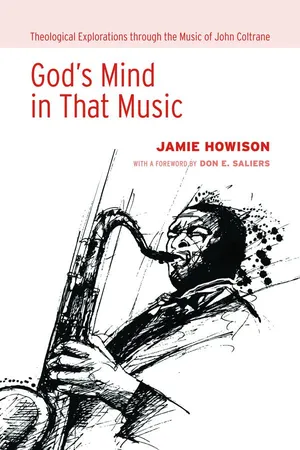
God's Mind in That Music
Theological Explorations through the Music of John Coltrane
- 250 pages
- English
- ePUB (mobile friendly)
- Available on iOS & Android
eBook - ePub
About this book
As part of the growing literature on theology and the arts, God's Mind in that Music explores the substantial theological insight expressed in the music of jazz legend John Coltrane. Focusing on eight of Coltrane's pieces, themes under consideration include lament ("Alabama"), improvisation ("My Favorite Things" and "Ascension"), grace ("A Love Supreme"), and the Trinity ("The Father and the Son and the Holy Ghost"). By attending to the traditions of theology and of jazz criticism, and through a series of interviews with musicians, theologians, and jazz writers, Jamie Howison draws the worlds of theology and jazz into an active and vibrant conversation with each other. Built around a focused listening to John Coltrane's music as heard against the background of his life and social context, and interacting with the work of a range of writers including James Baldwin, Dorothee Soelle, Jeremy Begbie, and James Cone, God's Mind in that Music will be of interest not only to those interested in the intersection of music and theology, but also to Coltrane fans, students of jazz studies, and anyone who believes that music matters.
Information
Topic
Theology & ReligionSubtopic
Christian Theology1
Theology’s Engagement with Music
An Overview
The fact that theology has generated such an enormous range of music is impressive. But much more than this historical fact, I think, is the claim that theology worth its salt is implicitly musical. When the great Passions of Bach, or the creation by Haydn, or the mysteries of the Trinity set by Olivier Messiaen compel us to enter a deeper knowing of the theological truths, we witness this inevitable drive toward music. But not only in the ‘high art’ traditions of classical music; there is something also of the cosmic energy in John Coltrane’s sax, or Art Tatum’s prodigious harmonic re-hearing of melodies, or in the singing of Spirituals like ‘Nobody Knows the Trouble I’ve Seen’ or ‘Go Tell It on the Mountain’; that gives us access to what theology tries to say.
—Don Saliers, Music and Theology
In the Western (European-North American) theological heritage, there are only occasional reflections on music, and most of those are negative—music as a theologically subversive activity.
—Clyde J. Steckel, “How Can Music Have Theological Significance?”
At a glance, it would seem that the quotations with which I open this chapter are at odds with one another. There is first Saliers’ statement that “theology has generated such an enormous range of music,” followed by Steckel’s suggestion that in the Western tradition theological reflections on music have been only occasional, and for the most part negative. The truth is that for as long as there has been a Christian religious tradition, musicians of faith have found themselves compelled to create music that expresses their engagement in that tradition . . . and theologians have wondered just what to do with it.
And the wondering of the theologians is surprising, really, when one considers that the Bible is hardly silent when it comes to music, and that for the most part the biblical assumption is that music is a part of life, and a good thing. The earliest reference to music comes in Genesis 4:21, where we read that one of the descendants of Cain was named Jubal, and “he was the ancestor of all those who play the lyre and the pipe.” Jubal is listed as the brother of Jabal, “the ancestor of those who live in tents and have livestock,” and as the half-brother of Tubal-cain, “who made all kinds of bronze and iron tools” (Gen 4:21–22). This seems to give to the musician a status equal to that of the herder and the smith, both of which offered essential services in that social context. It would appear that music was regarded as being equally essential to life in the everyday world.
After the Hebrew slaves made their escape through the Red Sea, praise was offered up in music; first by “Moses and the Israelites” (Exod 15:1–18), and then by Miriam “and all the women,” whose considerably shorter, single verse song was accompanied “with tambourines and with dancing” (Exod 15:20–21). It is tempting to see the music and dance of the women as something of a response to the more didactic wordiness of the song offered by the men.
The great King David was said to have been a musician, and the music he offered on his lyre was the only thing that could calm Saul when he was besieged by the madness of an evil spirit (1 Sam 16:1). David apparently had music not only in his hands, but in the whole of his body as well, for on the day when the Israelites finally brought the ark of the covenant in to Jerusalem “David danced before the Lord with all his might,” clad only in “a linen ephod” (2 Sam 6:14).
All you have to do is to page through the Hebrew scriptures, and you’ll find example after example of how music was embedded in the passages, rituals, and markings of the community’s life. And then of course there are the Psalms. The Book of Psalms as we know it is generally recognized as having been the hymnbook of what is known as “Second Temple Judaism.” Back at home after the Babylonian Exile, with the long, slow process of rebuilding in view, this collection was solidified. Material referring back to the glory days of David was combined with the more recent exilic and post-exilic writings to create a collection that could speak to every season and experience of individual and communal life. What’s more, it was brought together without being overly tidied, meaning that as a collection it can speak into any number of individual and community contexts. There is praise, lament, anger, celebration, and consolation. There are royal hymns right alongside of expressions of protest by those who have lost everything. Great hymns of creation roll into detailed rehearsals of the shared history as Israelites under God, yet these are followed by confessions of utter despair. There are personal and communal psalms relating to just about any experience imaginable. It is an extraordinarily courageous approach to prayer, and it is all to be sung.
The Psalms don’t simply contain material about music, but in a sense embody it. Not literally of course—though there are those little bits of instruction “to the leader”—yet they do give to the reader a sense of what is worth singing about. And apparently just about everything is worth singing about.
When we come to the New Testament, there are rather fewer references to the singing of songs, and when they do occur it is not unlikely that the Psalms are in view. In fact, they are quite clearly in view in Ephesians 5:19 and Colossians 4:16, both of which refer to singing “psalms and hymns and spiritual songs.” The Gospel according to Luke offers the great songs of proclamation of Zechariah, Mary, and Simeon, which the church continues to sing in our own day. And then there is the Revelation to John, in which songs of praise are sung by the “four living creatures” and “the twenty-four elders,” the angels, and ultimately by every creature “in heaven and on earth and under the earth and in the sea” (Rev 4 and 5). It is almost as if in John’s strange vision the new creation will be sung into being.
It is odd, then, to notice how seldom the writers of the ancient church dealt with music. Although others before him did offer occasional reflections on music—all with caution and many quite negatively—Augustine’s appreciative yet ambivalent view merits a bit of extra attention. In his wonderings about the place of music in the life of the church, Augustine wrestles in the tension between his own love of music and his fear that its emotional grip will steer believers into dangerous spiritual waters. For our purposes here, the place to focus is his highly personal reflections in The Confessions. Although he is writing in the late fourth century, these words might just as easily have been written by someone just coming from an eighteenth-century field meeting led by John Wesley, or in fact from a twenty-first-century praise and worship service led by one of the more gifted practitioners of that genre. “How I wept during your hymns and songs! I was deeply moved by the music of the sweet chants of your Church. The sounds flowed into my ears and the truth was distilled into my heart. This caused the feelings of devotion to overflow. Tears ran, and it was good for me to have that experience.”1 Yet Augustine finds that as he more deeply engages the substance of his maturing faith it is “the words being sung” that move him, and that “when they are sung with a clear voice and entirely appropriate in modulation” he is able to “recognize the great utility of music in worship.”2 Here the music seems a kind of an aid or even a tool, which is useful in bringing emphasis to the word, but only when done properly. There is embedded in this a suspicion of music’s potentially deceptive sensuality; of its ability to touch the sensate and emotional person all the while bypassing the intellect. Here Augustine’s primary concern is how the created thing—in this case music—can be mistaken as an end and as a good in and of itself, rather than as something flowing from, and pointing back to, the Creator. For Augustine, this is the threat that always hovers close by for a fallen humanity.
Still, unlike many others in the ancient church, Augustine will make room for music in worship, albeit very carefully. “Thus I fluctuate between the danger of pleasure and the experience of the beneficent effect, and I am more led to put forward the opinion (not as an irrevocable view) that the custom of singing in Church is to be approved, so that through the delights of the ear the weaker mind may rise up towards the devotion of worship. Yet when it happens to me that the music moves me more than the subject of the song, I confess to commit a sin deserving punishment, and then I would prefer not to have heard the singer.”3 I do need to be careful in focusing too narrowly on the idea of the utility of music, as it might create an impression that Augustine saw music as merely an emotionally and sensually laden means by which the word could be communicated. He does stand in the long tradition winding back to Pythagoras in the sixth century BCE, who not only recognized that music was related to numbers and mathematics, but also believed that the whole of the cosmos was engaged in “the music of the spheres”; “the belief that planets and stars of different sizes emit different pitches, generating a huge, but inaudible, cosmic music.”4 This sort of an understanding was carried forward by Plato and then by Plotinus, to be fully adapted into a Christian context by Augustine. Part of the caution Augustine raises around the potential dangers of music is his sense—inherited from Plato—that what might be most important about music is to be found not in the actual playing of it, or even listening to it, but in its study. To study harmony in an almost purely mathematical sense, for instance, might give us insight into the triune God who is harmony. As summarized by Carol Harrison, for Augustine, “The basic, but revolutionary, insight is that God is music: he is supreme measure, number, relation, harmony, unity, and equality. When he created matter from nothing he simultaneously gave it existence by giving it music, or form—in other words measure, number, relation, harmony, unity, equality . . .”5
Yet as Catherine Pickstock shows in her reading of De Musica, Augustine is not interested in music as mere theory. The theological insights he derives are also related to the fact o...
Table of contents
- TItle Page
- Foreword
- Introduction
- Listening Guide
- Chapter 1: Theology’s Engagement with Music
- Chapter 2: The Contested Story of Jazz
- Chapter 3: John William Coltrane
- Chapter 4: “My Favorite Things”
- Chapter 5: “Naima” and “Wise One”
- Chapter 6: “Alabama”
- Chapter 7: “A Love Supreme”
- Chapter 8: “Ascension”
- Chapter 9: “The Father and the Son and the Holy Ghost”
- Chapter 10: “Attaining”
- Chapter 11: In Memoriam
- Bibliography
Trusted by 375,005 students
Access to over 1.5 million titles for a fair monthly price.
Study more efficiently using our study tools.
Frequently asked questions
Yes, you can cancel anytime from the Subscription tab in your account settings on the Perlego website. Your subscription will stay active until the end of your current billing period. Learn how to cancel your subscription
No, books cannot be downloaded as external files, such as PDFs, for use outside of Perlego. However, you can download books within the Perlego app for offline reading on mobile or tablet. Learn how to download books offline
Perlego offers two plans: Essential and Complete
- Essential is ideal for learners and professionals who enjoy exploring a wide range of subjects. Access the Essential Library with 800,000+ trusted titles and best-sellers across business, personal growth, and the humanities. Includes unlimited reading time and Standard Read Aloud voice.
- Complete: Perfect for advanced learners and researchers needing full, unrestricted access. Unlock 1.5M+ books across hundreds of subjects, including academic and specialized titles. The Complete Plan also includes advanced features like Premium Read Aloud and Research Assistant.
We are an online textbook subscription service, where you can get access to an entire online library for less than the price of a single book per month. With over 1.5 million books across 990+ topics, we’ve got you covered! Learn about our mission
Look out for the read-aloud symbol on your next book to see if you can listen to it. The read-aloud tool reads text aloud for you, highlighting the text as it is being read. You can pause it, speed it up and slow it down. Learn more about Read Aloud
Yes! You can use the Perlego app on both iOS and Android devices to read anytime, anywhere — even offline. Perfect for commutes or when you’re on the go.
Please note we cannot support devices running on iOS 13 and Android 7 or earlier. Learn more about using the app
Please note we cannot support devices running on iOS 13 and Android 7 or earlier. Learn more about using the app
Yes, you can access God's Mind in That Music by Jamie Howison in PDF and/or ePUB format, as well as other popular books in Theology & Religion & Christian Theology. We have over 1.5 million books available in our catalogue for you to explore.