eBook - ePub
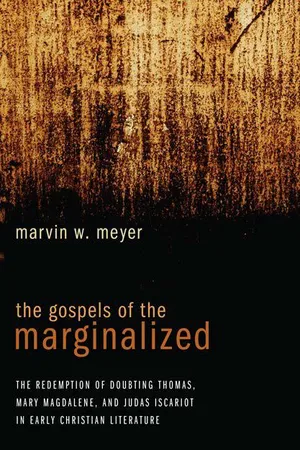
The Gospels of the Marginalized
The Redemption of Doubting Thomas, Mary Magdalene, and Judas Iscariot in Early Christian Literature
- 166 pages
- English
- ePUB (mobile friendly)
- Available on iOS & Android
eBook - ePub
The Gospels of the Marginalized
The Redemption of Doubting Thomas, Mary Magdalene, and Judas Iscariot in Early Christian Literature
About this book
The Gospels of the Marginalized provides an exciting new study of three of the most maligned figures in the New Testament story of Jesus: Thomas, usually considered the quintessential doubter among the disciples; Mary Magdalene, characterized as a repentant prostitute during much of the history of the church; and Judas Iscariot, presented as the despicable disciple of Jesus who betrayed his master for money. In this book Marvin Meyer, one of the most prominent of the scholars of gnostic texts and other early Christian literature, offers fresh and accurate translations of the Gospels of Thomas, Mary, and Judas, with their proclamation of the good news of the wisdom of Jesus, and he uses these gospels as the occasion to reexamine the place of Thomas, Mary Magdalene, and Judas Iscariot in the Jesus movement. His striking analysis suggests that Thomas was no doubter, that Mary Magdalene was a beloved disciple in the inner circles of disciples around Jesus, and that the tale of Judas Iscariot as betrayer of Jesus is a piece of fiction. Meyer adds a "Gospel of the Redeemed" as a vivid illustration of how the gospel story of Jesus might read with Jesus as a Jewish teacher of wisdom and Thomas, Mary, and Judas restored as loyal followers of the teacher from Nazareth.
Information
Topic
Theology & ReligionSubtopic
Biblical Studies1
Introduction
Doubting Thomas, Mary Magdalene, Judas Iscariot: The very names of these disciples conjure up images in Christian tradition of bad faith, questionable morality, and wicked betrayal.1 In the New Testament gospels, to be sure, all the disciples have moments of doubt and uncertainty, and Peter himself denies vehemently and profanely that he knows Jesus on the eve of the crucifixion. Yet within the New Testament and early church history, Thomas, Mary, and Judas are shunned and ostracized in particular ways and for particular reasons. In the Gospel of John, Thomas is doubting Thomas, the stubborn disciple who will not believe until he touches the wounds of the crucified and raised Jesus. According to the Gospel of Luke chapter 8, Mary Magdalene has to be cleansed by Jesus of demon possession (she is a woman, it is suggested, with psychological or social problems), and in the late sixth century Pope Gregory the Great equated her (wrongly) with the unnamed prostitute of Luke 7, so that thereafter Mary Magdalene is thought to be a repentant prostitute—repentant, but a prostitute nonetheless. It is no wonder that she cannot break into the circle of the Twelve in most of Christian tradition. And Judas Iscariot remains one of the most vilified of all the characters in human history. Didn’t he turn his friend, perhaps his best friend, over to the Roman authorities to be crucified? Didn’t he do so with a kiss—the Judas kiss? Is there anything more heinous and reprehensible than that?
Hence, Thomas, Mary Magdalene, and Judas Iscariot have commonly been marginalized as followers of Jesus—at least until recent times. In the past century or so, several early Christian gospels have been discovered in the sands of Egypt, and these newly recovered texts have begun to shed important new light on the early church and the roles of disciples of Jesus in early Christian communities. According to these gospels, Thomas, Mary Magdalene, and Judas Iscariot may be viewed in a more positive way than traditionally has been the case. Thomas may be understood as the guarantor of the sayings of Jesus, Mary may be a beloved disciple, and Judas may be reconsidered as the one who knew Jesus best and who is the recipient of revelations about God and the world from the master.
The Gospels of Thomas, Mary, and Judas have all come to the attention of scholars and other interested readers in the past few years, and since their discovery they have suggested exciting new possibilities for how we may choose to read and interpret the history of the Christian movement—from the earliest days until the present.
∆
Around the end of 1945, the texts known as the Nag Hammadi library were discovered, not at the city of Nag Hammadi itself, but near the base of a majestic cliff, the Jabal al-Tarif, which flanks the Nile River a few kilometers from Nag Hammadi.2 Among the texts in the Nag Hammadi library was a Coptic translation of the Gospel of Thomas, an early Christian gospel known from a few citations in the church fathers and, as it turns out, Greek papyrus fragments uncovered in an ancient rubbish heap at Oxyrhynchus in Egypt. The villages closest to the Jabal al-Tarif bear the names Hamra Dum, al-Busa, al-Dabba (the site of the Monastery of the Angel, Deir al-Malak), al-Qasr (the site of the Pachomian monastery at Chenoboskion), and Faw Qibli (the site of the Pachomian monastery at Pbow). Five years after the discovery, the French scholar Jean Doresse explored the region and tried to find out the circumstances of the discovery of the Nag Hammadi library. He published his story in his book, The Secret Books of the Egyptian Gnostics. According to Doresse, he spoke with some people from the area, and they directed him to the southern part of an ancient cemetery. They reported that peasants from Hamra Dum and al-Dabba, searching for manure to fertilize their fields, found somewhere near this locale a large jar filled with papyri bound in the form of books. Doresse writes,
The vase was broken and nothing remains of it; the manuscripts were taken to Cairo and no one knows what then became of them. As to the exact location of the find, opinion differed by some few dozen yards; but everyone was sure that it was just about here. And from the ground itself we shall learn nothing more; it yields nothing but broken bones, fragments of cloth without interest, and some potsherds.3
He concludes,
We have never been able to discover exactly where the Coptic Manichaean manuscripts came from, nor the Pistis-Sophia, nor the Bruce Codex. So it was well worth the trouble to find out, in a pagan cemetery a few miles from Chenoboskion, the exact site of one of the most voluminous finds of ancient literature; thus to be a little better able to place this library in the frame of history to which it belongs; and to support, with concordant details, the hypotheses that have been made about its antiquity.4
James M. Robinson has offered another version of the story of the discovery.5 For a number of years, Robinson conducted interviews with people from the towns and villages in the Nag Hammadi area, in particular Muhammad Ali of the al-Samman clan, a resident of al-Qasr, and from the interviews he pieced together a fascinating account of how the Nag Hammadi codices were uncovered—an account many of us find more convincing than that of Doresse. Where possible, Robinson attempted to confirm dates and events from official records. As Robinson has reconstructed the story, the discovery of the Nag Hammadi library took place in about December of 1945, when several Egyptian fellahin—including Muhammad Ali, his brothers Khalifah Ali and Abu al-Magd, and others—were riding their camels to the Jabal al-Tarif in order to gather sabakh, the natural fertilizer from manure that typically accumulates around there. They hobbled their camels at the foot of the Jabal, the account continues, and began to dig around a large boulder on the talus, or slope of debris, that has formed against the cliff face. As they were digging, they unexpectedly came upon a large storage jar buried by the boulder, with a bowl sealed on the mouth of the jar as a lid. Apparently the youngest of the brothers, Abu al-Magd, initially uncovered the jar, but Muhammad Ali, as the oldest of the brothers, took control of the operation. In his account of what transpired, Muhammad Ali has suggested to Robinson that he paused before removing the lid or breaking open the jar, out of fear that the jar might contain a jinni, or spirit, that could cause trouble if released from the jar. It seems that Muhammad Ali also recalled stories of hidden treasures buried in Egypt, and his love of gold overcame his fear of jinn. He smashed the jar with his mattock, and indeed something golden in color and glistening in the sunlight—fragments of papyrus, we might conclude—flew out of the jar and disappeared into the air. And when he looked into the broken jar to see what remained, he found only a collection of old books—the codices of the Nag Hammadi library.
Robinson’s version of the story is carefully documented, and it includes colorful anecdotes and detailed accounts of events. For instance, Robinson reminisces about how he persuaded Muhammad Ali to return to the site of the discovery, so close to Hamra Dum, where a family caught up in acts of vengeance with the family of Muhammad Ali lived. Robinson recalls,
I had to go to Hamra Dum myself, find the son of Ahmad Isma’il, the man Muhammad Ali had butchered, and get his assurance that, since he had long since shot up a funeral cortège of Muhammad Ali’s family, wounding Muhammad Ali and killing a number of his clan, he considered the score settled. Hence, he would not feel honor-bound to attack Muhammad Ali if he returned to the foot of the cliff. I took this good news back to Muhammad Ali, who opened his shirt, showed me the scar on his chest, bragged that he had been shot but not killed, yet emphasized that if he ever laid eyes on the son of Ahmad Isma’il again, he would kill him on the spot. As a result of this display of a braggadocio’s fearlessness, he could be persuaded to go to the cliff, camouflaged in my clothes, in a government jeep, with me sitting on the “bullets” side facing the village and him on the safer cliff side, at dusk in Ramadan, when all Muslims are at home eating their fill after fasting throughout the daylight hours.6
The precise circumstances of the discovery of the Nag Hammadi library are still debated among scholars, and the debate is likely to continue into the future. However the codices of the Nag Hammadi library may have been uncovered on that eventful day in or around 1945, the discoverers could not have imagined the impact these texts, especially the Gospel of Thomas (Codex II,2), would have on our understanding of early Christianity and the world of antiquity and late antiquity.
The Gospel of Thomas is a sayings gospel. There is very little narrative in the Gospel of Thomas, and although Jesus does not do much in the Gospel of Thomas, he says a great deal (the sayings of Jesus in the Gospel of Thomas are numbered, conventionally, at 114 sayings). Unlike the ways in which Jesus is portrayed in the New Testament gospels, Jesus in the Gospel of Thomas performs no physical miracles, reveals no fulfillment of prophecy, announces no apocalyptic kingdom of God about to disrupt the world order, dies for no one’s sins, and does not rise physically from the dead on the third day.7 He lives, to be sure, but he lives through his words and sayings, and as the Gospel of Thomas says in the first saying, “Whoever discovers what these sayings mean will not taste death.” Jesus does not pull rank in the Gospel of Thomas; he is, as Stephen Patterson has put it, just Jesus.8 Few Christological titles are applied to Jesus in the Gospel of Thomas, and if he is said to be a child of humanity (or, son of man) and a living one, these same titles and epithets are applied to other people of knowledge and insight.
In short, the Gospel of Thomas does not proclaim a gospel of the cross, like the New Testament gospels, but rather a gospel of wisdom; and if it recalls any early Christian text, it calls to mind the synoptic sayings gospel Q. The Gospel of Thomas, however, offers a more mystical—even gnosticizing—presentation of sayings of Jesus, and in the Gospel of Thomas the sayings are said to be hidden or secret sayings. The gospel opens, in its prologue, “These are the hidden sayings the living Jesus spoke and Judas Thomas the Twin recorded,” and so Judas Thomas the Twin, perhaps thought to be the twin brother of Jesus, is the one who writes everything down. Far from being the doubting Thomas of the Gospel of John, the Thomas of the Gospel of Thomas, of all people, knows the mind of his brother. The reader or hearer of the gospel is invited to interact with these sayings of Jesus, to seek and find and uncover the meaning through the hiddenness of the text—to find the meaning or interpretation, the hermeneia, as saying 1 puts it. Saying 2 outlines the process whereby one comes to wisdom and knowledge: Jesus says, “Seek and do not stop seeking until you find. When you find, you will be troubled. When you are troubled, you will marvel and reign over all.” In other words, according to the Gospel of Thomas, the encounter with the hidden sayings of Jesus brings true salvation in the reign of God.
Gospel of Thomas saying 3 offers insight into precisely where the kingdom or reign of God is. Jesus tells a little joke and says,
If your leaders tell you, “Look, the kingdom is in heaven,” then the birds of heaven will precede you. If they say to you, “It’s in the sea,” then the fish will precede you. Rather, the kingdom is inside you and it is outside you. When you know yourselves, then you will be known, and you will understand that you are children of the living Father. But if you do not know yourselves, then you dwell in poverty and you are poverty.
The kingdom of God, Jesus says in the Gospel of Thomas, is not simply in heaven or in Hades. It is without and within, and it is achieved through true knowledge of self, the self that is within.
Saying 108 of the Gospel of Thomas completes this mystical thought of the reign of God within with reference to one’s relationship with Jesus. In this saying Jesus declares, “Whoever drinks from my mouth will become like me. I myself shall become that person, and the hidden things will be revealed to that one.” Finally, according to the Gospel of Thomas, one becomes Christ and Christ becomes that person, and in this way what is hidden is revealed. Or, as the Gospel of Philip, the text that follows the Gospel of Thomas in Codex II of the Nag Hammadi library (Codex II,3), puts it, don’t just become a Christian; become Christ—Christ within.
∆
The Gospel of Mary was discovered in 1896 when a German scholar, Carl Reinhardt, bought the Berlin Gnostic Codex from a dealer from Akhmim, in central Egypt.9 As with the Gospel of Thomas, Greek fragments of the Gospel of Mary were also found in th...
Table of contents
- Title Page
- Preface
- Chapter 1: Introduction
- Chapter 2: Thomas
- Chapter 3: Mary Magdalene
- Chapter 4: Judas Iscariot
- Chapter 5: Epilogue
- Bibliography
Trusted by 375,005 students
Access to over 1.5 million titles for a fair monthly price.
Study more efficiently using our study tools.
Frequently asked questions
Yes, you can cancel anytime from the Subscription tab in your account settings on the Perlego website. Your subscription will stay active until the end of your current billing period. Learn how to cancel your subscription
No, books cannot be downloaded as external files, such as PDFs, for use outside of Perlego. However, you can download books within the Perlego app for offline reading on mobile or tablet. Learn how to download books offline
Perlego offers two plans: Essential and Complete
- Essential is ideal for learners and professionals who enjoy exploring a wide range of subjects. Access the Essential Library with 800,000+ trusted titles and best-sellers across business, personal growth, and the humanities. Includes unlimited reading time and Standard Read Aloud voice.
- Complete: Perfect for advanced learners and researchers needing full, unrestricted access. Unlock 1.5M+ books across hundreds of subjects, including academic and specialized titles. The Complete Plan also includes advanced features like Premium Read Aloud and Research Assistant.
We are an online textbook subscription service, where you can get access to an entire online library for less than the price of a single book per month. With over 1.5 million books across 990+ topics, we’ve got you covered! Learn about our mission
Look out for the read-aloud symbol on your next book to see if you can listen to it. The read-aloud tool reads text aloud for you, highlighting the text as it is being read. You can pause it, speed it up and slow it down. Learn more about Read Aloud
Yes! You can use the Perlego app on both iOS and Android devices to read anytime, anywhere — even offline. Perfect for commutes or when you’re on the go.
Please note we cannot support devices running on iOS 13 and Android 7 or earlier. Learn more about using the app
Please note we cannot support devices running on iOS 13 and Android 7 or earlier. Learn more about using the app
Yes, you can access The Gospels of the Marginalized by Marvin W. Meyer in PDF and/or ePUB format, as well as other popular books in Theology & Religion & Biblical Studies. We have over 1.5 million books available in our catalogue for you to explore.