eBook - ePub
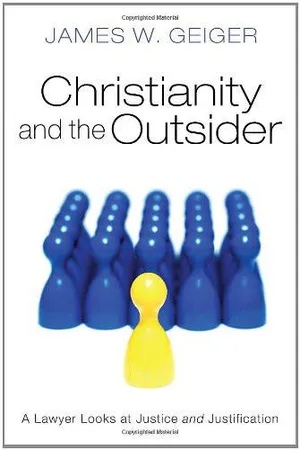
Christianity and the Outsider
A Lawyer Looks at Justice and Justification
- 214 pages
- English
- ePUB (mobile friendly)
- Available on iOS & Android
eBook - ePub
About this book
What does Christianity have to say about the salvation of the African tribesman who died before the missionaries arrived, and the "great sorrow" of the Messianic Jew who grieves for family and friends who did not or will not acknowledge his Jesus as their Messiah? C. S. Lewis said these outsiders represent the "scandal of exclusivity." Jim Geiger is a Christian insider and fully committed to the exclusivity of Christ's atonement. However, he is suggesting an expanded Christology where:
- The constant speed of light in E = mc2 corroborates the constant Christ of Heb 13:8.
- Special and general relativity model special and general revelation.
- The Christ of general revelation represents the hope of salvation for some of Christianity's outsiders.
Information
Topic
Theology & ReligionSubtopic
Christian Theology
1
Confession of a Christian Insider
There is a fundamental difference between “insiders” and “outsiders.” Insiders draw circles around themselves and “their kind” in order to exclude outsiders from a variety of privileges. Some forms of exclusion are related to race, class, and ethnicity, but the most controversial ones are associated with religion.
In 1958 I began a journey that exposed both the privileges of insiders and the problems of outsiders. I was a White Anglo-Saxon Protestant (WASP) and a senior at a Christian college in the segregated South. I needed a summer job, but I wasn’t worried because I was an insider. I had lined up a construction job through my father who was a superintendent for a company that built bridges. Having just gotten married, I was in a position to support my new bride and to save money for my last year in college. I was not only a WASP but also an upper middle class son of privilege—a 24-carat insider.
A new awareness of my insider status dawned on me that summer as I worked next to a young man who was also recently married. George was a black laborer instead of a white college boy. We were part of a small rigging crew that included a truck crane and an operator. Our job was to demolish the old McArthur Causeway that connected Miami and Miami Beach. Section by section, we worked our way across Biscayne Bay, knocking out the asphalt roadway, removing the structural steel beams, and loading them onto trucks to be hauled away.
My awareness of George’s outsider status was both positive and negative. On the positive side, we became friends. I learned that we were the same age and had the same hopes and dreams for our families. Working with George, I found that he was smart, honest, and hard working. I also learned that he lived out of town. He rode a Greyhound bus from Perrine to Miami each day and then transferred to a city bus in order to get to work. He wore clean clothes on the bus, changed into work clothes on the job site, and then reversed the process on his way home. I admired his thoughtfulness toward his fellow passengers, but confess that I would not have changed clothes before and after each bus ride if I had been in George’s position.
On the negative side, I found that I was helpless to eliminate or even mitigate the bigotry and the use of the “N” word that were heaped upon George by the crew finishing the new bridge. On one occasion a man tried to dehumanize George by saying, “He’s not George; he’s just a damn n . . . ” I have often wondered what became of my friend after that summer. I have also wondered how my philosophical and theological ideals would have been affected if I had been the outsider instead of the insider.
My insider status allowed me to finish college, attend law school, and enter the legal profession. I became an FBI agent, served as a private lawyer, and was elected to the office of prosecuting attorney. In addition to having a legal career, I taught law related courses and Great Books at a local college and led Bible studies at my church. But I have never forgotten my early exposure to the gulf that separates insiders and outsiders.
That experience over fifty summers ago changed my life and prompted me to seek a deeper understanding of the insider/outsider phenomenon. The temptation, of course, is to theorize about differences like the racial tensions between Caucasians and people of color, religious distinctions between Christians and non-Christians, and today’s conflicts between Western civilization and the Islamic world.
I have found that attitudes are often softened when abstract categories become personal relationships like my friendship with George and my work with Jewish colleagues. Most conservative pastors are unequivocal when they generalize about eternal damnation, but they tiptoe around the particulars when they counsel with Messianic Jews regarding the fate of traditional parents and grandparents. The truth is that insider/outsider issues are more difficult to deal with when they involve personal relationships.
Personally, I have struggled with the apparent inconsistency that says I should love non-Christian outsiders as they are, but that I should also try to change them into Christian insiders. Jesus, himself, said, “You have heard that it was said, ‘You shall love your neighbor, and hate your enemy.’ But I say to you, love your enemies, and pray for those who persecute you” (Matt 5:43–44). But he also said, “Go therefore and make disciples of all the nations, baptizing them in the name of the Father and the Son and the Holy Spirit teaching them to observe all that I commanded you . . . ” (Matt 28:19–20).
Clearly, Christians have commitments to both insiders and outsiders—But how are we to fulfill our responsibilities on both sides of the street? Where would one begin sorting over two thousand years of troubles between Christians and non-Christians? I think we have to start at the very beginning.
Christianity originated in Israel twenty centuries ago when a group of Jewish outsiders acknowledged Jesus of Nazareth as Israel’s promised Messiah. The religious and political forces in Israel opposed the “Jesus people” from the very beginning. Later, the Roman Empire joined the opposition and eventually engaged in a series of horrendous persecutions.
Of course, Emperor Constantine’s conversion to Christianity in 312 CE and the tolerance required by the Edict of Milan in 313 CE changed everything. It eliminated the systematic persecution of Christians and eventually turned Christianity into the official religion of the Roman Empire. Beginning with the Council of Nicaea in 325 CE, the new respectability helped bring about a series of church councils, and these councils hammered out a Christian consensus that soon dominated the Western world. In less than three hundred years, these religious outsiders had become religious insiders.
In 1054 CE a church split occurred that divided the Orthodox Catholics in the East and the Roman Catholics in the West. Eastern Orthodoxy then developed around cultural identities that resulted in the Greek Orthodox Church, the Russian Orthodox Church, and so forth. Five hundred years later, the Protestant Reformation broke the Roman Catholic dominance in the West and ushered in an era of multiple churches and denominations.
Christians are now scattered all over the earth, and they represent an array of beliefs—from fundamentalists, to conservatives, to moderates, to liberals, to radicals. Notwithstanding all the theological differences, that fourth century consensus still carries considerable weight, and it continues to identify Christians as insiders and non-Christians as outsiders.
Statisticians now estimate the world’s population to be about seven billion people, but only about two billion of them have any connection with Christianity. Who are these Christian “insiders,” and what is their relationship with non-Christian “outsiders”?
Even more important, what is God’s relationship to the five billion outsiders who have not heard, do not understand, or have rejected Christianity? Are all of these outsiders separated from God and destined for eternal damnation?
This book is the confession of a Christian insider who grieves over the traditional enmity between Christians and non-Christians and grapples with the idea of eternal damnation for non-Christian outsiders who have not heard or understood the gospel.
Admittedly, Christians can be judgmental when generalizing about non-Christians. However, the insider/outsider phenomenon is not limited to the Judeo-Christian tradition. Indeed, it is further complicated by role reversals in the Middle East and other parts of the world. For example, in the Arab world, the followers of Muhammad (570–632 CE) are the insiders, and Christians are the outsiders. Similar inversions exist with other religions as well as with secular humanism. The insider/outsider classifications are reversed, but the conflict remains the same. Furthermore, there are people on both sides who avoid building bridges between insiders and outsiders.
There is a limited sense in which even the Bible seems to work against building bridges between insiders and outsiders. The Scripture says God’s “covenant” with Israel goes back nearly four thousand years to Abraham, and Christianity’s “new covenant” goes back two thousand years to Christ and the early church. These two covenants correspond to the Old Testament/New Testament division in the Bible, and they account for the exclusive message of each tradition, that is, the exclusivity of Israel’s insider status as well as the exclusivity of Christianity’s insider status.
At the same time, the Bible reveals God’s compassion toward outsiders, a compassion that should foster the “bridge building” process. In the Old Testament, the Jewish prophet Jonah preached repentance to non-Jewish outsiders in Nineveh. Both the people and their leader repented, and God showed compassion toward them. But there is no indication that the outsiders of Nineveh became part of God’s covenant with Israel. In the New Testament we find the apostle Paul preaching the gospel to religious outsiders in Lystra and Athens, and many of them eventually became Christian insiders. However, as I will discuss later, Paul seems to suggest that God had compassion for the “generations gone by” who had been excluded from the biblical covenants (Acts 14:16).
These are some of the issues that have prompted me to dig deeper, to revisit Scripture passages that deal with outsiders, and to reassess the insider/outsider dilemma in the Judeo-Christian tradition.
As the son of a bridge builder, I am suggesting the possible existence of a biblical “bridge” between Christians and non-Christians. The proposed bridge is based upon a spirituality that says human existence should be understood in relationship to constant value—that is, eternal value that is independent of human existence and does not change with the passing of time.
The idea of constant value is not new. In the world of science, constant value is seen in the constant speed of light as in E=mc2. In the secular world and in various world religions, constant value is understood as an abstraction that manifests itself as love in personal relationships and as justice in social relationships. In the Christian world, constant value is made concrete in the person of Jesus Christ who is the same “yesterday and today, yes and forever” (Heb 13:8)—In other words, the constant Christ of the Bible does not change from time to time and place to place just as the constant speed of light does not change from time to time and place to place.
Experientially, the universality of love and justice i...
Table of contents
- Title Page
- Preface
- Part 1: Insiders and Outsiders
- Part 2: Divine Initiatives
- Part 3: The Case for the Constant Christ
- Part 4: Special Revelation: Life Within an Covenant
- Part 5: General Revelation: Life Without a Covenant
- Chapter 20: Conclusion
- Appendix
- Bibliography
Trusted by 375,005 students
Access to over 1.5 million titles for a fair monthly price.
Study more efficiently using our study tools.
Frequently asked questions
Yes, you can cancel anytime from the Subscription tab in your account settings on the Perlego website. Your subscription will stay active until the end of your current billing period. Learn how to cancel your subscription
No, books cannot be downloaded as external files, such as PDFs, for use outside of Perlego. However, you can download books within the Perlego app for offline reading on mobile or tablet. Learn how to download books offline
Perlego offers two plans: Essential and Complete
- Essential is ideal for learners and professionals who enjoy exploring a wide range of subjects. Access the Essential Library with 800,000+ trusted titles and best-sellers across business, personal growth, and the humanities. Includes unlimited reading time and Standard Read Aloud voice.
- Complete: Perfect for advanced learners and researchers needing full, unrestricted access. Unlock 1.5M+ books across hundreds of subjects, including academic and specialized titles. The Complete Plan also includes advanced features like Premium Read Aloud and Research Assistant.
We are an online textbook subscription service, where you can get access to an entire online library for less than the price of a single book per month. With over 1.5 million books across 990+ topics, we’ve got you covered! Learn about our mission
Look out for the read-aloud symbol on your next book to see if you can listen to it. The read-aloud tool reads text aloud for you, highlighting the text as it is being read. You can pause it, speed it up and slow it down. Learn more about Read Aloud
Yes! You can use the Perlego app on both iOS and Android devices to read anytime, anywhere — even offline. Perfect for commutes or when you’re on the go.
Please note we cannot support devices running on iOS 13 and Android 7 or earlier. Learn more about using the app
Please note we cannot support devices running on iOS 13 and Android 7 or earlier. Learn more about using the app
Yes, you can access Christianity and the Outsider by James W. Geiger in PDF and/or ePUB format, as well as other popular books in Theology & Religion & Christian Theology. We have over 1.5 million books available in our catalogue for you to explore.