- 194 pages
- English
- ePUB (mobile friendly)
- Available on iOS & Android
eBook - ePub
About this book
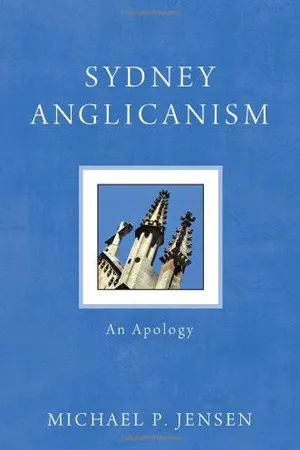
Sydney's evangelical Anglicans have been the focus of a great deal of controversy and criticism in the Anglican world. Their blend of conservatism towards doctrine and radicalism towards the institutional church has made them something of an enigma to other Anglicans. But what makes them really tick? Michael Jensen provides a unique insider's view into the convictional world of Sydney Anglicanism. He responds to a number of the common misunderstandings about Sydney Anglicanism and challenges Sydney Anglicans to see themselves as making a positive contribution to the wider church and to the city they inhabit.
Information
Topic
Theology & ReligionSubtopic
Christian Churchone
Introduction
Indomitable Sydney?
The famous Asterix the Gaul comic books that I read when I was a kid begin in this way:
The year is 50 B.C. Gaul is entirely occupied by the Romans. Well, not entirely. . . One small village of indomitable Gauls still holds out against the invaders. And life is not easy for the Roman legionaries who garrison the fortified camps of Totorum, Aquarium, Laudanam and Compendium . . .1
The Gauls gain their fabulous strength from a magic potion brewed by their druid, Getafix. But the secret of their ability to defy the odds, and the Romans, comes from somewhere else. They are possessed of a remarkable inner fortitude. They have an almost casual confidence about them that drives their opponents to distraction. They have a clear sense of shared identity in the face of what seems like insurmountable opposition. They love to eat wild boar.
The way the story of the Anglican diocese of Sydney has been told by her supporters and critics alike often sounds like the opening to Asterix. In the view of Melbourne journalist and Anglican laywoman Muriel Porter, for example, the evangelical variety of Anglicanism that in general characterizes the diocese of Sydney is defiantly peculiar.2 As she reads it, an Anglicanism that is Catholic in liturgy and liberal in theology has triumphed everywhere. It is the dominant form, and reigns unchecked and unchallenged across Australia and even across the globe. This one small diocese of indomitable, very conservative, and (to be frank) completely unhinged evangelical Anglicans holds out against the onward march of liberal Catholic Anglicanism. And life is, as a result, not easy for those who surround it and have to deal with it. Sydney’s commitment to lay presidency at the Lord’s Supper3 and its objection to the ordination of women to the priesthood are symptoms of the baffling and stubborn irrationality that characterizes the diocese. They simply get in the way of what would be a normal development in other places.
The same story can be told from within the gates of the Sydney Anglican village as well. While all around, Anglicanism has capitulated almost totally to the liberal, broad-church paradigm—with the exception a few parishes in each diocese that are allowed to remain traditional Anglo-Catholic or conservative evangelical—Sydney is the only diocese in which an evangelical form of Anglicanism holds sway. Alone it holds the torch against the onslaught of darkness. Alone it defies the complete capitulation of Anglican Christianity to Western cultural mores. Alone it holds to priority of Scripture over culture as authoritative for church belief and practice. Splendidly, nobly alone.
It is the thesis of this book that this narrative is simply untrue and that holding to it is potentially disastrous. From both perspectives, the story has its undoubted appeal. For the critic, it is a means to write off Sydney’s form of Anglicanism as extremist. It is so weird, so manifestly eccentric, that it must be maintained by a powerful cadre of warriors who drink from a magic potion. Critics like to emphasize the words “powerful” and “hardline” with reference to Sydney diocese, because strong-arm tactics are surely the only way this bizarre twist on Anglican faith could be upheld. For the supporter, there is something compelling about belonging to a group that is so savagely attacked by its critics. The sense of a shared identity as we collectively hold against the terrible odds is worth the cost of the nastiness directed against us. Indeed, the more the critic spits his poisonous words, the more we draw a collective energy from the shared experience of being talked about in such a way.
But however appealing it is, the story is distinctly inaccurate. To be fair, the diocese of Sydney has a unique character as a predominantly evangelical metropolitan diocese in Australia.4 But it shares its evangelical convictions with many millions of Anglicans all over the world in continuity with those in the past. In fact, as far as worldwide Anglicanism goes, it is evangelicalism that is on the rise. Liberal-Catholic Anglicans, on the other hand, are good at inhabiting church structures, but not good at missionary work—nor even at the business of catechizing their own young people. Evangelical Anglicans of the sort found in Sydney have good ground for claiming the Anglican heritage as their own and ought not to accept the view that they are in some way the illegitimate children of the Anglican family. Sydney is not, as I hope to show, as isolated and eccentric as its critics pretend.
Their critics have dubious grounds for holding to the Asterix narrative, and Sydney’s Anglicans shouldn’t fall for its allure either. It is dangerous to tell such stories about oneself, because isolationism is ultimately unhealthy. Taking too much notice of one’s critics makes clear-eyed self-awareness all the more difficult. Friendly criticism is too readily cast as betrayal. It is too simple to cast one’s identity in terms of difference and to see the purpose of one’s existence in negative rather than positive terms. This is, as I shall argue, exactly what the critics of Sydney want: to isolate it further so it can be treated as completely marginal.
But there is far more to the diocese of Sydney than this. It is not a fundamentalist sect. It has a rich and developing heritage of robust and intellectually vigorous evangelical faith. It aspires to be a genuinely missionary movement, concerned to send people to all corners of the globe and to contribute to the spread of the Christian faith everywhere. It is not marginal or eccentric, unless staking oneself on the authority of Scripture has somehow become marginal and eccentric in Christianity. It is conservative on content and flexible on form—which is surely the way in which historic Christianity has, under the hand of God, been preserved and expanded over two millennia.
Wrestling the Leviathan
It surprises visitors to Sydney to learn what a brutal and bruising place it can be. The playwright David Williamson described it once as the “Emerald City”—an image that captured the extraordinary sensuality and prosperity of the shimmering city but also the Gollumish greed that it nurses. Sydney is desperate to please and desperate to be pleased; the local band The Whitlams once sang of it as “a whore / opening its legs to the world.” It looks like it is going to be an easy place to live, until you discover that the citizens of Sydney are clambering over each other’s prone bodies just to stake their claim for a harbor view. It looks as if Sydney is all about desire and especially about sex—it has an entire festival, the Gay and Lesbian Mardi Gras dedicated to sexuality. In reality her addictions are work—and power.
It is a civilization founded on the sound of the lash, the burning taste of rum and the sweat of the chain gang. Things have gotten a lot better for the locals since those days, but those early lessons haven’t been forgotten. You have to be tough to survive here, even as a clergyman. When local journalist John Birmingham wrote a book about the monstrous side of Sydney’s character he called it after the biblical sea monster: Leviathan.5 It’s a great description of Sydney. She’s a sea-beast wearing mascara; a snake showing a bit of leg. She has a come-hither gaze and a murky heart.
Sydney lacks the urbanity and cultural pretentions of little sister Melbourne. The culture of its political parties is more pragmatic and less ideological. The NSW branch of the Australian Labor Party, for example, is dominated by its famous Right faction. It would be a mistake to say that the Labor Right is without ideals. It is just that, in Sydney, the beauty of the ends is not felt to be corrupted by the ugliness of the means. It has no interest in flavorless virtues like “balance.”
That same difference of culture can been observed in church circles. It has been noted regularly, to the point of cliché, but it is certainly not inaccurate. The person who chooses to be a god-botherer amongst the descendants of convicts and gold-diggers is not usually a person who is afraid of being out of kilter with the prevailing culture. The Sydney Anglican subculture is therefore built on a one-eyed determination to survive—because the expectation is that no one else is going to cut you any slack. Ministering in the early colony broke the spirit of Rev. Richard Johnson, the first chaplain. He was replaced by the somewhat sturdier figure of Rev. Samuel Marsden—the Yorkshireman now legendary in Sydney history as “the flogging parson,” since he acted as magistrate as well as pastor to the colony and (according to the myth) was not averse to meting out severe discipline. But he was also generous of spirit and keen to see the gospel of Jesus proclaimed in the unchartered territories of the south, including New Zealand as well as Australia.
The first chaplains of the colony of New South Wales were evangelical churchmen. They left a permanent impress on the type of Anglicanism that would be found in Sydney. By the late eighteenth century, the evangelical movement within the Church of England was on the rise. What it lacked in ecclesiastical preferment, it made up for in entrepreneurial spirit and missionary zeal. It was no accident that the first clergy to arrive were recruited from among the ranks of the evangelicals. The movement would reach its high point sometime in the 1830s, when the Oxford Movement began the revival of the High Church party within Anglicanism. In Sydney, however, the presence of a growing number of Irish Roman Catholics meant that there was a need on the Anglican side for clergy who would understand what was at stake. Many early Sydney clergy were recruited from the Church of Ireland, where a clear Protestant identity was necessary for survival.
The problem of recruiting and training clergy was always a pressing one. When the bequest of Thomas Moore (1762–1840), a wealthy shipbuilder and landowner, was made available for the “education of men of the Protestant persuasion,” Bishop Barker (1808–1882) arranged for the founding of Moore College. The college opened its doors for students at Liverpool in 1856, and moved to its present site in Newtown in 1891. To this day, Moore College is central to the identity of the Sydney diocese. Unlike in the Church of England, where a diocese may employ clergy trained at any number of different colleges, in Sydney local clergy are trained at Moore, with a very few exceptions.
It’s a policy that has often been questioned, but it is key to maintaining the evangelical character of the diocese. The Anglicanism of compromise and nominalism lives by the power of inertia. It rises to the top in so many places around the world because it isn’t challenged. Over a century and half, evangelicals in Sydney have been determined that a different character would mark their diocese. That has meant an, at times, angular relationship with a national church in which many other agendas are running.
This background goes some way in explaining why the diocese of Sydney has been the subject of a number of books and articles over the last two decades, including a book published in 2011—Muriel Porter’s Sydney Anglicans and the Threat to World Anglicanism.6 No one has written in this way about, say, Melbourne diocese or even the diocese of London. Needless to say, none of these works is appreciative and some are scathing. And, from my point of view as an insider, none of these books does justice to the object of their derision.
An Apology?
My vantage point is a great deal different. I grew up at Moore College, one of the ventricles of the Anglican diocese of Sydney. My father, the present Archbishop of Sydney, was the principal of that college. In my early years of high school it became clear to me that there were other Anglicans who were very critical of Moore and of the diocese of Sydney. The denomination in which I found my home was actively and openly hostile to the kind of Anglican I had learned to be. They called the church that I attended “not really Anglican.” But if it wasn’t “really Anglican” then what was it?
Since I have been old enough to read newspapers or to care what they had to say, the Sydney Morning Herald has run a narrative about Sydney Anglicans, siding very much with the views of those liberal Anglican critics. Since the early 1980s, I can recall reading very few articles about church life that I recognized to be accurate or fair to my experience of it. The depiction was always of a rabidly fundamentalist patriarchal sect dogge...
Table of contents
- Title Page
- Chapter 1: Introduction
- Part 1: The Bible
- Part 2: The Church
- Bibliography
- Index
Trusted by 375,005 students
Access to over 1.5 million titles for a fair monthly price.
Study more efficiently using our study tools.
Frequently asked questions
Yes, you can cancel anytime from the Subscription tab in your account settings on the Perlego website. Your subscription will stay active until the end of your current billing period. Learn how to cancel your subscription
No, books cannot be downloaded as external files, such as PDFs, for use outside of Perlego. However, you can download books within the Perlego app for offline reading on mobile or tablet. Learn how to download books offline
We are an online textbook subscription service, where you can get access to an entire online library for less than the price of a single book per month. With over 1.5 million books across 990+ topics, we’ve got you covered! Learn about our mission
Look out for the read-aloud symbol on your next book to see if you can listen to it. The read-aloud tool reads text aloud for you, highlighting the text as it is being read. You can pause it, speed it up and slow it down. Learn more about Read Aloud
Yes! You can use the Perlego app on both iOS and Android devices to read anytime, anywhere — even offline. Perfect for commutes or when you’re on the go.
Please note we cannot support devices running on iOS 13 and Android 7 or earlier. Learn more about using the app
Please note we cannot support devices running on iOS 13 and Android 7 or earlier. Learn more about using the app
Yes, you can access Sydney Anglicanism by Michael P. Jensen in PDF and/or ePUB format, as well as other popular books in Theology & Religion & Christian Church. We have over 1.5 million books available in our catalogue for you to explore.