eBook - ePub
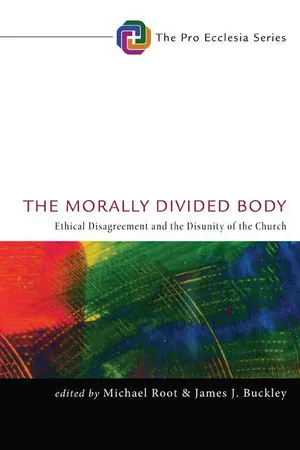
The Morally Divided Body
Ethical Disagreement and the Disunity of the Church
- 156 pages
- English
- ePUB (mobile friendly)
- Available on iOS & Android
eBook - ePub
The Morally Divided Body
Ethical Disagreement and the Disunity of the Church
About this book
At the same time as Catholic and evangelical Christians have increasingly come to agree on issues that divided them during the sixteenth-century reformations, they seem increasingly to disagree on issues of contemporary "morality" and "ethics." Do such arguments doom the prospects for realistic full communion between Catholics and evangelicals? Or are such disagreements a new opportunity for Catholics and evangelicals to convert together to the triune God's word and work on the communion of saints for the world? Or should our hope be different than simple pessimism or optimism? In this volume, eight authors address different aspects of these questions, hoping to move Christians a small step further toward the visible unity of the church.
Information
Topic
Theology & ReligionSubtopic
Christian Church1
Can Ethical Disagreement Divide the Church?
The following essay is—whatever its errors or other faults—at least timely. For the question stated by its title is beyond much doubt the next great ecumenical stumbling block—or just possibly, and only by uncovenanted mercies of God, opportunity. Churches are dividing in themselves and from their ecumenical partners over matters that once were not even on the agenda. Many believers are desperate for their churches. Thus the 2010 conference of the Center for Catholic and Evangelical Theology, where an oral version of this essay was presented, drew the largest and most engaged crowd in the center’s recent history.
To go with the question’s actuality, there is its difficulty. An adequate treatment would deal at once with dogma, ethical theory, and political theory. I cannot promise such adequacy, but perhaps an inadequate initial attempt may be useful.
There are, it seems to me, three subquestions—or there are three if the first two are answered as I will propose. The first is, Can differences about ethics be properly church divisive? We may, I think, limit the field for immediate discussion; the most obvious candidates for such a role will be questions that either determine church discipline—for example, must a bishop really be the husband of no more than one wife?—or questions on which churches will make a witness whether they want to or not—for example, can there be a right to abort an unborn child? Or what military actions are just, if any?
The question is not whether differences about ethics in fact divide the church; they have done so throughout history and are doing so now with new virulence. The question is whether some such divisions are unavoidable—whether, faced with an ethical disagreement that at least for the foreseeable future cannot be reconciled, it can in some cases be necessary for one party to recognize that for that same foreseeable future it cannot be in complete eucharistic and ministerial fellowship with the other party.
The second question supposes an affirmative answer to the first: Supposing that divisions in ethics sometimes truly divide the church, how do we tell when that is the case? What are the criteria? If, as seems likely, some ethical divisions are tolerable within communion and some are not, how do we tell the difference? And the third question is, When it appears that some of us cannot for reasons of ethics be in full fellowship with others whom we nevertheless regard as church, what are we to do about that?
Can It Happen?
The dominant voices of the contemporary American church say that disagreement about ethics cannot be legitimately church divisive. It is widely said—especially at the headquarters of the once-mainline Protestant denominations—that such disagreements cannot break our “unity in Christ” and that this “deep” unity mandates “living together” despite being unable to agree about major points of church discipline or of moral witness to the world.
Now at some level this must be right. Those baptized into Christ are indeed bound together in a bond that can be broken only by deliberately renouncing it—and perhaps even explicit renunciation cannot finally succeed. But just what level is it where this bond obtains?
I will argue that the unbroken unity in Christ of baptized believers divided in moral discipline or public moral witness obtains at the same level as does the unity of baptized believers divided in doctrine. In the case of doctrinal division, the contradiction between broken fellowship and deep unity in Christ is the very motive of ecumenical dialogue. That doctrinally separated communities of the baptized are nevertheless somehow one in Christ is a mandate to argue the differences, not permission simply to live with them. Indeed, this shared effort is itself a necessary part of their remaining unity. Just so, I propose, the contradiction between “unity in Christ” and division about what sorts of sexual behavior are blessed, for example, is a mandate for something much like traditional ecumenical dialogue, not permission to live with the dissensus. And the necessity of that effort is again an essential part of remaining unity in Christ.
So to the argument. That matters of ethics have in fact divided the church, and that such divisions have in fact often been taken as holding at the same level as divisions caused by doctrine, is a matter of open record.
Thus the canons of the ancient councils are very much about ethics. Studying them in seminary—if indeed we still do—we skip over those bits, but the councils themselves lay down their ethical judgments right along with their doctrinal judgments. A canon of the very first ecumenical council, at Nicea, offers a nice example. There was at the time a self-segregated sect of rigorists that prohibited second marriages, at least by clergy. Some bishops and presbyters of the sect were applying for re-entry into the clergy of the catholic church. The council decreed that they were to be admitted, but only after making formal renunciation of this rule. One could not, according to the council, advocate a prohibition of second marriage and be in the communion of the catholic church.
For a more recent case, one may instance the Lutheran World Federation’s break of fellowship with the white Lutheran churches of South Africa, on account of their practice of apartheid. The action was widely applauded at the time—including by some who now call for living together in spite of almost anything. The Lutheran churches trotted out the heavy artillery, status confessionis: tolerating apartheid was held to contradict the church’s confession of faith. And then one may note Second Peter’s vehement exclusion from all fellowship of a party whose fault, so far as it can be made out, was their tolerated sexual practices.
Now of course it could be maintained that the historical fact that the church has often treated some ethical disagreements as breaking fellowship in the same way as do some doctrinal disagreements, does not in itself prove that this ought to have been done—though surely it imposes some burden of proof on those who maintain the contrary. What will surely settle the matter are instances of recognized necessary teaching that simply are at once doctrinal and ethical. Are there any? It seems to me that there are indeed. And of course what I really want is scriptural instances; something from the New Testament would be very nice.
So consider Paul’s argument in 1 Corinthians 11:17ff. The problem in Corinth was the way in which more prosperous believers treated the less prosperous at the common meals of which the eucharistic loaf and cup were then a part. It was a mandate recognized throughout the earliest church, not as an ideal but as a rule of church discipline: the economically well-off are to share with the less well-off. And of course the paradigm of such care was the sharing of food at the bonding meal of the ecclesia. Indeed, in the first Jerusalem congregation, as Luke tells it, certain necessities of life were administered from a common chest—an ethic enforced in one case of dereliction and a cover-up by a particularly final sort of excommunication.
Paul finds some Corinthians in violation of this discipline. How does he deal with it? He does not repeat and emphasize the rule, nor does he enforce it from general ethical principles of generosity or even from the law of God—though elsewhere he can do that sort of thing perfectly well. Instead, he invokes the doctrine of the risen Christ’s bodily presence for the church and as the church: the errant Corinthians by their defiance of the rule of sharing violate the Corinthian assembly’s unity as the body of Christ, and just so they violate Christ’s body on the table. Now, that the shared bread and wine are the one body of the risen Christ, and that just so the community that shares them is the same one body of the risen Christ, is surely a piece of doctrine if there ever was one (and indeed an especially challenging one), and Paul makes it the warrant for his rebuke of certain Corinthians’ ethical deviation.
Of course, in prophetic style, Paul wants the Corinthian offenders to repent. What if they refuse? Paul apparently then even expects some of them to depart the church by the same route as Annanias and Saphira. And if the delinquents were to defy Paul’s ruling by starting their own eucharistic fellowship, where they could divide their goods according to their own reasonings about justice and propriety, would not that be schism? One can imagine the Corinthians’ position: the Lord has given us these goods. Would he have done that had he not wished us to enjoy them, in or out of the ecclesia? Or if the prosperous packed a meeting, took over the Corinthian congregation, and established their own ethic of appropriate stewardship, would not Paul have called the faithful to come out?
The most profound and obvious case in which biblical doctrine and biblical ethics are inextricably entangled is also the case that is currently most distressing the churches. There is no way for me to avoid the matter of marriage. Can disagreement about who can be married, and the subplots of that argument, constitute a break of church fellowship?
I need to start with the word itself. Marriage and its equivalents in other languages have heretofore functioned as a label—not as a concept, but as a mere label—for the legal and cultural forms by which societies recognize and regulate a particular biological-social phenomenon, one that is simply found to be there. That phenomenon is the coincidence of the most complete possible bodily union between existing human persons, with equally bodily unity between old and new human persons. Marriage was a label for the culturally and legally recognized unity of ordered sexual passion and ordered procreation, for the culturally and legally recognized forms of that bio-social phenomenon in which the two constituting modes of human society, synchronic unity at one time and diachronic unity across time, occur as one relation. Thus also in Scripture the word marriage and its derivatives do no more than mention an institution that is assumed to be there, and indeed this one.
We should perhaps further note that in its previous use, the word marriage did not specify a mode of affection or of personal commitment, though these have often been counted as blessings of marriage, and may well come to be the most treasured part of the relation. But persons could be in the relation labeled marriage with or without notable affection or private commitment. If we wish to talk about the reality previously labeled marriage, we will not regard these blessings as the constitutive aspects of the relation.
These matters noted, let me for a while drop discussion of the word marriage and directly consider the phenomenon heretofore so labeled. The Scriptures interpret the phenomenon in their very first statement about what it means to be human. According to Genesis, God creates ha-adam, “the Adam” in the singular—with the article, not a personal proper name—as “male and female” in the plural. This striking proposition presents itself as what Western philosophy would call an “ontological” proposition. That is to say, it describes a fundamental structure of human being: to be human is to be one of a possible pair, to be male or female, to have an other that is made other by correlated bodily difference. To quote an aphorism devised or borrowed by an able student of mine last semester, “Humanity is male and female; each human is male or female.” Nor should we dismiss the first creation narrative as myth or legend. As historical scholarship has long since made clear, it is the product of a philosophically and scientifically sophisticated scholar-priest, or perhaps of a school of such savants, who knew exactly what he or they were doing.
Then, in the second creation account, we are told how this unity-in-duality is actual: a man leaves his parents and “cleaves” to his wife, and the two become one basar, “one flesh,” as it is usually translated. This word flesh, as it functions in the Old Testament, is complex. To begin, something that is flesh is anything that is real but is not God, that is to say, a creature. Thus “all flesh is as grass” simply means that all creatures are as perishable as is the creature grass. But flesh further denotes the sheer stuff of living creatures—from leaves of grass to advanced organs—that in fact distinguishes them from God.
Each half of the couple is depicted as flesh as the other is flesh, in the most direct fashion: they were once a single chunk of it. These two, the man and the woman, then come together by the mutually adapted flesh of their bodies, to be one real new creature, one flesh, precisely by the pairing of their organs.
Now it might be argued that this biblical ontology is not directly Christian doctrine; after all, we are not compelled to adopt the science of the creation accounts, why should we adopt their ontological views? But that escape is stopped by New Testament Christology.
At a famous passage in Ephesians (5:31–32), the author quotes our passage from Genesis. Then he interprets: “This passage tells a deep mystery; here I read it of Christ and the church.” Is he interpreting the mystery of sexual union by the relation of Christ and the church, or the mystery of Christ and the church by sexual union? Perhaps the final exegetical judgment must be that he is doing both at once. But the context makes the first interpretation primary, and that is anyway the one that concerns us.
Read in context, the passage could not be plainer: the author of Ephesians founds the unity of husband and wife by the unity of Christ a...
Table of contents
- Title Page
- Contributors
- Introduction
- Chapter 1: Can Ethical Disagreement Divide the Church?
- Chapter 2: Race, Slavery, and Shattered Churches in Early America
- Chapter 3: Doctrine: Knowing and Doing
- Chapter 4: Internal Injuries: Moral Division within the Churches
- Chapter 5: Unity in the Sacraments and Unity in Ethics
- Chapter 6: Grace and the Good Life: Why the God of the Gospel Cares How We Live
- Chapter 7: Learning How to Be Morally Divided:
- Chapter 8: Ethics in Ecumenical Dialogues: A Survey and Analysis1
- Appendix 1
- Appendix 2
- Contributors
Trusted by 375,005 students
Access to over 1.5 million titles for a fair monthly price.
Study more efficiently using our study tools.
Frequently asked questions
Yes, you can cancel anytime from the Subscription tab in your account settings on the Perlego website. Your subscription will stay active until the end of your current billing period. Learn how to cancel your subscription
No, books cannot be downloaded as external files, such as PDFs, for use outside of Perlego. However, you can download books within the Perlego app for offline reading on mobile or tablet. Learn how to download books offline
Perlego offers two plans: Essential and Complete
- Essential is ideal for learners and professionals who enjoy exploring a wide range of subjects. Access the Essential Library with 800,000+ trusted titles and best-sellers across business, personal growth, and the humanities. Includes unlimited reading time and Standard Read Aloud voice.
- Complete: Perfect for advanced learners and researchers needing full, unrestricted access. Unlock 1.5M+ books across hundreds of subjects, including academic and specialized titles. The Complete Plan also includes advanced features like Premium Read Aloud and Research Assistant.
We are an online textbook subscription service, where you can get access to an entire online library for less than the price of a single book per month. With over 1.5 million books across 990+ topics, we’ve got you covered! Learn about our mission
Look out for the read-aloud symbol on your next book to see if you can listen to it. The read-aloud tool reads text aloud for you, highlighting the text as it is being read. You can pause it, speed it up and slow it down. Learn more about Read Aloud
Yes! You can use the Perlego app on both iOS and Android devices to read anytime, anywhere — even offline. Perfect for commutes or when you’re on the go.
Please note we cannot support devices running on iOS 13 and Android 7 or earlier. Learn more about using the app
Please note we cannot support devices running on iOS 13 and Android 7 or earlier. Learn more about using the app
Yes, you can access The Morally Divided Body by Michael Root,James J. Buckley, Root, Buckley in PDF and/or ePUB format, as well as other popular books in Theology & Religion & Christian Church. We have over 1.5 million books available in our catalogue for you to explore.