eBook - ePub
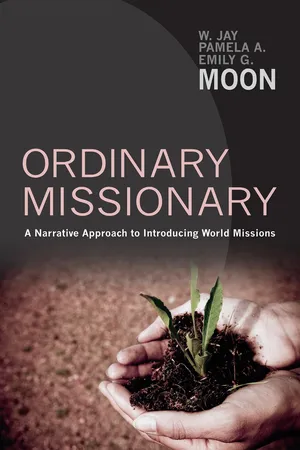
Ordinary Missionary
A Narrative Approach to Introducing World Missions
- 142 pages
- English
- ePUB (mobile friendly)
- Available on iOS & Android
eBook - ePub
Ordinary Missionary
A Narrative Approach to Introducing World Missions
About this book
I am not like Hudson Taylor, David Livingstone, or William Carey. The stories of these people are inspiring, but they also make me question, "Am I really good enough to be a missionary? Because I don't consider myself super-spiritual like these missionary heroes seem to be." Ordinary Missionary introduces world missions through the story of an ordinary family facing ordinary questions about their own insecurities and inadequacies. Step into the shoes of three authors who combine their thoughts to put a face, a feeling, and a person to contemporary missions. Join Jay, husband and father, as he prepares to minister among the Builsa people in Ghana, West Africa. Observe Pam, wife and mother, as she addresses the personal concerns of the family. Follow Emily, oldest daughter, in the struggles and joys of being a missionary kid.
This story is not a triumphant tale of missionary heroes. The real heroes show up in unlikely places when they are least expected. Our steps are ordinary, but the journey is beyond extraordinary. These real stories will inspire you to trust your own life in the hands of our extraordinary God.
Information
Topic
Theology & ReligionSubtopic
Christian Ministry1
Called to Missions?
The sound of hot coffee trickles in the background, as I get ready to go to my college class. The news blares on the TV, but I am not paying attention. Suddenly, I realize they are talking about Africa and I snap alert.
“Three thousand people a day are dying in Ethiopia,” the anchor explains, as video footage of desolation and despair flashes across the screen.
I am floored. I know that the drought in Ethiopia during the 1980s is bad, but I have no idea the extent of the suffering. Attending Virginia Tech to study Civil Engineering, I quickly calculate that the magnitude of this loss is comparable to the entire population of my large university being wiped out in a week. This sinks into my soul, and it is hard to shake.
Turning to God with a mixture of guilt and bewilderment, I ask, “Why am I so fortunate to be at a comfortable school learning and growing while others around the world are simply struggling to survive? This does not seem fair, God.”
I talk to my pastor, and we find some guidance from Luke 12:48. “From everyone who has been given much, much will be demanded; and from the one who has been entrusted with much, much more will be asked.”
Instead of feeling guilty about the blessings that God has given me (such as an opportunity for education), Jesus’ words remind me that this education is not for me alone. This is entrusted to me to use for God’s glory.
I didn’t always ask questions like this. For my first year of college, I was actually oblivious to the working of God around the world. In my sophomore year, though, I found some Christian groups on campus (or did they find me?), and I would never be the same. It was a breath of fresh air from the other activities I had participated in during my freshman year. Hungry to learn, I eagerly listened as they discussed God’s heart for the world. For the first time, it seemed, I was hearing God’s heart for mission from Genesis all the way through Revelation.
Just as important, I began to notice others living this out before me. For example, there was Oscar, a student who set up a hot dog stand in the lobby of the dorm on Sunday and Monday nights. Hordes of addicted football fans would take a break from the TV long enough to devour dozens of hot dogs. Oscar (a nickname given him based on his favorite hot dog brand, Oscar Meyer) had one simple and advertised motive. He was raising money for World Vision to aid in the suffering of those in Ethiopia.
In these Christian groups, they talked about taking summer trips to places like Haiti. Unlike the college students traveling to Daytona Beach, I felt like this trip was purposeful and meaningful. Praying for God to direct me, a Christian friend offered me the opportunity to help with a sanitation system in Haiti. Tim’s enthusiasm was so contagious, so compelling, and so life-giving that I found myself unable to resist.
The short trip lasted about a week, but the effects were life changing. Sleeping on the concrete floor at the orphanage, we awoke to the sound of kids running around us, curious to know us. Daily we surveyed the grounds, gathering data that would be used for a desperately needed design for a sanitary system. On a couple occasions, I met with missionaries that had dedicated their lives to living in Haiti. I was surprised to find that these people were not like Billy Graham or any other super-spiritual figure. They were like me—normal, ordinary people that had felt, and obeyed God’s calling on their lives.
I realized for the first time that I didn’t have to choose between engineering and spiritual ministry because God could be glorified through both. My body had two hands, why not offer two sides of ministry—spiritual and physical?
During the Haiti trip, I increasingly felt God nudge me to consider further mission service. Sometimes, I felt this nudge during times of prayer. Other times, it came upon me unexpectedly.
On a long bus ride, one of the other guys on the Haiti trip looked straight at me and said, “Jay, I can see that this energizes you. You should consider further mission service.”
Back at Virginia Tech, a professor made a comment one day in class, “Eighty percent of the diseases of the world are caused by inadequate water and sanitation. If you want to make a difference in the world, sanitary engineering is more crucial than medicine.” Like a heat seeking missile locked in on its target, this hit home.
Taking a step of faith, I shifted my focus at Virginia Tech to sanitary engineering, which focuses on water and sanitation. Engineers do not normally take classes in topics like World Hunger, New Testament, Gods and Rituals, and the Economics of Sharing, but I filled all of my electives with the classes that I hoped will prepare me.
But I needed to know if this was just a phase that I was going through or if this was a legitimate call of God. I started to fast and pray once a week. Instead of eating lunch, I spent that time to pray and asked God to either further increase or decrease my desire for mission. Instead of looking at fasting as gaining favor in God’s eyes, I realized that fasting with prayer was really a way to tune out the daily chatter and allow time for God to speak to my heart.
The problem was, some days I was very excited for missions. When I read magazines from mission agencies, talked with missionaries, and prayed, I felt encouraged to take further steps. Some days, though, I had nagging fears about my own inadequacy.
“Am I able to handle this for a long period of time? What about health issues? What about finding a wife (gulp) who is willing to be a part of this crazy idea?” I pondered.
Psalms 37:4 arrived like a package sent from heaven, “Delight yourself in the Lord and he will give you the desires of your heart.” If I put God’s desire first, then God promised to gradually change the desires of my heart to conform with God’s desires. In the end, I can trust the heart desires that God places there and follow those. Through the months, I recognized that God was growing the desires in my heart for missions. Sure, there were days of doubt, but these were more erratic due to my immediate circumstances. The long-term trend was a nagging, nudging conviction that God’s intent for me is to be engaged in mission service. If plotted on a chart (something engineers like to do), it would look like the figure below.

Figure 1: Discerning a Call: Mission Desire vs. Time
Notice the bottom line jumps up and down, indicating these are desires of the flesh. Since they are more volatile, they can deceive and should not be trusted. On the other hand, the upper line has a long-term trend upwards. While there are some dips and spikes, they are not nearly as wide as the desires of the flesh. This long-term trend is trustworthy. It indicates the way God changes a heart’s desire to conform to God’s own desire.
• • •
These heart desires give me direction for the next step to take. Moreau1 notes, “For most of us, God does not lay out the entire life plan in a single call. Rather, he leads step-by-step along the way.” While there are more preparations to come, at least I can see the headlights lighting the road ahead. That is enough to take one more step.
What about the drought in Ethiopia? About six years later, we are actually appointed to Ethiopia as full-time missionaries to help with water development and church planting. Preparing, packing, and planning for Ethiopia, God’s call takes another surprising turn, but that is getting ahead of the story.
1. Moreau, Corwin, and McGee, Introducing World Missions: A Biblical, Historical and Practical Survey, 170.
2
Do Not Doubt in the Dark What You Know to be True in the Light
As soon as the words are out of my mouth that I am considering mission service in a foreign land, well-intended family and friends are eager to talk about snakes, bugs, sickness, political instability, and “what about all of the things that the children will miss?” Tellin...
Table of contents
- Title Page
- Contributors
- Foreword
- Acknowledgments
- Introduction: How Did I Get Here?
- Chapter 1: Called to Missions?
- Chapter 2: Do Not Doubt in the Dark What You Know to be True in the Light
- Chapter 3: Mission Family
- Chapter 4: Blessed are the Flexible, for They Will Not be Bent Out of Shape
- Chapter 5: Incarnation: God Moves into the Neighborhood
- Chapter 6: Where There is No Doctor
- Chapter 7: Occupational Hazard: Culture Shock
- Chapter 8: “Pray in the Spirit on All Occasions” (Ephesians 5:30)
- Chapter 9: Missionary Kids
- Chapter 10: Even the Four-Year Olds are Laughing at Me!
- Chapter 11: Where are you? (Genesis 3:9)
- Chapter 12: God Outwits Us
- Chapter 13: Shocked!
- Chapter 14: “God chose the weak things of the world to shame the strong.” (I Corinthians 1:27)
- Chapter 15: Where Do I Start to Preach?
- Chapter 16: Opening Doors to the Heart
- Chapter 17: House help
- Chapter 18: I Promise Not to Beat Her
- Chapter 19: “The Foolishness of God is Wiser than Man’s Wisdom.” (I Corinthians 1:25)
- Chapter 20: What About Those Who Have Not Heard?
- Chapter 21: Attacked by an Unseen Enemy; Rescued by an Unseen God
- Chapter 22: Is He an Angel?
- Chapter 23: All of the Roofs Leak
- Chapter 24: Arrows
- Chapter 25: Holding the Egg
- Chapter 26: Beauty: Solely in the Eye of the Beholder?
- Chapter 27: Going . . . and Coming
- Chapter 28: Two Homes
- Chapter 29: What’s a Tomagotchi?
- Chapter 30: Looking Back
- Appendix
- Bibliography
Trusted by 375,005 students
Access to over 1.5 million titles for a fair monthly price.
Study more efficiently using our study tools.
Frequently asked questions
Yes, you can cancel anytime from the Subscription tab in your account settings on the Perlego website. Your subscription will stay active until the end of your current billing period. Learn how to cancel your subscription
No, books cannot be downloaded as external files, such as PDFs, for use outside of Perlego. However, you can download books within the Perlego app for offline reading on mobile or tablet. Learn how to download books offline
Perlego offers two plans: Essential and Complete
- Essential is ideal for learners and professionals who enjoy exploring a wide range of subjects. Access the Essential Library with 800,000+ trusted titles and best-sellers across business, personal growth, and the humanities. Includes unlimited reading time and Standard Read Aloud voice.
- Complete: Perfect for advanced learners and researchers needing full, unrestricted access. Unlock 1.5M+ books across hundreds of subjects, including academic and specialized titles. The Complete Plan also includes advanced features like Premium Read Aloud and Research Assistant.
We are an online textbook subscription service, where you can get access to an entire online library for less than the price of a single book per month. With over 1.5 million books across 990+ topics, we’ve got you covered! Learn about our mission
Look out for the read-aloud symbol on your next book to see if you can listen to it. The read-aloud tool reads text aloud for you, highlighting the text as it is being read. You can pause it, speed it up and slow it down. Learn more about Read Aloud
Yes! You can use the Perlego app on both iOS and Android devices to read anytime, anywhere — even offline. Perfect for commutes or when you’re on the go.
Please note we cannot support devices running on iOS 13 and Android 7 or earlier. Learn more about using the app
Please note we cannot support devices running on iOS 13 and Android 7 or earlier. Learn more about using the app
Yes, you can access Ordinary Missionary by W. Jay Moon,Pamela A. Moon,Emily G. Moon in PDF and/or ePUB format, as well as other popular books in Theology & Religion & Christian Ministry. We have over 1.5 million books available in our catalogue for you to explore.