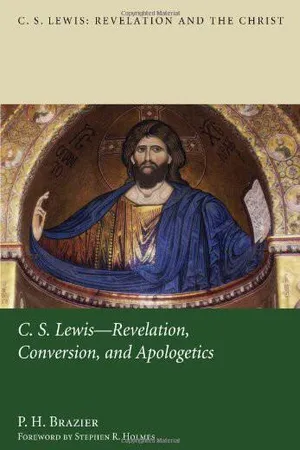
- 316 pages
- English
- ePUB (mobile friendly)
- Available on iOS & Android
eBook - ePub
C.S. Lewis: Revelation, Conversion, and Apologetics
About this book
This is a series of books which have a common theme: the understanding of Christ, and therefore the revelation of God, in the work of C. S. Lewis. These books are a systematic study of Lewis's theology, Christology and doctrine of revelation; as such they draw on his life and work. They are written for academics and students, but also, crucially, for those people, ordinary Christians, without a theology degree who enjoy and gain sustenance from reading Lewis's work.
www.cslewisandthechrist.net
Information
Topic
Theology & ReligionSubtopic
Christian TheologyPart One
The Personal God of Salvation—Conversion and Acceptance
“I was the object rather than the subject in this affair.
I was decided upon.”
I was decided upon.”
C. S. Lewis talking about his conversion, in,
“Cross Examinations” (1963)
“Cross Examinations” (1963)
1
Conversion: God is God
SYNOPSIS:
Christ did not come primarily to give humanity knowledge; knowledge is in some ways a by-product: salvation is the work and purpose of the incarnation, and therefore of the cross and resurrection. Christology is more than reasoning about Jesus Christ, the Spirit of the Christ indwells the church: therefore the Holy Spirit that proceeds from the Father and the Son works in and through the people of God. All people, including children, can be religious. Children can respond implicitly to the love of God in Christ in an unselfconscious way. Where was this relationship in C. S. Lewis’s childhood? What was the boy Lewis’s relationship with Christ, implicit and hidden though it may have been for most of the time? Were there moments of grace? What was Lewis’s religious background? What role does the death of his mother play when he was ten-years of age, likewise the Edwardian public school system? As an adult C. S. Lewis is to be seen as an explicitly Christian religious person, not just theistic or deistic or generally religious, but from the final point of his protracted conversion he expounds an explicit belief in the God revealed in Jesus Christ. But why was Lewis’s conversion so long and drawn-out, so delayed and prolonged? It was a conversion that happened in several distinct stages. What was Lewis’s conversion from and to? Initially, as we shall see in this chapter, it is to theism. Lewis knew intense moments of longing (Sehnsucht), a piercing disabling longing, a desire that disappeared as swiftly as it had crept up on him, which he called “Joy.” These intense moments are of immense importance and are in effect to be seen as the work of the Holy Spirit. With hindsight Lewis could see how this sense of Sehnsucht/“Joy” had pointed him to the truth of the Christian revelation. Lewis’s autobiographical works—The Pilgrim’s Regress (1933) and Surprised by Joy (1955)—illuminate much that we can understand about his conversion through which God laid claim to his life, and in response Lewis wrote for God’s glory.
1. Introduction
The purpose of the incarnation, crucifixion, and resurrection is the salvation of humanity. Knowledge is in some ways accidental, or a by-product, even though there is this hunger in humanity to know about God, to be reassured that God exists. This reassurance is often in human terms: people want to believe in the “god” they would feel most comfortable with. If they truly come across God, if God announces himself to them, seeks to enter their lives, they are often shocked and want to retreat into the picture of the ideal god of their fantasies, the “god” they can control, that doesn’t pressurize them, that doesn’t threaten their religious ideas. If the whole purpose of the incarnation, crucifixion, and resurrection is the potential salvation of all of humanity then any resulting knowledge will relate very closely to God’s desire to redeem us, to know us in our redemption.
In many ways it is impossible for us to know God because to do so means we must turn God into an object—an object to study, to observe, maybe even interrogate, an object to dissect like a scientist. We will want God to justify God’s self, give good reason for, prove, that God exists, give an explanation for how he has treated us, and so on. C. S. Lewis called this putting “God in the dock”: we put God on trial and expect him to prove his innocence!1 This makes us the subject and God the object (this is to explicitly use the language of grammar and sentence structure). The correct relationship is where God is the subject, the eternal subject, and we are the object, the created object of his love. This means we know God in the way a baby or an infant knows its parents. This is why in one way we know God as Father. But, in becoming incarnate as a human being, in Jesus of Nazareth, God essentially makes himself an object—the self-objectification of God. As Christ, as an object, we can know God; we can study God in a way that before was impossible, or at best limited. But, this knowledge comes about because of what God does for our salvation. In these first two chapters we will look at C. S. Lewis’s conversion, how God cut through all the false “gods” that Lewis believed in as an atheist. We will see how this relationship of subject and object relates very closely to how Lewis the intellectual, the academic, began to perceive and realize how God is, and how God expected Lewis to be in relation to God’s love.2
2. C. S. Lewis’s Pilgrimage: Childhood
Lewis was excellent at writing about the faith, about Jesus Christ. However, this is only part of what Christology is, or should be, about. Christ is not only an object for study; the church has proclaimed from the time of Peter and the disciples—who were gathered, huddled and frightened, in upstairs rooms—that the Spirit of the Christ was alive and indwelt them. So, what was Lewis’s relationship with Jesus Christ?—and how does it affect our study?
i. Lewis’s Background
Lewis was a pilgrim. In effect Lewis’s pilgrimage is from a child with a sincere faith, to a self-confessed atheist, to an Hegelian idealist as a young don, to a theist, then to a Christian—a trinitarian theologian rooted in the Anglican tradition. Lewis’s teenage atheism is confirmed by his experiences in the trenches of the First World War (he was wounded and invalided out before he was slaughtered like the millions who died). Nothing he came across as a student at Oxford after the war threatened his atheism. However, it is when he is teaching at Oxford that he begins to find difficulties with his atheistic belief system. At the centre of Lewis’s pilgrimage is what he termed “Joy.” Indeed Lewis regards this mystical experience as central to his conversion, his faith, and his work as a Christian apologist.
Born in Belfast, Ireland, on the November 29, 1898, Clive Staples Lewis was baptized into the Church of Ireland, as a baby. Albert James Lewis (1863–1929), his father, was a solicitor whose family roots were in Welsh Methodism, Evangelicalism, and the Church of England. Flora Augusta Hamilton (1862–1908), Lewis’s mother, was the daughter of a Church of Ireland minister, the Revd. Thomas R. Hamilton. Flora’s family was steeped in an ecclesiastical tradition, the family having settled in Ulster in the early seventeenth century, with a number of establishment chaplains, a bishop, and a First in theology amongst her forbears.3 C. S. Lewis had an older brother named Warren Hamilton Lewis (1895–1973). From the age of four years C. S. Lewis insisted he was “Jacksie,” or Jack, and that his brother was Warnie. At the age of six years the family moved into a large, substantial, detached house named Little Lea. Jack was therefore raised in a solidly Victorian middle-class professional home in Ireland; his father was called to the bar, his mother was a graduate in mathematics—a First from Queen’s University, Belfast. Lewis was raised in his early years to read whatever he could find amongst his parents’ library. However, the settled secure and secluded life at home with his brother for companion was shattered and irretrievably lost when his mother died of cancer in 1908. Thereafter, from the age of ten years, Lewis is educated at several public schools. It is through these rigid Edwardian institutions that Lewis’s religious, social, and personal development takes place.
ii. Childhood Religion
All children will have religious experiences. All children of whatever age can be religious. The spiritual life in and with Christ is not necessarily something cultural that is learnt from other people. The outward form of our religion will be cultural and will depend on where we are born, the family we are born into, the culture or society we grow up in. However, the ability of the human being to respond to God is innate: we were made to love and worship God, in this is our greatest happiness. Whatever love we have is a reflection in us of the love of God. Children can love God as profoundly as the most mature saints or martyrs, priests, religious, or bishops. However, most children are not self-consciously religious; such religious self-consciousness is learnt, absorbed. However, what is important is not how religious we are in our childhood but that God in Christ loves children:
People were bringing little children to him in order that he might touch them; and the disciples spoke sternly to them. But when Jesus saw this, he was indignant and said to them, “Let the little children come to me; do not stop them; for it is to such as these that the kingdom of God belongs. Truly I tell you, whoever does not receive the kingdom of God as a little child will never enter it.” And he took them up in his arms, laid his hands on them, and blessed them.
Mark 10:13–16
Mark 10:13–16
To receive the kingdom of God we must receive it like a little child. Jesus is not saying that all children are innately innocent and can do no wrong. There is an openness in children which is, to a degree, lost by adults. Children are dependent in a way that adults are not. This relates to original sin: children are as affected by original sin as adults, but adults are much more decisive and in control of their lives and often the lives of others. Children can bully and exercise power over others, it is true, but to much, much, less of a degree than adults because of their dependence. Children can exhibit flexibility in their views and opinions; they can also appear to be more forgiving than adults. This is probably what Jesus was talking about. However, being dependent, relying upon adults and the adult world, can disrupt a child’s religious world when the adult world is threatened. But in that threat there may be the potential for spiritual growth even if this growth is delayed until adulthood. This is what happened to C. S. Lewis. The security and dependability of the world he lived in as a child was shattered. And the growth in Christ which issued from it was delayed until his adult years.
So where was Christ in Lewis’s childhood, his upbringing and schooling? Where was the love of God in the security and dependability of the world he lived in? And what happened to that world? To answer these questions we need to look at what Lewis tells us in his spiritual autobiography and other writings.
iii. Moments of Grace
Written over forty years after the childhood events it recalls, Lewis the intellectual, in his spiritual autobiography, Surprised by Joy (subtitled, The Shape of My Early Life), does a good job of trying to account for what was important in his childhood. Lewis is in many ways a Romantic in the sense of being open to and valuing beauty and magnificence, feeling and emotion; also he holds imagination in great esteem. Lewis writes of a moment of intense beauty which must been seen as a moment of grace: the Holy Spirit of Christ touching Lewis’s mind and soul in a way that does not normally happen in everyday discourse and actions. Lewis was probably about four or five years of age (the incident occurs prior to the move to Little Lea). Lewis classifies this as the earliest of his aesthetic experiences, though it is probably more spiritual, even religious, than aesthetic, not because it evokes pantheism but because it perhaps was authored by the Holy Spirit. He describes how his brother presented him with a lid from a biscuit tin decked with twig, moss, flowers, in effect a model garden: “That was the first beauty I ever knew . . . As long as I live my imagination of Paradise will retain something of my brother’s toy garden.”4 Along with the childhood glimpses of the far distant hills—the Castlereagh Hills—this generated a wistful yearning, a desire always unfulfilled: “They taught me longing—Sehnsucht; made me for good or ill, and before I was six years old, a votary of the Blue Flower”5 More than half a century later, in The Chronicles of Narnia, Lewis would often present the Aslan-Christ as characterized by, above all, beauty; often a terrible beauty that judges by its very presence but also a beauty that children fall in love with, a beauty whose innate attractiveness will draw in all, a beauty that cannot be controlled or predicted. What we have here is the first hint of something which is of profound importance to Lewis, particularly the apostate atheistic young Lewis: Sehnsucht, which we will define and deal with later, but for now we will simply call it a longing, a yearning. Several years afterwards, Lewis noted what he termed the memory of a memory, how these moments from his childhood returned to possess him momentarily:
It is difficult to find words strong enough for the sensation which came over me; Milton’s “enormous bliss” of Eden (giving the full, ancient meaning to “enormous”) comes somewhere ne...
Table of contents
- Title Page
- Series Preface
- List of Illustrations
- Foreword
- Acknowledgements
- Introduction: C. S. Lewis—Revelation, Conversion, and Apologetics
- Part 1: The Personal God of Salvation—Conversion and Acceptance
- Part 2: C. S. Lewis—Theologian and “Mere” Christian
- Part 3: C. S. Lewis—Apologist, Broadcaster, and Public Figure
- Conclusion: Apologist and Defender of the Faith
- Select Bibliography
Trusted by 375,005 students
Access to over 1.5 million titles for a fair monthly price.
Study more efficiently using our study tools.
Frequently asked questions
Yes, you can cancel anytime from the Subscription tab in your account settings on the Perlego website. Your subscription will stay active until the end of your current billing period. Learn how to cancel your subscription
No, books cannot be downloaded as external files, such as PDFs, for use outside of Perlego. However, you can download books within the Perlego app for offline reading on mobile or tablet. Learn how to download books offline
Perlego offers two plans: Essential and Complete
- Essential is ideal for learners and professionals who enjoy exploring a wide range of subjects. Access the Essential Library with 800,000+ trusted titles and best-sellers across business, personal growth, and the humanities. Includes unlimited reading time and Standard Read Aloud voice.
- Complete: Perfect for advanced learners and researchers needing full, unrestricted access. Unlock 1.5M+ books across hundreds of subjects, including academic and specialized titles. The Complete Plan also includes advanced features like Premium Read Aloud and Research Assistant.
We are an online textbook subscription service, where you can get access to an entire online library for less than the price of a single book per month. With over 1.5 million books across 990+ topics, we’ve got you covered! Learn about our mission
Look out for the read-aloud symbol on your next book to see if you can listen to it. The read-aloud tool reads text aloud for you, highlighting the text as it is being read. You can pause it, speed it up and slow it down. Learn more about Read Aloud
Yes! You can use the Perlego app on both iOS and Android devices to read anytime, anywhere — even offline. Perfect for commutes or when you’re on the go.
Please note we cannot support devices running on iOS 13 and Android 7 or earlier. Learn more about using the app
Please note we cannot support devices running on iOS 13 and Android 7 or earlier. Learn more about using the app
Yes, you can access C.S. Lewis: Revelation, Conversion, and Apologetics by P. H. Brazier in PDF and/or ePUB format, as well as other popular books in Theology & Religion & Christian Theology. We have over 1.5 million books available in our catalogue for you to explore.