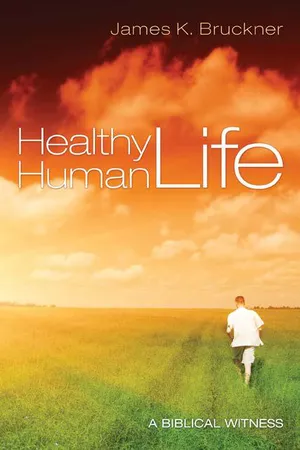
- 256 pages
- English
- ePUB (mobile friendly)
- Available on iOS & Android
eBook - ePub
About this book
Health is God's original created intent: whole persons, healthy relationships, a thriving environment, and ongoing interaction with himself. In the Bible, human health is body-based, community-based, and deeply integrated in a relationship with God's creating Spirit. The Pentateuch, prophets, writings, Gospels, and epistles all are deeply, if not primarily, concerned with the ongoing and ultimate health of God's good creation. Scripture also has a wide perspective on the disruption of human health. It deals with the human tendency to violence, corruption, and self-destructive behaviors.
The recently renewed interest in health, vitality, and spirituality of all kinds has led to this articulation of a biblical spirituality in relation to human health. Surprisingly, when we look for spirituality in the Bible, we find real and embodied relationships. Everyone is for health and for the restoration of health. But what are health and healing? How does the Bible describe or define them?
Here is the result of ten years of conversations with health care professionals in a master's course on biblical perspectives on health and healing. The biblical witness can transform the way we practice the healing arts. This book provides a biblical foundation for health and its restoration.
Information
Part One
Primary Biblical Narratives
Chapter One
What is a Healthy Human Being?
Claims from the Book of Genesis
Introduction: What is a Human Being?
Cultural, religious, and scientific traditions differ in their view of the substance of a human being, with corresponding assumptions concerning daily life and health. The way a society treats women, children, those with disabilities, criminals, and the elderly is based on the degree to which they are regarded as more or less human. The practical matter of how a health care professional views and treats patients to heal or maintain their health is related to her or his assumption of what a person is. Is the patient simply a sick mammal? Is she a lost soul? Or someone with unreached potential? Is this patient as important as the person in the next room?
Science and modern medicine have generally focused on human beings as biological complexities, but the ancient narrative of the Judeo-Christian traditions has a richer and more substantive view. The biblical narrative makes claims about human origins and human relationship to God, while corroborating much of what science and philosophy have learned about people. Its deeper perspective engages the human imagination about the past, provides perspective for restoring human health in the present, and gives hope for what we can be in the future.
Chapter one will engage and interpret the ancient narrative of Genesis, which provides a look at human beings in their original relationship to God, animals, the environment and themselves. In these key texts, healthy, whole relationships between man, woman, God, and animals are gained and lost. Death and alienation become part of the human reality.
The chapter will focus on five central points of the biblical witness: 1) all human beings are made of the same common clay; 2) all receive God’s breath; 3) all human beings are made in the image of God, the Creator of all things; 4) all humans are given dominion, which can be used for good or ill; 5) all human beings are capable of deception of self and others to their own and others’ detriment, and to the detriment of our shared, vulnerable environment. Created from clay and God’s breath and made in God’s image, human beings are constantly at risk of twisting or rationalizing the nature of their created reality. Awareness of this factor is an important component of maintaining a healthy life.
Common Clay: God Formed
Several years ago, I gave a guest lecture in a “Nursing and Spirituality” course. Among the future nurses were agnostics, orthodox Jews, a Muslim immigrant, and an African Christian student. The Christian asked, “When I am giving primary care to someone who does not share my faith, how can I communicate with them beyond the medical care? They don’t even believe in God!” The answer I gave is rooted in a claim made by the biblical text of Genesis. Before Judaism, before Christianity, before Islam or any other faith system, God created humanity from the same clay. All people, all human beings were made from the ground, and share the same created ancestor.
Genesis one’s account of creation makes a remarkably universal claim about the origins of human beings. Most creation stories world-wide focus on the creation of the ethnographic group that tells the story. Most are ethnocentric etiologies. This is true among indigenous peoples today and was also the case in the ancient world. The Canaanite myth describes the creation of the Canaanites.1 The Babylonian Enuma Elish describes the ascendance of their god Marduk over the other gods and describes the order he sustained for the sake of the Babylonians.
In contrast, the origins of Israel do not come into focus until the twelfth chapter of Genesis, after the formation of all other cultures and languages is described. The creation described in Genesis includes all people. We are all made of common clay.
Then the LORD God formed the human (ha-adam), . . . dust (‘aphar) of the ground (ha-adamah) and breathed into his nostrils the breath of life; and the human (ha-adam) became a living being” (Gen 2:7; my translation).
A Hebrew play on words drives the point home: “ha-adam was formed from ha-adamah.” A comparable English word play would say: “the human was formed from the humus.” This reminds us of our humility in relation to one another, and that our “common ground” extends to all living creatures.2 The text claims that all life originally came from the earth’s soil: plants (Gen 2:9); amphibians and mammals (Gen 1:24); and birds (Gen 2:19).
The formative “raw material” of the first human is the dust of the ground.3 Later in the narrative we are also reminded that human beings are originally mortal. Only access to the tree of life provided the conditional immortality of the garden. In our created form, we are not built to live forever. Once humans gain the knowledge of good and evil and lose access to the tree of life, death becomes the norm.
By the sweat of your face you shall eat bread until you return to the ground (ha-adamah), for out of it you were taken; you are dust (‘aphar), and to dust (‘aphar) you shall return. (Gen 3:19)
Our capacity to treat all people as equals regardless of their personal histories is given in the very act of creation. All are created by God, made from the same clay, and will suffer the return to the dust. To be human and to meet others on this common ground is deeply imbedded even in the linguistics of the ancient narrative. Christian belief in the bodily resurrection is a conditional understanding of immortality, and does not negate the shared experience of the human condition.
The texts also gives humans commonality with all living creatures, both plant and animal life. They are not created in exactly the same way, but we are given a point of relationship in the biblical text. All living things are made from the ground and are given life by God.4 We recognize this interdependence in the web of life that creates health between persons and all aspects of their environment.5
Common Breath: God’s Breath of Life
Breath serves as a primary indicator of health for doctors and nurses. Attention to breathing by a delivering mother can manage pain in childbirth. Hospice nurses can recognize the approaching end of life by the sound of a patient’s breathing. God is the source of the newborn’s first breaths and the each breath taken thereafter. Genesis 1 and 2 tell us that God gave the breath of life to all creatures, and breathed his own breath into the nostrils of human beings in order to give them life.
“Breath of life” is expressed in three ways in biblical Hebrew, each with its own nuance. In Genesis 1:30, the words translated “breath of life” are nephesh khayyah. “And to every beast of the earth . . . to everything that has the breath of life I have given every green plant for food.” Nephesh indicates the body-based reality of created life. In i...
Table of contents
- Title Page
- Foreword
- Preface and Acknowledgments
- Part 1: Primary Biblical Narratives
- Part 2: Primary Word Concepts
- Part 3: Primary Traditions of Restoration
- Bibliography
Trusted by 375,005 students
Access to over 1.5 million titles for a fair monthly price.
Study more efficiently using our study tools.
Frequently asked questions
Yes, you can cancel anytime from the Subscription tab in your account settings on the Perlego website. Your subscription will stay active until the end of your current billing period. Learn how to cancel your subscription
No, books cannot be downloaded as external files, such as PDFs, for use outside of Perlego. However, you can download books within the Perlego app for offline reading on mobile or tablet. Learn how to download books offline
Perlego offers two plans: Essential and Complete
- Essential is ideal for learners and professionals who enjoy exploring a wide range of subjects. Access the Essential Library with 800,000+ trusted titles and best-sellers across business, personal growth, and the humanities. Includes unlimited reading time and Standard Read Aloud voice.
- Complete: Perfect for advanced learners and researchers needing full, unrestricted access. Unlock 1.5M+ books across hundreds of subjects, including academic and specialized titles. The Complete Plan also includes advanced features like Premium Read Aloud and Research Assistant.
We are an online textbook subscription service, where you can get access to an entire online library for less than the price of a single book per month. With over 1.5 million books across 990+ topics, we’ve got you covered! Learn about our mission
Look out for the read-aloud symbol on your next book to see if you can listen to it. The read-aloud tool reads text aloud for you, highlighting the text as it is being read. You can pause it, speed it up and slow it down. Learn more about Read Aloud
Yes! You can use the Perlego app on both iOS and Android devices to read anytime, anywhere — even offline. Perfect for commutes or when you’re on the go.
Please note we cannot support devices running on iOS 13 and Android 7 or earlier. Learn more about using the app
Please note we cannot support devices running on iOS 13 and Android 7 or earlier. Learn more about using the app
Yes, you can access Healthy Human Life by James K. Bruckner in PDF and/or ePUB format, as well as other popular books in Theology & Religion & Biblical Criticism & Interpretation. We have over 1.5 million books available in our catalogue for you to explore.