- 250 pages
- English
- ePUB (mobile friendly)
- Available on iOS & Android
eBook - ePub
About this book
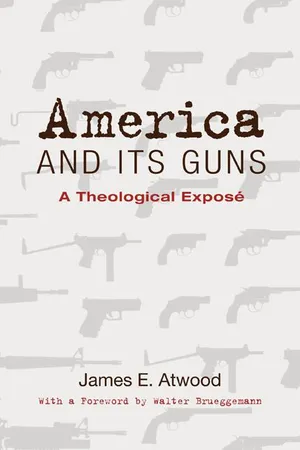
James Atwood contends that the thirty thousand gun deaths America suffers every year cannot be understood apart from our national myth that God has appointed America as "the trustee of the civilization of the world" and even "Christ's light to the nations." Because these purposes are noble, and we are supposedly a good and trustworthy people, violence is sometimes "required" and gives license to individuals to carry open or concealed weapons, which "save lives" and can even be "redemptive."
Atwood, an avid hunter, cautions that an absolute trust in guns and violence morphs easily into idolatry. Having spent thirty-six years as a Presbyterian pastor fighting against the easy access to firearms, one of which took the life of a friend, he uses his unique experience and his biblical and theological understanding to graphically portray the impact guns have on our society. He documents how Americans have been deceived into believing that the tools of violence, whether they take the form of advanced military technology or a handgun in the bedside stand, will provide security. He closes with a wake-up call to the faith community, which he says is America's best hope to unmask the extremism of the Gun Empire.
Information
Topic
Theology & ReligionSubtopic
Christian Ministry1
A Tale of Two Guns
My First Gun
My first gun was a Remington twelve-gauge shotgun, which I ordered in 1958 from a Sears Roebuck Company catalog. It never crossed my mind that most countries would consider buying a gun through the mail a dangerous practice. I used my Sportsman 58, with its patented poly-choke, to hunt quail, dove, rabbit, and deer in southeastern North Carolina, when I was pastor of the Wallace Presbyterian Church.
In August 1965, my wife, our two young children, and I boarded the USS President Wilson for Japan, where we served for nine years as missionaries with the United Church of Christ. With our passage we shipped two large crates of household goods to our new home in Kobe, where we studied Japanese for two years. I packed my shotgun in one of the crates because I learned Japan had good duck and pheasant hunting.
Passing through customs in Yokohama, I discovered quickly that my host country did not have America’s laissez-faire attitude about guns. When I presented the customs declaration form to the official he was troubled and informed me the police were required to take my gun because no unlicensed guns were allowed in the country. He assured me the Yokohama Police would send the gun to the Kobe Police Department, which would tell me how it could be returned.
The Yokohama police helped me open my crate, and I turned the gun over to them. Several weeks later, I received a telephone call from the Kobe Police asking if some officers could come to my home and bring the gun. Two officers arrived and after we had tea, they took the gun from its case and asked me to identify it. After taking measurements and recording serial numbers, the lieutenant asked me to open and close the firing mechanism. They wanted to see if I knew how to use the gun and if it was in good working order. Passing muster, the officers told me I had three more things to do to reclaim my shotgun.
I had to bring the following documents to the Kobe Police Station:
1. A written statement from a physician declaring I was mentally and physically able to operate the firearm.
2. A certificate showing I attended and passed a course on gun safety and hunting regulations in Japan.
3. A receipt from the prefecture showing I paid the license fees.
Soon thereafter, I presented these documents to the Kobe Police, who returned my shotgun. I was somewhat irritated that I had to jump through all these bureaucratic hoops and spend so much time simply to get a license for an ordinary shotgun. I had no criminal intent; I just wanted to hunt some birds. Why all the fuss?
All the same, I changed my mind about these bureaucratic hoops. When I read the papers back home in North Carolina, there were always articles on gun deaths, which I accepted without much thought. They were simply part of American life, like automobile accidents. The Japanese newspapers, however, didn’t have recurring stories about gun deaths because they didn’t have many. In the fall of 1965, I read a short report on gun deaths in Japan for the previous year. I don’t remember the exact numbers, but I do recall it was only a handful.
Slowly, I saw the wisdom of regulating firearms and was somewhat embarrassed I considered those few hours spent securing the three documents to be such a burden on my busy life. Japan’s commonsense gun policies made the streets of Kobe and Tokyo, where we lived for nine years, some of the safest in the world. No child in Japan was afraid to go to school for fear of being shot, and no gunshots were heard in their inner cities. Suicides, while prevalent, were not committed with guns. America should have been so blessed.
I returned home in 1974. That year, Tokyo, which was then the largest city in the world, had one death by firearms and the nation’s death toll from guns was infinitesimal. In contrast, America had 35,000 deaths by guns and some cities were virtual shooting galleries.
The Gun That Changed My Life
Even so, the unique American tragedy of gun violence was still an abstraction for me. I paid little attention to it until one autumn day in 1975, when I received a telephone call from the Intensive Care Unit of Alexandria (Virginia) Hospital. I rushed to the bedside of Herb Hunter, a charter member of my church who was dying from a lacerated liver, having been shot by a teenager who picked up a gun from a friend at the local bowling alley. The youngster complained he had no money, so his friend reached into his jacket and pulled out a Saturday night special. “Here, go get yourself some money,” he said, “and when you get some, give me twenty bucks and you can keep the gun.”
The boy entered the Hunter Motel in Springfield and pointed the gun at Herb, demanding money. Herb opened the cash register and, holding his hands in the air, backed away from the youth, who took the cash. Unfortunately, Herb tripped on a rug, which startled the boy. He turned around and shot Herb three times. Two days later we prepared for Herb’s funeral.
I remembered Japan’s commonsense laws and was both sad and angry as I realized that back home it was as easy to get a Saturday night special as a Big Mac. There were more gun dealers in the country than McDonalds restaurants, more gun dealers than gas stations. A dealer’s license cost only ten dollars per year and most of them did their business from the trunks of their cars. They drove to Virginia and other states with lax or nonexistent gun laws, loaded up their trunks with high-powered guns, and returned to metropolitan areas to sell their merchandise at huge profits. No questions were asked. What buyers did with their purchases was none of their business. Guns were everywhere and I learned one indisputable fact: where the most guns are, society records the most gun deaths. It was no coincidence that in the seventies most gun deaths were in the South; the same is true today.
The day after I buried Herb, I drove to the offices of the National Coalition to Ban Handguns in Washington, D.C. (After the introduction of assault rifles to civilian markets and the attempted manufacture of plastic handguns, which we called “hijacker specials,” the name was changed to the Coalition to Stop Gun Violence (CSGV).) I met Mike Beard and the Rev. Jack Corbett of the Methodist Church, its co-founders, and shared my grief over Herb’s murder. I spoke of the gun laws under which I lived in Japan and volunteered to help in any way I could. I have now worked with the coalition for the past thirty-seven years, serving as chairman of their national board, writing letters, making speeches, preaching, drafting resolutions, lobbying Congress, raising money, marching in demonstrations, and putting my arms around those whose family and friends were shot and killed. In 2000, I was the Interfaith Chair of the Million Mom March, as one million Americans gathered on the Mall in Washington, D.C., to demand sensible gun laws. I’m presently serving as Chair of Heeding God’s Call in Greater Washington, an ecumenical movement that organizes faith communities to put public and spiritual pressure on gun stores that sell inordinate numbers of guns found at crime scenes. The retailer code we ask them to sign would virtually eliminate straw purchasing.
I’m not a gun hater or a gun grabber as many pro-gun people describe those of us who work for balanced laws. I go deer hunting every fall, a fact that has led some to call me a hypocrite because I hunt and kill “those beautiful, defenseless creatures.”
I don’t apologize for hunting or eating venison. I look forward each November to being with my close friend Will Johnston on his beautiful tree farm in Gore, Virginia and also enjoy the camaraderie of Will’s nephew, Mike, who depends on getting several deer each year to help feed his family.
There is a profound difference between shooting a wild animal and shooting a human being created in God’s image. The Bible says God made people just a little lower than the angels and crowned us with glory and honor. God has put all creation under our feet, and he has given us dominion over all the works of his hands, including all sheep and oxen and the beasts of the fields and the birds of the air (Gen 1:26). God did not, however, place other human beings “under our feet” (Ps 8:5–8). No human being is created to have dominion over other people. No human being is made to be hunted or killed. No human being should be in the crosshairs of another’s rifle or the target of an assault pistol. We are all brothers and sisters in God’s family.
Though I own guns, I do not believe they should be exempt from safety requirements, wise regulation, and restrictions. Guns are made to kill. America has an abominable record of balancing an individual’s right to have a gun with the public’s inalienable right to life, liberty, and the pursuit of happiness. Public safety in the company of three hundred million guns should not be a wish or the pipe dream it is today. Children in the United States are twelve times more likely to die from firearms injury than children in twenty-five other industrialized nations combined. Gun murder rates in the United States per one-hundred thousand people are more than seventeen times higher than those in Australia; thirty-five times higher than in Germany; thirty-seven times higher than in Spain; and 355 times higher than in Japan.1 If the United States respected both the constitutional right to keep and bear arms and the right of its citizens to live on safe streets, these figures would drop precipitously. We should be embarrassed to be first in the developed world for gun deaths.
Why People Join This Movement
My anguish over Herb Hunter’s death was a call from God to try and stop so many senseless deaths. How was a kid in a bowling alley able to pick up a gun so easily and nonchalantly snuff out the life of such a good and generous man? I was angry that our country was so indifferent to 30,000 gun deaths every year. I joined the movement in anger, but I stay in the movement because I believe the wrong will fail and the right will prevail. Trusting in God’s power and love have kept me working these thirty-six years to try and save precious lives. I can’t be casual before thousands of preventable deaths. Although these years have been stressful, and I’ve known only a few large victories, I’ve had the privilege of working with some of the kindest and

International Murders by Guns (2008)
most courageous people I have ever known. I’ve grown stronger in the presence of these people, who have suffered their own virtual hells, yet have managed to keep a loving spirit while dedicating their lives to preventing the same heartbreak in others. The survivors I know are not sentimental people filled with bubbly feelings; theirs is a love that is tough, bold, and demanding, and they work largely for the safety of those they will never know personally.
Naturally, their anger burns hot because a loved one or friend was cruelly snatched away. Their grief and anger often resurface and will for as long as they live. Nonetheless, they struggle to cobble together common-sense, balanced legislation, which, had it been in place, would have prevented at least some of their tragedies, not all, but at least some.
I consider it a miracle that I can count on one hand the times I have heard these survivors say, “All guns should be banned.” Their responses to their misfortunes have been restrained, ...
Table of contents
- Title Page
- Foreword
- Preface
- Chapter 1: A Tale of Two Guns
- Chapter 2: Closing the Door on Discussion
- Chapter 3: Guns as Idols—A Risk or a Reality?
- Chapter 4: Commandments: More Than Rules—Relationships
- Chapter 5: Violence Lite and Its Insatiable Observers
- Chapter 6: The Language of a Gun Culture
- Chapter 7: Violence in Our DNA
- Chapter 8: The Principalities and the Powers
- Chapter 9: The Idol’s Greatest Need
- Chapter 10: The Idol’s Greatest Strength
- Chapter 11: The Idol Can’t Keep Its Promises
- Chapter 12: The Idol Transforms People and Communities
- Chapter 13: The Idol Requires Human Sacrifice
- Chapter 14: The Second Amendment and Freedom
- Chapter 15: Fifty Laws and Policies That Perpetuate Murder and Disorder
- Chapter 16: Expanding and Exporting Our Gun Culture
- Chapter 17: What to Say at the Scene of a Mass Shooting
- Chapter 18: A Message to Peacemakers and Most Members of the NRA
- Chapter 19: A Wake Up Call for the Faith Community
- Bibliography
- APPENDIX
Trusted by 375,005 students
Access to over 1.5 million titles for a fair monthly price.
Study more efficiently using our study tools.
Frequently asked questions
Yes, you can cancel anytime from the Subscription tab in your account settings on the Perlego website. Your subscription will stay active until the end of your current billing period. Learn how to cancel your subscription
No, books cannot be downloaded as external files, such as PDFs, for use outside of Perlego. However, you can download books within the Perlego app for offline reading on mobile or tablet. Learn how to download books offline
Perlego offers two plans: Essential and Complete
- Essential is ideal for learners and professionals who enjoy exploring a wide range of subjects. Access the Essential Library with 800,000+ trusted titles and best-sellers across business, personal growth, and the humanities. Includes unlimited reading time and Standard Read Aloud voice.
- Complete: Perfect for advanced learners and researchers needing full, unrestricted access. Unlock 1.5M+ books across hundreds of subjects, including academic and specialized titles. The Complete Plan also includes advanced features like Premium Read Aloud and Research Assistant.
We are an online textbook subscription service, where you can get access to an entire online library for less than the price of a single book per month. With over 1.5 million books across 990+ topics, we’ve got you covered! Learn about our mission
Look out for the read-aloud symbol on your next book to see if you can listen to it. The read-aloud tool reads text aloud for you, highlighting the text as it is being read. You can pause it, speed it up and slow it down. Learn more about Read Aloud
Yes! You can use the Perlego app on both iOS and Android devices to read anytime, anywhere — even offline. Perfect for commutes or when you’re on the go.
Please note we cannot support devices running on iOS 13 and Android 7 or earlier. Learn more about using the app
Please note we cannot support devices running on iOS 13 and Android 7 or earlier. Learn more about using the app
Yes, you can access America and Its Guns by James E. Atwood in PDF and/or ePUB format, as well as other popular books in Theology & Religion & Christian Ministry. We have over 1.5 million books available in our catalogue for you to explore.