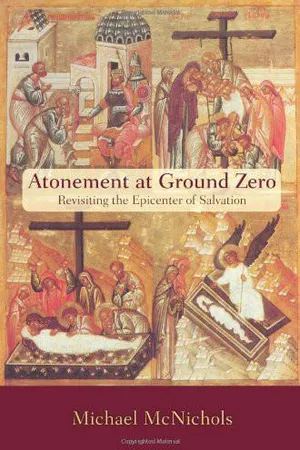
- 188 pages
- English
- ePUB (mobile friendly)
- Available on iOS & Android
eBook - ePub
About this book
An essential part of Christian orthodoxy is the belief that Jesus died at a particular point in human history. But it is not that Jesus died that has caused Christians to grapple with their understanding of faith; it is why he died that creates the struggle.
For centuries Christian thinkers have wrestled with the concept of the atonement. How the death of Jesus would result in the reconciling of the world to God is no simple puzzle. Yet, this complex topic is often viewed through certain doctrinal filters that reduce the richness of the atonement into single concrete, culturally based images. The New Testament, however, offers multiple metaphors in describing the atoning work of God in Christ.
Returning to the stories of the earliest witnesses to Jesus' life, death, resurrection, and ascension--the ground zero of our faith--offers the opportunity to suspend, if only briefly, our doctrinal preferences and step into the shoes of those who saw Jesus die and later return to them as their resurrected Lord. In doing so, we open the possibility of seeing the atonement with fresh eyes, recognizing the broad reach of God's love and learning to communicate that love in new ways.
Information
Topic
Theology & ReligionSubtopic
Christian TheologyPart One
Looking for Atonement in Our Story
1
Moving from Theory to the Narrative
The English word atonement is derived from the two words “at onement” and denotes a state of togetherness and agreement between two people. Atonement presupposes two parties that are estranged, with the act of atonement being the reconciliation of them into a state of harmony.1
Jesus’ self-consciousness as the one sent to die confronts us with the central mystery of the vocation of Christ, namely, his calling to be obedient to God’s divine mandate to the point of death. Out of Jesus’ own self-awareness, therefore, arose the early Christian proclamation that Jesus is the atonement for human sin. How are we to understand this central declaration of our faith? What is the significance of his death? And how does Jesus’ sacrifice affect us?2
“But we had hoped that he was the one to redeem Israel.”
(Luke 24:21a)
* * *
The ancient and ongoing processes of developing theological reasons for Jesus’ death have resulted in a variety of atonement theories. Several have emerged over the centuries, each one finding dominance for a period of time, and then giving way to new theological constructions. When it comes to applying meaning to the death of Jesus, these theories have come about through fresh biblical engagement and also through changing cultural grids.3
Theological reflection about the death of Jesus should not, however, begin with atonement theories. It should begin by immersion into the story we are given in Scripture about how and why he was killed. Jesus didn’t just die—he was executed. He was the victim of political and religious intrigue and was set up to die a criminal’s death.4 Peter makes this clear in his first sermon given on the Day of Pentecost:
“You that are Israelites, listen to what I have to say: Jesus of Nazareth, a man attested to you by God with deeds of power, wonders, and signs that God did through him among you, as you yourselves know— this man, handed over to you according to the definite plan and foreknowledge of God, you crucified and killed by the hands of those outside the law.” (Acts 2:22–23)
In his teachings and through the working of signs and wonders, Jesus disrupted the religious and political status quo. The local Jewish leaders felt threatened by him, fearing that the Roman government would bring harsh correction to actions hinting at revolution. These leaders were also protective of the faith of the Jewish people, and resisted any attempts at altering the religious structures they had come to value. Jesus was a threat at many levels.
For their part, the Romans seemed generally unimpressed by Jesus. There was, of course, the centurion who asked Jesus to heal his servant and then made a profound declaration about faith (Matthew 8:5–10; Luke 7:1–10). Outside of that, no one seemed to be on high alert because of Jesus, even when he entered Jerusalem as the crowds cheered him on. The Romans weren’t particularly concerned when they saw a humble, unarmed peasant riding alone into town on a donkey. Insurrectionists rarely took on that kind of posture.
The Romans were, however, happy to oblige the Jewish religious leaders in the end when they demanded that Jesus be put to death. The Romans were good at this sort of thing and believed that the occasional public execution was helpful for keeping the rabble in order.5 Watching someone suffer and die on a rough wooden cross would make a person think twice about crossing the Romans. After all, it was Caesar who was Lord.6
Up to the point of his arrest, Jesus had impacted many people. He had disciples, friends, family, enemies, and people who watched him from a distance. After his death, how might they have tried to make sense of what had just happened?
* * *
On August 31, 1997, Diana, Princess of Wales, was killed in a car crash in Paris, France. Millions of people all over the world mourned her death. Early reports blamed her death on speeding paparazzi. A later investigation suggested that the car’s driver was intoxicated.7
While Diana’s life had its share of scandal, many were saddened that a young, beautiful mother with a long ancestral connection to Britain’s Royal Family would die so violently and tragically. Consistent with her international rock-star status, the loss was felt deeply by many people all over the world.
If, however, we were to ask the great why? question about her death, we would reach too far if we claimed that Diana had to die in order to satisfy the needs of the British Monarchy, or that her death was orchestrated for a larger purpose that makes her passing meaningful. Instead, we would be better served to turn to some obvious answers: This is what happens to people who ride in a car driven recklessly by an intoxicated driver.
People would also have to admit that, while Diana’s death came too soon, her life passed as all lives must. Death terminates all life on earth. We probably shouldn’t be looking for reasons or purposes for Diana’s death beyond the obvious. It would be difficult to find greater meaning to her death than what circumstances have demanded. Her death was sad and tragic. But that’s just what happens to human beings on planet earth.
* * *
We don’t usually start with the obvious when we talk about the death of Jesus. We start with our doctrinal grids that have shaped our thinking about what God has done in the person of Jesus. We tend to take theological constructions that have emerged over the centuries and overlay them on the past. Starting with the obvious tends to shake some of those constructions because we are accustomed to starting with our theological preferences rather than with the historic reality of his death. As Abraham Heschel observes,
Explanation, when regarded as the only goal of inquiry, becomes a substitute for understanding. Imperceptibly it becomes the beginning rather than the end of perception.8
The actions of both the Jewish religious leaders and the Romans are the easiest and most obvious answers to the question of Jesus’ death: This is what happens when you cross the people who hold the power—they will take you out. In some ways, it is not surprising that this happened, given Israel’s history and Jesus’ own reflections on the subject:
“Jerusalem, Jerusalem, the city that kills the prophets and stones those who are sent to it! How often have I desired to gather your children together as a hen gathers her brood under her wings, and you were not willing!” (Matt 23:37)
It had happened before and it would happen again. The prophetic voices that called religious communities to the purposes of God would be silenced when that call violated the preferences of the dominant, ruling culture. Throughout recorded history, people have been killed for calling people to peaceful, healing, and reconciling ways of life.9 Such calls do not endorse power structures nor do they have a tendency to expand national economies. They do not offer support to the retention of systems that oppress and enslave. Such voices are often silenced. That is why Jesus’ enemies intended to silence him.10 As John Goldingay points out,
The gospel story is broken-backed. For the first half, Jesus strides the stage like Elijah or Elisha in their heyday, but in the second half, mighty works virtually cease. Jesus is now acted on rather than acting, suffering rather than relieving suffering, abandoned by God rather than working with God. There is a deep illogic about the need for this transition. Why should anyone want to oppose a man who brought people healing, cleansing, deliverance and teaching about questions such as prayer? But that is regularly the destiny of prophets.11
We Christians would not say, of course, that the political, religious, and power manipulations by Jesus’ enemies have written the end of the story. We believe that the story explodes dramatically soon after Jesus’ death, a belief that is grounded in the witness of Scripture. But still the story of his death begins, not with systematic theology, but rather with the account as it is given to us in the New Testament.
In reading Jesus’ story in the accounts of Matthew, Mark, Luke, and John, the tendency is to read as though the story is merely chronological, like a transcript of a video recording describing events on a blow-by-blow basis. These accounts, however, were written years after the events they are describing, crafted for particular audiences,12 and contain important theological reflection, if one reads carefully. These are reflective histories, not attempts at pure, objective, abstraction. The Gospels come to us as the framing of the writers’ ongoing experiences of faith within emerging Christian communities and in light of the larger work of God in Jesus Christ.
Mark’s account is the one that is particularly intriguing, because he sneaks up on us. Scholars believe Mark to be the earliest of the four Gospels, possibly written within forty years after Jesus’ death. One of the key themes found in Mark is the cluelessness of the disciples—throughout the book they repeatedly fail to catch on to what is happening. This comes out embarrassingly for James and John, whose brash obtuseness is recorded for all of history to enjoy:
James and John, the sons of Zebedee, came forward to him and said to him, “Teacher, we want you to do for us whatever we ask of you.” And he said to them, “What is it you want me to do for you?” And they said to him, “Grant us to sit, one at your right hand and one at your left, in your glory.” But Jesus said to them, “You do not know what you are asking. Are you able to drink the cup that I drink, or be baptized with the baptism that I am baptized with?” They replied, “We are able.” Then Jesus said to them, “The cup that I drink you will drink; and with the baptism with which I am baptized, you will be baptized; but to sit at my right hand or at my left is not mine to grant, but it is for those for whom it has been prepared.” (Mark 10:35–40)
James and John do not understand what is really going on, and Jesus points that out to them.13 It would be common for people in that time to view the places at the right and left of a ruling monarch to be places of significant power, and these boys wanted to be first in line for those privileges. But Jesus pushes back, making references to drinking the cup and being baptized that don’t appear t...
Table of contents
- Title Page
- Acknowledgments
- Foreword
- Introduction
- Part 1: Looking for Atonement in Our Story
- Part 2: Ground Zero
- Part 3: Metaphors and Meaning
- Conclusion
Trusted by 375,005 students
Access to over 1.5 million titles for a fair monthly price.
Study more efficiently using our study tools.
Frequently asked questions
Yes, you can cancel anytime from the Subscription tab in your account settings on the Perlego website. Your subscription will stay active until the end of your current billing period. Learn how to cancel your subscription
No, books cannot be downloaded as external files, such as PDFs, for use outside of Perlego. However, you can download books within the Perlego app for offline reading on mobile or tablet. Learn how to download books offline
We are an online textbook subscription service, where you can get access to an entire online library for less than the price of a single book per month. With over 1.5 million books across 990+ topics, we’ve got you covered! Learn about our mission
Look out for the read-aloud symbol on your next book to see if you can listen to it. The read-aloud tool reads text aloud for you, highlighting the text as it is being read. You can pause it, speed it up and slow it down. Learn more about Read Aloud
Yes! You can use the Perlego app on both iOS and Android devices to read anytime, anywhere — even offline. Perfect for commutes or when you’re on the go.
Please note we cannot support devices running on iOS 13 and Android 7 or earlier. Learn more about using the app
Please note we cannot support devices running on iOS 13 and Android 7 or earlier. Learn more about using the app
Yes, you can access Atonement at Ground Zero by Michael McNichols in PDF and/or ePUB format, as well as other popular books in Theology & Religion & Christian Theology. We have over 1.5 million books available in our catalogue for you to explore.