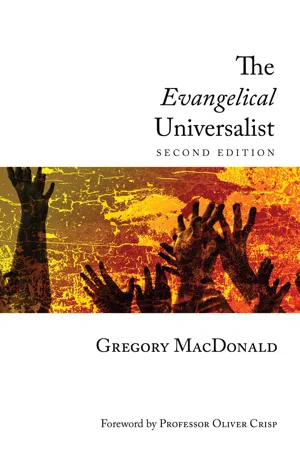
- 296 pages
- English
- ePUB (mobile friendly)
- Available on iOS & Android
eBook - ePub
About this book
-Can an orthodox Christian, committed to the historic faith of the church and the authority of the Bible, be a universalist?
-Is it possible to believe that salvation is found only by grace, through faith in Christ, and yet to maintain that in the end all people will be saved?
-Can one believe passionately in mission if one does not think that anyone will be lost forever?
-Could universalism be consistent with the teachings of the Bible?
Gregory MacDonald argues that the answer is yes to all of these questions. Weaving together philosophical, theological, and biblical considerations, MacDonald seeks to show that being a committed universalist is consistent with the central teachings of the biblical texts and of historic Christian theology.
This second edition contains a new preface providing the backstory of the book, two extensive new appendices, a study guide, and a Scripture index.
Information
Topic
Theology & ReligionSubtopic
Christian Denominationschapter one
A Hell of a Problem
The traditional position [is] . . . that God will be all in all despite the damnation . . . of many of his creatures . . . [T]he universalist asserts: “The God I believe in, the God I see in Christ, could not be all in all in these conditions: such victory could not be the victory of the God of love.”
—Bishop J. A. T. Robinson1
—Bishop J. A. T. Robinson1
When Biblical Interpretation and Reason Clash
It has long been recognized that Christian theology is guided by several key sources of wisdom: Scripture, tradition, reason, and experience. Of these, the Protestant churches agree that Scripture is the most authoritative. These four sources, however, inter-relate in such complex ways that one cannot claim to “just read the Bible” without paying attention to tradition, reason, and experience. In an ideal world, the four sources would beautifully dovetail and lead to clear conclusions. However, it is a common experience for the Church to be faced with situations in which Scripture seems to conflict with one or more of the other sources. What do we do in such situations if we are committed to a divinely inspired Scripture? We first ask whether reason, tradition, or experience may not be misleading or mistaken. We then also consider whether we may have misunderstood Scripture, for even a commitment to an inspired Bible is not a commitment to inerrant interpretations. Reason can play a role in exposing misinterpretations of the Bible. It is this role that I want to draw attention to in this chapter.
In the history of the Church it is not hard to find cases in which prevailing interpretations of the Bible were changed in the light of reason. One has only to think of how the Copernican revolution led to a new understanding of texts such as Psalm 932 or how modern cosmology has led to new ways of reading Genesis 1.3 On the non-scientific front, one thinks of how Aquinas’s metaphorical interpretations of biblical statements about God’s changing his mind were acceptable because his philosophy told him that they could not be literally true (for God is timeless). Most evangelicals, myself included, are quite happy with such a use of reason to guide interpretation.
In this chapter I wish to apply this method to the doctrine of hell. The mainstream Christian tradition speaks clearly on this issue, as does traditional interpretation of several key biblical texts. All who fail to accept the gospel of Jesus Christ, so the tradition goes, will be condemned to eternal, conscious torment in hell. The moment of death is the moment after which there are no more chances to receive God’s mercy. Within the tradition there has always been a minority report in favor of annihilation or universalism, but the main thrust of the tradition is clear. I think that the reflective Christian ought to start by taking the tradition as the default position—it should be assumed to be correct unless good grounds can be found to reject it. To jettison such a long-lasting and clear tradition is something that ought to be done cautiously and reluctantly. The Christian biblical scholar, philosopher, or theologian should begin then by attempting to defend this tradition. Many have rightly done so. However, Protestants do not, in theory, recognize tradition, nor interpretations of the Bible, as infallible; so we must be open to the possibility that we have made a mistake here.
I shall argue that philosophical attempts to defend the tradition to date have failed to present a convincing case. I shall further argue that philosophical arguments for universalism have considerable force. This produces a conflict between reason and traditional interpretations of the Bible. The reflective Christian should re-examine the Bible and theology to see if they are not, in fact, compatible with some form of universalism. If such an attempted re-reading fails, then they must return to philosophy and try again to make reason fit the Bible. I, however, shall argue in the following chapters that a universalist interpretation of the Bible can work; and, if it does, reason will have played a crucial role in exposing our misinterpretations and pointing us to a truer understanding of Scripture.
General Problems With the Traditional Doctrine of Hell
There are several problems that all attempts to justify the traditional doctrine must run up against, so I shall deal with these first, before looking at problems connected with specific defenses.
The Problem of the Justice of Infinite Retribution
Any roughly traditional doctrine of hell is parasitic upon a philosophy of punishment usually known as the retributive theory of punishment. This theory holds that the punishment of a criminal is justified, not on the basis of its rehabilitative effect, nor on the basis of its crime-deterring impact, but on the grounds that the criminal deserves it. Clearly, punishing sinners in the traditional hell is not going to rehabilitate them, nor deter them from future sins. God punishes the sinners in hell because they deserve it, because justice is served in this way.
Central to the retributive theory of punishment is the notion that the punishment must fit the crime. A punishment too lenient or too harsh does not serve the cause of justice. But it is here that the problem lies. According to the traditional doctrine, hell is everlasting, conscious torment. What possible crime is a finite human capable of committing that would be justly punished in this way? Many find the idea absurd, because it is hard to see how even the most hideous crimes humans commit could be balanced by the traditional eternal punishing. The upshot of this is that the traditional doctrine seems to require a theory of punishment that ends up undermining it.
I am aware of two approaches that try to circumvent this problem; and, it seems to me, both are problematic. The first solution is that of St. Anslem, who argued that as God is infinitely great and as any sin is an offence against him, then any sin incurs infinite demerit. The only fitting penalty for an offense against an infinite being is an infinite punishment—everlasting punishment.4 There are two common objections to this argument. The first is that it is based on a view of crime we no longer subscribe to. Marilyn Adams points out that the social background to this argument is that of a feudal society in which the gravity of a crime is determined by both the offense and the social status of the victim. Adams objects that Anselm’s argument carries little weight today, as we no longer consider the legal seriousness of a crime to be influenced by the social status of the victim.5 In a recent essay Oliver Crisp has vigorously defended the Anselmian tradition against this kind of objection.6 He agrees with Adams that the social status of the victim does not make any difference to the seriousness of the crime. However, we should not simply jettison Anselm’s argument for that reason. We also typically consider that crimes committed against humans are more serious than crimes committed against cats or mice. So we do usually recognize an ontological difference between humans and lesser species that makes crimes against human more liable to punishment. Given this common intuition, there is nothing obviously out of date with the claim that God is ontologically greater than humans and that crimes against God are more serious than crimes against humans. Indeed, God is infinitely great, and thus crimes against him may possibly incur infinite demerit and deserve infinite punishment.
It seems to me that Crisp may have successfully rescued Anselm from the first objection, though problems remain with his response. For instance, it is not obvious that a sin against God’s infinite honor incurs an infinite demerit. Suppose that John has 10 units of honor. Imagine further that Philip ignores John in public whilst Simon spits in John’s face. Both have offended against his honor, but the amount of demerit incurred is surely not 10 units in both cases. The nature of their crimes plays a key role in deciding their desert. So also it is with God. It does not necessarily follow from the claim that God has infinite honor that any crime against him is infinitely bad. This is because the gravity of an offense is determined not merely by the status of the offended party but also by the nature of the offense.7
The second objection to Anselm is that his theory makes all sins equally bad, and most people consider this consequence to be counter-intuitive. Thomas Talbott writes:
. . . if every sin is infinitely serious and thus deserves the same penalty as every other sin, namely everlasting torment, then . . . the idea so central to the retributivist theory, that we can grade offences, collapses—as does the idea of an excessive punishment and that of fitting lesser punishments to lesser crimes. Many Christians do, it is true, speculate that gradations of punishment exist in hell; some, they suggest, may experience greater pain than others. . . . But even this seems inconsistent with the idea that every sin against the infinite God is infinitely grave and therefore equal to every other sin . . . . 8
Crisp has responded to this objection also. It does not follow from the claim that all sinners are punished infinitely that they are punished equally. He asks us to imagine two sinners, Trevor and Gary. “Both are consigned to hell forever. Both suffer an infinite punishment in hell. But Trevor is only punished for one hour a day whereas Gary is punished for twelve hours a day. Clearly, in this state of affairs they are both punished infinitely but not equally.”9
Let us, for argument’s sake, grant that Crisp is correct to say that God could punish all sinners infinitely without all punishments being equal. The degrees of punishment he retains in his view of hell require sins to be gradable in terms of their seriousness. The very bad sins would merit severe punishments for infinity and the mild sins would merit mild punishment for infinity. The problem is that it is hard to give an account of how sins can be distinguished in degrees of seriousness if we begin, as Crisp does, from the claim that all sins incur infinite demerit. You cannot get worse than that. The very claim seems to flatten out any attempt to distinguish between degrees of sin. So it seems to me that Crisp has to make a stronger case that allows him to consider all sins as equally bad and yet also to allow him to distinguish lesser from greater sins. If he cannot do so, the standard objection remains and renders Anselm’s view implausible.
A more recent attempt to deal with the problem of the injustice of ev-
erlasting torment is to suggest that God only punishes sins with a temporary punishment but the damned are so furious at God that they rage against his treatment of them, thus sinning some more. This warrants yet more pu...
erlasting torment is to suggest that God only punishes sins with a temporary punishment but the damned are so furious at God that they rage against his treatment of them, thus sinning some more. This warrants yet more pu...
Table of contents
- Title Page
- Foreword
- Preface to the Second Edition
- Abbreviations
- Introduction
- Chapter 1: A Hell of a Problem
- Chapter 2: Universalism and Biblical Theology
- Chapter 3: Israel & the Nations in the Old Testament
- Chapter 4: Christ, Israel, and the Nations in the New Testament
- Chapter 5: A Universalist Interpretation of the Book of Revelation
- Chapter 6: To Hell and Back
- Chapter 7: The Advantages of Christian Universalism & Replies to Remaining Objections
- Appendix 1: A Reply to William Lane Craig’s Argument that Molinism Is Compatible with Non-Universalism
- Appendix 2: Christ, Cosmos, and Church: The Theology of Ephesians
- Appendix 3: The Lamb’s Book of Life
- Appendix 4: Love Wins?
- Appendix 5: Responses to (Some of) My Critics
- Appendix 6: Election
- Appendix 7: Hell, Moral Formation, and Calvinism
- Study Guide
- Bibliography
Trusted by 375,005 students
Access to over 1.5 million titles for a fair monthly price.
Study more efficiently using our study tools.
Frequently asked questions
Yes, you can cancel anytime from the Subscription tab in your account settings on the Perlego website. Your subscription will stay active until the end of your current billing period. Learn how to cancel your subscription
No, books cannot be downloaded as external files, such as PDFs, for use outside of Perlego. However, you can download books within the Perlego app for offline reading on mobile or tablet. Learn how to download books offline
Perlego offers two plans: Essential and Complete
- Essential is ideal for learners and professionals who enjoy exploring a wide range of subjects. Access the Essential Library with 800,000+ trusted titles and best-sellers across business, personal growth, and the humanities. Includes unlimited reading time and Standard Read Aloud voice.
- Complete: Perfect for advanced learners and researchers needing full, unrestricted access. Unlock 1.5M+ books across hundreds of subjects, including academic and specialized titles. The Complete Plan also includes advanced features like Premium Read Aloud and Research Assistant.
We are an online textbook subscription service, where you can get access to an entire online library for less than the price of a single book per month. With over 1.5 million books across 990+ topics, we’ve got you covered! Learn about our mission
Look out for the read-aloud symbol on your next book to see if you can listen to it. The read-aloud tool reads text aloud for you, highlighting the text as it is being read. You can pause it, speed it up and slow it down. Learn more about Read Aloud
Yes! You can use the Perlego app on both iOS and Android devices to read anytime, anywhere — even offline. Perfect for commutes or when you’re on the go.
Please note we cannot support devices running on iOS 13 and Android 7 or earlier. Learn more about using the app
Please note we cannot support devices running on iOS 13 and Android 7 or earlier. Learn more about using the app
Yes, you can access The Evangelical Universalist by Gregory MacDonald in PDF and/or ePUB format, as well as other popular books in Theology & Religion & Christian Denominations. We have over 1.5 million books available in our catalogue for you to explore.