The Holy Spirit provides access to relationship with and reflection on the Triune God. In West Africa, Christians approach the Triune God in a way that challenges the Jewish-Christian memory. Deeply rooted in their ancestral memory, where living is relationality, they embrace the Trinitarian faith, the economy of the relational God-Christ-Spirit, by expanding and reinventing their indigenous experience of God, deities, spirits, and ancestors. Christian faith-practice is marked by the spectacular dominance of the Holy Spirit, whose charisms reflect the operations of deities. African Initiated Churches (AICs), Protestant and Catholic charismatic movements, experience God-Spirit's liberating and healing hand for the enhancement and realization of communal and individual destiny (what one expects from a concerned providential deity).
This book argues that the emergent West African Trinitarian imagination is in harmony with Hebrew insight into the One and Only Yahweh of the patriarchs that assumed the dimensions of Elohîm, God—experienced as a sound of sheer silence by Elijah, and proposed in utter weakness as the Only God by Deutero-Isaiah—the God that Jesus called Abba, Father. As Spirit and Life, the Holy Spirit, which is the source of all charisms (Origen), is our link to the Trinity.
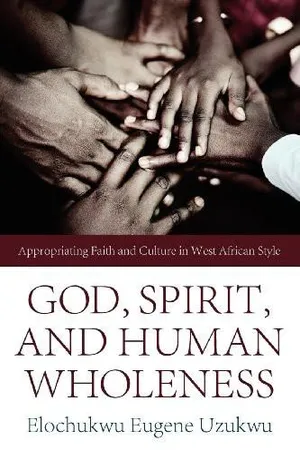
eBook - ePub
God, Spirit, and Human Wholeness
Appropriating Faith and Culture in West African Style
- 282 pages
- English
- ePUB (mobile friendly)
- Available on iOS & Android
eBook - ePub
God, Spirit, and Human Wholeness
Appropriating Faith and Culture in West African Style
About this book
Information
Topic
Theology & ReligionSubtopic
Christian Theologypart one
General Considerations
What This Book Is About
This book is about a West African approach to the Christian theology of God. It argues that West African Christians, rooted in their history and ancestral context, engage in interesting God-talk that challenges the Jewish-Christian memory. The history of Christianity in postcolonial Africa reveals that “Christian expansion and revival were limited to those societies that preserved the indigenous name of God.”1 West African Christians received the Trinitarian faith from the missionary churches. They embraced the teaching on the economy of the relational God-Christ-Spirit in their Christian communities. However, their faith is marked by the spectacular dominance of Spirit. This book argues that the spectacular dominance of Spirit is rooted in the West African map of the universe. In African Initiated Churches or “Spirit Churches” (AICs—also called African Instituted Churches or African Independent Churches) and in Protestant and Catholic Charismatic movements the indwelling Holy Spirit enables the community to experience what one expects from a concerned and providential God; an experience of the liberating, healing or therapeutic hand of God. The ancestral universe is dominated by God, multiple deities, spirits, and ancestors ideally for the enhancement or realization of the destiny of individual humans and the community. The everyday social, economic, and political business of life is displayed before the divine for approval, amelioration, and healing. Human destiny constitutes the core of West African religious practice. Consequently, human dignity, human values and needs control religious discourse. Religion is kin-focused. It generates a deep awareness of and respect for one another’s (an individual’s) destiny under the patronage and inspiration of God, deities, ancestors and spirits. In the absence of a “clash of gods,” religion, ideally, is opposed to violence. “Religious fanaticism has little place in African traditions, where a centralised, war-generating force that mobilises people for genocidal projects is hard to conceive.”2 Local war deities that are patrons of violent conflicts and that are instrumentalized for the generation of violence are abundant. But God, the origin of origins, never patronizes nor generates violence. Wars, jihads and crusades are never fought in the name of God as is common in the Jewish-Christian and Islamic traditions.
This book shows that the dominant features of West African Chris-tianity reflect ancestral religious roots. The ancestral religions reflect in turn an ontological structure prevalent in the region’s vision of the universe. In this region, duality or multiplicity functions as the constitutive principle of Life or Being. Relationality, flexibility, fluidity and palaver or dialogue are therefore structural to the socio-political, economic and religious life anywhere and anytime. This structure, this book argues, informs the appropriation of the relational Trinitarian God by West African Christians. The perception of a universe where relationality is the rule holds the key to unlocking the popularity of trance, vision or audition, healing and exorcism under the power of the Holy Spirit in AICs and Charismatic movements. Attention to this relational universe in theological reflection advances, and makes a significant contribution to, the Christian Trinitarian imagination. This book therefore adopts the open-ended flexibility, that the relational structure of the universe suggests, as a working hypothesis or methodological assumption to engage in theological discussion. In doing this, it follows the philosophical assumptions that inspired the works of Chinua Achebe who structured his thinking around duality. Hellenism’s preoccupation with being as one, with rest as opposed to change or motion, propagated by Western Christian tradition, is being integrated into West African Christian practice on clearly West African relational terms. For: “when something stands, something else will stand beside it.” This encourages flexibility, collaboration, dialogue across religions and cultures and could bring together or correlate the gospel ideal and the ideal of secular humanism.
Finally, this book argues that the West African Trinitarian imagination displays God-Spirit-Christ, the relational “origin and finisher” of individual and communal destiny (cf. Heb 12:2), as profoundly health-generating. This Trinitarian imagination opens the way to ameliorating relationship among humans; it enables spiritual combat, in the power of God’s Holy Spirit, against the evil that endangers relationship symbolized in witchcraft; and it challenges humans to reinvent and re-envision relationship between cultures, civilizations and religions, between all humans who come from God. Instead of the collision course between absolutist claims, of God or gods that are on our side against the others, the ideological “clash of civilizations,” it inspires relationship based on flexibility, transparency, and dialogue; and it inspires the enhancement of human dignity and the fulfilment of human needs and longings. West African style of Christianity contains the raw material for renewing Trinitarian theology, for renewing Christian life in the world church, and for renewing human life.
Developing Concerns of African Theology
This book is a contribution to the developing issues that preoccupy African theology. Over fifty years ago some francophone African and Caribbean priests met in Paris to discuss mission and evangelization. The fruit of their meeting was published in Des Prêtres noirs s’interrogent (“Some Black Priests Wonder”).3 Only a few of the contributors to the epoch making book, like Gérard Bissainthe and Robert Dosseh, are still around. Since 1956 theological explorations in Africa have come a long way. Some think that on the whole the numerous publications have made little impact on the life of ordinary African Christians. Perhaps African theologians, preoccupied with classical issues that the academia considers proper to theological discourse, have not engaged seriously the concerns of ordinary Christians or the questions that contexts are raising. It is becoming clearer that the African context should set the full agenda of theological discussion.
In this study I engage some issues that many have discussed these past fifty years. Many summaries of the genesis, concerns and developments of theological reflection in the continent exist.4 My objective is less ambitious. I limit my exploration to one way West Africans are appropriating Christianity, namely, their contextual way of saying, practicing, or better still receiving God-Spirit-Christ as a way of living human wholeness. This, I argue, contributes to and challenges the shape and the understanding of world Christianity. It reveals aspects of West African Christian thought and practice that could be shared with the rest of the Christian world. Many of my examples will be drawn from sociocultural groups in Nigeria, Benin Republic, Togo and Ghana. But I indicate the similarity of beliefs and practices beyond West Africa to Eastern and Central African countries to show how certain patterns of naming and relating to God are common in the region and beyond. The similarities could also argue for the mobility of aspects of Christian practice in the region and in other parts of Africa.
The first part of this book will focus on general considerations. I clarify the context and concerns of the whole work and set out my argument for adopting a methodology that is inspired by the dominant features of thought of a West African group—the Igbo (Nigeria) wisdom tradition. The second part will address the prevalent pattern of approaching God-Spirit and its impact on the appropriation of God-Spirit-Christ in West African Christianity. In a world where God-spirits and humans interrelate for the good of humans, the approach to the divine turns around human wholeness.
1. Sanneh, Whose Religion Is Christianity? 31–32.
2. Eggen, “Mawu Does Not Kill,” 359.
3. Des Pêtres Noirs S’interrogent. To commemorate the event, Karthala reedited the book and organised a colloquium in Paris in November 17–18, 2006. Also the Catholic University of West Abidjan, organized a conference February 12–16, 2007 around the book.
4. Le Devenir de la Théologie Catholique depuis Vatican II: 1965–1999, edited by Joseph Doré, contains entries from French and English speaking zones of Africa. See the contributions of Danet & Messi Metogo, “L’afrique Francophone,” and Uzukwu, “L’afrique Anglophone.” The Panorama de la Théologie au XXe siècle edited by Rosino Gibellini includes a bird’s eye view of the concerns and orientations of African theology as one among other theological movements in the third world. Gibellini also edited Paths of African Theology in an effort to capture the concerns of theology in Africa at the end of the second millennium. Originally, Gibellini, ed., Percosi Di Teologia Africana. Earlier publications like Ngindu Mushete, Les Thèmes Majeurs De La Théologie Africaine, or Parrat, A Reader in African Theology, or even Muzorewa, Origins and Development of African Theology are noteworthy attempts to present an overall picture of contributions and trends in African theology.
1
Preliminary Considerations
History, Culture, Context, and New Methodology for Interpreting Christianity in West Africa
This study that focuses on the interface between West African Christian practice and the Jewish-Christian memory naturally leans towards local history and West African ancestral context and traditions. Since I believe that the context generates intriguing questions about reality and provides adequate language to explore the same, I opt for methodological assumptions that will enable me to better analyze the reality. First, theology in our zone has to be attentive to the history of the various Christian communities in West Africa. Every contextual theology is based on the social history of the groups engaging the Christian tradition. Second, my methodological assumption is rooted in the structure of the ...
Table of contents
- Title Page
- Foreword and Acknowledgments
- Abbreviations
- Part 1: General Considerations
- Part 2: God-Spirit in West Africa and the God of Jesus Christ
- Conclusion: Re-appropriating the God of Wholeness in the Spirit
- Glossary
- Bibliography
Trusted by 375,005 students
Access to over 1.5 million titles for a fair monthly price.
Study more efficiently using our study tools.
Frequently asked questions
Yes, you can cancel anytime from the Subscription tab in your account settings on the Perlego website. Your subscription will stay active until the end of your current billing period. Learn how to cancel your subscription
No, books cannot be downloaded as external files, such as PDFs, for use outside of Perlego. However, you can download books within the Perlego app for offline reading on mobile or tablet. Learn how to download books offline
Perlego offers two plans: Essential and Complete
- Essential is ideal for learners and professionals who enjoy exploring a wide range of subjects. Access the Essential Library with 800,000+ trusted titles and best-sellers across business, personal growth, and the humanities. Includes unlimited reading time and Standard Read Aloud voice.
- Complete: Perfect for advanced learners and researchers needing full, unrestricted access. Unlock 1.5M+ books across hundreds of subjects, including academic and specialized titles. The Complete Plan also includes advanced features like Premium Read Aloud and Research Assistant.
We are an online textbook subscription service, where you can get access to an entire online library for less than the price of a single book per month. With over 1.5 million books across 990+ topics, we’ve got you covered! Learn about our mission
Look out for the read-aloud symbol on your next book to see if you can listen to it. The read-aloud tool reads text aloud for you, highlighting the text as it is being read. You can pause it, speed it up and slow it down. Learn more about Read Aloud
Yes! You can use the Perlego app on both iOS and Android devices to read anytime, anywhere — even offline. Perfect for commutes or when you’re on the go.
Please note we cannot support devices running on iOS 13 and Android 7 or earlier. Learn more about using the app
Please note we cannot support devices running on iOS 13 and Android 7 or earlier. Learn more about using the app
Yes, you can access God, Spirit, and Human Wholeness by Elochukwu Eugene Uzukwu,Elochukwu Uzukwu in PDF and/or ePUB format, as well as other popular books in Theology & Religion & Christian Theology. We have over 1.5 million books available in our catalogue for you to explore.