- 144 pages
- English
- ePUB (mobile friendly)
- Available on iOS & Android
eBook - ePub
About this book
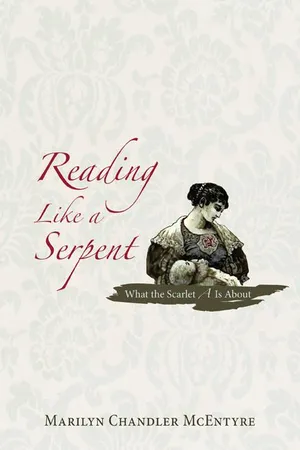
Many remember The Scarlet Letter as required reading for reluctant sixteen year olds. The unnamed, elusive narrator of Hawthorne's "tale of human frailty and sorrow" is--some readers might say maddeningly--indirect, ambiguous, and inconsistent. Readers who hope to arrive at satisfying judgments about the book's four iconic characters--Hester, Arthur, Roger, and Pearl--are often left to arrive at their conclusions by guess and inference. The narrator provides what seems to be willfully incomplete information. His point of view shifts from one moral or historical perspective to another without announcement or apology. Reading Like a Serpent invites readers to reconsider this American classic as Hawthorne's challenge to the American public to become more generous, versatile, and responsible readers--especially of the Bible, a book Hawthorne hoped to rescue from moralistic literalists and legalists, reminding us that "the letter killeth, but the spirit giveth life."
Information
Part I
A Prophet at Play
Who among those of us who attended American public schools does not remember our first encounter with Hester Prynne, the hapless heroine of The Scarlet Letter? Served up to sixteen-year-olds as standard fare, often sandwiched between Edgar Allan Poe (whose “The Pit and the Pendulum” was, let us admit, far more gripping stuff) and Emily Dickinson (all of whose poems, someone has pointed out, can be sung to “The Yellow Rose of Texas,” which makes it hard to grasp their depth and cunning at first glance), this quaint and curious tale has, in fact, failed to delight generations of young readers. Not all, to be sure, but I find, because I always ask when we embark on our return visit to this little American classic in college courses, that many students recall The Scarlet Letter as stiff, boring, wordy, moralistic, lacking in plot, and generally incomprehensible. So when I tell them it is one of my two or three favorite books in the world and has withstood considerable comparison in my long reading life, their curiosity is piqued—either about the hidden merits of the book or about my taste and credibility. Some of them, no doubt, think I really ought to get a life.
It is my privilege thereupon to lead them once again, the reluctant, the skeptical, the compliant, and the happy, eager few, into the thickets of Hawthorne’s antique syntax, to show them how to navigate the interpretive mazes he maps for his readers, and to witness the epiphanies that ensue. The Scarlet Letter is a book deeply occupied with reading and interpretation—most urgently with the ways we read Scripture, and consequently, history. The heart of its message is not about the sin of adultery (a word not mentioned once in the story) but rather about the sin of bad reading and the many sins that ensue from bad reading practices, especially when Scripture is read badly. Most egregious among these readerly sins are literalism, legalism, and misapplied allegorical or typological thinking.
The generation of readers Hawthorne addressed—educated New England folk weaned on sermons, and moralistic hornbooks—were also heirs to a Puritan legacy he himself found troubling, if not repugnant. Indeed, Hawthorne may be among those most responsible for giving the Puritans a bad name. A good many scholars of American Puritanism would assure us that those early settlers, for all the mistakes and cross-cultural offenses we might lay at their feet, were a complex, God-loving as well as God-fearing people, capable of beautiful music, lively poetry, and delight in the gifts of farm and family. But Hawthorne brooded on how his own bloodline led back to John Hathorne, the severest judge in the New England witch trials. He wrestled with the limitations of popular piety in churches he reluctantly attended.1 His travels to Italy as an adult fed a fascination with Roman Catholicism that shows up in many of his stories, especially the last. In that novel, The Marble Faun, a young American girl repeatedly described as a child of the Puritans finds her way into the basilica of St. Peter’s. Longing for release from her own anxieties about sin, she enters a confessional where a kindly priest, though he cannot give her absolution, comforts her, apparently, among other things, for the spiritual forfeitures of the Protestant Reformation, one of those being the relief of the sacrament of confession. In his home in Concord, Hawthorne hung a reproduction of Raphael’s lovely Madonna. Two of his daughters became nuns, one an Anglican, the other a Roman Catholic. The latter—his little Rose, later known to the world as Mother Alfonsa—has been beatified and is now a candidate for canonization.
Still, he himself did not convert, but lived in prolonged and uncomfortable reflection on the legacy of personal and collective “sin and sorrow” that held him captive to some extent and fueled an ambivalent interest in the terms of Protestant piety throughout his life. He shared with many socially conscious thinkers of his generation a fascination with the complexities of language, reading, and interpretation, and with how Scripture could be and was being read and misread. Along with Emerson, Thoreau, Melville, and others, he recognized the enormous social consequences of oversimplified, legalistic biblical literalism, and bent his own considerable intelligence to teaching readers to read more complexly, imaginatively, and audaciously.
His concern with reading also extended to the nature of historical narrative: how we receive, retell, and read the record of history.2 He understood how much imagination, and how many shaping assumptions, are at work in any representation of history. In writing an historical novel, he raises, both implicitly in the narrative itself and explicitly in the introductory “Custom House” section, the vexing questions of what it means to tell the truth about the past, what are the legitimate uses of the past, and what is the relationship of history to mythmaking.
For Hawthorne, history is most importantly parable. In The Scarlet Letter he borrows from and plays with the conventions of history and parable, and also of legend, novel, romance, satire, and sermon. This generic ambiguity serves a number of purposes, the most important of which is to call our attention to interpretive frames: our conclusions about the story’s meaning will vary considerably according to how we read it—and multiple valid interpretations are possible. Like Melville and others who took an interest in the beginnings of “higher criticism,” a controversial academic approach to biblical texts, Hawthorne was disaffected by the New England church, convinced that the Bible was being both misread and misapplied by a lineage of literalists and Pharisees. He was disturbed by how certain strands of moralistic preaching and popular piety suppressed the ambiguities of Scripture and made the Bible an instrument of control.
One of his evident purposes in The Scarlet Letter is to invite his readers to critical biblical reflection and, in that process, to teach them how to read more responsibly, more reflectively, more generously, and more wittily. To ask a Christian audience, and his would have been almost entirely that in 1850 New England, to reflect on the nature of language and text was, of course, necessarily to raise the issue of how to approach biblical language and the biblical text, those being the foundation of moral, spiritual, and even political instruction. The Bible was the book that provided the frame for the discursive world his readers inhabited. The story told in The Scarlet Letter is replete with echoes of gospel narratives: of the woman caught in adultery, of Pharisees’ hypocrisy and institutional oppression, of wrestling with demons, of the Sermon on the Mount, of passion and crucifixion.
Hawthorne plays freely with the material in the Gospels and, in an elaborate web of allusion, links the ancient story of salvation to the story of the settlement of New England. This analogy was certainly not original: by the time he inherited it from the Puritan settlers the notion of New England as a new Eden, a new wilderness, or a new Jerusalem had already shaped public life and legitimated questionable legal presumptions about entitlement to land. In the spirit of that legacy of analogy then, though giving it his own ironic spin, he assigned the story of early New England its own mythic status and offered it as a prototype for understanding the tensions of his own generation. In doing so, he situates himself squarely in the tradition of forebears who had seen the settlement of New England as a “type” of exile that replayed the wandering of the Israelites, God’s people, in the desert, or, alternatively, as a godly people called forth to inhabit the New World as a New Eden, whose purposes and theology were already mapped in the Old and New Testaments. But he turns that tradition to his own ironic, satirical, and deeply serious purposes, calling our attention to its dangers, among which perhaps the most egregious is the way a self-justifying agenda of exploration and settlement had legitimated insularity, greed, and self-righteousness. The redemptive message he offers in the midst of this jeremiad is that there is another way—of reading, of opening the heart to divine and human encounter, of living together in more equitable fellowship. The allegorical habits of mind that lingered in popular folklore and fiction (American Christians at the time grew up on Bunyan and Aesop) seemed to him to narrow the imagination and truncate the mysterious, and even fanciful, ways the mind might arrive at meaning. Those ways, he implies, might be far more trustworthy than was commonly believed.
As a parable, The Scarlet Letter holds up a mirror to North American descendants of the early English settlers, inviting them to question the terms on which settlement and governance were established, and particularly to consider the destruction, loss, and guilt that project had left in its wake. He aimed his sharpest satirical barbs at those who clung to the letter of the law and who, like their ancestors, imposed the weight of the law more heavily on those guilty of sexual crimes (easy to target and titillating to the public imagination) than on those who abused or self-servingly wielded the powers of church and state. (This tendency may sound familiar, gentle readers. I urge you to consider readily available contemporary analogies.)
Each of the four central characters in The Scarlet Letter—Hester Prynne, Arthur Dimmesdale, Roger Chillingworth, and Pearl—is rich with dimensionality and symbolic suggestion. Each manifests a permutation of a few central ideas: that every individual carries the mark of sin, that individuals in community are inextricably and subtly bound to each other in the body politic, as also in the body of Christ, and in something like what Whitman subsequently called the “body electric” or what Martin Luther King called the “beloved community”—a natural environment of shared energies, vulnerabilities, and purposes not always conscious. In their inextricable interdependence, the characters challenge entrenched notions of individualism, as well as challenging whatever criteria we bring to judgment of character. Their fates are so intertwined, they are virtually impossible to consider independently. And there’s an emphatic point to this careful and conspicuous interweaving: no one can be judged alone, apart from the social context in which his or her sin or virtue takes shape. It turns out, in their world as in this one, that none is righteous, that all have sinned, and that the sins, not only of the fathers, but of mothers and neighbors, are visited upon all God’s children. Adversaries are counterparts, bound as deeply together in their hatred as brothers in their love. And sinfulness is a contaminant we all breathe and inhabit.
So Hester, Arthur, Roger, and Pearl have won a permanent place in the American imagination—or at least in American school curricula. But arguably, the most interesting character in The Scarlet Letter is the narrator. This narrator has irritated and confused generations of readers (especially hapless adolescents who wish he’d just get on with the plot). He gives with one hand and takes with another. He offers judgments, reconsiders, then abdicates altogether with a “be that as it may,” or a “so it was said,” or a coy observation that it were improper, indelicate, or untimely to arrive at a conclusive assessment of the incidents just recounted. He revels in paradox, inference, and indeterminacy. He keeps tossing us readers the ball he’s been juggling, sometimes addressing us directly, standing in liminal space and time with one foot outside the frame, at times privy to the most intimate thoughts and feelings of the characters, and at other times abjectly dependent upon hearsay and scraps of barely decipherable evidence, like an historian facing frustrating gaps in a partial and dubious record. We get what we get from him by means of a cunning indirection that forces us into more active, critical, and self-critical reading.
The whole introductory narrative, “The Custom House,” serves to raise fascinating and troubling questions about the uses of the past and the nature of historical narrative. If, as he suggests, the texts and artifacts that connect us to the past acquire meaning only by means of subjective and uncertain attribution, in what sense are they reliable? The narrator of this putatively historical/autobiographical note (which, however, is also fiction) hews very close to the author’s younger self—an employee in a Salem custom house where he finds an old artifact, a scarlet A embroidered in gold—in a trunk, and begins a course of research and speculation to satisfy his curiosity about its origin and meaning. One point made repeatedly there and in the subsequent story is that what we take to be true and meaningful always comes to us through filters of speculation and inference. This insistence on the ubiquity of interpretation is not simply an early postmodernist rejection of absolute truth, but rather a reminder that we see through a glass darkly. That reminder turns into a warning worthy of the most ardent jeremiads of the Puritan preachers: beware those who claim to know the truth, the whole truth, and nothing but the truth. Beware also, he would add, of the literalists and legalists who turn the letter to their own purposes and ignore the Spirit.
The narrator who emerges in the story proper falls into a lineage one critic has described as “fictional transfigurations of Jesus.”3 If we can in any sense call Melville’s Billy Budd or Dostoevsky’s Prince Mishkin or C. S. Lewis’s Aslan or Tolkien’s Gandalf “Christ figures”—as all of them have been called—we must surely extend that category to include the nameless speaker in this singular American classic. He speaks to us as Americans and heirs of a very troubled Christian, Protestant, Puritan spiritual legacy, inviting us to a new understanding of our own sordid history, to reconsideration of its premises and to repentance for the abuses and infidelities that have shaped our ends as a nation. Echoing and invoking the Gospels at every turn, this narrator turns our attention first to “our” ancestors and their shortcomings, and, through them, to ourselves, if we are among the heirs of the dominant and domineering culture they established in this “new world.” As a tale of sin and sorrow, repentance, penitence, and the renewal of minds, it recasts the biblical story in which the speaker is the teacher (full of rabbinical wit and riddling) and the teller of parables, inviting his hearers to active discernment if they have ears to hear. Deeply preoccupied with the history of his people, this narrator turns that history to his own partially veiled purpose—a prophetic rehearsal of how history tends toward myth and legend, how we shape it to our immediate ends, and how self-serving those ends tend to be.
His strategies are many, and his aims complex. In the coming pages, I will explore this narrator’s tendency, for instance, to elicit judgment by indirection, implication, obliquity, and allusiveness; to align his sympathies first with one character and then with another, destabilizing our efforts to assess situations from a single point of view; to beg large theological questions such as how God is present in “Nature” by assuming but not naming that presence, intelligence, and intentionality; to dislocate us in time and space by making his observations from multiple historical and spatial vantage points; to indulge in wordplay that repeatedly calls our attention to the inevitable slippage of language itself; and, in short, to play the fool, in the best Shakespearean sense.
In doing so, the narrator falls into a long lineage of tricksters, teachers, and holy men who bear a resemblance well worth noting to the Jesus who speaks—mysteriously, invitingly, paradoxically, comfortingly, and disturbingly—in the Gospels. That similarity is perhaps made more striking when, in the latter chapters of The Scarlet Letter, he breaks this pattern of indirection and launches into homiletic interludes much like theatrical asides, pulling out the stops and making a forthright recommendation that the whole structure of society be “torn down and built up anew,” since as it is now, it continues to retrench institutionalized injustices—to women, to outsiders, and to the children who inherit its contentions.
It is my hope that in bringing close attention to this narrator’s strategies, to the ways he takes on and employs the roles of teacher, preacher, and prophet, we may come not only to a deeper understanding of Hawthorne’s purposes in this remarkable little story, but also that we may recognize the ways in which its wily, accusing, inviting, forgiving narrator still speaks with surprising relevance to American readers who share the problematic legacies of those who first ventured on their “errand in the wilderness” with good hearts, very likely, but often with clouded vision, looking upon all they saw with a very human combination of hope and ambition, gratitude and greed, authentic piety, and proprietary self-justification.
What’s in a Symbol
So let us begin our consideration of this narrator with one of his great prototypes, Jonathan Edwards. In “Images or Shadows of Divine Things,” Edwards writes, “Roses grow upon briars, which is to signify that all temporal sweets are mixed with bitter. But what seems more especially to be meant by it is that pure happiness, the crown of glory, is to be come at in no other way than by bearing all things for Christ. The rose, that is chief of all flowers, is the last thing that comes out. The briary, prickly, bush grows before that; the end and crown of all is the beautiful and fragrant rose.”4 He goes on to inventory a number of natural objects—hills, ...
Table of contents
- Reading Like a Serpent
- Preface
- Part 1: A Prophet at Play
- Part 2: Scriptures Reconsidered
- Bibliography
Trusted by 375,005 students
Access to over 1.5 million titles for a fair monthly price.
Study more efficiently using our study tools.
Frequently asked questions
Yes, you can cancel anytime from the Subscription tab in your account settings on the Perlego website. Your subscription will stay active until the end of your current billing period. Learn how to cancel your subscription
No, books cannot be downloaded as external files, such as PDFs, for use outside of Perlego. However, you can download books within the Perlego app for offline reading on mobile or tablet. Learn how to download books offline
Perlego offers two plans: Essential and Complete
- Essential is ideal for learners and professionals who enjoy exploring a wide range of subjects. Access the Essential Library with 800,000+ trusted titles and best-sellers across business, personal growth, and the humanities. Includes unlimited reading time and Standard Read Aloud voice.
- Complete: Perfect for advanced learners and researchers needing full, unrestricted access. Unlock 1.5M+ books across hundreds of subjects, including academic and specialized titles. The Complete Plan also includes advanced features like Premium Read Aloud and Research Assistant.
We are an online textbook subscription service, where you can get access to an entire online library for less than the price of a single book per month. With over 1.5 million books across 990+ topics, we’ve got you covered! Learn about our mission
Look out for the read-aloud symbol on your next book to see if you can listen to it. The read-aloud tool reads text aloud for you, highlighting the text as it is being read. You can pause it, speed it up and slow it down. Learn more about Read Aloud
Yes! You can use the Perlego app on both iOS and Android devices to read anytime, anywhere — even offline. Perfect for commutes or when you’re on the go.
Please note we cannot support devices running on iOS 13 and Android 7 or earlier. Learn more about using the app
Please note we cannot support devices running on iOS 13 and Android 7 or earlier. Learn more about using the app
Yes, you can access Reading Like a Serpent by Marilyn McEntyre in PDF and/or ePUB format, as well as other popular books in Literature & Literature General. We have over 1.5 million books available in our catalogue for you to explore.