- 258 pages
- English
- ePUB (mobile friendly)
- Available on iOS & Android
eBook - ePub
About this book
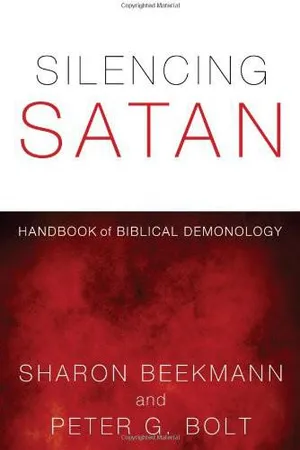
Silencing Satan: A Handbook of Biblical Demonology is about the nature and strategies of Satan and the demons, and their defeat through the life, death, and resurrection of our Lord and Savior Jesus Christ. The book is for Christians in ministry, whether seminarians, pastors, Bible teachers, Christian counselors, or lay leaders. It is for all who desire an informed faith relevant to supernatural evil and the Gospel of Jesus Christ. Each chapter reflects extensive research and is succinctly written to enable believers to quickly grasp biblical truths that expose the lies and half-truths propagated by popular culture, within and outside the church.
The authors teach that when face to face with supernatural evil in its various guises--apparitions, voices, sensations, false doctrine, and immoral temptations--believers resist the devil and reflexively turn to Jesus and Scripture. They fight by living a radical life of faith, expressed through love and obedience to Christ. As they do, God himself redeems the evil that Satan intends for his vainglory. God is building his church, and the gates of hades will not prevail against her (Matt 16:18)!
Information
Topic
Theology & ReligionSubtopic
Christian TheologySection 1
Ancient Near East Demonology
1
Introduction
The ancient Near East is the area around the eastern Mediterranean Sea that corresponds roughly to the modern Middle East. Generations of people in these lands worshipped and spoke of the great gods and goddesses, lesser deities, and the demons until the myths became deeply embedded in their cultures and worldviews. The narratives and the beliefs they contained gave primitive people meaning to their lives and ways to think about supernatural phenomena and transcendent truths.
Many people in twenty-first century Western cultures tend to believe that the mythical gods and goddesses were products of primitive imaginations and that no spiritual source, good or evil, significantly inspired their origination or participated in the cultic rituals that honored and appeased them. Nevertheless, the people of antiquity believed that their deities were objective spiritual realities—that they existed independently of people’s belief in them. Ancient Near East people both feared and honored their gods and goddesses, and they had good reason. As the following entries reveal, the activity and character of their deities more resembled Satan and his minions, as described in the Bible, than the triune God the Father, the Son Jesus Christ, and the Holy Spirit and his holy angels. Several biblical texts even associate the ancient Near East deities with demons (Deut 32:17, Ps 106:37, 1 Cor 10:20, Eph 2:2, Rev 9:20, cf. John 12:31). (See 45. Demons and Idolatry)
Christians are protected from the demons because they have a relationship with Jesus Christ who through his life, death, and resurrection defeated the demons. A Christian mother once contacted me (Sharon) after her twelve-year-old daughter and seven-year-old son saw a demon. The girl was roused from a sound sleep, opened her eyes, and stared into a pair of red eyes staring back at her from her closet. Sensing evil, she bolted upright and said, “I’m a child of God! Get out of here.” Instantly the eyes disappeared, and she soon fell asleep. But the next night the red-eyed demon terrified her younger brother in a similar way, and he ran to his parents.
We talked in her bedroom the next day, and she said, “The words just came out and he vanished. Do you think he’ll come back?”
I smiled and said, “Even if he does, you know what to do. That demon tried to bully you. What would your dad do if a kid bullied you at school?”
She smiled and said, “He’d be furious. I’d hate to be that kid!”
“God protects his kids. That demon tried to scare you and you told him that your Father was stronger and he had to leave. If he appears again, call out for Jesus.” Soon her mother and brother joined us for prayer, and I encouraged her brother to call on Jesus if the red-eyed demon appeared again. The demon never reappeared.
The girl’s confidence in her Savior to remove the demon illustrates the profound differences between Christian faith and the demonology depicted in the ancient Near East. Because of our relationship with Jesus Christ, Christians need not fear the demons, wait for archangels to save them, recite carefully worded prayers, or perform rituals. Like the girl, we know the Savior Jesus Christ, who has “rescued us from the dominion of darkness and brought us into the kingdom of the Son he loves, in whom we have redemption, the forgiveness of sins” (Col 1:13–14). Christians need only call on Jesus Christ who has defeated the enemy of our soul. Pagan people living in the ancient Near East before the time of Christ had no defense against the Enemy’s schemes.
STB
2
Mesopotamia
The Mesopotamians had an animistic worldview, and they expended considerable effort and time contending with their deities and demons. They believed that spiritual beings possessed the will and capability to influence humanity and nature for good and evil by inhabiting inanimate objects, people, and natural phenomena. The people both honored and feared their great gods and goddesses, the lesser deities, and the spirits of the dead. Their mythical great gods and goddesses allegedly brought order out of the chaos produced by lesser deities. For example, when dangerous monsters stirred up unwieldy waters and the mighty good gods restored order, Mesopotamians believed that good had triumphed over evil.1
In the Enuma Elish, the Babylonian creation story, the great agricultural god Marduk used the wind and huge nets to defeat Tiamat, goddess of the unruly waters of chaos. Marduk was son of Ea, head of the gods, and when Nebuchadnezzar I (1125–1104 BC) came to power, he named Marduk principal god of Babylon and head of the entire pantheon, the assembly of the great gods. Nebuchadnezzar built Marduk’s temple complex in the center of the city as a display of deference to him and as a declaration to the known world of Marduk’s power and prestige.2 When the Persian Cyrus the Great conquered Babylon in the sixth century BC, he “took the hand of Marduk” to ingratiate himself to the Babylonians. The people honored Marduk at annual New Year’s festivals.
Spirits of deceased family members and other afflicting demons were of more immediate concern. In the cult of ancestors, the family patriarch transferred his authority and power to his eldest son, who then honored his deceased father by ritualistically offering food to him and other dead ancestors at meal time and during monthly celebrations. He invoked the dead by name, both to acknowledge that family identity included the dead and to show deference to them.3 An old Babylonian text reads, “Come (dead ancestor), eat this, drink this, and bless . . . the king of Babylon.”4 The dead acted as family guardians and also meted out punishment to anyone who disrespected family interests.
Additionally, the Mesopotamians had an elaborate demonology for afflicting spirits. There were demons of plagues, nightmares, headaches, windstorms, and every human ill. One demon specialized in attacking the head and others the neck, breast, stomach, hand, and so forth.5 Spirits of people who died violently or whose bodies were left above ground attacked the living. People called on magicians, sorcerers, conjurers, and necromancers to appease these troublesome spirits. It was well known that demons inspired the magical arts.6
The Mesopotamians developed elaborate rituals, wore amulets, and recited formulas to contend with the demons and divert pending disasters from omens. They placed figurines around the house, such as armed warriors and dogs, to protect themselves from evil. They used the great gods to rid themselves of afflicting demons. When exorcising a demon associated with a particular disease, the magicians said, “In the name of the great god Ea . . . be ye exorcised,” and invited a protective spirit back.7 An inscription on a figurine from Nineveh reads, “Don’t stop to think, bite him [the demon].”8
In another recorded incantation, Marduk himself spoke through an exorcist. He listed the demons’ activities and said, “Be gone, depart, Evil that is in front of me, make off Enemy that is behind me! . . . I am (the god) who removes diseases, who destroys high mountains . . . who is merciful among mankind, Marduk.”9 Even so, the Mesopotamians differentiated between demonic-induced diseases and those from natural causes or the anger of the gods. Physicians treated or quarantined patients with diseases and if angry gods caused the disease, peop...
Table of contents
- Title Page
- Foreword
- Preface
- Acknowledgments
- Introduction
- Section 1: Ancient Near East Demonology
- 1: Introduction
- 2: Mesopotamia
- 3: Zoroastrianism
- 4: Chaldean Astrology
- 5: Egypt
- 6: Canaan
- 7: Greco-Roman
- 8: Greco-Roman
- 9: Greco-Roman
- 10: Plato
- 11: Old Testament Pseudepigraphal Literature
- 12: Apocrypha
- 13: Dead Sea Scrolls
- Section 2: Ancient Near East Terms
- 14: Exorcisms
- 15: Underworld
- 16: Cult of Ancestors
- 17: Omen
- 18: Curse
- 19: Animism
- Section 3: Old Testament Demonology
- 20: Introduction
- 21: Forbidden Practices
- 22: Satan and the Serpent (Genesis 3)
- 23: Evil Spirit from the Lord (1 Samuel 16–19)
- 24: Necromancy, Mediumship, and Demons (1 Samuel 28)
- 25: Satan and Physical Assaults (Job 1:6—2:7)
- 26: Hebrew Sheol and Afterlife
- Section 4: New Testament Demonology
- 27: Introduction
- 28: Survey of Satan in the Gospels
- 29: Satan and the Demons in Jesus’s Parables
- 30: Satan’s Defeat (Luke 10:18)
- 31: Armor of God (Eph 6:10–18)
- Section 5: The Names and Activities of Satan
- 32: Satan, the Adversary and Accuser (Prosecutor)
- 33: Devil, the Slanderer
- 34: Evil One
- 35: Beelzeboul/ub
- 36: Belial (2 Corinthians 6:15)
- 37: Dragon, the Serpent of Old (Revelation 12:9)
- 38: The Tempter
- 39: The Father of Lies
- 40: The Deceiver
- 41: Prince of Demons
- 42: One with the Power of Death
- 43: Murderer
- 44: Destroyer (Abaddon, Apollyon)
- Section 6: The Demons
- 45: Demons and Idolatry
- 46: Jesus and the Demoniacs
- 47: Doctrine of Demons and Antichrist(s)
- 48: Principalities and Powers
- Section 7: Demonology and Church History
- 49: The Early Christian Church and Monasticism
- 50: The Medieval Period and the Reformation
- 51: Enlightenment and Modernity
- 52: Pentecostal, Charismatic, and Evangelical
- Section 8: Ministry Applications
- 53: Testing the Spirits
- 54: Testing the Spirits
- 55: Divination and Talking to the Dead
- 56: Silencing Satan
- 57: Testing the Spirits
- 58:Alternative Health Practices
- Bibliography
Trusted by 375,005 students
Access to over 1.5 million titles for a fair monthly price.
Study more efficiently using our study tools.
Frequently asked questions
Yes, you can cancel anytime from the Subscription tab in your account settings on the Perlego website. Your subscription will stay active until the end of your current billing period. Learn how to cancel your subscription
No, books cannot be downloaded as external files, such as PDFs, for use outside of Perlego. However, you can download books within the Perlego app for offline reading on mobile or tablet. Learn how to download books offline
Perlego offers two plans: Essential and Complete
- Essential is ideal for learners and professionals who enjoy exploring a wide range of subjects. Access the Essential Library with 800,000+ trusted titles and best-sellers across business, personal growth, and the humanities. Includes unlimited reading time and Standard Read Aloud voice.
- Complete: Perfect for advanced learners and researchers needing full, unrestricted access. Unlock 1.5M+ books across hundreds of subjects, including academic and specialized titles. The Complete Plan also includes advanced features like Premium Read Aloud and Research Assistant.
We are an online textbook subscription service, where you can get access to an entire online library for less than the price of a single book per month. With over 1.5 million books across 990+ topics, we’ve got you covered! Learn about our mission
Look out for the read-aloud symbol on your next book to see if you can listen to it. The read-aloud tool reads text aloud for you, highlighting the text as it is being read. You can pause it, speed it up and slow it down. Learn more about Read Aloud
Yes! You can use the Perlego app on both iOS and Android devices to read anytime, anywhere — even offline. Perfect for commutes or when you’re on the go.
Please note we cannot support devices running on iOS 13 and Android 7 or earlier. Learn more about using the app
Please note we cannot support devices running on iOS 13 and Android 7 or earlier. Learn more about using the app
Yes, you can access Silencing Satan by Sharon Beekmann,Peter G. Bolt in PDF and/or ePUB format, as well as other popular books in Theology & Religion & Christian Theology. We have over 1.5 million books available in our catalogue for you to explore.