- 154 pages
- English
- ePUB (mobile friendly)
- Available on iOS & Android
eBook - ePub
About this book
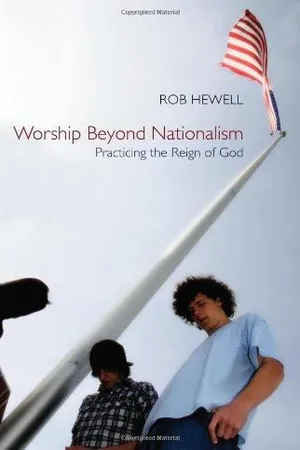
The church in the United States faces a dilemma: How is it possible for Christ's followers to worship faithfully in a nationalistic environment where religion and politics enjoy a vigorous affiliation while the separation of church and state is celebrated as the standard for the relationship between nation and faith?
When nationalism propagates itself through a cross-pollination of the stories, symbols, and celebrations of the nation-state and religious groups, the stage is set for a national history bearing the character of sanctified legend. Such resulting civil religious activity is likely to create dissonance for Christ's followers between what they understand to be biblically faithful and what nationalistic practices may endorse as religiously valid.
Worship Beyond Nationalism explores faithful worship as a political act by which Christians declare their allegiance to God in Christ rather than to worldly empires, enabling congregations to enact the reality of God's kingdom and embody the gospel for the glory of God and for the sake of the world.
Information
Topic
Theology & ReligionSubtopic
Christian Theology1 / Liturgy of the Kingdom
The incarnation of God in Christ Jesus was tangible evidence of the in-breaking of God’s kingdom, an arrival of the most radical sort. God’s appearance in Christ was historically organic, expressed in a specific season of human history, in a particular geography with deliberate ethnic imprimatur. Yet the coming of this transcendent kingdom and its definitive Sovereign was also historically dynamic. It encompassed long seasons of prophetic anticipation, was revealed in Christ’s personhood through sometimes confusing parables and numinous miracles, and pointed to an eschatological realization.
The coming of God in Christ was certainly an act of grace and mercy without equal on the part of a holy and loving God. That does not, however, mitigate the fact that it was also an enormous provocation designed to serve notice to all of creation that the Creator was wholly committed to redemption and re-creation. When taken at face value, the message of Christ’s life, teaching, and ministry brings the world face to face with the eternal kingdom of love. It is this kingdom, and the worship of this kingdom’s Sovereign, that require our attention in these pages.
Scripture is clear that the sovereignty of God’s reign in Christ extends to the fullest reaches of life and existence. No realm of creation is exempt—including the political arena. The apostle Paul signaled this truth when he wrote that Christ “is the image of the invisible God” and “in him all things in heaven and earth were created, things visible and invisible, whether thrones or dominions or rulers or powers—all things have been created through him and for him” (emphasis mine).1 In Christ “the whole fullness of deity dwells bodily” and he “is the head of every ruler and authority” and “He disarmed the rulers and authorities and made a public example of them, triumphing over them” (emphasis mine).2 Again, Paul wrote regarding “the immeasurable greatness of [God’s] power for us who believe.” This is the very power that worked in Christ who is not only resurrected from the dead but has ascended to God’s right hand in the heavenly places. It is the glorious Father who “has put all things under [Christ’s] feet and has made him the head over all things for the church, which is his body, the fullness of him who fills all in all.”3 The obvious force of God’s sovereignty invested in Christ is a bold statement of God’s political initiative.
To say such things about anyone cuts against the grain of the world’s self-affirming confidence in its own ways and wisdom. For those things to be said of Jesus Christ as identified in the biblical narrative is an offense of even greater magnitude. Jesus of Nazareth claimed not only to be the Son of God, but also claimed to be one with God. The sting of such boldness cost Jesus Christ his human life. The dare to risk, however, creates the tension by which the gospel wounds the world for the sake of the world’s healing. So it is that it could be said that “Jesus Christ was the supreme divine intrusion into the world’s settled arrangements.”4
Kingdom was not an unfamiliar concept among first century Jews. They were certainly well-steeped in the triumph and tragedy of their own national existence. The nation’s encounters with a multitude of other kingdoms and empires were the essence of lore. The practice of remembrance recalled an exodus of massive proportions: a departure from life in one oppressive kingdom, only to encounter numerous others on their way to a land promised by the God of Jacob, and a home for the descendants of Joseph who were the great nation of promise to Abram. The cumulative reality for ancient Israel was one of struggle for identity and independence. Their current status, as underlings in the powerful and ever-present Roman imperium, was a daily reminder of a unique ethnic and religious heritage to which they could give only partial expression. Their place in the world was not entirely their own.
Into this environment of incomplete dominion came John, the one known as the baptizer, proclaiming the nearness of the kingdom of heaven. His message was not original. Isaiah had predicted that a proclaimer would come, one who would precede a promised Messiah. The kingdom to be established by this Messiah would be an eternal one, for which failure was not a possibility. Accustomed to less successful ventures in creating and sustaining dominion, the kings and people of Judah looked forward to a kingdom without fail. Some seven hundred years or so later the post-Isaiah Israelites who encountered John’s message were still hoping for Messiah, though with a skewed character. Since the commencement of Roman rule six decades earlier, Jewish expectations for Messiah had taken a decidedly nationalistic turn with nearly unqualified inclination to a worldly means-to-an-end. Those expectations quite missed the point of the prophet’s inimitable message.
The people who heard John’s statements and responded to his plea for repentance and baptism were yet clueless about the true nearness of heaven’s kingdom. The baptizer’s message made it clear he himself was not the promised one of Israel. There was another coming that would transcend John’s own identity as messenger. John’s audience was witnessing the arrival of the kingdom, if they would but discern its manifestation among them. The arrival of the long-awaited Messiah was shocking, not because of its force but for its lack of force in worldly terms.
Jesus Christ’s own declarations regarding the kingdom of God were as numerous as they were enigmatic. Christ was constantly and pointedly drawing attention to the kingdom of God. No doubt the expectations of his hearers were culturally formed. Their hope for a warrior-king, much in the model of David, was deep-set and constantly nurtured. These expectations were clearly evident as Jesus approached Jerusalem days before his execution as the people shouted, “Blessed is the coming kingdom of our ancestor David!”5 To be sure, Jesus’ own lineage was traceable to mighty king David. Yet Jesus clearly proclaimed the kingdom of heaven—that of his Father God—not the rule of David. The misunderstanding represented by this praiseful acclamation was telling. Their hope was in the true Messiah, yet their goals were inconsistent with his aims of faithfulness to his Father’s will.
This much they knew: freedom would come at a price. All that was lacking was someone willing to accept the mantle of leading the uprising, one surely to signal a return to sovereignty over their own affairs. This person would also assume enormous risk, a dare most were generally unwilling to take. Was it not the word of the Lord God through the prophets that Messiah would come? Jesus Christ resisted the efforts of the Jews to cast him into their agenda, steadfastly preferring the agenda of his Father’s kingdom.
It would be unwise to overlook the second Testament’s focus on the kingdom of God. The term kingdom appears more than 160 times in the New Testament. It is understood to refer to a realm in which a particular king reigns. It is inclusive of the authority and sovereignty exercised by and fully vested in the ruler. A majority of the uses of three Greek forms6 are credited to Jesus Christ in referring to his Father’s kingdom, identified interchangeably as the kingdom of God or the kingdom of heaven. The terms are also used by Luke, Paul, John, and the writer of the book of Hebrews. The language reveals clear pronouncements about the impending arrival, present reality, and future fulfillment of God’s kingdom.
The kingdom of heaven was declared to be imminent in the words of John the baptizer, “Repent, for the kingdom of heaven has come near,” and of Jesus himself, “As you go, proclaim the good news, ‘The kingdom of heaven has come near.’”7 In other instances, the original language delivers news of the kingdom as being present. Jesus persistently spoke of the kingdom as a present reality: “Blessed are those who are persecuted for righteousness’ sake, for theirs is the kingdom of heaven” and “the kingdom of God is among you” and “My kingdom is not from this world.”8 In the first instance, Jesus is teaching about blessedness among those who seek and live humbly. Jesus offers the second in response to the Pharisees’ inquiry about the arrival of this kingdom. The third comes in response to Pilate’s question about Jesus’ kingship. While there was a sense in which the kingdom was in existence before their very eyes, Jesus’ audiences were many times either unable or unwilling to see it. The kingdom of God was not new, yet it was newly near.
Jesus’ encounter with the chief priests and elders in the temple is instructive as well. At the conclusion of a parable regarding wicked tenants—itself a pointed accusation of the elders and priests—Jesus declares, “the kingdom of God will be taken away from you and given to a people that produces the fruits of the kingdom.”9 The suggestion here is that something cannot be taken away unless it is first available to the persons from whom it is to be taken.
The biblical narrative indicates that on the Passover night prior to Jesus’ arrest, he blessed bread and cup, encouraging his disciples to eat and drink with new understanding of what it means to be in covenant with God. He then astounded them by saying he would drink the fruit of the vine with them next in the kingdom of his Father—and not un...
Table of contents
- Title
- Foreword
- Introduction
- Chapter 1: Liturgy of the Kingdom
- Chapter 2: Worship Against the World for the Sake of the World1
- Chapter 3: Nationalism Part 1: The Allure of Triumphalism
- Chapter 4: Nationalism Part 2: A God for a New World
- Chapter 5: The Miscalculations of Liturgical Collusion
- Chapter 6: Glimpses of Worship in Kingdom Now, Kingdom Come
- Epilogue
- Bibliography
Trusted by 375,005 students
Access to over 1.5 million titles for a fair monthly price.
Study more efficiently using our study tools.
Frequently asked questions
Yes, you can cancel anytime from the Subscription tab in your account settings on the Perlego website. Your subscription will stay active until the end of your current billing period. Learn how to cancel your subscription
No, books cannot be downloaded as external files, such as PDFs, for use outside of Perlego. However, you can download books within the Perlego app for offline reading on mobile or tablet. Learn how to download books offline
Perlego offers two plans: Essential and Complete
- Essential is ideal for learners and professionals who enjoy exploring a wide range of subjects. Access the Essential Library with 800,000+ trusted titles and best-sellers across business, personal growth, and the humanities. Includes unlimited reading time and Standard Read Aloud voice.
- Complete: Perfect for advanced learners and researchers needing full, unrestricted access. Unlock 1.5M+ books across hundreds of subjects, including academic and specialized titles. The Complete Plan also includes advanced features like Premium Read Aloud and Research Assistant.
We are an online textbook subscription service, where you can get access to an entire online library for less than the price of a single book per month. With over 1.5 million books across 990+ topics, we’ve got you covered! Learn about our mission
Look out for the read-aloud symbol on your next book to see if you can listen to it. The read-aloud tool reads text aloud for you, highlighting the text as it is being read. You can pause it, speed it up and slow it down. Learn more about Read Aloud
Yes! You can use the Perlego app on both iOS and Android devices to read anytime, anywhere — even offline. Perfect for commutes or when you’re on the go.
Please note we cannot support devices running on iOS 13 and Android 7 or earlier. Learn more about using the app
Please note we cannot support devices running on iOS 13 and Android 7 or earlier. Learn more about using the app
Yes, you can access Worship Beyond Nationalism by Rob Hewell in PDF and/or ePUB format, as well as other popular books in Theology & Religion & Christian Theology. We have over 1.5 million books available in our catalogue for you to explore.