- 260 pages
- English
- ePUB (mobile friendly)
- Available on iOS & Android
eBook - ePub
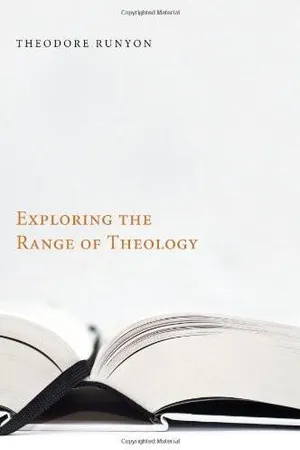
Exploring the Range of Theology
About this book
Every human being is a theologian. We have a curiosity about the ultimate context in which we exist. Theologians help us spell that out, and examine what faith is all about. The wide-ranging issues and questions this book addresses begin with the differences between Christianity and other religions, examine the relation between the Bible, science, and evolution, explore the role of religious experience in the birth of faith, and consider the contribution theologians like Paul Tillich, Friedrich Gogarten, Teilhard de Chardin, Jurgen Moltmann, and John Wesley can make to our thought today.
Information
Topic
Theologie & ReligionSubtopic
Christliche KirchePart I
Theology and Theologians
1
Competing Theological Models for God1
Originally presented at the fourth Oxford Institute of Methodist Theological Studies at Lincoln College, Oxford University, 1969, which brought British and American faculties in theological education together around the theme, “The Living God.”
In The Act of Creation, Arthur Koestler suggests that the creative imagination operates in science, art, and literature in ways that are not dissimilar. A frequent source of stimulation to the imagination in these disciplines, he says, arises from the tension produced by the comparison of two distinct and even contradictory conceptual frameworks or models, which cover the same general range of experience but express it in seemingly contrary manners. The tension introduced by such a “bisociation” presses toward resolution in a new synthesis or a whole achieved by reordering the old elements in a new configuration.2
Without guaranteeing that I shall be able to achieve either an adequate synthesis or a viable new configuration, if indeed one is desirable, I should like nonetheless to call attention to what seems to me to be a similar tension faced by the discipline of theology. In any attempt to arrive at new and more satisfying conceptual models for presenting the reality of God to our time, an internal contradiction that stems from the fact that we are the inheritors of not one but two models of the nature of divine reality must be recognized. Both models can claim considerable historical precedence, as we shall see. Both have served well in the past to illumine the Christian message. And both can justly claim adherents among those who stand in every shade of opinion along the contemporary theological spectrum. Yet they would appear to be almost mutually exclusive. And it is difficult to see how, if one is judged to be an adequate representation of the Christian message, the other would not by that very fact be rejected as a false and misleading rendering of the reality Christian thought seeks to explicate.
Models for God
The type of model for God that is by far the older and more universal, dating from the origins of religion itself, and that could therefore lay claim to the title of the religious model per se, can be described as cosmic monism. It views the divine as that which both empowers and comes to expression in the cosmos. The most universal of the primitive religions, animism, is perhaps the clearest example of this model. Animism is the belief that the world is permeated by spirits and powers, that nature is alive with divine energeia that can at times be friendly, at times hostile and threatening, to humanity’s fragile existence. The cosmos is understood as constituting one overarching and divine whole within which everything has its being. The animist would find largely meaningless, therefore, modern distinctions between the sacred and the secular. How could one conceive of what “secular” means when one can scarcely conceive of a non-sacred world? Anything that is, exists because of the sacred energy that empowers it. Every act of normal life—hunting, fishing, fire-building, planting, and tending crops—takes place in a religious context and is assisted and validated by the proper gestures and formulas that please and appease the appropriate gods. Ancient man’s “constant endeavor is to establish communion with the elemental powers.”3 What we term the secular world is able to exist only because of its participation in the indwelling spiritual presence.4
Needless to say, the world of the animist has cohesion. “Pluralism” is no problem, for the cosmos is a seamless garment that encompasses all reality in one self-contained, spiritually completed monism. Nothing can be imagined as existing outside this cosmic womb. Even the gods have their existence within it, as is seen, for example, in a highly sophisticated version of the same basic pattern, Hinduism, where the gods usually are viewed as subordinate to the divine principle embodied in the cosmos itself. According to Hindu speculation, “311 billion years constitute the life cycle of Brahma [the highest god]. But even this duration does not exhaust time, for the gods are not eternal, and the cosmic creations and destructions succeed one another forever.”5 Only the cosmos itself is eternal, and its spiritual power provides the ultimate category beyond which nothing can be imagined.
A similar pattern emerged with the pre-Socratics in the West. Speculation was born of the desire, says G. Rachel Levy, to discover the one divine principle lying behind all nature, “the ever present and pervading dynamic force.”6 By isolating theoretically this divine principle of animism the pre-Socratic philosopher, Thales, “interpreted the world as a unified psycho-physical whole, governed . . . by natural laws that man could hope to understand.”7 Thus the very origins not only of philosophy but of science as well are to be found in the rationalization of the theological world view of animism. And this was accomplished without fundamentally disrupting theological monism. Both disciplines appropriated largely without question the animistic assumptions about the nature of the unity of the world. Even Plato, in spite of his dialectical modifications, can be described by Mircea Eliade as “the outstanding philosopher of ‘primitive mentality,’ . . . the thinker who succeeded in giving philosophical currency and validity to the modes of life and behavior of archaic humanity [through the means that] the spirituality of his age made available to him.”8 To be sure, Plato represents a formidable reworking of the monistic model. He emphasizes the transcendence of the divine ideas that lie behind the visible world, and thus introduces a distinction between reality as apprehended by the senses and reality as it actually is. Yet what really is, is in the final analysis but a more sophisticated and rationalized form of the spiritual power that animism knew to be operative behind all appearances. Hence it would be difficult to claim that Plato broke with his religious past. Rather, he gave divine powers rational and therefore comprehensible form. He dissolved the mystery on one level while driving it deeper on another. Yet the final mystery is still conceived on the animistic-monistic model as a mystery that is coextensive with the being of the cosmos.
What is generally characterized as the Greek heritage in the West ought, therefore, to be recognized as part and parcel of a larger, more universal religious heritage that, even in the dialectical complexity of some of its developed forms, might be said to rest finally on the assumption that the cosmos is God. That is, divinity is the ultimate principle of the cosmos and is in the end inseparable from it.
The Hebrew Difference
At one point in the ancient world, however there was a variation in the otherwise almost universal pattern, a variation that would eventually prove to be of considerable significance, namely, the religion of the Hebrews. For the Hebrews provided an alternative model for describing the relation of the divine to the world. To be sure, there are indications that the remote origins of Hebrew faith may also lie in animism. And it is undeniable that animism in both its primitive and more developed forms was a constant temptation to the Hebrew peoples, especially after they settled in agricultural surroundings where identification with the local guarantors of fertility seemed a matter of economic necessity. Yet Israel’s development away from whatever animism may have characterized the primeval origins of the Semitic peoples was distinctive enough to constitute a quite new type, a fundamentally different understanding of the relation of the sacred to the cosmos. In the prevailing Hebrew notion of God, as reflected in those literary sources that have been preserved, the ultimate sacred authority has an existence conceived as independent from the world. The relation is that of Creator to creation. Were this to be expressed ontologically, reality for the Hebrew would be finally dual: the reality of the world is different from the reality of the Creator. Yet such a definition would be misleading, for it is not that the Hebrews think in degrees of reality; they do not speculate about a hierarchy of being. For them the world and humanity are no less “real” than is God; they do not suffer from a deficient mode of existence.9 The term “dual” must be restricted therefore to designating the discreteness between God’s existence and that of the universe, a discreteness that does not exclude the possibility of unity but understands any such unity on the model of interpersonal relations in which the meeting of minds and wills does not mean the dissolving of independent personhood but rather its preservation and enhancement. It is especially important that Hebrew “duality” not be confused with Persian “dualism” or the mind-versus-matter dualism of idealism. The latter refer to conflicts that take place essentially within the cosmos between competing cosmic forces and thus represent variations on the basic monistic model.
The Hebrew break with cosmic monism was one of those great “leaps in being,” as Eric Voegelin terms it, which was to portend a whole new direction of development in the history of humankind.10 Hitherto unimaginable possibilities were opened up. By distinguishing God from the world the Hebrews prepared the way for the “secularization” of the animistic cosmos. Holiness was understood to reside in God alone, and any human attempts to gain control over this holiness by fashioning earthly images of it were forbidden. Nothing in the creation was to be allowed to supplant the claim upon human life that belonged to Yahweh alone. Devotion to cosmic spirits was prohibited: “Behold, they are all a delusion; their works are nothing; their molten images are empty wind” (Isa 41:29 RSV). This is not to deny that the god of the Hebrews, Yahweh, functioned as a nature god insuring the seasons and the crops, the fertility, and the rain. Nevertheless Yahweh remained distinct from the world whose existence God undergirded and guaranteed. No immanental principle of divinity was necessary to enable the world to operate, and humans were freed from the necessity of regarding the world as a divine body. Whereas previously humans had understood themselves and their society as an integral part of the cosmos and constructed the patterns of life and institutions in such a way as to imitate the sacred law of the cosmos, they now understood themselves as standing over against the world by virtue of their relationship to the Creator. Thus “man is not simply a piece of nature, however firmly interwoven his life is in the order of nature,” but is called, as it were, to the side of the Creator and confronts the rest of creation from that vantage point.11 The discreteness of God from the world was therefore a chief means by which humans gained independence from a religiously venerated cosmos to which their religious consciousness had previously been held in bondage.
How did this variant in the religious consciousness arise that was destined to open up such significant possibilities by providing an alternative model for the relationship of the divine to humanity and the world? Those who stand in the Hebrew-Christian tradition will be inclined to speak of “revelation” and “grace,” but an empirically oriented age seeks a translation of theological explanations into a more public language. Is such a translation possible, and if so, can it do justice to the distinctive Hebrew-Christian contribution? It is to questions such as these that we now must turn.
Most of the peoples with whom the Hebrews came into contact during their crucial formative period had already developed agricultural economies. Animistic religion served within such communities not only as a way of coming to terms with the forces of nature up...
Table of contents
- Title Page
- Acknowledgments
- Introduction
- Part 1: Theology and Theologians
- Part 2: Biblical Foundations for Theology
- Part 3: Religious Experience
- Part 4: What Can Wesleyan Theology Contribute Today?
Trusted by 375,005 students
Access to over 1.5 million titles for a fair monthly price.
Study more efficiently using our study tools.
Frequently asked questions
Yes, you can cancel anytime from the Subscription tab in your account settings on the Perlego website. Your subscription will stay active until the end of your current billing period. Learn how to cancel your subscription
No, books cannot be downloaded as external files, such as PDFs, for use outside of Perlego. However, you can download books within the Perlego app for offline reading on mobile or tablet. Learn how to download books offline
Perlego offers two plans: Essential and Complete
- Essential is ideal for learners and professionals who enjoy exploring a wide range of subjects. Access the Essential Library with 800,000+ trusted titles and best-sellers across business, personal growth, and the humanities. Includes unlimited reading time and Standard Read Aloud voice.
- Complete: Perfect for advanced learners and researchers needing full, unrestricted access. Unlock 1.5M+ books across hundreds of subjects, including academic and specialized titles. The Complete Plan also includes advanced features like Premium Read Aloud and Research Assistant.
We are an online textbook subscription service, where you can get access to an entire online library for less than the price of a single book per month. With over 1.5 million books across 990+ topics, we’ve got you covered! Learn about our mission
Look out for the read-aloud symbol on your next book to see if you can listen to it. The read-aloud tool reads text aloud for you, highlighting the text as it is being read. You can pause it, speed it up and slow it down. Learn more about Read Aloud
Yes! You can use the Perlego app on both iOS and Android devices to read anytime, anywhere — even offline. Perfect for commutes or when you’re on the go.
Please note we cannot support devices running on iOS 13 and Android 7 or earlier. Learn more about using the app
Please note we cannot support devices running on iOS 13 and Android 7 or earlier. Learn more about using the app
Yes, you can access Exploring the Range of Theology by Theodore Runyon in PDF and/or ePUB format, as well as other popular books in Theologie & Religion & Christliche Kirche. We have over 1.5 million books available in our catalogue for you to explore.