- 124 pages
- English
- ePUB (mobile friendly)
- Available on iOS & Android
eBook - ePub
About this book
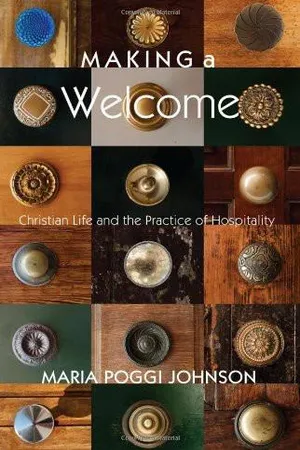
Making a Welcome combines an engaging personal story with an examination of the meaning and possibilities of hospitality, both as a domestic practice much in need of revival, and as a fundamental Christian orientation, with emotional, intellectual and spiritual implications.
Maria Poggi Johnson draws on her knowledge of the Christian tradition, and on two decades of personal experience of trying to welcome well, to consider what happens when we open our homes to others, what is involved in offering a genuine welcome, and how the skills we develop in doing so can shape our relationships with our spouses, with the society around us, with our own beliefs and commitments, and with God. Illustrated by stories drawn from Scripture, literature, film, and from the author's own experience, Making a Welcome challenges readers to discover the life-changing practice of true hospitality, not only in their homes, but in all aspects of their lives
Information
Topic
Theology & ReligionSubtopic
Christian Church1
The Place We Start From
Hospitality and the Home
Christian treatments of hospitality almost always begin with the story of Abraham at Mamre, told in Genesis 18. When Abraham welcomed the three men who appeared at his tent door “in the heat of the day,” he welcomed God and the covenant with him. The whole glorious and awful story of salvation history blossoms from that moment of welcome.
It’s not clear whether Abraham knew exactly who he was dealing with; the story, and Abraham’s behavior, and what follows from it, crosses back and forth over the lines between realism and national myth. But whether Abraham at any moment is best understood as an ancestral archetype or as a real historical nomad, he would have welcomed the strangers regardless of whom he believed them to be. In desert cultures like Abraham’s, a traveler’s survival depended on the welcome and generosity of those he encountered, and those cultures put a correspondingly high value on hospitality; it was a matter of life and death.
The kind of precariousness and dependence that was central to the experience of travelers in the deserts of the ancient world is largely foreign to that of most people likely to read this book. Motels and credit cards and technology and affluence and fast food restaurants and GPS gadgets and all those things that make the modern West such a bizarrely comfortable place to live in some ways (and so uncomfortably bizarre in other, less tangible ways) have gone a long way to insulating most of us from our own vulnerability and from that of others. Even if we know better, in practice most of us proceed on the assumption that feeling safe in our environment, and self-sufficient in our safety, is the normal condition of human life. We are dependent, of course, and vulnerable; deeply and awfully so. We depend, however, not on something obvious, and discrete, like the generosity of the old man in the tent under the terebinths, whom we can see clearly, and on whose immediate response to our immediate needs our life hangs, but on structures so large and complex that we can’t keep them in focus at all, and can’t begin to unravel the notion of what would happen if they weren’t there.
Ironically, then, as our experience of vulnerability has narrowed so has our definition of the hospitality that responds to it, until for many of us it means no more than “entertaining family and friends.”1 Insofar as the encounter with a stranger is an encounter with God, as it was for Abraham, this is indeed a cripplingly narrow definition. Contemporary culture does more than cripple and constrict our notions of hospitality, however; it deforms and distorts them. What, for instance, is one to make of the phrase “hospitality industry”? Or of the manuals and magazines and cable shows offering advice about hospitality-as-entertaining that seem to have less to do with actually entertaining one’s friends and family than with impressing or even intimidating them with fancy food and elaborate centerpieces?
Of course this debasement of the term does not go unchallenged. Many Christians make an eloquent case for a radical reclaiming of the Christian tradition of hospitality.2 To practice authentic hospitality, they argue—to be truly a child of Abraham in his welcome of the three men at Mamre—is to be open to the reality of human vulnerability and dependence, in oneself and in those in whom it is most obvious: the poor, the marginalized, the handicapped, the refugee, the sick, the addict, the suffering. These writers are entirely right. I should do this. Of course I should do this. We should all do this. And of course there are many more people, daring, selfless people, most of them not of the book-writing sort, who do do this—individually and in churches from all across the spectrum, and in a myriad of communities, some of which we will look at later.
But, like most of us, I don’t do this: our keeping an open house to bright middle-class kids is a small timid step towards the heights and depths of Christian hospitality. But small timid steps are all that many of us are likely to attempt or to comprehend readily. And, as Abraham’s world is so alien to us, it may be helpful to begin with what is relatively familiar, with the business of “entertaining family and friends,” and to see what we can learn from there about the nature of hospitality, and what the practicing of it can teach us about human life. What we do when we bring people into our homes both reveals and shapes who we are. It reveals who we are by helping us understand the extent and limits of our openness to others. It shapes us because having our lives, our spaces, our time, our routines and habits disarranged by the presence of others can disarrange our egos and challenge our instinctive sense of being at the center of things. Letting people into our kitchens and spare rooms, laying extra places, cooking extra food, washing extra dishes, staying up extra late, hearing new stories, digging out inflatable mattresses and extra towels, stretching our spaces and budgets and energy around the needs and personalities of our guests can stretch our sympathies, expand our hearts, our understandings of ourselves and of the world and our place in it.
So: three stories. They have in common the theme of people inviting others into their homes, sharing space and food and time with them. What distinguishes them is the attitudes of the hosts: to themselves, to their homes, to their guests. The first serves as a strident counter-example; how not to do it. It will stand as an emblem of what I will call an attitude of control. The second represents what I will call surrender, and functions as a cautionary tale: things to be careful of. The third story represents what I think of as genuine welcome: how hospitality can work when it really works.
The first story, from Proust’s Remembrance of Things Past, is simple: Swann, in love with Odette, pursues her to the house of her friends the Verdurins where she spends her evenings, becomes drawn into their world as his relationship with her progresses, accidentally offends Mme. Verdurin, and is alienated from their circle.
The Verdurins have a “salon” where their regular guests, “the faithful,” the “little nucleus,” gather almost every evening for food, games, music and conversation. In the formal and rigidly stratified world of Parisian society it is a haven of comfort and of deliberate informality. The Verdurins are wealthy, and generous with their wealth; they feed their guests, take them to the theater, to restaurants, even on holiday. They nurture and appreciate the talents of the young painter and the pianist who are part of the “little nucleus.” It is, initially, an appealing arrangement: intensely so to someone like me. The Verdurin’s salon is in many ways the kind of open house space we try to create here; a place where people can show up, get away from the varied pressures of campus life, know that they are welcome and can relax. It is appealing, then, but it quickly becomes apparent that the whole setup, the expenditure of time and money and attention, is a vast contraption to feed the insatiable vanity and egoism of Mme. Verdurin. If Mme. Verdurin values her guests at all, it is only because she can exercise on them, and display before them, her own personality. The salon, its air of informality and generosity, functions only to affirm Mme. Verdurin’s informality and generosity. Her appreciation of and sensitivity to art and music is not about art and music but entirely about her own appreciative and sensitive nature. Her affectionate concern for her guests is a performance of affection and concern. Mme Verdurin’s personality, and her monstrous vanity, is always at the center of the salon, whose purpose is to mirror it back to her.
Vanity is among the shallower sins, and thus far Mme. Verdurin is no worse than ridiculous. Swann, an art critic and collector who is vastly more cultivated than the Verdurins and has moved in much higher society than that of the “little nucleus,” manages to overlook her folly, to be devoted to her, and even to believe her “great-hearted.” He effectively abandons his other circles, and spends most of his free time with Odette at the Verdurins’. But Mme. Verdurin is something rather worse than vain and ridiculous. She does not only require patience and toleration from her guests, she demands exclusive fidelity, and explicit assent to the rigid dogma that governs the salon; that the Verdurins’ is the only place where one might possibly want to spend time, that “the evenings spent by other people, in other houses than theirs, were as dull as ditch-water,” that the entire social world outside of the “little clan” is full of “bores.”3
This demand leads to Swann’s downfall. It never occurs to him to mention, among the little nucleus, the other world to which he has access, but neither does it occur to him, when a newcomer to the group mentions Swann’s aristocratic connections, that he is required openly to disavow them as “bores.” Mme. Verdurin is wounded, offended, and angered by the discovery that her drawing room does not constitute Swann’s entire horizon: subtly, but swiftly and brutally, he finds himself first excluded from the “little clan” and later alienated from Odette, whom Mme. Verdurin encourages to move onto other men, whom Mme. Verdurin is better able to control.
What are we to make of Mme. Verdurin and her “hospitality?” A return to the story of the men who appear to Abraham at Mamre can help us here. When they leave Abraham they go on to the city of Sodom, where they are received by Abraham’s nephew Lot (the story is in Genesis 19). In the middle of the night a posse comes to Lot’s door demanding that he send his guests out to them; they want to have sex with them. Now it is a long way from gang rape in a desert city to passive-aggression in a Parisian drawing room, but in her own way Mme. Verdurin, although superficially a host like Abraham and Lot, is not unlike the men of Sodom. Like them she sees other people as objects, as tools that she can use to achieve her personal goals. Like them she is utterly indifferent to the humanity of the guests, their own stories, their lives. The men of Sodom don’t care who Lot’s guests are, where they come from, where they are going or why; they simply want to make use of their bodies for their own sexual pleasure. Mme. Verdurin, likewise, has no interest in the personhood of her guests, their stories, their likes, their loves, their talents, except insofar as they can serve as arenas for her to exercise her own perceived virtues of sympathy, encouragement, generosity.
The men of Sodom are motivated by lust, Mme. Verdurin by vanity, but also by fear. At the heart of her behavior is the horror of emptiness, of her own nothingness. The accessories that she makes of her guests do not ornament her, they constitute her; she is utterly identified with her role as hostess, utterly dependent on her guests to sustain her in that role, outside of which she has no integrity, no authentic identity. Any hint that they might have other loyalties, other perspectives that might challenge the orthodoxy that governs the salon is so terrifying that it must be eliminated. She appears to welcome, but in reality she seeks only to assimilate, to control. In her own way she is as hostile and as violent as the men of Sodom.
If Mme. Verdurin is like the men of Sodom, regarding her guests as objects for her private gratification, then surely the answer is to turn back to the example of Abraham, whose hospitality the story of Sodom throws into relief. This is just what Moshe and his wife Malli do, very literally, in the Israeli film Ushpizin: our second story. Moshe and Malli are deeply, extravagantly faithful Hasidic Jews, living in minute obedience to the Torah, passionately devoted to God, willing to stake everything on their trust in his provision. The story unfolds during the Festival of Booths, a weeklong holiday during which observant Jews live in sukkot—temporary outdoor huts—in commemoration of the forty years in the wilderness. Into their sukkah, and into their lives, come Eliyahu and Yossef, friends of Moshe’s from his past, from the days before he found his way to a religious life of strict observance. Eliyahu and Yossef have escaped from prison and are on the run. Moshe’s sukkah, tucked away in a courtyard in an ultra-Orthodox neighborhood of Jerusalem, furnished with cots and abundant holiday food, is an excellent place to lie low. They are happy to exploit the newfound piety of their old companion, who has turned away from a life of anger and violence to one of trust, devotion, and obedience.
The transaction between the characters is more complex and subtle, however, than naked exploitation of hosts by guests. Eliyahu and Yossef serve a purpose in the lives of Moshe and Malli, who regard their guests as an answer to prayer and an opportunity to increase their own holiness by honoring the commandment to welcome guests (ushpizin) into the sukkah. As it becomes plain, first, that the guests are uncouth and disrespectful and, later, that they are malicious and threatening, Moshe and Malli come to see them as a test, given to them by God to prove their fidelity, their readiness to be trustfully obedient to the divine will. They not only take Abraham and Sarah as religious examples, but identify personally with them: like Abraham and Sarah they are childless. When Abraham had welcomed the three men, they told him that Sarah would bear him a son.
But they miss an important point about the story in Genesis 18. Abraham goes out to meet the men, begs them to rest, to wash, to eat “that you may refresh yourselves.” He further says, “and after that you may pass on.” He acknowledges that they are on a journey, that they have their own story, and that after a bath, a nap, and a meal, it is appropriate that they move back into that story. Moshe and Malli’s naive piety, ironically, prevents them from seeing their guests as people with their own stories. Mme. Verdurin, as we saw, views her guests as tools in her desperate attempt to fill the yawning emptiness of her own echoing ego; their individuality is a matter of complete indifference to her. Likewise, Moshe and Malli are not the least interested in Eliyahu and Yossef’s motivation, their predicament, their rough charm, nor even the real menace they come to represent. Nor do the hosts attempt to set any appropriate limits to the relationship with their guests. They are willing to surrender their own comfort, and eventually their security and that of their neighbors—and even the integrity of their marriage—to God, if that is what is asked of them, but in this surrender to the divine demands of hospitality they avoid a genuine human encounter with their guests, whom they see as pawns in a transaction involving only themselves and God. Eliyahu finds Moshe’s piety and all its trappings ridiculous, but is shrewdly aware that he is essential...
Table of contents
- Making a Welcome
- Acknowledgments
- Introduction
- Chapter 1: The Place We Start From
- Chapter 2: Adoring Her Husband’s Virtues
- Chapter 3: The Whole Benefit of Reading
- Chapter 4: I Was a Stranger
- Chapter 5: Love Bade Me Welcome
- Epilogue
- Bibliography
Trusted by 375,005 students
Access to over 1.5 million titles for a fair monthly price.
Study more efficiently using our study tools.
Frequently asked questions
Yes, you can cancel anytime from the Subscription tab in your account settings on the Perlego website. Your subscription will stay active until the end of your current billing period. Learn how to cancel your subscription
No, books cannot be downloaded as external files, such as PDFs, for use outside of Perlego. However, you can download books within the Perlego app for offline reading on mobile or tablet. Learn how to download books offline
Perlego offers two plans: Essential and Complete
- Essential is ideal for learners and professionals who enjoy exploring a wide range of subjects. Access the Essential Library with 800,000+ trusted titles and best-sellers across business, personal growth, and the humanities. Includes unlimited reading time and Standard Read Aloud voice.
- Complete: Perfect for advanced learners and researchers needing full, unrestricted access. Unlock 1.5M+ books across hundreds of subjects, including academic and specialized titles. The Complete Plan also includes advanced features like Premium Read Aloud and Research Assistant.
We are an online textbook subscription service, where you can get access to an entire online library for less than the price of a single book per month. With over 1.5 million books across 990+ topics, we’ve got you covered! Learn about our mission
Look out for the read-aloud symbol on your next book to see if you can listen to it. The read-aloud tool reads text aloud for you, highlighting the text as it is being read. You can pause it, speed it up and slow it down. Learn more about Read Aloud
Yes! You can use the Perlego app on both iOS and Android devices to read anytime, anywhere — even offline. Perfect for commutes or when you’re on the go.
Please note we cannot support devices running on iOS 13 and Android 7 or earlier. Learn more about using the app
Please note we cannot support devices running on iOS 13 and Android 7 or earlier. Learn more about using the app
Yes, you can access Making a Welcome by Maria Poggi Johnson in PDF and/or ePUB format, as well as other popular books in Theology & Religion & Christian Church. We have over 1.5 million books available in our catalogue for you to explore.