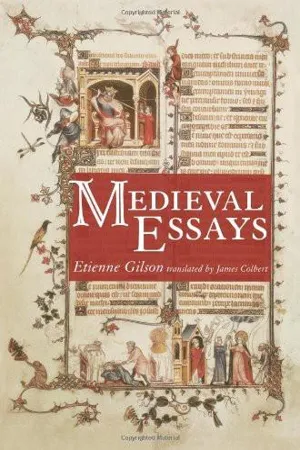
This book is a collection of nine articles by the twentieth century's leading medievalist, Étienne Gilson. A major participant in the revival of Thomistic philosophy, Gilson was a member of the French Academy and, after a university career culminating at the Sorbonne and the Collège de France, he turned down an invitation from Harvard University to become the guiding spirit of the Pontifical Institute of Medieval Studies at the University of Toronto for several decades.
Several of the articles stand on their own as making a significant contribution to topics like St. Anselm's ontological argument for the existence of God. Likewise, “The Middle Ages and Naturalism” contrasts Renaissance Humanists and Reformers with the medievals on the defining issue of their attitude toward nature in order to understand who actually stands closer to the ancient Greeks.
All of the articles give an insight into the great synthetic visions articulated by the better-known works of Gilson like The Spirit of Medieval Philosophy. We see Gilson's meticulous spadework for the broader theme of Christian philosophy in his examination of the Latin Averroist Boethius of Dacia's book on the eternity of the world. Gilson finds that Boethius never expresses the view attributed to Latin Averroism that there are contradictory truths in religion and philosophy, although he does think that Boethius is unsuccessful in his account of the relations between philosophy and theology.
The opening piece revisits a battle now won (and won in great measure by Gilson's efforts), namely the fight to acknowledge the very existence of medieval philosophy and win its place in the academic world. But the article also makes the effort—which becomes a connecting thread throughout the nine articles-to pinpoint the uniqueness of what Gilson calls Christian philosophy. The closing article studies the profound influence of the great Muslim thinker Avicenna on Latin Europe drawing a parallel between Avicenna's work and that of the great Christian medievals like Thomas Aquinas and Duns Scotus.
When Gilson died in 1978, a great deal of his work on the history of philosophy, and specifically God, the primacy of existence or esse over essence, and the impact of Christianity on philosophy had been translated. A significant amount of material, however, has not yet appeared in English. The publication of Medieval Studies represents a vital step in bringing these important works into the English-speaking world.
- 234 pages
- English
- ePUB (mobile friendly)
- Available on iOS & Android
eBook - ePub
Medieval Essays
About this book
Information
Topic
Theology & ReligionSubtopic
Christian Church1
Critical Historical Research and the Future of Scholasticism1
What change of perspective does critical historical research
suggest for our approach to scholasticism? What indications does it provide about its future? The question posed is broad, so we may be excused if we simply touch upon its main point within the brief space of a paper.
suggest for our approach to scholasticism? What indications does it provide about its future? The question posed is broad, so we may be excused if we simply touch upon its main point within the brief space of a paper.
A century ago in 1850, Barthélemy Hauréau published De la philosophie scolastique, followed by his Histoire de la philosophie scolastique in 1872 and 1880. Since then, works on medieval philosophy are countless: in 1900 Maurice de Wulf, Histoire de la philosophie médiévale; in 1905 François Picavet, Esquisse d’une histoire générale et comparée des philosophies médiévales; in 1921 Martin Grabmann, Die Philosophie des Mittelalters; in 1928 Bernard Geyer, Die patristiche und scholastiche Philosophie. We could mention others without even considering innumerable works devoted to the philosophies of Thomas Aquinas, Bonaventure, Duns Scotus, and Ockham. But for every ten histories of medieval philosophy, how many histories of medieval theology do we find? For twenty volumes on the philosophy of Thomas Aquinas, how many historical expositions of his theology are there? For a century historians of medieval thought generally seem to have tended to represent the medieval ages as inhabited by philosophers rather than theologians.
There are several reasons for this, the first a dogmatic one. Since philosophy was overtly established as a science separated from theology in the seventeenth century, there has been a desire to contrast scholasticism, qua pure philosophy, with other pure philosophies that attacked it. This trend started in the sixteenth century but accelerated towards the end of the seventeenth. In 1667, under the pseudonym Ambrosius Victor, the Oratorian André Martin, devoted his five-volume Philosophia Christiana to turning St. Augustine into a philosopher. In 1679 Antoine Goudin’s Philosophia juxta Thomae Dogmata came out, and innumerable Cursus Philosophiae Thomisticae were to follow up to our time. In 1746 Josephus Antonius Ferrari would defend Aristotle’s philosophy rationibus Joannis Duns Scoti subtilium principis. What a distance had been traversed since the time of Duns Scotus! In the fourteenth century, he used Aristotle to defend the faith! In the eighteenth century it is he who is conscripted to defend Aristotle. In 1782 Carolus Josephus a Sancto Floriano published his Joannis Duns Scoti Philosophia, which was not to be the last. Then as now, it was a question of comparing philosophy to philosophy, which is why medieval theologians who never wrote any philosophy in life, composed so much after death. But strictly historical factors complement the previous consideration. In the measure that history of philosophy was established as a distinct area of study, it became more and more difficult for it to neglect the Middle Ages. Might it not be that there was a great deal of philosophizing in the faculty of arts? Above all, one could not help noticing the striking difference that distinguishes modern philosophy at its inception from Greek philosophy at its end. Metaphysics emerged from the Middle Ages different from the state in which it entered them. Thus something had happened in philosophy, even within the theology faculties. That is why so many studies wavering between theology and philosophy had to be published, treating theologians as philosophers; in short, doing what could be done without troubling oneself excessively about theoretical distinctions. It was certainly necessary to search out medieval philosophy where it was.
Yet, did this involve adopting a medieval perspective on the Middle Ages? It was clearly perceived that it did not. The general stance of the great thirteenth-century doctors seems faithfully defined by the text of his In Hexaemeron (II, 7) where the Seraphic Doctor distinguishes four types of writings, each of which occupies a different level and deserves the respect that corresponds to its rank: 1) Holy Scripture, which contains what man needs to know to achieve his salvation; 2) writings of the Fathers in order to interpret Scripture; 3) Commentaries on the Sentences to interpret the Fathers; 4) books of philosophers to interpret the Commentaries on the Sentences or the Summas of theology. To be sure, one may have reservations about St. Bonaventure’s testimony, for he expressed his bad humor against philosophy and philosophers quite bitterly, above all in 1273. As has been noted, it is true that philosophy does not occupy the first rank in his thought, but when did it ever occupy first rank in the thought of any theologian worthy of the name? It certainly did not in that of St. Thomas Aquinas. With whatever personal nuances we please and which history demands, no medieval master of theology seems to have disputed the hierarchical order described by St. Bonaventure: Scripture first, the Fathers as interpreters of Scripture, the theologians as interpreters of the Fathers, philosophers to understand theologians. It is natural and healthy that for forty years historians with theological training have recalled this evidence to those whose formation was chiefly philosophical. Their warning can be summed up in the criticism directed by one of them against a book on St. Bonaventure’s “philosophy”: What you call philosophy is only mutilated theology. He was right, but that is equally true of every book about the “philosophy” of Thomas Aquinas, Duns Scotus, or Ockham. Our first conclusion will be that historical research, which originally focused on medieval philosophies, will tend more and more to reintegrate these philosophies into the theologies that contain them.
The second development is all the more remarkable, because, while linked to the first, it initially seems to contradict it. A century ago, one referred comfortably to the scholastic philosophy. Barthélemy Hauréau even tended to reduce it to one problem, as if everything came down to variations on the theme of universals. Nearer to us, some went so far as to maintain that St. Thomas’ doctrine on this point was the common doctrine of his time, that it could be expounded without citing him and appealing only to texts of his contemporaries. In fact, historical progress has led to differentiate doctrinal positions, and without denying what is common in their Aristotelian technique, to individualize, so to speak, the use theologians made of it. The special originality of each great doctrinal synthesis becomes increasingly apparent to us, and we perceive those syntheses to be more distinct than they once seemed. The unity of the schools themselves seems less rigid than we used to imagine. Albert the Great no longer appears to be simply a Thomist before his time, and today we would hesitate to affirm that Giles of Rome belongs to the school of St. Thomas Aquinas, something formerly regarded as indubitable. Now, in the eyes of a historian, this growing differentiation of scholastic theologies appears to be linked to that of the philosophical instruments they use. We re-encounter the lesson of the scholastic gibe: Qualis in philosophia, talis in theologia. Thus, our very effort to return to theology has situated us in the presence of as many distinct philosophies as we find distinct theologies. The fact is so important that it is worth considering it attentively.
In one sense that effort justifies so many historians devoting their preponderant attention to medieval philosophies. The very nature of theology validates them, because theology is intellectus fidei, and naturally, different ways of achieving that understanding within the unity of faith will engender different theologies. A theologian’s “philosophy,” even when integrated into his theology, will thus continue to occupy an important place in future history of medieval thought, but it will not be exactly the same as before. History has reached a point of no return. Experience teaches that the more a historian separates philosophy from theology in medieval doctrines, the more the former tends to be reduced to a common technique, increasingly stripped of originality, which at the extreme melds into Aristotle’s philosophy as revised by Avicenna or Averroes. In this regard it is notable that the historians who most diligently extract a philosophy free of any theology from medieval texts, ordinarily are the same people who insist on the existence of a kind of common philosophy or at the very least of a scholastic “synthesis,” which might be called that of the whole thirteenth century. From their point of view these historians are right. They are even absolutely right: act and potency, form and matter, the four causes, metaphysics as science of being, truth as taken from being just as it is, so many guiding theses—one could easily mention others—defined a philosophical interpretation of the world common to all our theologians. That is true, but if it were the whole truth, it would be necessary to conclude that the Christian Middle Ages remained philosophically sterile and that, as some still think, it only repeated a more or less deformed Aristotle ad nauseam.
It is here that the second conclusion to be drawn from so much historical research insistently demands our attention. Experience makes us see that the more medieval philosophies are reintegrated into their theological syntheses, the more original they appear to be. The same fact can be expressed in several ways. We can say, for example that philosophical thought became creative in its theological function at that time, or that the greater theologian a master is, the greater philosopher he is. Only the fact matters, and it is that the decisive progress of western philosophy in the Middle Ages occurred at the points where intellectus fidei in some way called for originality. At the same time as it justifies the medieval qualis in philosophia talis in theologia, historical research invites us to complete the saying by qualis in theologia, talis in philosophia, which is no less true and no less important. Indeed, these are two formulations of the same truth and well known to theologians themselves; because, if theology is intellection of faith, the intellection can neither be isolated from the faith whose understanding it gives, nor the faith from the intellection it seeks. In brief, medieval philosophy owed its fecundity precisely to being a theological instrument.
This historical lesson in turn poses doctrinal problems that the historian as such is not competent to resolve, but whose solution would not be without importance for the future of scholasticism.
If we recognize the thirteenth century as the golden age of scholasticism, that is doubtless because we judge it has succeeded in its endeavor, and if it is true that res eodem modo conservantur quo creantur, it seems that we could not hope to succeed as well in the future without proceeding in the same manner. But history here comes to the rescue to tell us how the thirteenth century proceeded. Despite excuses that may be found, the greatest objection to separating scholastic philosophy from its theology is that this inevitably creates the illusion that theologians worked by introducing a completely finished philosophy, just as they found it in the philosophers of their time, into a completely finished doctrine of the faith. Hence, the conclusion is often articulated that to redo the task of the thirteenth century would first involve our taking as point of departure the philosophy and science of our time in order to reconstruct a new scholasticism that would be in agreement with modern mentality and acceptable to our contemporaries. That seems to read a misinterpretation into history. Thirteenth-century theologians did not part from the philosophical sciences of their time to adapt theology to them. They parted from the faith to take up the philosophical sciences of their time, metamorphosing them in the light of faith. Centered on the intellectus fidei, they took in unchanged a great deal of philosophical or scientific knowledge of their time without necessary relation to Christian faith, and this is precisely the obsolete part of their work that we have no reason to conserve. But if nothing is more transitory than positive science, nothing is less transitory than Christian faith, and in order for thirteenth-century scholasticism to be taken up again where it left off, faith, not science, would have to have changed since then.
Though I want to be brief, I beg leave to insist on the capital point just stated, because not all errors of perspective are on the same side. To those who call for a new scholasticism founded on modern philosophy, some will respond that there is only one true philosophy, which is that of Aristotle, and that scholastic theology is true because it is founded on it. But neither Duns Scotus nor Thomas Aquinas founded their theology on any philosophy, not even Aristotle’s. As theologians, they used philosophy in the light of faith, and thereby philosophy emerged transformed. What metaphysics there is in Thomas Aquinas or in Duns Scotus is their own metaphysics. Each Aristotelian formula that they take over receives from the notion of esse or of ens infinitum a sense Aristotle never thought of, which he would hardly have been able to comprehend, and which their very disciples, when they come to confuse their master with Aristotle, no longer always understand in all its depth. It will never be said enough: to make over scholasticism starting from Kant or Hegel would be to wish to redo what has never been done.
Let us try to imagine what would have happened if our scholastics had started from Aristotle in constructing their theologies. Aristotle’s god did not create the world ex nihilo. He exercises no contingent action on the sublunar world. He never intervenes in the guise of particular providence but abandons the world to a necessity that only chance interrupts. In Aristotle, man, instead of being an immortal person called to his own destiny, is merely a completely perishable individual, with no other function than to repeat the species in a transitory way. Is that the philosophy on which our theologies rest? Yet it is Aristotle’s philosophy! Let us note here with Duns Scotus, whose judgement imposes itself on Thomists as well as Scotists, that there is a profound reason why Aristotle’s philosophy was this way. It is precisely that Aristotle’s metaphysics was a direct development of his physics. Precisely because they refused to speak as theologians, the medievals who started from Aristotelian science naturally ended like Averroes, in the same metaphysics. If it were true that our theologians had built their theologies on a metaphysics itself linked to now-obsolete science, it would be right to say that to redo their project would have to consist in theologizing starting from philosophies that are so many developments of today’s science. But, at once, one would come to the result that the work would immediately have to begin again. This has never been clearer than in our time, where one generation has seen three different physics succeed each other, that of gravitation, general relativity, and wave mechanics. Yesterday science was determinist, it is indeterminist today, it will become determinist again tomorrow. Are we going to change theology each time that, by changing physics, we must change metaphysics? But the absurdity of the proposition makes it quite clear that our theologians themselves have never done any such thing. Philosophizing, not in the light of physics, but in that of faith, the medieval theologians left us metaphysics and even philosophies of nature, which there is no need to remake continually, because these doctrines participate in the stability enjoyed by the light in which they were born. To philosophize as a scholastic cannot be to adapt Catholic theology to the science of our time nor to philosophies that are inspired by that science, but rather to adapt this science and these philosophies to the metaphysics created by our theologians in their effort to attain a certain intellection of faith We intend to do no more here than record certain lessons of history objectively. Perhaps the chief initiative of the medieval masters, because they were theologians, was never to have done their thinking starting from science or philosophy. Thus it is to misread history to say: Scholasticism tied faith to Aristotle’s old philosophy; let us do the same thing with the philosophy of our time. Scholastic theology created (in the human sense of the term) a new metaphysics, whose truth, independently of the state of science at any moment of history, remains as permanent as the light of faith in which it was born.
Thus the future of scholasticism does not consist in adapting medieval metaphysics of being and causes to the movement of science and philosophy, but to make it constantly take up the achievements of knowledge in order to rectify them and purify them. To do otherwise, would be to suppres...
Table of contents
- Medieval Essays
- Foreword to the French Edition
- Chapter 1: Critical Historical Research and the Future of Scholasticism
- Chapter 2: The Middle Ages and Ancient Naturalism
- Chapter 3: The Meaning and Nature of St. Anselm’s Argument
- Chapter 4: Peter Lombard and the Theologies of Essence
- Chapter 5: The Concept of Existence in William of Auvergne
- Chapter 6: Maimonides and the Philosophy of Exodus
- Chapter 7: Boethius of Dacia and Double Truth
- Chapter 8: Notes for the History of Efficient Causality
- Chapter 9: Avicenna in the West during the Middle Ages
- Bibliography
Trusted by 375,005 students
Access to over 1.5 million titles for a fair monthly price.
Study more efficiently using our study tools.
Frequently asked questions
Yes, you can cancel anytime from the Subscription tab in your account settings on the Perlego website. Your subscription will stay active until the end of your current billing period. Learn how to cancel your subscription
No, books cannot be downloaded as external files, such as PDFs, for use outside of Perlego. However, you can download books within the Perlego app for offline reading on mobile or tablet. Learn how to download books offline
Perlego offers two plans: Essential and Complete
- Essential is ideal for learners and professionals who enjoy exploring a wide range of subjects. Access the Essential Library with 800,000+ trusted titles and best-sellers across business, personal growth, and the humanities. Includes unlimited reading time and Standard Read Aloud voice.
- Complete: Perfect for advanced learners and researchers needing full, unrestricted access. Unlock 1.5M+ books across hundreds of subjects, including academic and specialized titles. The Complete Plan also includes advanced features like Premium Read Aloud and Research Assistant.
We are an online textbook subscription service, where you can get access to an entire online library for less than the price of a single book per month. With over 1.5 million books across 990+ topics, we’ve got you covered! Learn about our mission
Look out for the read-aloud symbol on your next book to see if you can listen to it. The read-aloud tool reads text aloud for you, highlighting the text as it is being read. You can pause it, speed it up and slow it down. Learn more about Read Aloud
Yes! You can use the Perlego app on both iOS and Android devices to read anytime, anywhere — even offline. Perfect for commutes or when you’re on the go.
Please note we cannot support devices running on iOS 13 and Android 7 or earlier. Learn more about using the app
Please note we cannot support devices running on iOS 13 and Android 7 or earlier. Learn more about using the app
Yes, you can access Medieval Essays by Étienne Gilson, James G. Colbert in PDF and/or ePUB format, as well as other popular books in Theology & Religion & Christian Church. We have over 1.5 million books available in our catalogue for you to explore.