eBook - ePub
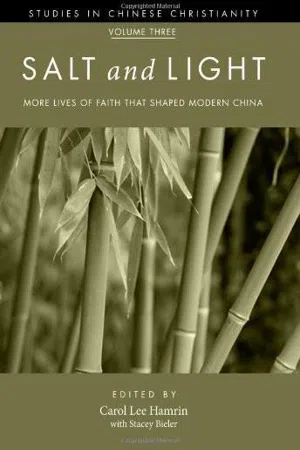
Salt and Light, Volume 3
More Lives of Faith That Shaped Modern China
- 278 pages
- English
- ePUB (mobile friendly)
- Available on iOS & Android
eBook - ePub
Salt and Light, Volume 3
More Lives of Faith That Shaped Modern China
About this book
In this centennial year of China's 1911 Revolution, Volume 3 in the Salt and Light series includes the life stories of influential Chinese who played a political or military role in the new Republic that emerged. Recovering this precious legacy of faith in action shows the deep roots of the revival of Christian faith in China today.
Information
Topic
Theology & ReligionSubtopic
Christian MinistryNotes
Introduction
1. For a recent, pioneering analysis of the Protestant social elite, with a review of the literature, see John Barwick, “Chinese Protestant Elites and the Quest for Modernity in Republican China” (PhD diss., University of Alberta, Canada, 2011). For resources and short biographies of Catholic and Protestant Chinese Christians and foreign missionaries, see The Ricci Institute for Chinese-Western Cultural History at http://usf.usfca.edu/ricci/christianity/index.htm and Biographical Dictionary of Chinese Christianity at http://www.bdcconline.net/en/; Howard L. Boorman, ed., Biographical Dictionary of Republican China vols. 1–4 (New York: Columbia University Press, 1967–1970).
For an overview of the materials collected for an unfinished history of this elite in the 1960s, see M. Searle Bates, Melville O. Williams, Cynthia McLean, and Martha Lund Smalley, Gleanings from the manuscripts of M. Searle Bates: the Protestant Endeavor in Chinese Society, 1890-1950 (New York: The China Program, National Council of churches of Christ in the U.S.A., 1984) and Martha Lund Smalley, comp. “Guide to the Miner Searle Bates Papers (Record Group No. 10),” Yale University Library, Divinity Library Sepcial Collections (New Haven: Yale University Library, August 1983) http://webtext.library.yale.edu/xml2html/divinity.010.con.html. Accessed February 14, 2011.
2. See “Postface: This volume in the Context of Evolving Interna-tional Scholarship,” and chapters in Daniel H. Bays and Ellen Widmer, eds. China’s Christian Colleges: Cross-Cultural Connections, 1900–1950 (Stanford, CA: Stanford University Press, 2009).
3. The volume by Bays and Widmer is dedicated to Jessie Lutz, whose work (along with that of Bays) since the 1970s has pioneered a balanced perspective and a focus on indigenous Christians. See Jessie G. Lutz, Pioneer Chinese Christian Women: Gender, Christianity, and Social Mobility (Bethlehem, PA: LeHigh University Press, 2010).
4. For background, see Richard Hofstadter, The Age of Reform: From Bryan to F.D.R. (New York: Random House Vintage Books, 1955), and James T. Kloppenberg, Uncertain Victory: Social Democracy and Progressivism in European and American Thought, 1870–1920 (Oxford: Oxford University Press, 1986).
5. Edwin Woodrull Tait, “The Cleansing Wave,” and William Kostlevy, “Saving Souls and Bodies,” Christian History and Biography 82 (Spring 2004): 22–25, 28–31.
6. Ryan Dunch, “Locating China in the World: Space and Time in Late Imperial Protestant Missionary Texts” (paper, Association for Asian Studies annual meeting, Boston, March 22–25, 2007), 10. Dunch cites Alexander Williamson, in a preface to Jidu shilu [Life of Christ] in the 1880s, as an example of this.
7. Tu Weiming, “The Quest for Meaning: Religion in the Peoples’ Republic of China,” Peter L. Berger et. al., eds. The Descularization of the World: Resurgent Religion and World Politics (Wm. B. Eerdmans Publishing, 1999), 91–92; Wang Gungwu, Anglo-Chinese Encounters sice 1800: War, Trade, Science and Governance (Cambridge: Cambridge University Press, 2003); You Xilin, “Modernity and Secularity: the dual significance of Christianity for China’s modernization,” China Study Journal 18:1 & 2 (August 2003): 10–11. The following paragraphs are adapted from Barwick, chap. 1, 48–63.
8. Dana L. Roberts, Christian Mission: How Christianity Became a World Religion (Malden, MA: Wiley-Blackwell, 2009), 49–50, discusses the attractions of Christianity to different social groups; 64–67, the development of internationalism and the concept of “world Christianity;” and 72–73, the transformation of the missionary movement into a multi-cultural network of international Christian NGOs.
9. Li Shenzhi, schooled before 1949 at Christian institutions—Yanjing and St. John’s University, held high-ranking posts in the PRC thereafter and was a prominent reformer as Vice President of the Chinese Academy of Social Sciences until he was demoted in 1990 for protesting the June Fourth crackdown. See Selected Writings of Li Shenzhi (Kettering Foundation Press, 2010), for his essay “Goodbye, Revolution,” an ironic echo and implied reversal of Mao Zedong’s famous essay “Goodbye, John Leighton Stuart” (former missionary and Yanjing University president and the last U. S. ambassador to China before the communist takeover).
10. See chapter three in this volume, and Lyon Sharmon, Sun Yat-sen: His Life and its Meaning (Stanford: Stanford University Press, 1934), 91–92, 182, 310.
Notes
11. Sharmon, Sun Yat-sen, 108–9, discusses the Guangzhou (Canton) uprising of March 29, 1911, and the memorial there to the “Martyrdom of the Seventy.”
12. See James E. Sheridan, Chinese Warlord: The Career of Feng Yu-hsiang (Stanford: Stanford University Press, 1966).
13. Lloyd E. Eastman, The Abortive Revolution: China under Nationalist Rule 1927-1937 (Cambridge, MA: Harvard University Press, 1974), 166–172, details the politics behind the progression of drafts from Wu’s, which gave most power to the legislature, to the last draft of 1936, which reflected pressures for a dictatorship by Chiang Kai-shek that ended the chances for constitutional government.
14. Dan Cui, The Cultural Contribution of British Protestant Missionaries and British-American Cooperation to China’s National Development During the 1920s (New York: University Press of America, 1998), 348–349.
15. Jeffrey N. Wasserstrom, Global Shanghai, 1850–2010: A History in Fragments (New York: Routledge, 2009), 66–67.
16. Hamrin, personal communication with a PRC ambassador who has represented China in leading international organizations.
17. Barwick, chap. 1, 57–58; chap. 3, 144–46.
18. Li Xing, “Besides rote learning, add values in child’s education,” China Daily Supplement to the Washington Post, February 25, 2011, H3. Li was commenting on the debate over Amy Chua’s book, Battle Hymn of the Tiger Mother, which raised controversy over whether Chinese or Western mothering was superior.
Chapter 1: Huang
Acknowledgments
This chapter is adapted from Anne Pang, “Huang Naishang: A Chinese Christian reformer in late Qing and early Republican China,” (PhD diss., Monash University, 2009).
I wish to express my sincere thanks to the Yale University Divinity School Library Special Collections and the National University of Singapore Archives for their assistance, as well as Ms. Huang Wuqiong who gave valuable information about her father, Huang Naishang. I am also grateful to the second Mrs. Huang who shared her memories of Huang Naishang and provided personal details not found in the public domain.
Notes
1. Huang Naishang, Fucheng qishi zixu [Fucheng’s autobiography at age seventy] reprinted in Shiwu Fuzhou kenchang wushi zhounian jiniankan [Commemorative Publication of the Fiftieth Anniversary of the Fuzhou Settlement in Sibu] 1901–1950 (Sibu: Fuzhou Association of Sibu, 1951), 100. Thou...
Table of contents
- Salt and Light 3
- Note on Romanization
- Key to Pronunciation
- Map of China
- Acknowledgments
- Introduction
- • Huang Naishang
- • Yu Rizhang
- • Liu Tingfang
- • Zhang Zhijiang
- • Zeng Baosun
- • Wu Jingxiong
- • Wang Liming
- • Lin Yutang
- • Zhang Fuliang
- Time Line
- Notes
- Contributors
- Index
- Sources of Illustrations
Trusted by 375,005 students
Access to over 1.5 million titles for a fair monthly price.
Study more efficiently using our study tools.
Frequently asked questions
Yes, you can cancel anytime from the Subscription tab in your account settings on the Perlego website. Your subscription will stay active until the end of your current billing period. Learn how to cancel your subscription
No, books cannot be downloaded as external files, such as PDFs, for use outside of Perlego. However, you can download books within the Perlego app for offline reading on mobile or tablet. Learn how to download books offline
Perlego offers two plans: Essential and Complete
- Essential is ideal for learners and professionals who enjoy exploring a wide range of subjects. Access the Essential Library with 800,000+ trusted titles and best-sellers across business, personal growth, and the humanities. Includes unlimited reading time and Standard Read Aloud voice.
- Complete: Perfect for advanced learners and researchers needing full, unrestricted access. Unlock 1.5M+ books across hundreds of subjects, including academic and specialized titles. The Complete Plan also includes advanced features like Premium Read Aloud and Research Assistant.
We are an online textbook subscription service, where you can get access to an entire online library for less than the price of a single book per month. With over 1.5 million books across 990+ topics, we’ve got you covered! Learn about our mission
Look out for the read-aloud symbol on your next book to see if you can listen to it. The read-aloud tool reads text aloud for you, highlighting the text as it is being read. You can pause it, speed it up and slow it down. Learn more about Read Aloud
Yes! You can use the Perlego app on both iOS and Android devices to read anytime, anywhere — even offline. Perfect for commutes or when you’re on the go.
Please note we cannot support devices running on iOS 13 and Android 7 or earlier. Learn more about using the app
Please note we cannot support devices running on iOS 13 and Android 7 or earlier. Learn more about using the app
Yes, you can access Salt and Light, Volume 3 by Carol Lee Hamrin,Stacey Bieler, Hamrin, Bieler in PDF and/or ePUB format, as well as other popular books in Theology & Religion & Christian Ministry. We have over 1.5 million books available in our catalogue for you to explore.