eBook - ePub
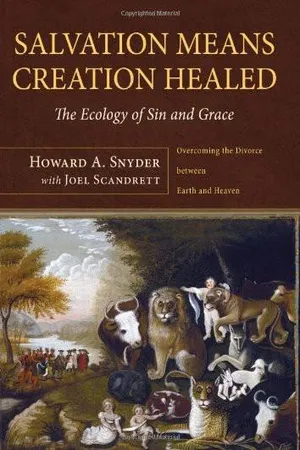
Salvation Means Creation Healed
The Ecology of Sin and Grace: Overcoming the Divorce between Earth and Heaven
- 278 pages
- English
- ePUB (mobile friendly)
- Available on iOS & Android
eBook - ePub
Salvation Means Creation Healed
The Ecology of Sin and Grace: Overcoming the Divorce between Earth and Heaven
About this book
The Bible promises the renewal of all creation--a new heaven and earth--based on the incarnation, life, death, and resurrection of Jesus Christ. For centuries this promise has been sidelined or misunderstood because of the church's failure to grasp the full meaning of biblical teachings on creation and new creation.
The Bible tells the story of the broken and restored relationship between God, people, and land, not just God and people. This is the full gospel, and it has the power to heal the church's long theological divorce between earth and heaven. Jesus' resurrection in the power of the Holy Spirit is the key, and the church as Christ's body is the primary means by which God is reconciling all things through Jesus Christ. Jesus' ultimate healing of all creation is the great hope and promise of the gospel, and he calls the church to be his healing community now through evangelism, discipleship, and prophetic mission.
Information
Topic
Teología y religiónSubtopic
Iglesia cristianaPart One
The Divorce of Heaven and Earth
1
The Great Divorce in
Christian Theology
The arm of the Lord is not too short to save, nor his ear too dull to hear.
But your iniquities have separated you from your God;
your sins have hidden his face from you, so that he will not hear.
But your iniquities have separated you from your God;
your sins have hidden his face from you, so that he will not hear.
(Isa 59:1–2 TNIV)
Salvation means creation healed. But why does creation need healing? The short answer is that all creation is diseased because of sin. First comes the mystery of Satan’s fall, followed by humanity’s fall into sin, pictured so graphically in Genesis 3. With sin came moral disease, a fourfold alienation of man and woman from God, from themselves, from each other, and from the earth. All of this, and especially the disease of sin, is explained in a new way in chapters 5 and 6 of this book.
The disease of sin brought alienation, a divorce, between people and their maker and between people and their world, their habitat, which is planet earth. Divorce is an apt metaphor for the whole problem of the relationships between God, humans, and the earth. Sin, in effect, triggered a divorce between heaven and earth. And salvation is about overcoming this divorce both now and in the future. Ultimately salvation means the final marriage of heaven of earth in the New Creation. Thus, the book of Revelation speaks of “the marriage supper of the Lamb” (Rev 19:9).
But there is a fore-story here that must first be told. There is another divorce, a secondary divorce that also cries out for healing. This is the great divorce in Christian theology between heaven and earth. This theological divorce has to be faced. In fact, healing this theological divorce is key to grasping the larger healing that salvation implies and promises. So we begin this book with the intriguing but mostly untold story of a great divorce in Christian theology. We will show how the divorce happened, so that healing and reconciliation can begin.
First, we need a basic theological diagnosis. Think of it this way: A married couple is heading for divorce. Their problems are deep and seemingly insoluble. They seek out a trusted counselor, perhaps a pastor, and share their pain. Can reconciliation happen? Yes, but there’s a preliminary problem: the counselor discovers that the couple misunderstands marriage itself. They think it has to do only with emotional and sexual “compatibility,” not understanding the many other moral and spiritual dimensions of Christian marriage. The counselor has to diagnose the problem before he or she can introduce a reconciliation process. The couple first needs to come to a fuller understanding of marriage before they can live it out.
So also with the church. Just as a counselor has to hear the couple’s story in order to have a healing influence, so we have to understand the story, the history that led to the theological divorce of earth from heaven. In the following three brief chapters, we show how the theological divorce between heaven and earth came about, then we point a way forward.
But does this great divorce really exist? Yes. We testify to it whenever we:
- think salvation is about the soul only, not the body;
- see no spiritual significance in material things;
- view life on earth as something unreal or of little importance;
- view physical death as the end of our earthly life;
- think that beauty in this life (nature, people, art, music) is ultimately unimportant, except as it points to spiritual beauty;
- see this present world as evil or totally under Satan’s control;
- overlook the biblical mandate for creation stewardship;
- see spirit and matter as two opposite and irreconcilable categories.
Wherever such symptoms abound, we have evidence of the great theological divorce between heaven and earth that exists in the Christian tradition. Perhaps the most glaring evidence of this divorce is the church’s longstanding carelessness (with a few exceptions) about tending the garden, the earth that God has given us. Devastated, polluted, and barren spots in the garden are signs of the divorce. They shout to us that we have missed something basic. A quick review of church history shows why.
The Rise of Christianity, 30–330 AD
After Peter’s message on the Day of Pentecost, “those who welcomed his message were baptized, and . . . about three thousand persons were added. They devoted themselves to the apostles’ teaching and fellowship, to the breaking of bread and the prayers” (Acts 2:41–42).
This is a new story, but of course it is also the continuation of the Old Testament story. Now, Old Testament promises of a Messiah, the outpouring of the Holy Spirit, and the renewal of God’s covenant are being fulfilled.
The Jerusalem church was not really the “New Testament church,” however. The Acts 2 church is not the full biblical model, as some suppose. It is the embryo, the initial episode, the beginning of the story. After the scattering in Acts 8, and especially with the birth of the church in Antioch, we begin to see what the New Testament church really is—its visibility, its dynamic, its vision and mission. In the rise of Christianity as a global movement, Acts 11–13 more fully paints the birth of the church than does Acts 2. But it’s all part of one story, of course.1
By the close of the New Testament, the church has spread to many key cities of the Roman Empire. The Book of Acts ends in Rome with Paul’s ministry there. The letters to the seven churches in Revelation 2–3 give us a glimpse of the church in Asia Minor (present-day Turkey) about 90 AD. The church has grown remarkably, but we should remember that it is still a tiny, “illegal,” mostly underground sect within the Roman Empire. However by this time the faith has erupted also beyond the Roman Empire, spreading to Syria, India, North Africa, and Armenia, which would become the first Christian nation.
Within the Roman Empire the church was still running mostly “below the radar screen” of public notice. It was essentially a network of home-based fellowships, with no church buildings until about the mid-200s.
Then comes a key tipping point. By about 300 AD Christians were so numerous throughout the empire that they could not be ignored. The conversion of the Emperor Constantine (c. 272–337) in 312 brought a rapid and historically critical shift. Christianity moved quickly from a despised minority to the favored religion of the Empire. This period of the rise of Christianity reached its climax in the early fourth century with the official toleration of Christianity (Edict of Milan, 313) and the Council of Nicea (325). The Christian church, it seemed, had won—it had conquered the Roman Empire.
The rise of Christianity from about 30 to 330 AD is an amazing story. We can summarize these three hundred years by tracing three key themes: God’s narrative, God’s redemptive plan, and the visible church.2
The Narrative, the Plan, the Visible Church
The years from the end of the book of Acts to about 330 AD give us a sense of the church’s continuity, of an unfolding story. Early Christians knew God was at work among them, despite trials and persecutions. The church was multiplying—in numbers, geographic spread, influence, organization, and theological sophistication. Heresies arose and were countered; cultural barriers were crossed; essential consensus was reached on the canon of Scripture. Yet the church was more and more diverse, with varying forms of organization and leadership, differing doctrinal emphases in different places, and a range of conflicts and controversies.
The Council of Nicea in 325 (widely viewed as the First Ecumenical Council) and subsequent councils gave us the Nicene Creed—a key marker of early consensus on essential doctrinal points, particularly with regard to the identity of Jesus Christ.3
The Nicene Creed affirmed that God created “all things visible and invisible”; that God provides salvation through the incarnation, life, death, and resurrection of Jesus Christ; and that Jesus will return again and establish God’s everlasting kingdom, with “the resurrection of the dead” and ongoing life under God’s reign.
The early church clearly understood that God’s redemptive plan centers in the story of Jesus Christ and the victory of the Creator-Redeemer God in Jesus. This included the expectation of Jesus’ return within history, the physical resurrection of the dead, and God’s everlasting reign. Thus the narrative of Jesus builds upon and extends the Old Testament narrative, which is essentially t...
Table of contents
- Salvation Means Creation Healed
- Preface
- Introduction
- Part One
- Part Two
- Part Three
- Part Four
- Conclusion
- Bibliography
- General Index
Trusted by 375,005 students
Access to over 1.5 million titles for a fair monthly price.
Study more efficiently using our study tools.
Frequently asked questions
Yes, you can cancel anytime from the Subscription tab in your account settings on the Perlego website. Your subscription will stay active until the end of your current billing period. Learn how to cancel your subscription
No, books cannot be downloaded as external files, such as PDFs, for use outside of Perlego. However, you can download books within the Perlego app for offline reading on mobile or tablet. Learn how to download books offline
We are an online textbook subscription service, where you can get access to an entire online library for less than the price of a single book per month. With over 1.5 million books across 990+ topics, we’ve got you covered! Learn about our mission
Look out for the read-aloud symbol on your next book to see if you can listen to it. The read-aloud tool reads text aloud for you, highlighting the text as it is being read. You can pause it, speed it up and slow it down. Learn more about Read Aloud
Yes! You can use the Perlego app on both iOS and Android devices to read anytime, anywhere — even offline. Perfect for commutes or when you’re on the go.
Please note we cannot support devices running on iOS 13 and Android 7 or earlier. Learn more about using the app
Please note we cannot support devices running on iOS 13 and Android 7 or earlier. Learn more about using the app
Yes, you can access Salvation Means Creation Healed by Howard A. Snyder,Joel Alan Scandrett in PDF and/or ePUB format, as well as other popular books in Teología y religión & Iglesia cristiana. We have over 1.5 million books available in our catalogue for you to explore.