Knowing is less about information and more about transformation; less about comprehension and more about being apprehended.
This radical book develops the notion of covenant epistemology--an innovative, biblically compatible, holistic, embodied, life-shaping epistemological vision in which all knowing takes the shape of interpersonal, covenantal relationship. Rather than knowing in order to love, we love in order to know. Meek argues that all knowing is best understood as transformative encounter.
Creatively blending insights from a diverse range of conversation partners--including Michael Polanyi, Michael D. Williams, Lesslie Newbigin, Parker Palmer, John Macmurray, Martin Buber, and James Loder--Meek offers critically needed "epistemological therapy" in response to the pervasive and damaging presumptions that those in Western culture continue to bring to efforts to know.
The book's innovative approach--an unfolding journey of discovery-through-dialogue--itself subverts standard epistemological presumptions of timeless linearity. While it offers a sustained and sophisticated philosophical argument, Loving to Know's texts and textures interweave loosely to effect therapeutic epistemic transformation in the reader.
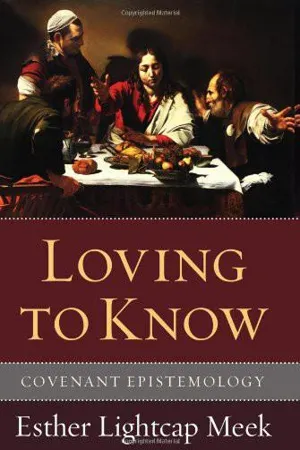
- 534 pages
- English
- ePUB (mobile friendly)
- Available on iOS & Android
eBook - ePub
About this book
Information
Topic
FilosofíaSubtopic
Ética y filosofía moral• part one
On the Way
• 1
The Need for “Epistemological Therapy”
Our Defective “Default” in Knowing
Epistemology is a word that many people have never heard, find intimidating. Many think that epistemology must be a field of study that is inscrutable, impractical, and not relevant to real life. Many people think the subject would be way over their heads, and painful to engage. This widespread perception has some truth to it: the formal philosophical study of epistemology has often deserved these epithets. But epistemology is the study of how we know what we know. It concerns knowing, and knowing is something that we all do all the time. It is neither optional nor avoidable. And we spend life seeking to know well. Growing grapes and making wine involves knowing. Working with computers involves knowing. Cancer research involves knowing. Seeking God involves knowing. Artistry of any sort involves knowing. Marketing involves knowing. Counseling involves knowing. Athletics involves knowing.
Knowing, like any semi-automatic aptitude, can be misdirected, or, with practice, can become a fine-tuned skill. A person aspiring to be an expert runner, or simply physically fit, can benefit from being coached how to breathe. Such coaching may feel odd, difficult, unnecessary, and for a time even unnatural. But the result will be better breathing and running. Similarly, what I am doing in this book is coaching readers to replace faulty habits of knowing with healthy ones.
In this book I want to talk about how we know what we know—epistemology—in such a way that everybody who reads it will benefit from it in every area of life that involves knowing—which is every area of life.
Everyone, in their knowing, is making some assumptions, probably not even consciously, about what knowing is. When my children were younger, we read a series of books about Amelia Bedelia, an enthusiastic, well-intended house servant, who always managed to misunderstand the directions she had been given.1 The misunderstanding always had to do with the oddities of our English language. For example, once Amelia Bedelia was sent to prune the bushes. What she did was to stick prunes all over the bushes, when what she was supposed to have done was to cut back their branches. Just as Amelia Bedelia’s doing the task involved a tacit assumption about what the task was, so knowing involves tacit assumption about what knowing is.
Whereas most of us get it right about pruning the bushes, I want to argue that most of us get it wrong about what knowing is. And while sticking prunes on the bushes isn’t perhaps the end of the world, getting it wrong about knowing—as a culture, over centuries, and as individual participants in that culture—turns out to be damaging to ourselves, our world, and our knowing in any endeavor. So while it may be a bit uncomfortable at first, exposing what is defective in our ideas about what knowing is, and reworking it, will make a great difference, and also become more natural, as we go.2
I am passionate about the importance of this book on epistemology. It endeavors to correct a defective outlook we all have without even knowing we have it, and one that issues in damage in all corners of our lives. My sister has a disease so rare that doctors don’t even know what its symptoms are. This means that my sister can have something wrong, in just about any bodily process, and nobody recognizes it as the disease it is. This describes aptly the situation in epistemology: unhealth crops up in every discipline, and often is not even recognized. Healing this disease will have widespread positive impact—perhaps even cultural change.
Education guru Parker Palmer underscores the critical importance of epistemology to all of life.
What is the nature of the knower? What is the nature of the known? And what is the nature of the relation between the two? These questions belong to a discipline called epistemology. It is an abstract and sometimes even esoteric inquiry into the dynamics of knowing. Its six-syllable name does not leap to our lips in normal conversation, and its insights appear remote from daily life . . . But now I understand that the patterns of epistemology can help us decipher the patterns of our lives. Its images of the knower, the known, and their relationship are formative in the way an educated person not only thinks but acts. The shape of our knowledge becomes the shape of our living; the relation of the knower to the known becomes the relation of the living self to the larger world.3
In his work, Palmer argues that the single key to the rehabilitation of pedagogy is challenging and replacing the reigning epistemological vision that has produced damaging practical effects for education, for persons, and for the world. As we talk about epistemology, we will come to understand this.
So this is a book for people who may never have heard of epistemology but who are involved in knowing all the time. It is also a book for people like me who have studied epistemology professionally for decades. I offer the proposals of this book as both common-sensically therapeutic, but also as philosophically worthwhile, a philosophical conversation that I hope many will enter and forward. But of the two groups, I put the “ordinary” knowers first—because we are all, after all, ordinary knowers.
Our “Subcutaneous Epistemological Layer,”
and Our “Default Mode”
and Our “Default Mode”
In this book I want to offer a fresh, transformative understanding of what knowing is. But before I talk about this, we need first to see how what we think knowing is adversely impacts what we are doing in knowing, and why all this matters so very much. So in this opening chapter we start with that.
Our outlook on what knowing is shapes all our knowing, whether we are aware of it or not. We can be operating, without knowing it, from defective or disordered presumptions about knowing. To make the point graphically, we all have acquired “a subcutaneous epistemological layer”—something operating from “under the skin” of our knowing. I also think of it as a default mode or setting—a way we (to compare ourselves to a computer) are preset to function. This default needs to be reset. I want to help us identify that subcutaneous layer, to expose that default mode to the light of day. “Epistemological therapy” is what I call my personal effort to help people reform their default epistemological settings in a way that brings health, hope, and productivity.
I do not mean to insinuate that a person could adopt an epistemological stance the way he/she might select a ripe tomato. Epistemological commitments are so much a part of us that they are more like our body, portions of which we may view “objectively” only with the help of a mirror, a video camera, or another person or group. And when we stop and look at our body or our epistemic commitments, it feels awkward; it bears little resemblance to our lived bodily experience. Usually we simply live out of an implicitly held epistemological vision. So scrutinizing and reforming our epistemological vision involves an allusive, complex, and possibly invasive process, rather than a calculating or arbitrary choice. But we do need to begin by identifying the commitments of which we haven’t been conscious, bringing them to the surface for a time, so that we can assess and adjust them. The ultimate goal is not to put an end to tacitly indwelling epistemic commitments, but to reform them, and then indwell them with intentionality and virtuosity. In fact, this book argues that knowing is more about transformation than it is about information. What I expect and intent is for this book itself itself to be the therapy that reshapes your epistemological stance as you read.
Since knowing is integral to everything humans do, our epistemic default impacts how we live and everything we do. It can adversely impact every kind of work. It impacts education, for example: since teachers teach knowledge, faulty and hidden assumptions can shape the process. Teaching is just one practice which stands to be made more effective and intentional if we do some “epistemological therapy.” Business, engineering, and library cataloguing are a few others. Others are theological studies, and living as a Christian. Any area where knowing is involved is adversely impacted by the default that we don’t name and reform. It is both responsible and advantageous to uncover that subcutaneous epistemological layer and diagnose its health.
I believe that the source of the defective default setting is the Western tradition of ideas and culture.4 We acquire this default epistemic setting, we may say, with our mother’s milk, because it is embedded in the Western cultural tradition. The legacy of the Western philosophical tradition continues to issue to children and grown-ups a default setting concerning knowledge.
This defective default epistemic setting we inherit actually goes against the grain of our humanness. What I will propose in this book as a replacement will restore us to the grain of our humanness. So there is a second sense in which I do not mean to insinuate that we can choose an epistemic outlook as we would choose a ripe tomato. For one outlook rather than another can align more favorably, healthfully, productively, with who we are as humans. Perhaps we may say that there is a deeper, truer, default.
The default we have inherited is a distortion that leads us to think that knowing is something other than what it is. The default means that even when we are going about knowing humanly, what we have been trained to see blinds us to what we are actually doing, which is actually working. It leads us to deemphasize the most important parts of the knowing event, rather than cultivate them. All this will become clearer as the book unfolds.
So what is this acquired epistemic default, and in what way is it defective? What do most people think that knowledge is?5 For starters, when we think of knowledge, we tend to picture it as information, facts, statements, and proofs. Knowledge consists exclusively of statements, pieces of information, facts. The best (and only) specimens of knowledge are those adequately justified by other statements that offer rational support, reasons, for the claim in question. Knowledge is statements and proofs. Knowledge is facts. I sometimes use the word, “factoids,” for its slight connotation of disconnected bits whose meaning isn’t particularly connected to the grand scheme of things. This is how we tend to picture what knowledge is.
People just assume that knowledge is information. To suggest that this is an epistemic outlook that could be revised can sound ridiculous to novice ears. Having a stance about knowledge being about information is like having an opinion about breathing. That’s why this book is going to be a tough sell. You will have to make a decision in the half-dark about buying it.
A “Daisy of Dichotomies”
Knowledge, thought of in this way, involves some sharp distinctions. This feature of our default setting becomes apparent when we start to think about what people generally contrast knowledge to. I am about to list a series of dichotomies. If you are visual, like I am, you can sketch the daisy as we go. For every pair, the first one goes on the yellow middle, and the second is a white petal. Put knowledge and its associates at the center of the daisy, and cast all their counterparts to the outside as petals, and you have it. I mean this as a diagnostic tool that helps us get a sense of our epistemic default.
Here’s how people generally think of knowledge:
- Knowledge gets contrasted to belief.
- Knowledge is identified with facts; facts sta...
Table of contents
- Loving to Know
- Acknowledgments
- Part One: On the Way
- Part Two: Transformation
- Part Three: Covenant
- Part Four: Interpersonhood
- Part Five: Covenant Epistemology
- Bibliography
- Name Index
- Subject Index
Trusted by 375,005 students
Access to over 1.5 million titles for a fair monthly price.
Study more efficiently using our study tools.
Frequently asked questions
Yes, you can cancel anytime from the Subscription tab in your account settings on the Perlego website. Your subscription will stay active until the end of your current billing period. Learn how to cancel your subscription
No, books cannot be downloaded as external files, such as PDFs, for use outside of Perlego. However, you can download books within the Perlego app for offline reading on mobile or tablet. Learn how to download books offline
Perlego offers two plans: Essential and Complete
- Essential is ideal for learners and professionals who enjoy exploring a wide range of subjects. Access the Essential Library with 800,000+ trusted titles and best-sellers across business, personal growth, and the humanities. Includes unlimited reading time and Standard Read Aloud voice.
- Complete: Perfect for advanced learners and researchers needing full, unrestricted access. Unlock 1.5M+ books across hundreds of subjects, including academic and specialized titles. The Complete Plan also includes advanced features like Premium Read Aloud and Research Assistant.
We are an online textbook subscription service, where you can get access to an entire online library for less than the price of a single book per month. With over 1.5 million books across 990+ topics, we’ve got you covered! Learn about our mission
Look out for the read-aloud symbol on your next book to see if you can listen to it. The read-aloud tool reads text aloud for you, highlighting the text as it is being read. You can pause it, speed it up and slow it down. Learn more about Read Aloud
Yes! You can use the Perlego app on both iOS and Android devices to read anytime, anywhere — even offline. Perfect for commutes or when you’re on the go.
Please note we cannot support devices running on iOS 13 and Android 7 or earlier. Learn more about using the app
Please note we cannot support devices running on iOS 13 and Android 7 or earlier. Learn more about using the app
Yes, you can access Loving to Know by Esther Lightcap Meek in PDF and/or ePUB format, as well as other popular books in Filosofía & Ética y filosofía moral. We have over 1.5 million books available in our catalogue for you to explore.