- 256 pages
- English
- ePUB (mobile friendly)
- Available on iOS & Android
eBook - ePub
About this book
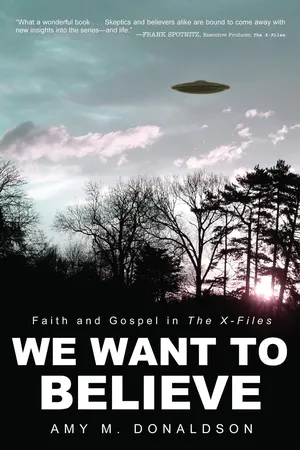
From the first episode to the latest feature film, two main symbols provide the driving force for the iconic television series The X-Files: Fox Mulder's "I Want to Believe" poster and Dana Scully's cross necklace. Mulder's poster may feature a flying saucer, but the phrase "I want to believe" refers to more than simply the quest for the truth about aliens. The search for extraterrestrial life, the truth that is out there, is a metaphor for the search for God. The desire to believe in something greater than ourselves is part of human nature: we want to believe. Scully's cross represents this desire to believe, as well as the internal struggle between faith and what we can see and prove. The X-Files depicts this struggle by posing questions and exploring possible answers, both natural and supernatural. Why would God let the innocent suffer? Can God forgive even the most heinous criminal? What if God is giving us signs to point the way to the truth, but we're not paying attention? These are some of the questions raised by The X-Files. In the spirit of the show, this book uses the symbols and images presented throughout the series to pose such questions and explore some of the answers, particularly in the Christian tradition. With a focus on key themes of the series--faith, hope, love, and truth--along the way, this book journeys from the desire to believe to the message of the cross.
Information
Topic
Theology & ReligionSubtopic
Christian Church1
I Want to Believe
MULDER: I guess I just wanted Big Blue to be real. I guess I see hope in such a possibility.
SCULLY: Well, there’s still hope. That’s why these myths and stories have endured. People want to believe. (“Quagmire,” 3x22)
From the first episode of The X-Files, you see this poster with a spaceship on it, and it says, ‘I want to believe.’ And that really is Mulder’s mantra. He doesn’t believe—he wants to believe, he wants to find reason to believe.”1 As Chris Carter describes here, the slogan on Mulder’s poster is a major theme throughout the series. I want to believe. This implies both passion and doubt, volition and uncertainty. Behind it lies the fervent desire to find something worth believing in, accompanied by the nagging possibility that the search for proof will eventually prove one wrong. Mulder wants to believe that there is other intelligent life in the universe, but the very heart of his quest is to find evidence to justify such a belief.
The search for the truth by Mulder, and Scully alongside him, symbolizes the most basic of human needs. We all long to believe in something, in some truth, that provides meaning for our everyday lives. For some people, it may be the truth about extraterrestrial life. For others, it is the truth about our existence on this planet, how we came to be here, why, and to what end. For yet others, it is the truth about experiences that defy explanation—whether there really is a divine hand behind them, and whether that divine being is personally engaged in our lives. Although many of us pursue these truths on an individual basis, we must also rely on one another in our search, on each other’s experiences and interpretations of reality. Whether or not we will proclaim it explicitly with the poster on Mulder’s wall, we all have an innate desire to believe.
The Search for Aliens and the Search for God
For Mulder, the slogan “I want to believe” refers to the truth about alien life, but the phrase can apply more broadly to the variety of places in which people search for truth or meaning. The slogan also represents the parallel that may be seen between the search for aliens and the search for God. The correlation is significant particularly in two ways: the desire for something to believe, and the nature of faith itself. The second point will be the focus of chapter 2, but it is also wrapped up in the first point, wanting to believe.
The first episode of Season 2 (“Little Green Men”) opens with a voiceover by Mulder, which begins: “We wanted to believe.” He recounts past efforts by humans to send a welcome message out into space, and SETI projects that search for possible extraterrestrial radio signals. When Mulder, at an abandoned radio-telescope observation post, experiences what might be alien contact, he still expresses doubt: “Is this just some elaborate joke played on those who want to believe?” What Mulder continues to seek is the truth about what happened to his sister, who he believes was abducted by aliens, and so he also seeks the truth about alien life. He is looking for answers to the event that forever changed his life. Therefore, his is more than simply an intellectual curiosity. He has a personal stake in whatever his search will uncover. Later in that season (“Colony,” 2x16), Mulder believes he has found some of the answers that he seeks. As he expresses it there in another voiceover, he has found justification for his belief “that there is intelligent life in the universe other than our own.” This statement sums up what many other people are looking for as well: evidence that humans are not alone in the universe, that there is other intelligence out there, usually perceived as superior or more powerful intelligence—whether that be aliens or God.
The X-Files mirrors the search for aliens and the search for God in a number of ways. In “Gethsemane” (4x24), Mulder makes this parallel explicit by comparing his quest for the truth about aliens to Scully’s belief in God. As they debate the significance of what is possibly an alien corpse, he tells her, “Definitive proof of sentient beings sharing time and existence with us, that would change everything . . . There is no greater revelation imaginable, no greater scientific discovery.” But when Scully counters, “You already believe, Mulder . . . What will proof change for you?” he replies, “If someone could prove to you the existence of God, would it change you?” This dialogue exemplifies the theme found throughout the series: the quest for the truth about alien life is a metaphor for the human search to understand whether God exists and what our relationship to God might be. This metaphor provides a vehicle for exploring what people believe about a higher power or greater intelligence, and how that is related to the evidence we find to argue for or against the existence of such a being.
At times in The X-Files, the metaphor becomes the reality, making the parallel more overt. For the alien cults, such as those led by Absalom and Josepho during Seasons 8 and 9, and for other characters who describe alien encounters in terms of religious experiences, the aliens have themselves become a type of god. For example, Cassandra Spender reports that the aliens, who abducted her repeatedly over the years, have told her “that I am an apostle, here to spread the word of a dawning of a new age of supernatural enlightenment”; Mulder thus sarcastically refers to her as “the prophet” (“Patient X,” 5x13). In a scholarly panel discussing Cassandra’s testimony, one of the panelists, Dr. Fazio, proposes that our relationship to the aliens is that of “subjects, much like we think of our relationship with God.” This is clearly Cassandra’s understanding, although others would interpret her experiences differently.
While Cassandra Spender is a fictional character, she represents a truth that extends beyond mere science fiction. In fact, in real life as in The X-Files, the line between alien and religious phenomena sometimes becomes blurred. One example is the phenomena experienced at Fatima in Portugal, beginning in 1917. The lights and otherworldly encounter are largely understood as religious, a vision of Mary. However, Jacques Vallee has described the same phenomena in terms of an alien encounter.2 He refers to the clouds parting to reveal a silver disk, an image that in other contexts is often interpreted as a UFO. What may be perceived by one person as a vision of the Holy Mother is in the eyes of another an alien visitation. Vallee assesses: “As a society, we are developing a great thirst for contact with superior minds that will provide guidance for our poor, harassed, hectic planet.”3 People are longing for something to believe in, something greater than ourselves. And in this desire, we often look to the heavens to find the ultimate truth. The fact, then, that so many people are searching the skies for “superior minds that will provide guidance” illustrates the basic human need to find a sense of meaning and purpose that transcends ourselves.
We Are Not Alone
After the opening credits, “Jose Chung’s From Outer Space” (3x20) begins Act 1 with a close-up on Mulder’s poster—“I want to believe” dominates the screen. The entire episode revolves around various perceptions of reality and truth, and therefore the various beliefs that people hold about what really happened. The primary story line is about an alien abduction, which seems to be in part a government hoax. But no one can quite explain the appearance of another alien, Lord Kinbote. The encounter that one character, Roky Crikenson, has with this alien (who looks more like King Kong than like one of the little green men) is a perfect example of the blurred lines between alien encounter and religious experience. The scene, as Roky remembers it, resembles an angelic visitation. Lord Kinbote even uses religious language, of the type that usually occurs in an encounter with a divine or heavenly figure—in other words, the alien speaks in King James English: “Roky, be thou not afraid. No harm will come unto thee” (cf. Luke 1:13, 30; Revelation 1:17). What other characters describe merely as a perplexing and unexpected encounter has become for Roky quite literally a religious experience. He uses his memories of the visionary tour of the earth’s core by Lord Kinbote as the basis for a new religion.
The episode closes with an update on several of the characters. As for Roky Crikenson, his encounter with Lord Kinbote has turned him into a preacher sharing the gospel of the enlightenment in the inner core of our souls and the inner core of the earth (where we must watch out for the lava men). But the fate of other characters is, relatively speaking, more mundane. Blaine Faulkner, the stereotypical UFO nut, continues to search for meaning in extraterrestrials and for new worlds where he can be taken away from the cares of this one (i.e., where he isn’t expected to get a job). Chrissy Giorgio has taken her experiences as a calling to better her own planet, so she has devoted herself to humanitarian causes. But for Harold Lamb, his search for meaning is much more simple and basic: he loves Chrissy and wants her love in return. As Jose Chung’s closing voiceover tells us, there are some, like Harold, who seek meaning not in extraterrestrials but in other human beings: “For although we may not be alone in the universe, in our own separate ways on this planet, we are all alone.” Each of these people is searching for meaning, for something beyond themselves to which they can devote their energy and in which they can find fulfillment. Whether it’s through aliens, religion, social causes, or human relationships, everyone is searching for some meaning in life.
This common search for meaning is described by the philosopher Blaise Pascal as an attempt to fill an “infinite abyss” within us, but that void “can be filled only with an infinite and immutable object; in other words by God himself.”4 This abyss is often referred to as a “God-shaped hole” within the human soul. The exact phrase may have derived from Jean-Paul Sartre, but the sentiment goes back to St. Augustine in the fourth century. As he says in his Confessions, “Man is one of your creatures, Lord, and his instinct is to praise you . . . The thought of you stirs him so deeply that he cannot be content unless he praises you, because you made us for yourself and our hearts find no peace until they rest in you.”5 The first half of the Confessions is a narrative of Augustine coming to this realization, doing the very thing that Pascal describes: searching in vain through philosophies, relationships, and any experience he can find to fill the longing in his heart. Finally Augustine comes to understand that the longing, the God-shaped hole, was made for and by God and therefore can only be filled by God himself. Augustine’s heart only finds peace once it rests in God.
More recently, Huston Smith, a student of world religions, has reiterated this same point: “Having been created in the imago Dei, the image of God, all human beings have a God-shaped vacuum built into their hearts. Since nature abhors a vacuum, people keep trying to fill the one inside them.”6 The X-Files illustrates this notion of the imago Dei, the image of God imprinted on each of us by our Creator, through alien DNA. Initial tests show that the wunderkind and chess prodigy Gibson Praise has extraordinary activity in part of his brain called “the God module” (“The End,” 5x20). When Scully performs further DNA tests, she finds something more incredible: there is DNA in Gibson that matches DNA from an alien claw and an alien virus, DNA that is actually common to all humanity (a genetic remnant that is usually inactive but has been turned on in Gibson). Mulder concludes that this means Gibson is part alien, but Scully voices the real implications: “It would mean that all of us are” (“The Beginning,” 6x01). Using aliens as a parallel, this is a modern, scientific way of explaining an old idea. The imago Dei is like God’s DNA within each of us. It is a part of us that is latent and waiting to meet its potential but only does so when returning to its Creator, when reuniting with God. Until that time, it leaves a longing within us to find something “out there” that will put into perspective who we are and why we are here.
With the longing for the divine, there is also hardwired into us, into our spiritual DNA, a longing for each other. “Then God said, ‘Let us make humankind in our image, according to our likeness . . .’ So God created humankind in his image, in the image of God he created them; male and female he created them” (Genesis 1:26–27). God himself is a being who lives in community, and he has created us, in his image, to be communal beings. “Let us make humankind in our image.” In ancient Near Eastern terms, God here consults the divine council; in Christian terms, he addresses the other two members of the Trinity (the Son and the Spirit). The implications for this become clearer in the next verse: “male and female he created them.” It is together that the two genders represent the image of God. Whether through male-female relationships, through friendships, through family, we most exhibit the image of God within us through our relationships with each other. God is a being who loves and who lives in relationship. Our longing to find meaning in other people, to love and be loved, is part of God’s own character and personality built into our very nature (see also chapter 4, below). It is no wonder that Harold Lamb, as narrated by Jose Chung, is searching for his meaning not in the heavens but in his love for Chrissy Giorgio. As humans, we desire to no longer feel alone, either on this planet or in the universe.
At the end of the pilot episode, an FBI superior asks Scully what her new partner thinks about the alien-abduction case they have just completed; Scully answers simply, “Agent Mulder believes we are not alone.” This sets up a major theme for the series: Are we alone in the universe? On the surface, the question applies to extraterrestrial life, but on deeper levels, it also applies to the supernatural and even to human relationships. Underlying the question are two basic points, both of which reflect essential human needs: (1) people don’t want to be alone, so we seek to connect with something or someone beyond ourselves; and (2) we feel the question is worth answering, and so we constantly push further into the universe, or into the mystical, in order to discover the truth. Mulder, then, symbolizes the fundamental human quest to answer the question and its corollaries: Are we alone? If not, who’s out there? And what is their relationship to us?
“The Grand Inquisitor”
One other way The X-Files explores the parallel between the extraterrestrial and the divine is by portraying the aliens themselves with godlike qualities. This imagery especially emerges in the final episode of Season 3, “Talitha Cumi.” The story opens with the all-too-familiar scene of a gunman gone crazy in a public place. The disgruntled, and r...
Table of contents
- Title Page
- Preface
- Introduction
- Chapter 1: I Want to Believe
- Chapter 2: Faith
- Chapter 3: Hope
- Chapter 4: Love
- Chapter 5: The Truth Is Out There
- Chapter 6: The Way of the Cross
- Epilogue
- Appendix
Trusted by 375,005 students
Access to over 1.5 million titles for a fair monthly price.
Study more efficiently using our study tools.
Frequently asked questions
Yes, you can cancel anytime from the Subscription tab in your account settings on the Perlego website. Your subscription will stay active until the end of your current billing period. Learn how to cancel your subscription
No, books cannot be downloaded as external files, such as PDFs, for use outside of Perlego. However, you can download books within the Perlego app for offline reading on mobile or tablet. Learn how to download books offline
Perlego offers two plans: Essential and Complete
- Essential is ideal for learners and professionals who enjoy exploring a wide range of subjects. Access the Essential Library with 800,000+ trusted titles and best-sellers across business, personal growth, and the humanities. Includes unlimited reading time and Standard Read Aloud voice.
- Complete: Perfect for advanced learners and researchers needing full, unrestricted access. Unlock 1.5M+ books across hundreds of subjects, including academic and specialized titles. The Complete Plan also includes advanced features like Premium Read Aloud and Research Assistant.
We are an online textbook subscription service, where you can get access to an entire online library for less than the price of a single book per month. With over 1.5 million books across 990+ topics, we’ve got you covered! Learn about our mission
Look out for the read-aloud symbol on your next book to see if you can listen to it. The read-aloud tool reads text aloud for you, highlighting the text as it is being read. You can pause it, speed it up and slow it down. Learn more about Read Aloud
Yes! You can use the Perlego app on both iOS and Android devices to read anytime, anywhere — even offline. Perfect for commutes or when you’re on the go.
Please note we cannot support devices running on iOS 13 and Android 7 or earlier. Learn more about using the app
Please note we cannot support devices running on iOS 13 and Android 7 or earlier. Learn more about using the app
Yes, you can access We Want to Believe by Amy M. Donaldson in PDF and/or ePUB format, as well as other popular books in Theology & Religion & Christian Church. We have over 1.5 million books available in our catalogue for you to explore.