- 276 pages
- English
- ePUB (mobile friendly)
- Available on iOS & Android
eBook - ePub
About this book
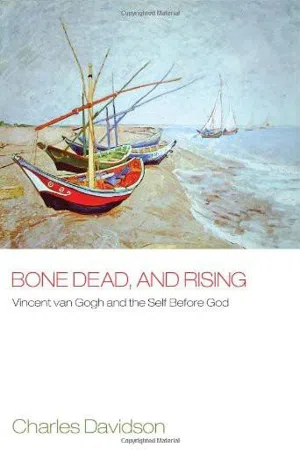
Here is a vivid, poetic, and evocative story of the painter Vincent van Gogh's struggle to become his true self. The author listens in on Vincent's most intimate, frequently startling thoughts on a host of topics, drawn from three volumes of his correspondence and his 900 extant paintings. What emerges is the portrait of an artist whose spiritual vision was borne of an agonizingly prolonged experience of the "dark night of the soul" through which his art dared to envision the triumph of joy over sorrow, of resurrection over suffering and death.
Readers will discover that in many ways Vincent's story is as much about us as about him. Tracing van Gogh's pilgrimage from being an apprentice art dealer to being called to minister, in self-renunciation and misery, among destitute coal miners, the narrative follows his winding, tortuous path into adulthood as he struggles with family, associates, lovers--and with himself. Constantly evidenced in Vincent's own eloquent words and paintings is his tussle with the mysterious presence and maddening absence of God. Vocation unveils as a process of summoning and birthing his own self, through an attempt to imitate Christ, calling forth van Gogh's extraordinary creative powers from deep within.
Adding choice supplies from other observers, Davidson here weaves his own exact, artful tapestry of interpretation, producing a suspenseful excursion into the life of van Gogh that offers profound meaning at every turn.
Information
Topic
Theology & ReligionSubtopic
Christian ChurchPART ONE
The “Birth” of an Artist
ONE
A Lark in the Sky
“Stranger on the Earth”
On the beautiful autumn Sunday morning of the 29th of October, 1876, a young Dutchman by the name of Vincent van Gogh, twenty-three years of age, feeling at once solemn and anxious, was hiking afoot in the western outskirts of London along the Thames River “in which the great chestnut trees with their load of yellow leaves and the clear blue sky were mirrored.”1 Embarked upon a mission, he was clipping off the distance of three miles, headed south from the town of Isleworth toward the Wesleyan Methodist Church in the community of Richmond.
It was to be the first time he had ever stood in a pulpit to preach the sermon—though we can envision him as a boy, his imagination sailing before him like a ship at full tilt, as he climbed upward to stand for a few moments behind the pulpit where his father had stood from Sunday to Sunday to proclaim God’s word to the people.
Looking out upon the Methodists gathered for worship, Vincent began to speak: “Psalm 119:19. I am a stranger on the earth, hide not Thy commandment from me. It is an old belief and it is a good belief, that our life is a pilgrim’s progress—that we are strangers on the earth, but that though this be so, yet we are not alone for our Father is with us. We are pilgrims, our life is a long walk . . . from earth to Heaven . . .
“Sorrow is better than joy—and even in mirth the heart is sad—and it is better to go to the house of mourning than to the house of feasts, for by the sadness of the countenance the heart is made better. Our nature is sorrowful, but for those who have learnt and are learning to look at Jesus Christ there is always reason to rejoice. It is a good word that of St. Paul: as being sorrowful yet always rejoicing. For those who believe in Jesus Christ, there is no death or sorrow that is not mixed with hope—no despair—there is only a constantly being born again, a constantly going from darkness into light . . .
“We ourselves change in many respects, we are not what we once were, we shall not remain what we are now.”2
Growing up in Holland, he had been a shy and introverted lad, coveting solitude, in contrast to his frequent fits of hot temper that made him hard to manage—and which, not surprisingly, led to his being pulled by his parents from the village school at Zundert at age nine to be tutored at home by a governess.
At age eleven, still presenting a considerable challenge to his family and teachers, he had been placed for two years in a private boarding school for boys in Zevenbergen, followed by several more lonely high school years spent away in Tilburg. Then, upon turning sixteen, with no money available for his further education, Uncle “Cent” arranged for him to try his hand at becoming an apprentice at the Goupil art firm, located at The Hague—since it was more or less “in the cards” that Vincent be groomed to follow in the hallowed footsteps of his favorite uncles.
Over the course of the ensuing seven years, before his April 1876 return to England, and before he began teaching and preaching as a pastoral assistant, he had been transferred back and forth between the firm’s London and Paris branches, where he was often seen not so much to be going about his duties as an apprentice, as to be sitting in a corner immersed in the study of Scripture or the art of various painters. With little or no aptitude and even less interest for learning how to operate the business, he mostly kept to himself rather than converse with the employees and customers.
Throughout these formative years, on many a day he was poking his head into an art exhibition, such as those at the Louvre, the Luxembourg, the British Museum, or the Royal Academy, there carefully observing the various displays and studying paintings of the great masters. All the while, he was collecting items for his scrapbooks and purchasing whatever he could afford at Goupil by way of prints and photographs to decorate the walls of his room. He was reading volumes of poetry, including Keats and Longfellow, alongside numerous other works of fiction, history, or biography, and as always the Bible. Occasionally on his travels he would stop to speak with someone he would meet, quite often a fellow artist, though he was chiefly given to solitude. During the period he was assigned to work at the Goupil gallery of London, with his mind frequently drifting from the immediate task at hand, he unsuccessfully fell in love with a lovely young Brixton woman by the name of Eugenie Loyer, to whose mother he was paying rent.
Overall, Vincent found his liking for the business of art to be wanting, but his passion for the art itself was all-consuming. His employers, who were equally as unenamored of him as he was of them, viewed him with an eye of critical skepticism and dubbed him an “eccentric.”
At last, in January 1876, Goupil had given him notice of his forthcoming dismissal, effective as of the first of April. This would leave him without job and income. On the tenth of January he had dashed off a note to his brother, Theo, saying: “When the apple is ripe, a soft breeze makes it fall from the tree; such was the case here; in a sense I have done things that have been very wrong, and therefore I have but little to say” (CL 50). He did not indicate what had “ripened” the apple or what sort of “soft breeze” had caused it to fall from the tree.
By now his attention had been drawn to the 1866 political novel Felix Holt, the Radical, written by George Eliot, which, as he said to Theo, was “a book that impressed me very much” (CL 51). The story related to the changing British social order ranging from the 1830s to the time the novel was published, addressing the tensions that existed between the conservative landed aristocracy of England and a restless industrial working class, the latter being championed by the reformist sympathies of the protagonist, Felix Holt. Themes of importance to Eliot, such as differences of attitude toward Victorian women, were central to the plot.
Vincent’s wide scope of reading to that time often had reflected his interest in historical matters as well as current events of the day, whether taking place in England or on the European continent. Eliot’s novel had resonated with the tone of Vincent’s own growing spirit of social radicalism, so much so that he passed the borrowed book on to Theo to read, asking Theo to send it to their parents before returning it to the owner.
Toward the end of January, Vincent posted a letter to Theo, declaring: “There is a phrase which haunts me these days—it is today’s text, ‘His children shall seek to please the poor’” (CL 52). He was referring to his reading of the tenth verse of the twentieth chapter of the book of Job: “His children shall seek to please the poor, and his hands shall restore their goods.”3
Subsequently, in February, Vincent read Eliot’s Scenes from Clerical Life, and made a point to mention the “tale” within it called “Janet’s Repentance,” which he said “struck me very much.” He summarized it as “the story of a clergyman who lived chiefly among the inhabitants of the squalid streets of a town” and “died at the age of thirty-four. During his long illness he was nursed by a woman who had been a drunkard, but by his teaching, and leaning as it were on him, [she] had conquered her weakness and found rest for her soul. At his burial they read the chapter which says, ‘I am the resurrection, and the life: he that believeth in me, though he were dead, yet shall he live’” (CL 55).
Back in England by the month of April, and no longer in the employ of Goupil, Vincent had decided to teach languages and math for a few months at a small school run by Mr. William Stokes in the eastern coastal town of Ramsgate. The school soon relocated to Isleworth, but Vincent quickly moved on to teach until December at another Isleworth school operated by the Reverend Mr. Thomas Slade-Jones, a Methodist minister. It was Mr. Jones whom Vincent assisted at the Turnham Green Congregational Church, located not far away from the sanctuary where Vincent preached the gospel on that auspicious autumn Sunday morning in late October. When Christmas arrived, Vincent left for Etten, Holland, to be with his family. Just as he had alluded in his sermon, it seemed that he had been possessed for some time by a recurring sense of darkness and doom. He decided therefore not to return to England but instead was introduced by an uncle to the proprietor of the bookshop Blussé and Van Braam in Dordrecht, where he went to work as a clerk for a trial period of one week in the middle of January 1877. He remained there through the end of April of that same year.
Thirty-seven years later, in June 1914, in a column published in a Rotterdam newspaper—which was based upon a conversation between the writer, Mr. M. J. Bruuse, and the son of the bookseller, Mr. D. Braat, who had personally known Vincent—Mr. Bruuse offered some impressions.
In theory Vincent had the show goods, and now and then the delivery goods, under his care . . . but whenever anyone looked at what he was doing, it was found that instead of working, he was translating the Bible into French, German, and English, in four columns, with the Dutch text in addition. . . . At other times when you happened to look, you caught him making little sketches, such silly pen-and-ink drawings, a little tree with a lot of branches and side branches and twigs—nobody ever saw anything else. (CL 1.108)
Mr. Bruuse further stated that Vincent “had not the slightest knowledge of the book trade, and he did not make any attempt to learn. . . . On the contrary, he was excessively interested in religion.” As Mr. Braat had said to Mr. Bruuse: “On Sunday he always went to church, preferably an orthodox one. . . . And during the week, well, we started work here at eight o’clock in the morning; at one o’clock he went home to lunch until three; and then he came back in the evening for a few hours. For the rest, he had no intercourse with anybody; he led an absolutely solitary life. He took many walks . . . but always alone. In the shop he hardly spoke a word. In short, he was something of a recluse” (CL 1.109).
Mr. Braat’s sister thereupon added:...
Table of contents
- BONE DEAD, AND RISING
- Illustrations
- Foreword
- Prologue
- Acknowledgments
- PART ONE
- PART TWO
- Epilogue
- Appendix
- Bibliography
- Subject Index
Trusted by 375,005 students
Access to over 1.5 million titles for a fair monthly price.
Study more efficiently using our study tools.
Frequently asked questions
Yes, you can cancel anytime from the Subscription tab in your account settings on the Perlego website. Your subscription will stay active until the end of your current billing period. Learn how to cancel your subscription
No, books cannot be downloaded as external files, such as PDFs, for use outside of Perlego. However, you can download books within the Perlego app for offline reading on mobile or tablet. Learn how to download books offline
Perlego offers two plans: Essential and Complete
- Essential is ideal for learners and professionals who enjoy exploring a wide range of subjects. Access the Essential Library with 800,000+ trusted titles and best-sellers across business, personal growth, and the humanities. Includes unlimited reading time and Standard Read Aloud voice.
- Complete: Perfect for advanced learners and researchers needing full, unrestricted access. Unlock 1.5M+ books across hundreds of subjects, including academic and specialized titles. The Complete Plan also includes advanced features like Premium Read Aloud and Research Assistant.
We are an online textbook subscription service, where you can get access to an entire online library for less than the price of a single book per month. With over 1.5 million books across 990+ topics, we’ve got you covered! Learn about our mission
Look out for the read-aloud symbol on your next book to see if you can listen to it. The read-aloud tool reads text aloud for you, highlighting the text as it is being read. You can pause it, speed it up and slow it down. Learn more about Read Aloud
Yes! You can use the Perlego app on both iOS and Android devices to read anytime, anywhere — even offline. Perfect for commutes or when you’re on the go.
Please note we cannot support devices running on iOS 13 and Android 7 or earlier. Learn more about using the app
Please note we cannot support devices running on iOS 13 and Android 7 or earlier. Learn more about using the app
Yes, you can access Bone Dead, and Rising by Charles Davidson in PDF and/or ePUB format, as well as other popular books in Theology & Religion & Christian Church. We have over 1.5 million books available in our catalogue for you to explore.