- 404 pages
- English
- ePUB (mobile friendly)
- Available on iOS & Android
eBook - ePub
About this book
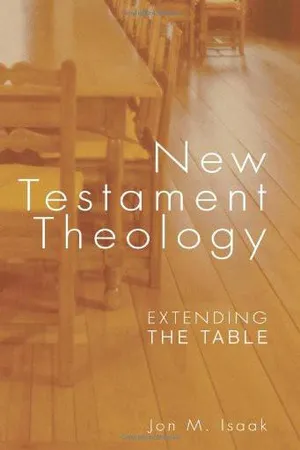
New Testament theology ought to be both descriptive and constructive-this is the argument of New Testament Theology: Extending the Table. According to Isaak, New Testament theology is descriptive in that it deals with the accounts that people narrate of their experience with Yahweh, the God of Israel, in the light of Easter. It is constructive in that it joins the diverse testimonies of the New Testament writers into a textured and thick space within which contemporary followers of Jesus continue to be shaped by the ancient yet living Spirit of God. Isaak's approach is historical, thematic, and theological in orientation. It explores the conversation taking place "around the table," where the writers of the NT share their guiding vision of God's saving work among them, and their passion for the Christian church engaged in God's mission. The differing perspectives of the New Testament authors are held together without reduction, forming a deep and rich space within which ongoing community reflection and praxis can take place.
Information
1
Introduction to New Testament Theology
In this chapter my aim is to set out some of the framework from
within which I propose to do the work of NT theology. The chapter has five objectives: (1) to review the history of biblical theology, (2) to make a case for biblical theology, (3) to assess the three main models of doing NT theology today, (4) to set out criteria for assembling a NT theology, and (5) to develop the controlling metaphor of a conference table for conceptualizing the task of NT theology.
within which I propose to do the work of NT theology. The chapter has five objectives: (1) to review the history of biblical theology, (2) to make a case for biblical theology, (3) to assess the three main models of doing NT theology today, (4) to set out criteria for assembling a NT theology, and (5) to develop the controlling metaphor of a conference table for conceptualizing the task of NT theology.
The History of Biblical Theology
The term biblical theology was first used in print by Wolfgang J. Christ-mann in 1629, but it was Henricus A. Diest’s 1643 book that functioned to establish the emerging discipline (Hasel 1978:17). These early biblical theologies amounted to collections of Bible verses collated and organized to demonstrate the biblical basis for certain points of traditional Christian doctrine. On the doctrine of God, for example, authors listed all the texts they could find in the Bible that expressed some attribute of God. Typically, they devoted one chapter to citing OT texts and one to listing NT texts. Then they proceeded on to contributions from early-church theologians and significant figures in Christian history, concluding with formulations of contemporary importance for churchly life. These scholars did not see themselves as writing biblical theology, as opposed to some other kind of theology. At this early stage, they were simply writing theology. The interests of biblical studies and doctrinal studies were completely integrated: they were one and the same thing. The discourse was shaped primarily by the traditional doctrines of the Christian creed.
The integrated situation, where doctrine governed the direction of biblical and theological discussion, was followed by two reactionary movements. They were different, but related. First, there was the pietistic reaction of the seventeenth century. In Germany, scholars like Philip J. Spener (1635–1705) voiced concerns about doctrinally dominated biblical theology. Spener felt that the situation had become altogether too scholastic and dry, serving the purposes of doctrine alone. In his 1675 book, Spener advocated a biblical theology aimed at nurturing the individual spiritual lives of Christian believers. His basic criterion for sound theology was personal significance. Others in this period of German Romanticism were instrumental in launching the home Bible-study movement that spread through Reformation churches and denominations of the time period.
Second, and a little later, there was the rationalistic reaction of the eighteenth century. Still in Germany, scholars like Johann P. Gabler (1753–1826) also began to voice criticism of biblical theology’s servitude to dogmatic theology. However, instead of calling for the criterion of personal significance as Spener had done, these scholars argued that science should be the determining criterion for sound theology. Gabler argued that human reason could be used to determine the universal truths from the biblical narrative and that these could be and should be separated from the time-bound particularities of the ancient Near Eastern culture out of which the Bible emerged. The resultant truth, distilled from the raw material, was real biblical theology. Gabler’s famous speech, delivered in 1787 at the University of Altdorf, argued for a complete separation between biblical theology (that which was descriptive, historical, and scientific) and dogmatic theology (that which was prescriptive, religious, and churchly). A few key lines from that speech read as follows:
But let those things that have been said up to now be worth this much: that we distinguish carefully the divine from the human, that we establish some distinction between biblical and dogmatic theology, and after we have separated those things which in the sacred books refer most immediately to their own times and to the [people] of those times from those pure notions which divine providence wished to be characteristic of all times and places, let us then construct the foundation of our philosophy upon religion and let us designate with some care the objectives of divine and human wisdom. Exactly thus will our theology be made more certain and more firm . . . We must diligently investigate what in the books of the New Testament was said as an accommodation to the ideas or the needs of the first Christians and what was said in reference to the unchanging idea of the doctrine of salvation; we must investigate what in the sayings of the Apostles is truly divine, and what perchance merely human. (Sandys-Wunsch and Eldredge 1980:138, 142–43)
One result of this turn of events was that an “iron curtain” was eventually erected between biblical theology and doctrinal theology. Increasingly, biblical theology was done independently of the church and almost exclusively in large universities. This was the situation as it developed in the various sectors of the Protestant Reformation tradition. Catholic theology faced its struggle with biblical theology later in the twentieth century.
By the nineteenth century few biblical-theology textbooks on the whole Bible were being written. Instead, given the shift toward history, biblical theology was replaced by the writing of OT and NT theologies. Both these kinds of books were essentially historical in nature. OT theologies reconstructed the historical development of Israel’s religion. Typical questions included the following: How did Israel’s concept of God compare to its pagan neighbors? How did Israel’s monotheism come to be? How was Canaan settled? What are the sources behind the OT books that we have today? In this period, for the first time in Christian history, the OT prophets were allowed to speak for themselves, without the NT adding anything to them. With the same independence, NT theologies reconstructed the historical development of early Christianity. Here, typical questions included the following: How did Jesus come to understand his mission? When did he come to think of himself as the Messiah? What was the nature of Paul’s struggle with Palestinian and Hellenistic Judaism? What was the relationship between the early Jesus movements? How did the formation of the Christian Bible and orthodoxy come about? What are the sources behind the NT books?
While such historical questions are certainly significant, they typically did not lead to much theological discussion. In many cases, the conversations shifted to a discussion of religion as a developing social phenomenon within a historical model of cause and effect. In the academy, this kind of biblical theology came to be known as Religionsgeschichte or the history-of-religion, which addressed the history of the traditions or confessions behind and embedded in the biblical text. The highpoint of this period came in the 1950s with the work of Gerhard von Rad on the OT and Rudolf Bultmann on the NT.
Of course, more conservative biblical theologies were produced during this time, but these only seemed to emphasize the growing wedge between biblical and dogmatic theology. Biblical theology, as practiced in the academy, came to be associated with those who thought of it as a descriptive discipline primarily interested in how humanity developed and articulated its thinking about God. Dogmatic theology, on the other hand, came to be associated with those in churchly institutions, who had much less interest in historical questions. For these scholars, theology was a confessional or normative discipline, setting out how God is to be known and worshiped by human beings.
In 1970, Brevard S. Childs named the wedge between the historical and the theological concerns as the “crisis of Biblical Theology.” The crisis erupted largely because of the stubborn insistence that a choice must be made: either biblical theology is about what humanity thinks about God, or it is about what God thinks about humanity. Either biblical theology is a dispassionate study of the development of the Judeo-Christian tradition as it emerged out of its Mediterranean cradle, or it is a study that reads the biblical texts as a witness to what God intends or desires for humanity. The polarization of purpose that marked the “crisis in Biblical Theology” for Childs in the 1970s continues today in the twenty-first century. As with most polarized debates, there seldom are only two choices. In fact, as indicated, I will argue that a strong case can be made for a biblical theology that is both descriptive (i.e., tracing the historical development of the Judeo-Christian tradition) and constructive (i.e., confessing that the voice of God’s intentions can be discerned in the collection of texts that now form the Christian Bible).
A Case for Biblical Theology
For some, it is difficult to speak confidently of doing biblical theology in the twenty-first century (see Via 2002; Penner and Vander Stichele 2005; Olson 2006; Mead 2007). In the decades since Childs named the crisis in biblical theology, two further challenges have made the prospects of doing biblical theology even more daunting. If a compelling case is to be made for a biblical theology that is both descriptive (i.e., historical) and constructive (i.e., theological), it must be able to respond to these two contemporary challenges.
First, the Western world’s diminishing confidence in the possibility of objective truth outside human subjectivity presents a challenge to the assumptions of biblical theology. This plays itself out in a growing mistrust in the historical approach. What can be said with certainty about the ancient world? Whose perspective on past events is going to be named as the “historical” account? There is a growing loss of confidence in the Enlightenment synthesis that claims there are universal, self-evident, objective truths foundational to our world, which keep it all working in order. In the same way, there is a growing loss of confidence that a biblical theology exists “out there” to discover, if we just keep looking. The shift away from the modern synthesis to an increasingly postmodern worldview presents new challenges for doing biblical theology.
The issue is that in the Western world the very nature of truth is questionable. In our increasingly postmodern world, many would say that there is only one truth: namely, my truth or perhaps the truth held by my community. Put another way, the only absolute is that there is no absolute outside ourselves and our community. The Enlightenment idea that the machine-like nature of the material world can be unlocked by human reason has fallen out of fashion. Appreciation for randomness, chaos, and chance is replacing the older fascination with the classical laws of gravitation and motion that explained the movements of planets and satellites, but that are not sufficient to explain motion at the subatomic level or at the speed of light.
Postmodernity is a reaction to the idea that there is a universal, overarching story; a unifying theory of everything; and a master plan holding everything together—all of which modernity thought could be discerned through the proper application of specific procedures. For the postmodern person such a worldview is seen as “the tyranny of the one,” as the domination of the powerful over the powerless, and as the privileged speaking for the marginalized. Attempts to find common ground on which to resolve differences are mostly futile, because there is no common ground and no master story. Therefore, attempts to construct a biblical theology that holds the message of the Bible together become questionable. Some suggest it is better to abandon the effort. Clearly the shift away from the assumption that God exists outside us, making claims on humanity through the witness of the biblical writers, presents new challenges for doing biblical theology.
Second, the emergence of multiple reading strategies has also proved to be a challenge to the task of doing biblical theology. Related to postmodernity’s challenge to the existence or nature of truth is the emergence of many different reading approaches to the Bible, which have become fashionable in the last decades.
Until recently, the only acceptable exegetical method for interpreting the Bible was the grammatical-historical method (sometimes called the historical-critical method), a product of the Enlightenment. Here, the biblical text was explored in its grammatical context (with attention to the meanings of words, to the flow of the argument or narrative, and to similar concerns) and in its historical context (with attention to the social setting of the author, the occasion of the writing, and the audience). By thoroughly considering the grammatical and the historical contexts, interpreters felt confident in determining the author’s intentions, which were assumed to be directly applicable to reading communities regardless of time or location.
Such confidence in the grammatical-historical method popularized by modernity is no longer shared by all. During the twentieth century numerous other reading strategies emerged: literary, social-scientific, rhetorical, structuralist, reader-response, feminist, liberationist, postcolonial, to name some. The obvious issue raised is one of adjudicating. Is one method better or more productive? Or perhaps each method is just as legitimate as another, since each person or community is involved in their own meaning-making enterprise. Some wonder if anyone other than the reader can determine the meaning of a biblical text, since access to the author’s intentions or to the text’s meaning is questionable. Rather than speaking of the text’s meaning, it is fashionable to speak of the community’s meaning of the text. The text funds the meaning-making enterprise and is governed by the reader’s preferred reading strategy, not by something located in the text. Clearly the shift away from the notion that a text has meaning to a more postmodern appreciation for multiple textual meanings presents new challenges for doing biblical theology.
To sum up, the earlier crisis in biblical theology is exacerbated by two of postmodernity’s assertions. First, the modern project has erred by searching for absolute, objective knowledge that is accessible through a precisely definable method. Thus, the very idea of a biblical theology is ruled out from the start. Second, all understanding is tentative, personal, subjective, and ad hoc. Thus, the plurality of meanings undercuts the enterprise of discerning an overarching biblical theology.
Now, before abandoning the enterprise of biblical theology altogether, let’s look at the postmodern challenge a little more closely. While twenty-first-century people in the West have no choice as to the worldview in which they find themselves located, they do have a choice as to how to live in an increasingly postmodern world. Some choose an isolationist approach and pretend that postmodernity is an aberration that will go away if left alone. They might say, “Retreat to the hills. Let’s set up a commune and wait it out.” This is the os...
Table of contents
- New Testament Theology
- Tables
- Preface
- 1 Introduction to New Testament Theology
- 2 New Testament Theology as a Historical and Theological Discipline
- 3 The Theological Contribution of Paul
- 4 The Theological Contribution of the Synoptic Gospel Writers
- 5 The Theological Contribution of the Johannine Traditions
- 6 The Theological Contribution of the Remaining Canonical Witnesses
- 7 Conference Intermission
- 8 Christology
- 9 Revelation
- 10 Theology
- 11 Anthropology
- 12 Pneumatology
- 13 Ecclesiology
- 14 Eschatology
- Epilogue
- Bibliography
- Index of Authors
Trusted by 375,005 students
Access to over 1.5 million titles for a fair monthly price.
Study more efficiently using our study tools.
Frequently asked questions
Yes, you can cancel anytime from the Subscription tab in your account settings on the Perlego website. Your subscription will stay active until the end of your current billing period. Learn how to cancel your subscription
No, books cannot be downloaded as external files, such as PDFs, for use outside of Perlego. However, you can download books within the Perlego app for offline reading on mobile or tablet. Learn how to download books offline
Perlego offers two plans: Essential and Complete
- Essential is ideal for learners and professionals who enjoy exploring a wide range of subjects. Access the Essential Library with 800,000+ trusted titles and best-sellers across business, personal growth, and the humanities. Includes unlimited reading time and Standard Read Aloud voice.
- Complete: Perfect for advanced learners and researchers needing full, unrestricted access. Unlock 1.5M+ books across hundreds of subjects, including academic and specialized titles. The Complete Plan also includes advanced features like Premium Read Aloud and Research Assistant.
We are an online textbook subscription service, where you can get access to an entire online library for less than the price of a single book per month. With over 1.5 million books across 990+ topics, we’ve got you covered! Learn about our mission
Look out for the read-aloud symbol on your next book to see if you can listen to it. The read-aloud tool reads text aloud for you, highlighting the text as it is being read. You can pause it, speed it up and slow it down. Learn more about Read Aloud
Yes! You can use the Perlego app on both iOS and Android devices to read anytime, anywhere — even offline. Perfect for commutes or when you’re on the go.
Please note we cannot support devices running on iOS 13 and Android 7 or earlier. Learn more about using the app
Please note we cannot support devices running on iOS 13 and Android 7 or earlier. Learn more about using the app
Yes, you can access New Testament Theology by Jon Isaak in PDF and/or ePUB format, as well as other popular books in Theology & Religion & Biblical Criticism & Interpretation. We have over 1.5 million books available in our catalogue for you to explore.