- 136 pages
- English
- ePUB (mobile friendly)
- Available on iOS & Android
eBook - ePub
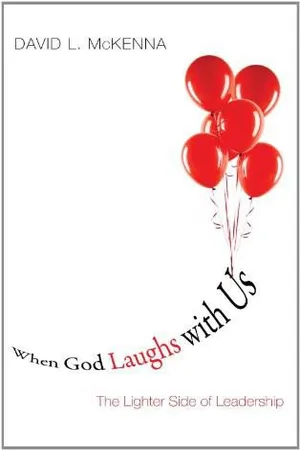
About this book
Lighten up!
Most of us take ourselves too seriously. Christian leaders, in particular, are tempted by the position they hold, or the power they wield, to lose touch with their humanity, become arrogant, and alienate their followers.
But what about our tendency to shoot ourselves in the foot, time and time again? Can we laugh at ourselves?
David McKenna, a Christian college president, brings a lifetime of learning to this question. By confessing his own foibles and laughing at the ludicrous, he finds that God is laughing with him--not to ridicule, but to give the special grace that saves us from ourselves.
The lessons are humbling when the laugh is on us, but they can lead to the discovery that a sense of humor is a partner with the witness of a joyful spirit. McKenna shows us by example how to lighten up and find God as we laugh at ourselves.
Information
Topic
Theology & ReligionSubtopic
Christian ChurchChapter 1
The Apple That Fell on Plymouth Rock
“Angels fly because they can take themselves lightly.”
—G. K. Chesterton
“Let’s all stand and sing, ‘Amazing Grace.’” On that confident command, spoken at the age of twelve, my leadership career was launched—along with a lifetime of laughter.
What in the world was I doing, leading singing in church at the age of twelve? To catch the full humor of this defining moment, come back with me to the age of nine when I heard a sermon citing scriptural proof that children become accountable for their sins at the age of twelve. The evangelist used the story of Jesus being presented in the temple by his parents as proof of his point. As if quoting Scripture, he declared, “We do not become accountable for our sins until we reach the age of twelve.” Great news for a hardened sinner who, although only nine years old, fronted for a teenage gang by putting eleven cents on the counter and lying to the storekeeper, “I’m getting these cigarettes for my uncle.” (The storekeeper knew that my father didn’t smoke.) This sin, however, paled against the time that I skipped out of fourth grade in the middle of the day and sneaked into the Wuerth Theater to watch Oliver and Hardy in Blockheads. At the age of nine I may not have been accountable, but I sure felt guilty as I sat in the balcony all alone with one eye watching the entrance for a truant officer. No wonder that I breathed a sigh of relief and decided to “sin boldly” for the next three years. On my twelfth birthday, however, the full weight of accumulated guilt hit me. I was a sinner doomed to die and in need of Christ’s forgiveness.
Sure enough, in a Wednesday night prayer meeting where everyone had to testify or go to the altar, there was no escape. The countdown left me all alone with the option of faking my faith or confessing my sin. I stood up and blurted out, “I don’t have a testimony. I am a sinner and I need Christ to forgive me.” With a burst of tears, I ran to the sawhorse altar crying for mercy. My father came from the opposite side, met me at the front, and together, we “prayed through to victory.”
My conversion set off a string of events. Of course, the prayers of my parents and grandparents were answered along with those of the little old ladies in the church who patted me on the head and said, “You are going to be our preacher boy.” Most coincidental, however, was the appearance in town of another twelve-year-old boy who traveled across the country preaching at the county fairs. Billed as “Little David,” the preaching prodigy and his troupe came to Ypsilanti, Michigan, in the same summer as my conversion. The pastor of our basement tabernacle by the railroad tracks must have sensed the competition and decided to put our own “Little David” on display. Starting at the lowest level of risk, he asked me to lead singing at the Wednesday night prayer meeting. Despite my age and lack of experience, to deny him was to deny God. So, I agreed to lead the singing of my favorite hymn, “Amazing Grace.” Like all neophytes in their first leadership experience, I imitated song leaders whom I most admired. I remembered that they always smiled, asked the people to stand, called out the number in the songbook, and then told a story. Aha! As soon as I saw that “Amazing Grace” was written by Isaac Watts, my mind—the budding mind of a future history major—latched on to the story I would tell. Feeling extra smart before a congregation of God’s best, but poorly educated, people, I spun my yarn: “Did you know that ‘Amazing Grace’ was written by Isaac Watts? He also discovered the Law of Gravity while sitting under an apple tree when an apple fell off and hit him on the head. This is one of the greatest discoveries in human history, but it is nothing compared to Isaac Watts’ other discovery, when ‘Amazing Grace’ fell and saved a wretch like him. Let’s sing it.”
Wave after wave of gratitude rolled over the people. They sang, cried, and shouted as they sang,
Amazing grace,
How sweet the sound,
That saved a wretch like me.
I once was lost,
But now am found;
Was blind,
But now I see.
After five verses and repeats, I motioned for the congregation to be seated and left the platform in triumph to take my place in the old theater seats next to my grandmother. Because her approval meant everything to me, I waited for her pat on the hand and her good word. Instead, she sat motionless and silent for a moment or two. Then, she leaned over and whispered into my ear, “Isaac Newton discovered the law of gravity.” All of the air went out of my punctured balloon. I slumped down in utter defeat. Little David had failed, and failed miserably.
While I demeaned myself and vowed never to lead anything ever again, Grandma came to my rescue. Bending down and whispering again, she said, “But no one else noticed.” Together, we lowered our heads and laughed, not just then, but for years to come.
Only in the wildest stretch could we imagine what happened next. While I continued my “pity party” our pastor took his text from Genesis and the story of Abraham obeying God by “going out by faith, not knowing where he went.” In a rampaging sermon propelled by “uhs” and “ahs” he pranced and danced on the platform in a one-man show acting out Christopher Columbus, like Abraham, sailing into the unknown in search for the new world. “Amens” and “Hallelujahs” took him to his peak when he shouted, “Praise God. Columbus sailed through storms that almost wrecked his little ship, but his faith was rewarded when he discovered America by landing on Plymouth Rock.”
Grandma and grandson doubled over in a conspiracy of bottled laughter. Nothing was said until she leaned over one more time and whispered, “God is good.”
Chapter 2
The Prank That Rocked Western Culture
“Nothing shows a man’s character
more than what he laughs at.”
more than what he laughs at.”
—Goethe
Humility is a leader’s master teacher. Among the painful memories of my years in junior high school is that of hearing my social science teacher, Mr. Cushman, single me out with the indictment, “Mr. McKenna, you have a case of an ‘exaggerated ego.’” I don’t remember what provoked his comment, but I can still feel the sting. As a kid from the modest side of town and a member of a holiness tabernacle next to the railroad tracks, I cannot imagine any reason for having a puffed head, unless it was compensation for low self-esteem.
However it is explained, an exaggerated ego is not cured all at once, but by lumps along the way. One of those lumps came in my sophomore year in college when my roommate and I tried to be funny, but failed.
Homecoming at Spring Arbor Junior College doubled as Parent’s Weekend. To show off the campus for alumni and parents, all of the dorms held open houses with prizes for the cleanest and most creative rooms. After talking over our plans, my roommate, Paul Hepler, and I decided that an open house was kid stuff that needed a touch of humor. So, tapping into Paul’s skills as an art major, we decorated our room as an old-fashioned outhouse. The plan was that alumni and parents who opened the door would be greeted by a red carpet leading to a box fashioned as a “one-holer” complete with the amenity of a Sears catalog and a crescent-shaped cutout of a half moon shining overhead.
Our perverse creation never saw the light of day. Word leaked to the President’s office and the order came back, “Lock the door and let no one in.” Our aborted attempt at bathroom humor failed, one might say, on the launching pad. On Monday morning after Homecoming and Parent’s Weekend, the Dean of Men knocked on our door and gave the order, “The President wants to see you, NOW.”
All of the dread of parental punishment fell over me. My father never punished me physically, but I respected him so much that the look in his eye could spur me on, set me straight, or turn me around. Knots still form in my stomach when I think about the time that Dad invited me for a ride on Sunday afternoon. He didn’t have to tell me why. He had trusted me with the family car when he and my mother went to Chicago for a weekend. By chance, on Saturday evening my father called home to let me know that they had cut short their trip and would be arriving early at the train station. He called to ask me to pick them up. Getting no answer at our house, Dad phoned the home of my best friend, Dick Peters. His father answered with a matter-of-fact tone, “Oh, they just left in your car for the movies.” For Dick’s family, movies were standard fare; for our family, they were a mortal sin.
Sure enough, as we rode out of the city on Sunday afternoon, Dad inquired, “Did you enjoy the movie last night?” Like a snared animal in a trap, I retaliated, “Yes, I did. How did you know?” Dad unraveled the story in keeping with my mother’s favorite admonition, “Be sure your sins will find you out.” At that moment, I wanted my father to beat me with a stick or ground me for weeks. Instead, he spoke simply and softly, “If you want to go to movies, that’s your decision, but please don’t use my car or my money.” His words slashed me like a cat-o‘-nine-tails. I had disappointed the man whom I esteemed above all others. Hell has no greater punishment.
So, as I headed for the President’s office on orders from the Dean, the memory of that Sunday afternoon ride came back to me. President James F. Gregory had become my spiritual and intellectual father. He modeled for me the godly life and challenged me to go on and study for a PhD. Just as with my father, I knew that I had disappointed him by violating his trust. What would he say?
The President’s secretary ushered me into his office. With tight lips and a crisp Canadian accent, the President stood, invited me to be seated, and came around his big desk to sit opposite to me, face to face. Dad’s Sunday afternoon speech came back in the same tone with a different text:
“David,” Dr. Gregory began, “There are certain proprieties in Western culture that we respect, whether we are Christians or not. Your display violated those proprieties. Bathroom jokes—whether in private or on public display—are not funny. You could be dismissed from college.” He paused to let the truth sink in. “If, however, you can assure me that you have learned a lesson and something like this will never happen again, I will place you on the strictest probation. One misstep and you will be expelled.”
No rebellion rose in me this time. As president of the sophomore class, I had violated my trust and disappointed my mentor. A foolish prank intended to get a laugh brought tears to my eyes as I asked his forgiveness.
From then on, I took every class in theology, philosophy, and preaching offered by the President, attended every speech or sermon that he gave, and led a non-violent student protest when the Board of Trustees asked for Dr. Gregory’s resignation because he wasn’t tough enough for the job. In fact, my next trip to the President’s office came when I went in asked him to withdraw his resignation and stay with us. Again, the gentle voice of a lover rather than a fighter spoke to say, “David, thank you for your support. The decision has been made and it is time for me to move on.” Within a short time, he was named as editor of Light and Life magazine, the official organ of the denomination, and served with great distinction as the spiritual and intellectual voice for the Free Methodist Church.
As my friend Paul Harvey would say, “Now for the rest of the story.” When James F. Gregory died in the late 1950s, he had no idea that I would eventually follow in his footsteps as President of Spring Arbor College and then Chair of the Board of Trustees for Spring Arbor University. After I spoke at his memorial service, Mrs. Gregory told me that her husband had left some things for me in his will. We went together to their home and into Dr. Gregory’s book-lined office. From the closet she pulled out his doctoral cap and gown and put them into my hands. Then, she went to his desk and picked up two books ...
Table of contents
- (Start)—When God Laughs with Us
- Prologue
- 1 The Apple That Fell on Plymouth Rock
- 2 The Prank That Rocked Western Culture
- 3 The Holy Hoop in the Sabbath Fog
- 4 The Dirty Spot on Clean Hands
- 5 The Bag That Let the Cat Out
- 6 The Tennis Racket That Unstrung a President
- 7 The Chapel with the Cha-Cha-Cha
- 8 The Untimely Twist of a Tangled Tongue
- 9 The Wet Finger on Ancient Crystal
- 10 The Buried Head on a Tilted Table
- 11 The Blind Sledder on an Alpine Run
- 12 The Jokester Who Should Have Succeeded Nixon
- 13 The Short Arm of the Law
- 14 The Rabbit That Played a Grand Piano
- 15 The Little Piggy That Went to Missions
- 16 The Yankee in Colonel Sanders’ Court
- 17 The Rainstorm and the Rebel’s Revenge
- 18 The Saintly Rider on a Wayward Horse
- 19 The Smart Campus That Sprung a Leak
- 20 The Ghost in the Choir Loft
- 21 The Bad Money in a Good Book
- Epilogue
- About the Author
Trusted by 375,005 students
Access to over 1.5 million titles for a fair monthly price.
Study more efficiently using our study tools.
Frequently asked questions
Yes, you can cancel anytime from the Subscription tab in your account settings on the Perlego website. Your subscription will stay active until the end of your current billing period. Learn how to cancel your subscription
No, books cannot be downloaded as external files, such as PDFs, for use outside of Perlego. However, you can download books within the Perlego app for offline reading on mobile or tablet. Learn how to download books offline
Perlego offers two plans: Essential and Complete
- Essential is ideal for learners and professionals who enjoy exploring a wide range of subjects. Access the Essential Library with 800,000+ trusted titles and best-sellers across business, personal growth, and the humanities. Includes unlimited reading time and Standard Read Aloud voice.
- Complete: Perfect for advanced learners and researchers needing full, unrestricted access. Unlock 1.5M+ books across hundreds of subjects, including academic and specialized titles. The Complete Plan also includes advanced features like Premium Read Aloud and Research Assistant.
We are an online textbook subscription service, where you can get access to an entire online library for less than the price of a single book per month. With over 1.5 million books across 990+ topics, we’ve got you covered! Learn about our mission
Look out for the read-aloud symbol on your next book to see if you can listen to it. The read-aloud tool reads text aloud for you, highlighting the text as it is being read. You can pause it, speed it up and slow it down. Learn more about Read Aloud
Yes! You can use the Perlego app on both iOS and Android devices to read anytime, anywhere — even offline. Perfect for commutes or when you’re on the go.
Please note we cannot support devices running on iOS 13 and Android 7 or earlier. Learn more about using the app
Please note we cannot support devices running on iOS 13 and Android 7 or earlier. Learn more about using the app
Yes, you can access When God Laughs with Us by David L. McKenna in PDF and/or ePUB format, as well as other popular books in Theology & Religion & Christian Church. We have over 1.5 million books available in our catalogue for you to explore.