- 196 pages
- English
- ePUB (mobile friendly)
- Available on iOS & Android
eBook - ePub
About this book
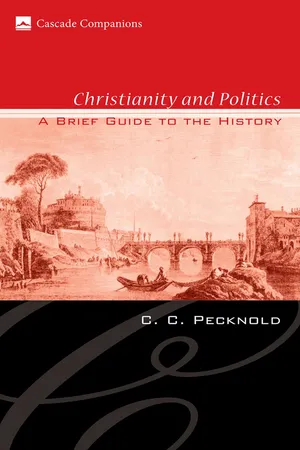
It is not simply for rhetorical flourish that politicians so regularly invoke God's blessings on the country. It is because the relatively new form of power we call the nation-state arose out of a Western political imagination steeped in Christianity. In this brief guide to the history of Christianity and politics, Pecknold shows how early Christianity reshaped the Western political imagination with its new theological claims about eschatological time, participation, and communion with God and neighbor. The ancient view of the Church as the "mystical body of Christ" is singled out in particular as the author traces shifts in its use and meaning throughout the early, medieval, and modern periods-shifts in how we understand the nature of the person, community and the moral conscience that would give birth to a new relationship between Christianity and politics. While we have many accounts of this narrative from either political or ecclesiastical history, we have few that avoid the artificial separation of the two. This book fills that gap and presents a readable, concise, and thought-provoking introduction to what is at stake in the contentious relationship between Christianity and politics.
Information
Topic
Theology & ReligionSubtopic
Christian ChurchNINE
The Freedom of the Church
While diverse bonds of neighborly love between human beings have existed over time, only in Christ can the human family be made truly whole. And we would argue here that it is only in the church catholic that Christian unity can be made visible. However, modern Christians have accepted a settlement that weakens authentic witness to the unity of Christ’s body. The settlement has been a political settlement brokered by the early modern nation-state, but accepted by people whose intellect, imagination, memory and conscience had been reformed and sometimes deformed throughout the various reform movements over time. One of the consequences of this has been that Christians have forgotten the bonds of fraternal love that would normally order their lives, their loves, and their liberties. Many Christians implicitly believe that there can be no argument about the visible bonds of Christian unity because they have also implicitly accepted the political settlement which guaranteed that any visible unity between diverse Christians would now be provided by liberal political orders.
This book suggests that such a comprehensive political arrangement is contingent and thus not necessary. It suggests that Christian political hope is better situated around new ways of imagining the visible as well as invisible bonds of unity between Christians. Christians too often accept that we are no longer allowed to even argue hopefully (i.e. hopeful that the argument will lead us to transcendent truth) about Christian unity. The determinism which is thus attached to ecclesial division is thus an extension of a people who have been ordered to a unity which is political, but is not a politics ordered to Christ’s Body. We need to return to more hopeful modes of argument, dialogue, theological reflection, prayer, and works of charity that would lead us to modes of relation we have not yet imagined.
In this concluding chapter we consider a politics of freedom that contrasts with the kind of freedom envisioned by those who framed our modern liberal orders. In our examination of these modern accounts of political freedom, an important aspect on which we have focused has been the transformation of conscience, especially in the sixteenth and seventeenth centuries. Conscience was transformed in the name of freedom, in the name of releasing human beings from the “bondage” of tradition. In the great mystical migration, the conscience was detached and reattached to the new liberal orders. This book argues that such detachments have not made us freer. Such detachments have made us forgetful of who we are, and the tradition of which we are a part. Consequently, we struggle to identify the good which is common to us. It is difficult to know how to bring faith and political reason into mutually illuminating discourse today. If we want to return our attention to the conscience, we will have to recognize that the conscience is necessarily attached to a tradition, a living memory of the good which forms us, and which directs us towards certain ends. In bringing this book to a close, we will need not only to sum up our narrative, but also to imagine a new course that is not simply a repetition of the past. Such a task is difficult, but try we must.
This concluding chapter has three parts (a sketch for a baroque triptych). Indeed, each part builds upon the previous one, but each could also be taken alone as a kind of partial conclusion. In the first part we will recall the various models for relating Christianity and politics that have been surveyed in this book, and will ask about the ecclesial criterion for thinking in this category of relation as Christians. In the second part we will examine Pope Benedict’s encyclical on Catholic social teaching, Caritas in Veritate, where he reflects on the priority of truth (and truthfulness) for the dialogue of faith and public reason, and for the formation of the conscience. Here we examine the conditions for forming the conscience in communion. In the wake of the history we have surveyed, it is crucial that we attend to the way God’s love is concretely embodied in the practice of Eucharistic communion, and even in the papacy itself, if we want to repair the ecclesial divisions that have caused us so much pain, and have so often distorted the relation of Christianity and politics. This leads us to reflect on Benedict’s vision of the papacy as “advocate of Christian memory,” and as the power of the Christian conscience. Such ecumenical reflections on the papacy lead us to the call to communion where the conscience is formed and where a genuinely Christian politics of reconciliation is a witness to God’s city which abides with us. Rather than reflect upon this abstractly, in the third part of the conclusion we narrate a Eucharistic exchange between Pope Benedict XVI and the Metropolitan of Constantinople, Bartholomew I. In this narrative mode of ecclesial relation, in the very heart of the communion between Christians in God’s triune love, our theo-political imaginations can set out on a new course.
Part I
Models of Relating Christianity and Politics
After reading a book such as this, readers may want to reflect on the history that has been described. What does the constantly shifting relationship between Christianity and politics mean for Christians today? What does it mean for the future? How should we think of the Christian conscience, the papacy or the Eucharist today as we seek to understand the relationship between faith and political reason, not only with a view to ecclesial unity, but also with a view to bring the consciences of all people into an encounter with truth? As we have reflected on this history, we have viewed a number of different models for relating Christianity and politics. Ideally, we could summarize each of them in turn here, in this concluding chapter, and discuss how the church bears witness to a freedom that is distinct from the freedom of any social or political order throughout history—just as easily as we identify those moments when the church has not been entirely true to the gifts she has received. Barring a more extensive conversation about these models, let us simply review the ones we have covered by listing them as follows:
Model 1: Persecuted Minority
Model 2: Imperial Absorption
Model 3: Two Cities
Model 4: Papal Rule
Model 5: Lutheran Wedge
Model 6: Calvinist Commonality
Model 7: Hobbesian Bodies
Readers will notice that there is no distinctively Catholic or Orthodox model for the relation of Christianity and politics, though both Latin and Greek speaking Christians have clearly participated in each of these models of relating Christianity and politics over time. As well, the way we imagine the state today is reduced to a basically Hobbesian arrangement of a comprehensive social contract which is imagined to gather and protect us from a fundamental violence in nature. One can narrate the social or political whole quite differently. The models, however, are not intended to suggest a typology. Nor are the models are an apologetic for that one perfect model (tempting as it may be, in Hegelian fashion, to construct a synthetic eighth one). There are very good reasons for why such a synthesis is not desirable, and several are worth mentioning here.
The first reason is that the only perfect model is the one that appears in the Lord’s Prayer, that God’s will be done “on earth as it is in heaven.” That is the eschatological hope of all Christians, and the end to which Christians rightly desire to direct all their actions. That is the “politics of peace” which is grounded in God’s love; and the church catholic is a visible sign of this politics for the world. So to construct a synthetic model could only look utopian, inattentive to the fact that the proper relationship between Christianity and politics is eschatological.
The second reason we have not constructed a perfect, synthetic, eighth model is that all but one of these models is historically contingent. That is, most of these models are not actually models but descriptions of real historical relations. The only model that doesn’t quite fit is the third one: Augustine’s doctrine of the two cities. It is, of course, an historical description, at least partially contingent upon the historical particulars of how Christianity and politics related in fifth century Rome. However, this model stands apart from mere historical description because it is also a model conceived by a theologian who was not trying to construct a synthetic model for the relation of Christianity and politics, but who was trying to describe the theopolitical grammar of divine revelation itself by attending to the spiritual significance of the relation between Jerusalem and Babylon that is narrated for us in the scriptures. Put differently, Augustine’s narrative about the two cities is a Christological rule for narrating all history. It is this third model that has endured “through the ages” (saeculum) and reveals the comprehensive scope of Christian thinking about politics. Indeed, all of these models can be explained by it, but it cannot be explained by any of them. That gives the third model a special place in shaping how we understand the freedom of the church in contrast to the more limited freedoms that can, and should be secured in the contingent and temporary circumstances of time (e.g. the state as one limited association amongst many).
What such an assessment should prompt in us, however, is the realization that the fundamental task set for us in reading the history of Christianity and politics is both personal and communal. What we are asking ourselves in such a search is personal: what transcendent truth could be great enough to make the effort of my journey worthwhile? As well, we are also asking ourselves communal questions about the “whole” of which we are a part. To whom do we “belong”? These questions are ultimately questions about communion with God, but they are also questions about our neighbors and our families and how we relate to one another in a way that we could all say were more or less good modes of relation—ways in which we can say with confidence that we are being formed in love and truth, ways in which sin can be squarely faced, ways in which forgiveness is possible. What we need in such evaluations of the personal and communal good are critical re-evaluations in the “category of relation.”
Thinking in the “Category of Relation”
As we have seen, the fundamental category of relation for Christians is participation in the communion of God’s triune love, visibly, mysteriously and really present in the celebration of the Eucharist...
Table of contents
- Title Page
- Acknowledgments
- An Introduction to Christianity and Politics
- One — The Western Political Imagination
- Two — God’s New City
- Three — Saint Augustine’s Two Cities
- Four — Pope and King
- Five — Towards Hobbesian Bodies
- Six — Luther and Machiavelli
- Seven — Between Calvin and Hobbes
- Eight — Restless Democracy’s True Desire
- Nine — The Freedom of the Church
- Bibliography
Trusted by 375,005 students
Access to over 1.5 million titles for a fair monthly price.
Study more efficiently using our study tools.
Frequently asked questions
Yes, you can cancel anytime from the Subscription tab in your account settings on the Perlego website. Your subscription will stay active until the end of your current billing period. Learn how to cancel your subscription
No, books cannot be downloaded as external files, such as PDFs, for use outside of Perlego. However, you can download books within the Perlego app for offline reading on mobile or tablet. Learn how to download books offline
Perlego offers two plans: Essential and Complete
- Essential is ideal for learners and professionals who enjoy exploring a wide range of subjects. Access the Essential Library with 800,000+ trusted titles and best-sellers across business, personal growth, and the humanities. Includes unlimited reading time and Standard Read Aloud voice.
- Complete: Perfect for advanced learners and researchers needing full, unrestricted access. Unlock 1.5M+ books across hundreds of subjects, including academic and specialized titles. The Complete Plan also includes advanced features like Premium Read Aloud and Research Assistant.
We are an online textbook subscription service, where you can get access to an entire online library for less than the price of a single book per month. With over 1.5 million books across 990+ topics, we’ve got you covered! Learn about our mission
Look out for the read-aloud symbol on your next book to see if you can listen to it. The read-aloud tool reads text aloud for you, highlighting the text as it is being read. You can pause it, speed it up and slow it down. Learn more about Read Aloud
Yes! You can use the Perlego app on both iOS and Android devices to read anytime, anywhere — even offline. Perfect for commutes or when you’re on the go.
Please note we cannot support devices running on iOS 13 and Android 7 or earlier. Learn more about using the app
Please note we cannot support devices running on iOS 13 and Android 7 or earlier. Learn more about using the app
Yes, you can access Christianity and Politics by C. C. Pecknold in PDF and/or ePUB format, as well as other popular books in Theology & Religion & Christian Church. We have over 1.5 million books available in our catalogue for you to explore.