eBook - ePub
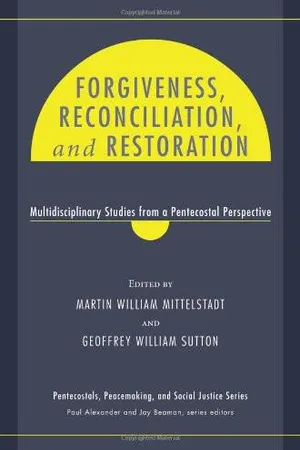
Forgiveness, Reconciliation, and Restoration
Multidisciplinary Studies from a Pentecostal Perspective
- 266 pages
- English
- ePUB (mobile friendly)
- Available on iOS & Android
eBook - ePub
Forgiveness, Reconciliation, and Restoration
Multidisciplinary Studies from a Pentecostal Perspective
About this book
Although history is replete with tales of revenge, Christian forgiveness provides an alternate response. In this volume, Pentecostal scholars from various disciplines offer their vision for forgiveness, reconciliation, and restoration. The essayists offer long-overdue Pentecostal perspectives through analysis of contemporary theological issues, personal testimony, and prophetic possibilities for restoration of individual relationships and communities. Though Pentecostals remain committed to Spirit-empowered witness as recorded in Luke-Acts, these scholars embrace a larger Lukan vision of Spirit-initiated inclusivity marked by reconciliation. The consistent refrain calls for forgiveness as an expression of God's love that does not demand justice but rather seeks to promote peace by bringing healing and reconciliation in relationships between people united by one Spirit.
Information
Topic
Theology & ReligionSubtopic
Christian ChurchA Theological Perspective
1
Pentecostals and the Gospel of Peace
Spirit and Reconciliation in Luke-Acts
Martin William Mittelstadt
A child raised in a Pentecostal church hears early and often of the importance of Scripture memorization. I remember receiving repeated challenges to memorize the words of Jesus in Acts 1:8, namely, “you will receive power when the Holy Spirit has come upon you; and you will be my witnesses in Jerusalem and in all Judea and Samaria and to the ends of the earth.” These words, possibly more than any other words, provided me and many other young Pentecostals an early synopsis of Pentecostal teaching. Pentecostals treasure intimate experience with the Holy Spirit and ensuing power for witness. While this teaching remains central to catechesis, Pentecostal identity surely extends beyond Spirit reception and empowerment. Indeed, many Pentecostals search with insatiable passion to enlarge their Pentecostal vision through fresh reading of the Scriptures. One such experience constitutes the background for this essay.
During recent readings of Luke-Acts, I began to focus upon Luke’s emphasis on peace and reconciliation. Today, as Pentecostals strive to articulate their pneumatological heritage for the current generation, I believe a fresh look at Luke’s investment in peace and reconciliation may invigorate and enlarge their missiological vision. While Pentecostals typically limit salvific language to individual reconciliation between humans and God, Luke goes further. For Luke, peace does not function as an inner state of being, but as a means of identifying humans often with a history of unforgiveness and conflict now reconciled not only to God but also to each other.
In this favorite text for Pentecostal identity, I believe Luke envisions Spirit-led proclamation of the gospel as reconciliation. I propose the following course. First, I lay a foundation for this study based upon methodological guidelines well suited for thematic discovery. By employing a literary approach, I continue with a brief introduction to Luke’s interest in the Spirit as well as peace and reconciliation. Second, in tracing the convergence of Spirit and reconciliation in Luke-Acts, I argue that Spirit-inspired witnesses solicit intentional embrace of the counter-cultural gospel of peace. On numerous occasions Luke correlates Spirit-reception and the breaking of boundaries marked by long histories that include marginalization, division, and conflict; these boundaries are replaced by the formation of an alternative community. At the same time, Luke does not avoid the implications of the rejection of reconciliation as paramount to rejection of the gospel. Finally, given the centrality of a Spirit-inspired gospel of peace, I suggest that the convergence of Spirit and peace in Luke-Acts provides fresh possibilities for contemporary Pentecostal mission.
Methodology: A Literary Analysis
The following methodological parameters serve as a guide for analysis. First, while it is possible to read Luke’s gospel and Acts as separate texts, an approach encouraged by their division in the canon, I examine them as a two-volume work. Luke’s introduction of Acts as a continuation of “all that Jesus did and taught” (Acts 1:1) establishes his desire to furnish a comprehensive and coherent narrative unity with inner integrity, overarching themes and repeated patterns.1 Second, I envision Luke as a literary artist; a gifted storyteller adept at connecting short vignettes into one long coherent narrative. His readers must take the whole story into account via narrative developments, plot lines, character roles, irony, repetition, anticipation, and fulfillment. Finally, these literary features, commonly associated with modern novels, short stories and films, provide the key to his theological intentions.2 As an artist with considerable literary skill and a rich imagination, Luke develops and sustains various motifs in order to convey his vision of Jesus Christ and of the mission that follows.
In order to prepare for the convergence of Spirit and reconciliation, I must introduce a specific literary convention employed by Luke. Luke regularly utilizes programmatic and literary prophecy, that is, a strategic literary device at critical junctures within the narrative to direct interpretation of the subsequent narrative.3 When effective, programmatic and/or literary prophecy helps the reader to anticipate the course of the story. Luke typically develops themes in the following manner: 1) previews often found in songs, oracles, and speeches anticipate the purposes of God to be realized through Jesus and his witnesses in the subsequent story; 2) repeated words or phrases often found early but also throughout the narrative receive special attention for understanding the story; 3) commission statements disclose divine purposes and tasks for particular characters and ensuing keys to the plot; 4) readers are assured that anticipatory statements come from the lips of reliable characters who often speak under the direct inspiration of the Holy Spirit.
The following well-known examples demonstrate Luke’s reliance upon this literary convention. First, Luke programmatically directs the geographical course of the Third Gospel and Acts. At Luke 9:51, Jesus begins his journey toward death in Jerusalem and in Acts 1:8, the resurrected Jesus commissions his disciples upon reception of the Spirit to take the gospel from Jerusalem to the ends of the earth. The Third Gospel marches toward Jerusalem while Acts advances away from Jerusalem. In another literary prophecy, the Lord speaks to Paul through Ananias. Ironically, Paul will not only serve as a primary apostle to the Gentiles, but as a former persecutor must suffer as he proclaims the gospel to the Gentiles (Acts 9:15–16). The subsequent narrative delivers repeated fulfillment not only of Paul’s powerful proclamation but also his severe suffering on account of the message. In a similar manner, I suggest that Luke introduces his theology of peace and reconciliation via literary and programmatic prophecies and then provides substantial fulfillment in the subsequent narrative. I turn now to a brief overview of the importance of the two motifs under consideration.
Spirit and Peace—Thematic Prominence in Luke-Acts
The preeminent role of the Holy Spirit in Luke’s writings is well documented. Given Luke’s frequent references to the Spirit in the Third Gospel and his incessant use of “Spirit” in Acts 1–12, scholarly interest in Lukan pneumatology particularly among Pentecostals comes as no surprise. Roger Stronstad, one of the foremost Pentecostal scholars to capitalize on emergent literary analyses, describes Lukan pneumatology not as initiatory, but charismatic, vocational, and prophetic.4 The Spirit inspires prophecy, worship, witness, and guidance for the inauguration, development and expansion of a new charismatic community. In the Third Gospel, Luke anticipates a new community based upon numerous Spirit-filled announcements that point to Jesus. As the Lukan narrative unfolds, Jesus serves as the consummate man of the Spirit. The paradigmatic Jesus embodies the gospel message and fills his followers with the same Holy Spirit in order to assure extension of the gospel. Luke’s emphasis upon these crucial stages resonates well with his weighty referencing of the Spirit in the programmatic birth narrative (Luke 1:15, 17, 35, 41, 47, 67, 80; 2:25, 26, 27), the inauguration of Jesus’ ministry (Luke 3:16, 22; 4:1 [2], 14, 18) and travel narrative (10:21; 11:13; 12:10, 12), and the expansion of the new community in early Acts (more than 25 references in Acts 1–12).
While the scholarly debate concerning Lukan pneumatology continues at a feverous pitch, the same cannot be said concerning Luke’s interest in reconciliation. Recent bibliographical overviews on the history of interpretation in Luke-Acts provide no category for peace, forgiveness, reconciliation, or conflict resolution.5 Due to length restrictions, I concentrate on Luke’s extensive use of the term “peace.”
The underlying political context for Luke’s narrative (and historical) world is marked by Roman occupation, war, brutality, and persecution. The political power of the Roman emperor and his empire stands as a critical backdrop for Luke’s theological integration of gospel and peace. Luke uses the word “peace” fourteen times in the Third Gospel and seven times in Acts, compared to minimal usage in Matthew (four), Mark (one), and John (six).6 Based upon a simple word count, Luke appears to be more interested in associating the word and concept of peace with Jesus’ story than other Gospel writers. Whereas a broken world remains inclined toward power, self-interest and conflict, Luke presents the challenging way of peace, a message of radical love based on God’s desire for communities built upon human inclusivity. Spirit-led characters announce the coming of Jesus who incarnates the gospel of peace. As Jesus models this gospel of peace, his followers continue to embody a...
Table of contents
- Forgiveness, Reconciliation, and Restoration
- Series Preface
- Contributors
- Acknowledgments
- Introduction
- Part 1: A Theological Perspective
- Part 2: Literary Perspectives
- Part 3: Historical Perspectives
- Part 4: Psychological Perspectives
- Part 5: A Sociological Perspective
- Part 6: An Educational Perspective
- Epilogue
- Modern Authors Index
Trusted by 375,005 students
Access to over 1.5 million titles for a fair monthly price.
Study more efficiently using our study tools.
Frequently asked questions
Yes, you can cancel anytime from the Subscription tab in your account settings on the Perlego website. Your subscription will stay active until the end of your current billing period. Learn how to cancel your subscription
No, books cannot be downloaded as external files, such as PDFs, for use outside of Perlego. However, you can download books within the Perlego app for offline reading on mobile or tablet. Learn how to download books offline
Perlego offers two plans: Essential and Complete
- Essential is ideal for learners and professionals who enjoy exploring a wide range of subjects. Access the Essential Library with 800,000+ trusted titles and best-sellers across business, personal growth, and the humanities. Includes unlimited reading time and Standard Read Aloud voice.
- Complete: Perfect for advanced learners and researchers needing full, unrestricted access. Unlock 1.5M+ books across hundreds of subjects, including academic and specialized titles. The Complete Plan also includes advanced features like Premium Read Aloud and Research Assistant.
We are an online textbook subscription service, where you can get access to an entire online library for less than the price of a single book per month. With over 1.5 million books across 990+ topics, we’ve got you covered! Learn about our mission
Look out for the read-aloud symbol on your next book to see if you can listen to it. The read-aloud tool reads text aloud for you, highlighting the text as it is being read. You can pause it, speed it up and slow it down. Learn more about Read Aloud
Yes! You can use the Perlego app on both iOS and Android devices to read anytime, anywhere — even offline. Perfect for commutes or when you’re on the go.
Please note we cannot support devices running on iOS 13 and Android 7 or earlier. Learn more about using the app
Please note we cannot support devices running on iOS 13 and Android 7 or earlier. Learn more about using the app
Yes, you can access Forgiveness, Reconciliation, and Restoration by Martin William Mittelstadt,Geoffrey W. Sutton, Mittelstadt, Sutton in PDF and/or ePUB format, as well as other popular books in Theology & Religion & Christian Church. We have over 1.5 million books available in our catalogue for you to explore.