- 152 pages
- English
- ePUB (mobile friendly)
- Available on iOS & Android
eBook - ePub
About this book
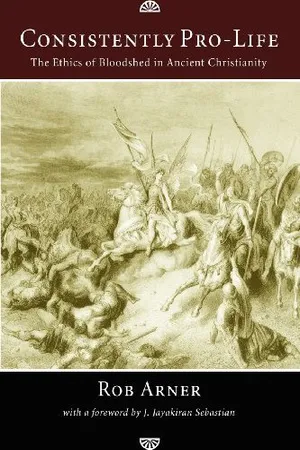
Consistently Pro-Life is a book about killing. Specifically, it takes up the question of when and under what circumstances is it morally justifiable for a Christian to take human life. The murder of abortionist Dr. George Tiller on Pentecost Sunday 2009 reignited the national debate over abortion by focusing attention on the seeming hypocrisy of those who would kill to defend life. But many times, those who would condemn the killing of Dr. Tiller would readily justify the killing of human beings in other circumstances. This leads to the question: What basis do we have to judge a specific act of violence as morally good or ethically justifiable in light of the gospel of Jesus Christ?
Rob Arner explores these issues and argues that the deliberate killing of any human being is incompatible with the moral life of a follower of Jesus. Readers will discover in the witness of the ancient Christian church an example of how modern Christians might consistently apply gospel precepts toward questions of the taking of human life. Through a new taxonomy that categorizes the ancient Christian witnesses according to individual issues such as abortion/infanticide, killing in war, and the bloody Roman "games," Consistently Pro-Life demonstrates that the early church consistently opposed the killing of human persons, and suggests that the discipline and moral clarity of the ancient Christians on issues of violence can show us a new way forward in a time of polarizing culture wars.
Information
Topic
Theology & ReligionSubtopic
Christian Theologypart one
Consistently Pro-Life?
1
Tragedy at Pentecost
Murder in Wichita
The Holy Spirit certainly never willed this.
* * *
On Pentecost Sunday, inside Reformation Lutheran Church of Wichita, Kansas, the ushers and greeters are busy preparing for the morning’s worship service. As on any other Sunday, there are hands to be shaken, church bulletins to be organized and handed out, visitors to be welcomed. But this is to be no ordinary Sunday.
Pentecost is the day that Christians commemorate the beginning of the church, the day when the Holy Spirit came upon the believers in power, as narrated in the second chapter of the Acts of the Apostles. The sound of a roaring wind, tongues of fire, and the newfound ability to speak in many languages were among the signs and wonders that accompanied the pouring out of the Spirit, testifying to the church’s commission to spread the good news of what God had done through Jesus among the nations.
As the worship service begins in Wichita, one of the ushers, a bespectacled, grandfatherly-looking figure named George, takes up his place at the entrance, prepared to hand bulletins to any late-comers who might arrive. George is approached by a lone, middle-aged man who had been attending services at Reformation Lutheran for the past several weeks. As George smiles and prepares to offer the man the church bulletin, the visitor reaches down and draws a pistol. He calmly aims it at the startled George, and fires. George is killed instantly by a single bullet to the head. He collapses, scattering church bulletins everywhere. George’s assailant then turns and flees the scene, threatening two would-be heroes with the gun as he gets into his car and speeds off.
* * *
As shocking as this murder scene in a house of worship on Pentecost is, what separates this particular homicide from the over 10,000 murders that occur every year in the United States alone? It was not the setting or the timing, but the victim and the motive. “George” is Dr. George Tiller, the notorious or courageous (depending on your perspective) abortionist, famous for being one of the very few abortion providers in the country willing to offer that service as late as the end of the third trimester of pregnancy.
Known by many supporters and opponents as the “doctor of last resort”1 because of his willingness to perform abortions in some of the most extreme cases turned down by most other physicians, Tiller was a lightning rod of controversy. Frequently outspoken in his support for what he felt to be his life’s calling, Tiller had by his own admission performed over 60,000 abortions in his thirty-year career. In an indication of the controversy his profession continues to stir up among Christian churches, Tiller had been excommunicated by his previous church, a congregation of the strongly anti-abortion Lutheran Church-Missouri Synod, for refusing to cease his practice.2 Reformation Lutheran Church, which had embraced Dr. Tiller and his profession, is a congregation of the Evangelical Lutheran Church in America. The fact that such a polarizing figure could be excommunicated by one Christian group because of their belief that his occupation was incompatible with the life of Christian discipleship, while being welcomed with open arms by another Christian group with the same theological heritage is itself a sorry commentary on the schizophrenic nature of the modern American Christian church, pointing to deep discrepancies in theological and moral foundations in the church’s various expressions. Combating a similar sort of moral schizophrenia is the subject this book.
The “Spin” Begins
The reaction to George Tiller’s murder has been strong. Pro-abortion groups began the process of Tiller’s hagiography just as quickly as anti-abortion groups had demonized him. The website of the National Abortion Federation, for example, contains a star-spangled banner alongside Tiller’s portrait, bearing the inscription “Remembering an American Hero—Dr. George Tiller.”3 Likewise, Tiller’s colleague at his Wichita abortion clinic, Dr. LeRoy Carhart, speaking at a memorial service for his fallen friend, told the assembled mourners that Tiller’s assassination was “the equivalent of Martin Luther King being assassinated.” He continued: “This is the equivalent of Pearl Harbor, the sinking of the Lusitania and any other major historic event where we’ve tolerated the intolerable for too long.”4 The president of the Religious Coalition for Reproductive Choice, which boasted Dr. Tiller as a member, called him a “humble, courageous man who dedicated his life to justice, liberty and freedom” and “a true American hero.”5 Tiller has even been called “a religious martyr in the fullest classical sense,” killed because he acted in accord with his conscience, religious convictions, and moral choices.6
Even as the accolades by Tiller’s supporters and friends were pouring in, his many fierce critics and opponents were also expressing themselves. Troy Newman, current president of the anti-abortion activist group Operation Rescue which had in recent years relocated its national headquarters to Wichita in order to directly oppose Dr. Tiller’s practice, was filled with mixed emotions. In an interview with the New York Times (before it was announced that Tiller’s clinic would be closing permanently), Newman expressed his shock and fear that the murder would encourage similar violence around the country. Referring to Tiller’s alleged assailant, he lamented, “This idiot did more to damage the pro-life movement than you can imagine.”7 After Tiller’s family announced that the clinic would not reopen after the doctor’s assassination, Newman expressed his gratitude that the goal for which he and his organization had labored had finally been accomplished, but deplored the way it came about. “We are thankful that Tiller’s clinic will not reopen and thankful that Wichita is now abortion-free,” he said, but emphasized that “this is a bittersweet moment for us at Operation Rescue. We have worked very hard for this day, but we wish it would have come through the peaceful, legal channels that we were pursuing.”8
Some anti-abortion advocates were less regretful of Tiller’s murder. Randall Terry, the original high-profile founder of Operation Rescue, did not equivocate in his opinion of Tiller. While denouncing the “vigilante justice” of the murderer, Terry called Tiller “one of the most evil men on the planet; every bit as vile as the Nazi war criminals who were hunted down, tried, and sentenced after they participated in the ‘legal’ murder of the Jews that fell into their hands.”9 Though he personally denounced the way in which Tiller was stopped, he told the National Press Club that Tiller was “a mass murderer” who “reaped what he sowed.”10
These disparate reactions to the murder of such a polarizing figure rest on the interpretation of what Dr. Tiller did for a living. If, as his defenders claim, Tiller’s occupation was one of therapy and healing for women faced with unintended pregnancy, then Tiller can rightly be called a hero for facing the daily harassment and protests outside his workplace.11 But if, as his detractors assert, Tiller was guilty of deliberately taking thousands of human lives through legitimized, institutionalized murder, then the shock and horror of antiabortion advocates is justifiable.
Three Moments in the Cycle of Violence
As has been made clear in everything from domestic abuse to international wars, violence breeds more violence, and the slaying of Dr. Tiller, far from being an isolated case of killing, is itself part of a causal cycle of violence. It was preceded by human bloodshed, and additional human bloodshed may well follow it. This manifestation of the ubiquitous cycle of violence comprises three essential “moments” that can be isolated from one another:12
- First, we have the killing of fetuses in utero via abortion. This was how Dr. Tiller made his living.
- Second, Dr. Tiller is himself killed by an assassin in the shocking murder described above.
- Third, Tiller’s alleged murderer may, upon conviction, be killed himself by the state through the violence of capital punishment, as Paul Hill was executed for the 1994 murder of abortionist John Britton and his clinic escort James Barrett.
Nobody is for killing, of course. Reasonable people would assert their opposition in principle to killing a human being in most cases. Yet with few exceptions, most people will admit certain circumstances or instances in which they believe deliberate killing can be justified, if not in fact being a positive moral good. For each of the three moments in this violence cycle, there are those who would justify one of the three specific instances of killing, while denouncing the other two. In what follows, I will analyze examples of such justifications by those who would rationalize killing in one of those three specific moments in order to better understand what happens when we drop our moral scruples against violating the imago Dei in another ...
Table of contents
- Title Page
- Foreword
- Preface
- Part 1: Consistently Pro-Life?
- Chapter 1: Tragedy at Pentecost
- Chapter 2: Justifications for the Violence of Abortion
- Chapter 3: Justifications for Anti-Abortion Violence
- Chapter 4: Justifications for State-Sanctioned Violence
- Chapter 5: The Need for Consistency
- Part 2: The Ethics of Bloodshed in Ancient Christianity
- Chapter 6: Recovering an Ancient Church Teaching
- Chapter 7: Killing Our Children: Abortion and Infanticide
- Chapter 8: Killing for Fun: Roman Bloodsport and the “Spectacles”
- Chapter 9: Killing Ourselves: Suicide
- Chapter 10: Killing Our Enemies: War and Military Service
- Chapter 11: Faithful Christians Do Not Kill
- Chapter 12: The Virtue of Patience
- Chapter 13: Realized Eschatology
- Chapter 14: Martyrdom and the Way of the Cross
- Conclusion
- Appendix A: Reading List of Primary Source Documents
- Appendix B: A Lexicon of Esteem
- Appendix C: The Semantics of Oppression
- Modern Sources Cited
Trusted by 375,005 students
Access to over 1.5 million titles for a fair monthly price.
Study more efficiently using our study tools.
Frequently asked questions
Yes, you can cancel anytime from the Subscription tab in your account settings on the Perlego website. Your subscription will stay active until the end of your current billing period. Learn how to cancel your subscription
No, books cannot be downloaded as external files, such as PDFs, for use outside of Perlego. However, you can download books within the Perlego app for offline reading on mobile or tablet. Learn how to download books offline
Perlego offers two plans: Essential and Complete
- Essential is ideal for learners and professionals who enjoy exploring a wide range of subjects. Access the Essential Library with 800,000+ trusted titles and best-sellers across business, personal growth, and the humanities. Includes unlimited reading time and Standard Read Aloud voice.
- Complete: Perfect for advanced learners and researchers needing full, unrestricted access. Unlock 1.5M+ books across hundreds of subjects, including academic and specialized titles. The Complete Plan also includes advanced features like Premium Read Aloud and Research Assistant.
We are an online textbook subscription service, where you can get access to an entire online library for less than the price of a single book per month. With over 1.5 million books across 990+ topics, we’ve got you covered! Learn about our mission
Look out for the read-aloud symbol on your next book to see if you can listen to it. The read-aloud tool reads text aloud for you, highlighting the text as it is being read. You can pause it, speed it up and slow it down. Learn more about Read Aloud
Yes! You can use the Perlego app on both iOS and Android devices to read anytime, anywhere — even offline. Perfect for commutes or when you’re on the go.
Please note we cannot support devices running on iOS 13 and Android 7 or earlier. Learn more about using the app
Please note we cannot support devices running on iOS 13 and Android 7 or earlier. Learn more about using the app
Yes, you can access Consistently Pro-Life by Rob Arner in PDF and/or ePUB format, as well as other popular books in Theology & Religion & Christian Theology. We have over 1.5 million books available in our catalogue for you to explore.