eBook - ePub
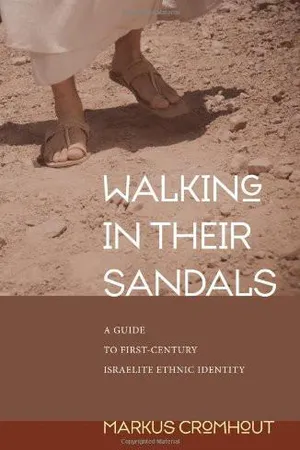
Walking in Their Sandals
A Guide to First-Century Israelite Ethnic Identity
- 144 pages
- English
- ePUB (mobile friendly)
- Available on iOS & Android
eBook - ePub
About this book
This volume invites readers to walk in Israelite sandals, that is, to take a journey of the imagination, and to immerse themselves in the identity, values, and institutions of first-century CE Israelites with the help of contemporary social-scientific studies and theories. What emerges is that the Israelites did not practice a religion. Rather, they were an ethnos, or as this book describes it, an ethnic identity, who lived out a particular way of life and culture the customs of the fathers. It is to belong to a people who obtained their collective identity, honor, and sense of worth from their socialization and membership in Israel and from the social convention of loyalty to their rich cultural tradition. It was to belong to a "world," or having a perspective on the world with its own quality of "knowledge," which, among other things, preferred collectivism over individualism, and orthopraxy over orthodoxy.
Information
1
An Introduction to Ethnicity Theory
This chapter is dedicated to the proposal and explanation of a general model of ethnicity. In the process of setting out the general model at first, it will also for the reader serve as a general introduction to ethnicity theory, bringing together some of its most important insights. Hopefully it will become obvious in the process how fruitful ethnicity theory and its application to the New Testament and/or Israelite literature can be. How fruitful this sort of interaction can be has already been demonstrated by the pioneering work of various scholars to whom I am indebted in more ways than one (e.g., Duling 2005; 2008a; 2008b; 2010; Esler 1998; 2003a; Brett 1996).
But why this preoccupation with ethnicity? It is an underlying conviction of this book that the “House of Israel” as it existed in the first century must be understood and approached as an ethnic identity, and not as a form of “religion” (cf. Stegemann 2006; Esler 2006:27). It can be argued that seeing first-century Israel as an ethnic identity—as opposed to being a form of religion—will develop to be one of the most important analytical adjustments in recent scholarship. If one reads the Bible through the lens of ethnic identity, one will proverbially see ethnic identity “screaming” for attention, and in particular illuminate our understanding of the conflict and challenges faced by the earliest followers of Jesus Messiah, as Israelites and Gentiles had to be accommodated in the same movement and which asked serious questions about identity loyalty, both old and new. The difference in emphasis argued for here may seem somewhat small if not trivial for some, yet this distinction is vital. This can be explained in an elementary form by the following contrast. For most Westerners for whom religion is in the realm of the individual and the private, being actively involved in a local church is in a way being “religious,” or being a person of “faith.” And being a Christian does not say anything per se about your ethnic identity. For the Israelites of the first century, however, religion was but one aspect of their overall identity. From a social-scientific perspective it is generally agreed that religion is embedded in the realms of kinship and politics, yet a modification is perhaps in order here. It can be argued that for Israelites in particular that their religion was embedded in the more comprehensive realm of ethnicity. This means that serving their God or living the “Judean way of life” (Ioudaismos)1 was not an expression of religiosity or spirituality as such, but more an expression of their ethnic identity—it was simply being an Israelite!
It would be something akin to Brazilians playing football, African people seeking guidance from their ancestors, Afrikaners being passionate about rugby, or cowboys wearing their hats and enjoying rodeos. So for most people, whether ancient or modern, there are some things in life—which may or may not be shared by others—which lie very close to the heart. This may be the kind of sport they play, the music they make, the traditional dances they perform, the clothes they wear, the language they speak, particular food they eat, serving their god(s), or associating with a community in which these things are shared; it is part of the rich adventure of being human and making sense of the world, finding your place in the world, or simply put, having an identity! And to reiterate, for most Israelites following the “Judean way of life” it would be an expression of their ethnic identity, which would have been the equivalent of living within the covenant, obeying God’s law (Torah), or to borrow from Paul, to do “works of the law.”
Human beings can naturally have various social identities, some more important than others, depending on underlying value systems or social situations which require expression of an identity there and then while in other situations it may need to be suppressed. Without dismissing the importance as to the fluid nature of identity and that one can step into and out of various social roles, this book has a narrow focus, namely, in ethnic identity. For many peoples of the world today, it remains the primary means of self-identification. It was arguably the same for most Israelites of the first century CE, as the various writings and archaeological record of the period bear witness and to which we will often refer.
Ethnicity theory, which will drive our study here, is part of the rich and broad enterprise of social and/or cultural anthropology. It was expected at one stage that distinctive ethnicities would disappear, since their existed more and more inter-cultural contact between various ethnic groups, and the powers of globalization were also expected to diffuse such loyalties. Yet, this prediction proved to be way off the mark, since in many parts of the world ethnic affiliation still exists, and on top of that, is growing stronger, due to inter-ethnic conflict or migrant groups forming ethnic minorities. Since the 1960s in particular, ethnicity became a major topic of investigation, and part of the endeavor is to understand the underlying dynamics of ethnicity, and also to propose how ethnic conflict can be avoided and how co-existence can be accommodated (Horowitz 1985). Although ethnic affiliation can lead to all kinds of atrocities, it should not be dismissed as an inherently negative aspect of human nature, since ethnic communities can live in peaceful co-existence. According to Stanley (1996:115):
Recent studies in comparative ethnic relations have shown that interethnic cooperation is more common in settings where relations between groups are highly structured; where they occupy different (and/or complementary) socioeconomic or territorial niches; where political power is distributed in a mutually acceptable (though not necessarily equal) manner; where they have equally long histories of residence in the same area; or where they share a common language and worldview and a similar set of values. Ethnic conflict is more likely in places where groups are competing for scarce social, economic, or territorial resources; where there are discrepancies or change in the size or political power of competing groups; where one group has migrated into the territory of another; where there is a history of conflict between groups; or where groups in the same geographical area possess discordant systems of personal and social values. (emphasis original)
Naturally, ethnic identity also provides many people with meaning—the world makes sense based on who they are, what values they hold, where they come from, the quality of life in the present, and forming a link to past and future generations.
The problem with ethnicity theory, however, is that there is still much disagreement and discussion on how ethnicity is to be defined. Is ethnicity primordial, or on the other hand constructionist, circumstantial, situational, or instrumental? More on this will be stated below, but ethnicity theory seems to be undermined by approaches that were deemed to be mutually exclusive. Some anthropologists came to see ethnicity as something difficult to wrap one’s head around. It is problematic to come to grips with because it is manifested in a myriad of ways, or alternatively, plays no role whatsoever in some contexts. In effect, it is not something “out there” but only exists in observers’ heads. Some have therefore argued for the deconstruction of ethnicity, where the concept is investigated in itself, but the underlying presuppositions of its representations must be critically engaged (Banks 1996). Yet a more sensible approach is to see the various approaches as mutually complimentary and that ethnicity can at any given time exhibit various characteristics with varying emphasis. This kind of integrative approach is also evident in the work of ethnicity theorists themselves (e.g., Scott 1990; Fenton 2003; Brubaker, Loveman & Stamatov 2004:49–52).
Since ethnicity theory is a modern construct, what relevance does it have on New Testament or biblical studies in general? A great deal! This must be qualified, however, by the fact that ethnicity theory uses concepts and models that would have been alien to the ancients, and they would have understood “ethnicity” on their own terms. Nevertheless, a degree of overlap is discernable. For example the word ethnos had a wider range of meaning in antiquity, and could refer to any grouping, human or animal, of any size. But it also acquired the meanings of “people” and “nation,” referring “to a group of people with cultural, linguistic, geographical, or political unity” (Saldarini 1994:59). It also was used to refer to “other” peoples, in contrast with one’s own. The plural form ta ethnē (also genē) was even more used of other peoples in contrast to one’s own group, and is normally associated with ethnocentric stereotyping (Duling 2005:129; Esler 2003a:55).
There is another degree of overlap between modern ethnicity theory and ancient views of peoples, since already in antiquity people were identified by their various customs, languages, phenotypical features, ancestry, and geographical location, all features recognized today as contributing towards ethnicity. The ethnographic writings of Herodotus (Histories) and Tacitus (Germania), for example, are replete with references to traditional customs, territories, languages, rites, religious practices, ancestries, kinship and phenotypical characteristics among the people they write about.
A peculiar feature of the ancients was that they believed that the locality of various peoples engendered specific character traits “rooted in the water, soil, air, and sky native to the ethnic group” (Malina & Neyrey 1996:156), and these were passed on from parents to their offspring (Malina 1996:49). For example, look at the following stereotyping of peoples associated with specific geographical regions, as we find it in the progymnasmata (rhetorical handbooks):2
Let us speak of what ought to be the citizens’ natural character. This one might discern by looking at the famous cities of Greece and by observing how the whole inhabited world is divided up among nations. The nations inhabiting the cold places and those of Europe are full of spirit but somewhat deficient in intelligence and skill, so that they continue comparatively free, but lacking in political organization and capacity to rule their neighbors. The peoples of Asia on the other hand are intelligent and skillful in temperament, but lack spirit, so that they are in continuous subjection and slavery. But the Greek race participates in both characters, just as it occupies the middle position geographically, for it is both spirited and intelligent, hence it continues to be free and to have very good political institutions, and to be capable of ruling all mankind if it attains constitutional unity. (Politics 1327b.1–2)
You will come to the topic of his native country. Here you must ask yourself whether it is a distinguished country or not [and whether he comes from a celebrated and splendid place or not]. If his country is famous, you should place your account of it first, and mention it before his family . . . If the city has no distinction, you must inquire whether his nation as a whole is considered brave and valiant, or is devoted to literature or the possession of virtues, like the Greek race, or again is distinguished for law, like the Italian, or is courageous, like the Gauls or Paeonians. You must argue that it is inevitable that a man from such a [city or] or nation should have such characteristics. (Menander Rhetor 2.369.18—370.5)
Ethnic groups were therefore subject to stereotyping, and unlike modern sensitivities, having certain characteristics were seen as a “natural” part of life. People were not so much self-made or socialized into a way of life, they were understood to be born with it. It was something flowing through their veins. For Israelites the phenomenon of stereotyping of the “other” also applies, but perhaps for other reasons. They would have understood themselves as “kingdom of priests and a holy people (ethnos hagion)” (Exod 19:6), in contrast to Gentiles who are “impure” or morally degenerate, because they were not elected by God and did not receive his Law. However it came to be, stereotyping was part and parcel of the ancient way of identifying your own or other “peoples” and gives further evidence that what we understand today as “ethnic groups” had their equivalent in antiquity.
It can also be argued that ethnic groups existed in the biblical world, if not at all periods, ever since humankind decided to group together in more or less permanent settlements (cf. Duling 2005:127–29; Esler 2003a:53). According to Anthony Smith (1986:32–46; 1997) ethnic communities played an active part in human society from at least the third millennium BCE. He suggests that what helped to shape ethnic groups were (1) sedentarization and nostalgia, where pastoral and nomadic lifestyles were replaced with small village settlements. This led to the creation of local folk culture and ties, to which was attached a nostalgia for the past; (2) organized religion, where ethnic origins were explained through mythical tales and connected with religious beliefs about creation. Religion also helped to communicate ethnic myths and symbols; and (3) inter-state warfare between different kinds of political authority. Smith (1986:46) concludes that “ethnicity provides one of the central axes of alignment and division in the pre-modern world, and one of the most durable.”
For now let us focus our attention on the general model of ethnicity that will be prop...
Table of contents
- Walking in Their Sandals
- Abbreviations
- Introduction
- Chapter 1: An Introduction to Ethnicity Theory
- Chapter 2: A Socio-Cultural Model of Israelite Ethnicity
- Chapter 3: What Advantage Is There in Being a Judean?
- Bibliography
Trusted by 375,005 students
Access to over 1.5 million titles for a fair monthly price.
Study more efficiently using our study tools.
Frequently asked questions
Yes, you can cancel anytime from the Subscription tab in your account settings on the Perlego website. Your subscription will stay active until the end of your current billing period. Learn how to cancel your subscription
No, books cannot be downloaded as external files, such as PDFs, for use outside of Perlego. However, you can download books within the Perlego app for offline reading on mobile or tablet. Learn how to download books offline
Perlego offers two plans: Essential and Complete
- Essential is ideal for learners and professionals who enjoy exploring a wide range of subjects. Access the Essential Library with 800,000+ trusted titles and best-sellers across business, personal growth, and the humanities. Includes unlimited reading time and Standard Read Aloud voice.
- Complete: Perfect for advanced learners and researchers needing full, unrestricted access. Unlock 1.5M+ books across hundreds of subjects, including academic and specialized titles. The Complete Plan also includes advanced features like Premium Read Aloud and Research Assistant.
We are an online textbook subscription service, where you can get access to an entire online library for less than the price of a single book per month. With over 1.5 million books across 990+ topics, we’ve got you covered! Learn about our mission
Look out for the read-aloud symbol on your next book to see if you can listen to it. The read-aloud tool reads text aloud for you, highlighting the text as it is being read. You can pause it, speed it up and slow it down. Learn more about Read Aloud
Yes! You can use the Perlego app on both iOS and Android devices to read anytime, anywhere — even offline. Perfect for commutes or when you’re on the go.
Please note we cannot support devices running on iOS 13 and Android 7 or earlier. Learn more about using the app
Please note we cannot support devices running on iOS 13 and Android 7 or earlier. Learn more about using the app
Yes, you can access Walking in Their Sandals by Markus Cromhout in PDF and/or ePUB format, as well as other popular books in Theology & Religion & Biblical Criticism & Interpretation. We have over 1.5 million books available in our catalogue for you to explore.