eBook - ePub
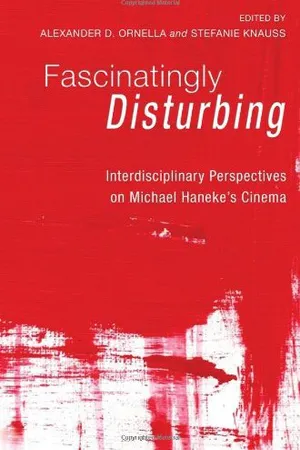
Fascinatingly Disturbing
Interdisciplinary Perspectives on Michael Haneke's Cinema
- 342 pages
- English
- ePUB (mobile friendly)
- Available on iOS & Android
eBook - ePub
Fascinatingly Disturbing
Interdisciplinary Perspectives on Michael Haneke's Cinema
About this book
Michael Haneke is one of Europe's most successful and controversial film directors. Awarded the Palme d'Or and numerous other international awards, Haneke has contributed to and shaped contemporary auteur cinema and is becoming more and more popular among academics and cinephiles. His mission is as noble as it is provocative: he wants "to rape the audience into independence," to wake them up from the lethargy caused by the entertainment industry. The filmic language he employs in this mission is both highly characteristic and efficient, and yet his methods are open to criticism for their violence toward and manipulation of the audience. The aim of this book is to analyze critically Haneke's aesthetics, his message, as well as his ethical motivation from an interdisciplinary and intercultural perspective. Contributors to the book come from a variety of academic disciplines and cultural backgrounds-European and North American.
Information
Topic
Theology & ReligionSubtopic
Religious Art1
“We Live in a Permanent State of War”
An Interview with Michael Haneke
Franz Grabner
Grabner: One might be inclined to ask “What’s become of the positive, Mr Haneke?” in reference to a poem by Erich Kästner, which you yourself once quoted. Looking at your films up to now, it is clear that death plays a central role, but also an “unnatural” role, as it is always brought about by human beings themselves.
Haneke: I believe “unliveable” life plays a central role in the trilogy. Death, or rather suicide, is merely an outcome. On the one hand, these films make it clear in the way they are structured that these are not merely individual cases, but they do in fact concern us all. On the other hand, the situations depicted in these films are tapered to such an extent that the protagonists in question have no means of acting freely. That ought to make the audience feel slightly nervous. And I think that’s quite a fitting analogy to the reality of our own social reality in the so-called affluent society. It is quite difficult not to recognize suicidal tendencies within this society. I would say this kind of provocation is absolutely necessary. It is necessary to ask questions in an era when the official reaction is to assuage concerns by offering incessant answers. What’s more, these questions are absolutely necessary as the chasm between the questions and the answers has widened to an unfathomable level. Friedrich Dürrenmatt summarized this quite neatly: “Nowadays, a story must always exhibit a catastrophic turn for it to be accepted as a worthwhile story.” I think it’s very difficult to disagree with this, because every fictional story—irrespective of how abysmal and harrowing it is—is really pathetic in comparison to the horrors of reality we experience. One needn’t be a pessimist to understand this—just being awake should suffice.
Grabner: Your cinematographic work has been mainly defined by these horrors and the often absurd escalation of the stories. But if one looks at Funny Games or Time of the Wolf, one might end up with the impression that society consists solely of violent madmen. You yourself have talked about a “civil war.” But surely this doesn’t happen in reality?
Haneke: I think it’s difficult to deal with both films in tandem.
Funny Games is a filmic reflection on media representations of violence, and the two lads in the film are not characters as such but rather artefacts, in other words a reconstruction of media archetypes.
By contrast, I did try to replicate contemporary reality in all its contradictions in Time of the Wolf. I don’t agree that there are only thugs and madmen in the film. It’s far more about people trying to deal with each other—successfully to some extent—in a human(e) manner over the course of this story.
As far as the expression “civil war” is concerned, yes, I do believe that we live in a permanent state of civil war. I don’t mean the war of us rich versus the poor of this world. It’s impossible to deny that war anyway, and I hope that will also be a thorn in the side of each and every one of us. What I was referring to with “civil war” was the war of carelessness and unkindness, which is something all of us participate in day in day out. The daily wounds from this civil war are perhaps the real reasons behind the so-called “real” wars.
Grabner: So why invent more harrowing stories?
Haneke: Because we shut our eyes to the horrors of reality in order to endure them in the first place. Suppression is the original sin, both in social and individual terms—we are all powerless against it.
Perhaps we invented art just to have a small weapon against it. The “positive” you asked about (Kästner actually answered this question in his poem in a very amusing way: “The devil knows what’s happened to it. And still you accord the good and the beautiful merely the empty space above the couch. You still can’t get used to the idea of being clever and courageous at the same time.”), this positive can only mean the relentless demand of personal truthfulness. Yet, the truth is no longer beautiful. It’s as Nietzsche said in the last century: “It’s undignified for a philosopher to say the good and the beautiful are one. And if he were to add: and the true!, one should beat him. Truth is ugly.”
But back to the films: I try to make the viewer feel provoked and forced to do something against what I am showing him/her. I don’t offer solutions, I merely pose the questions. It’s the politicians’ job to offer solutions: to offer lies and assurances. If solutions existed, the world wouldn’t be the way it is at present. That is why we must ask the right questions, and if they are not the correct questions, then at the very least they should be productive questions asked in such a pressing manner that they effect something in the viewer: anger, energy, the wish to resist the huge swindle of compromise, to be discontent, to question oneself. Insight is always a shock!
Working in the metier of film, one asks oneself: what are the adequate means to elicit this type of provocation, how do I achieve this productive restlessness in a viewer? The psychological realism of mainstream cinema is utterly useless in this respect. Every escalated constellation and every problem very quickly have their boil lanced, which in turn allows the viewer to reduce the events to the individual character whilst keeping out of it as a passive onlooker. I was made aware of the case with which The Seventh Continent deals through an article in the magazine Stern: the reporting journalist listed anything and everything that could be used as an explanation for the shocking family suicide: the family’s financial situation, the married couple’s sexual problems etc. etc. The effect of this was that the only thing left of the horror of the deed was a voyeuristic, psychological, and perhaps pathological isolated case, which had no disconcerting effect on readers, let alone served as a reason to search for disturbing similarities in one’s own life.
Mainstream cinema uses the same form of narration. Take, for example, Falling Down—the constellation of events is very similar to that of 71 Fragments: a man runs amok, because he cannot cope with the stupor, the brutality, and the mendacity of daily social reality. But what did the Americans do in order to attract an audience? They turned it into an action-packed melodrama about a fascistic unemployed person, who has also got huge marital problems. In so doing, the explosive nature of it all is taken out and every viewer who hasn’t got marital problems or isn’t unemployed can ignore the case as not applicable to his or her circumstances. I’m trying to find a form that will make this impossible and that will place the viewer at the centre of the story with all his/her fears and aggression by including a radical escalation and by avoiding individualized psychological patterns. The viewer thereby fills the empty matrix. S/he has the responsibility for this.
Grabner: This answer is a double-edged sword for the viewer.
Haneke: Give me one example of contemporary literature that deserves to be called literature without offering opposition towards the status quo! And I don’t mean just as far as its content is concerned, but also in its form. “The anti-social aspect of art is the definite negation of a certain society”—Adorno made this point already half a century ago. Anyone associated with what is vaguely called “art”-production—writers, painters, musicians, or whatever—will accept that as a self-evident premise of his/her work. I say “art”-production and not “culture”-production, because culture means something very different in the age of media-driven mass-democracy. It means an affirmation of the existing status quo. Therefore the question has got to be altered slightly: film, the industrial product of film, which aesthetically-speaking still pretends that we are living in the nineteenth century, is undoubtedly part of the culture industry. It has little to do with the radicalism that still typifies “art.” Not because its producers are not capable of this, but because the production of a film—the most financially dependent production of an artefact, because it’s also the most expensive form of production—does not grant space to an oppositional position to common sense by its very definition. Film must be marketable.
Take “violence” as an example—a central theme of our social reality. Due to its means of representation film is probably the most suited of all media to deal with this. And indeed, cinema has made the biggest financial gains precisely in this area: action thrillers are the most profitable genre of the medium on a global scale. How so? By making violence consumable: through aestheticization and dramaturgic legitimization. What we feel in the cinema is the superficial allure of violence, a more and more virtuoso maelstrom of blood and gestures. It is very difficult for us to withdraw ourselves from the speed and allure of this maelstrom, and we can identify with a representative, the hero, who is legitimized through the narration and the plot, and with whom we can kill and shoot and fight, without having to think about the moral hangover. Bad conscience doesn’t sell. We all sit in the helicopter in Apocalypse Now and are firing the guns at the ant-like Vietnamese to the “Ride of the Valkyries,” firing at what is alien, unfathomable, fear-inspiring, to be extinguished, and we feel as relaxed as having visited the sauna, because we do not have any responsibility for the massacre, because what is responsible for this is communism, the impenetrable political sleaze in Washington, or if needs be the American president, who isn’t even a good friend of us. We all gladly pay seven Euros for that, don’t we?
Grabner: So what’s the difference to the way violence is portrayed in your films?
Haneke: Firstly, violence is never depicted from the perspective of perpetrators. It appears as what it really is: the suffering of victims. Hence the viewer gets to see what it actually means to exercise violence and that is why these films are seen as painful. Where I do show violence being exercized, I try to make it clear to the viewer through particular formal means that s/he is a voyeur, and I try to ruin the “consumption” of violence for him/her. Take, for example, the murder in Benny’s Video: the viewer does not get to see the murder—it takes place almost exclusively off-screen and we can only hear what’s happening—instead the viewer can only see a TV set and on this TV set, which is showing the adolescent murderer’s room, which he himself is recording with his video camera, there is nothing to be seen: it is only our fantasy—spurred on by the noises—that enlivens the screen. And later on, when the murderer shows his parents the video recording, all we can see again is the TV screen and the parents’ heads, which echo our own horror that we felt earlier. In this manner, the viewer has no real opportunity to enjoy the violence, or rather to participate in it guiltlessly. . .
Grabner: . . . which is a form of narration, which you stick to in other films, for instance, Funny Games . . .
Haneke: Well, I refined the process somewhat for that film. I turn the viewers into the accomplices of the perpetrators and then I accuse them of being just that—in order to make them feel how easy it is to manipulate them, and that their voyeuristic enjoyment is based on self-deceit.
The second point, however, is this: there is never any violence in my films that is legitimized. “Normally” that is the precondition for any violence in films: the policeman fights for law and order against the criminal, those seeking revenge are doing this only because of something that happened before the film and thus they merely react, a murder inspired by jealousy is the result of sexual humiliation and so on. There is always a deed in the past that legitimizes the violence that now dominates the screen. And the gravity of said deed merely acts as an alibi for being particularly brutal and gruesome when atoning for the ...
Table of contents
- Title Page
- Acknowledgments
- Introduction
- Voices
- Chapter 1: “We Live in a Permanent State of War”
- Chapter 2: How Much Haneke Do We Deserve?
- Traces
- Chapter 3: Theology, Aesthetics, and Film
- Chapter 4: Stasis
- Chapter 5: Guilt and Sin in the Work of Michael Haneke
- Off
- Chapter 6: Pieces of Truth for Moments of Death in Michael Haneke’s Cinema
- Chapter 7: Just Like a Prayer
- Chapter 8: Cat and Mouse
- Dialogue
- Chapter 9: The Marriage of Past and Present
- Chapter 10: Auteurism and the Aesthetics of Irritation
- Chapter 11: A Game Gone Wrong or a Perversion?
- Constructions
- Chapter 12: On Puzzles and Scores
- Chapter 13: Surveillance and Voyeurism in Haneke’s Code Unknown and Caché
- Chapter 14: Ethical Solicitations and the Film Poetics of Michael Haneke’s Caché
- Chapter 15: The Struggle for Identity, or Michael Haneke’s Ethics
- Michael Haneke’s Filmography
- Contributors
Trusted by 375,005 students
Access to over 1.5 million titles for a fair monthly price.
Study more efficiently using our study tools.
Frequently asked questions
Yes, you can cancel anytime from the Subscription tab in your account settings on the Perlego website. Your subscription will stay active until the end of your current billing period. Learn how to cancel your subscription
No, books cannot be downloaded as external files, such as PDFs, for use outside of Perlego. However, you can download books within the Perlego app for offline reading on mobile or tablet. Learn how to download books offline
Perlego offers two plans: Essential and Complete
- Essential is ideal for learners and professionals who enjoy exploring a wide range of subjects. Access the Essential Library with 800,000+ trusted titles and best-sellers across business, personal growth, and the humanities. Includes unlimited reading time and Standard Read Aloud voice.
- Complete: Perfect for advanced learners and researchers needing full, unrestricted access. Unlock 1.5M+ books across hundreds of subjects, including academic and specialized titles. The Complete Plan also includes advanced features like Premium Read Aloud and Research Assistant.
We are an online textbook subscription service, where you can get access to an entire online library for less than the price of a single book per month. With over 1.5 million books across 990+ topics, we’ve got you covered! Learn about our mission
Look out for the read-aloud symbol on your next book to see if you can listen to it. The read-aloud tool reads text aloud for you, highlighting the text as it is being read. You can pause it, speed it up and slow it down. Learn more about Read Aloud
Yes! You can use the Perlego app on both iOS and Android devices to read anytime, anywhere — even offline. Perfect for commutes or when you’re on the go.
Please note we cannot support devices running on iOS 13 and Android 7 or earlier. Learn more about using the app
Please note we cannot support devices running on iOS 13 and Android 7 or earlier. Learn more about using the app
Yes, you can access Fascinatingly Disturbing by Alexander Darius Ornella,Stefanie Knauss, Ornella, Knauss in PDF and/or ePUB format, as well as other popular books in Theology & Religion & Religious Art. We have over 1.5 million books available in our catalogue for you to explore.