- 202 pages
- English
- ePUB (mobile friendly)
- Available on iOS & Android
eBook - ePub
About this book
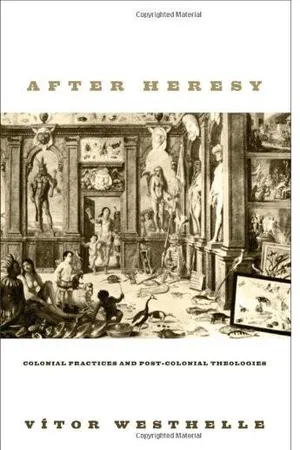
In this important contribution to post-colonial theological studies, the argument is made that religious practices and teachings imposed on colonized peoples are transmuted in the process of colonization. The very theological discourse that is foisted on the colonized people becomes for them, a liberating possibility through a process of theological transformation from within. This is offered as an explanation of the mechanisms which have brought about the emergence of the current post-colonial consciousness. However, what is distinctive and unique about this treatment is that it pursues these questions with two basic assumptions. The first is that the religious expressions of colonized people bear the outward marks of the hegemonic theological discourse imposed on them, but change its content through a process called "transfiguration." The second is that the crises of Western Christianity since the Reformation and the Conquest of the Americas enunciates the very process through which post-colonial religious hybridity is made possible.
This book unfolds in three parts. The first (the "pre-text") deals with the colonial practice of the missionary enterprise using Latin America as a case study. The second (the "text") presents the crisis of Western modernity as interpreted by insiders and outsiders of the modern project. The third (the "con-text") analyses some discursive post-colonial practices that are theologically grounded even when used in discourses that are not religious.
Some of the questions that this project engages are: Is there a post-colonial understanding of sin and evil? How can we understand eschatology in post-colonial terms? What does it mean to be the church in a post-colonial framework? For those interested in the intersection of theology and post-colonial studies, this book will be important reading.
Information
Topic
Theology & ReligionSubtopic
Christian Church1
The Conquest: Interest and Desire
Colombo! Fecha as portas de teus mares.
[Columbus! Shut the doors of your seas.]
—Antônio de Castro Alves1
Discovered because invented because imagined
because desired because named, America became
the utopia of Europa.
because desired because named, America became
the utopia of Europa.
—Carlos Fuentes2
The Pre-text of Colonization
Colonialism is, from its inception, a complex and multifaceted phenom-enon. Its beginnings were no less complicated, for different and often conflicting parties were involved in it. To make a binary juxtaposition of oppressor and oppressed as the interpretative principle is naïve, at least, and, at most, deceptive to the point of being misleading about what is at stake. Colonial interests are not necessarily in sync with the colonist’s desires. The same can also be said about the colonized, but that will be discussed later. The Conquest of the Americas, along with the late-fifteenth-century Portuguese maritime ventures into Asia, serves as the best template for understanding the design of modern colonialism. The three key players in this reprehensible but historic venture were the sponsoring crown, the patronage of the church, and the conquistadores themselves. The strange alliances they formed and their divergent colonial projects are nothing but a personification of their conflicting interests and desires. And the situation gets even more complex, because the individual nation-states claiming a colony were in dispute with other nations competing for domination. Armed conflicts were not the only evidentiary proofs for this rivalry, for they also resorted to ideological warfare—compounded by theological rationales—to justify a given party’s claim to power while discrediting and denigrating opponents.
The Conquest of the Americas is the pre-text of the colonial inscription of the world under the parameters of Western hegemony. The agents of this pre-text were the conquistadores who established the conditions for the colonial project. But who were they? Customarily, what is presented is a very bleak picture of the conquistadores. They were no raiders of the Lost Arc but raiders nevertheless, eager to amass the fast and immediate wealth of gold, silver, precious stones, etc., through plundering and pillaging. And this certainly is also true. Columbus’s mission, as history tells us, was to find gold. His diary, transcribed by Las Casas, has Columbus ordering his men not to take anything from the Indians other than gold. “The Admiral ordered that nothing should be taken, in order that they surmise that the Admiral wanted nothing but Gold.”3 Felipe Guaman Poma de Ayala, the Inca chronicler, in the beginning of the seventeenth century wrote about a thousand-page report on the situation of Peru under colonial rule with many graphic illustrations, Nueva Crónica y Buen Gobierno, and in it there is a sketch of an encounter between a conquistador and an Inca in which the Inca offers the Spaniard a plate with gold in it. The Inca asks the conquistador: “cay coritacho micunqui?” which in Quiché means: “Do you eat this gold?” And the Spaniard answers in Castilian: “Este oro comemos!” (“This gold we eat!”)4 There is clear sarcasm in the portrayal with the Inca suggesting that for the Spaniard gold was the means of subsistence. The plundering of the treasuries of the great civilizations of the Inca in South America, the Maya in Central America, and the Aztecs in the south of North America seems to indicate that this was the real motivation and offered one of the pre-texts for the conquest. This image of the conquistadores was responsible for the creation of the so called leyenda negra, the “black legend”, which accounted for the particularly inhumane way in which the conquistadores would deal with Indians; enslaving, torturing, and killing them, all in the name of the idol that they were fixated on—gold.
The Black Legend
Despite its credibility, the picture of the conquistadores presented in the “black legend” does not fully account for what they really represented. And this is much more revealing than finding a character flaw in the conquistadores, as if they were a particular aberration of the Iberian character. The “black legend” describes the sort of reception or propaganda that was prevalent in Europe in connection with the Spanish conquest. Certainly the chronicle of Guaman Poma would have helped the propagation of the legend, but the manuscript sent to King Felipe of Spain was probably never read in Europe until centuries later.5
The emergence of this legend is older than Guaman Poma’s chronicle and is connected to the name of the celebrated bishop Bartolomé de las Casas, above all to the appearance in 1542 of his Brevíssima relación de la destruyción de las Yndias.6 The book by Las Casas was already widely read in the manuscript form before it was first published by the emerging press of Seville in 1552 and before it was translated into French (1579), English (1583), Dutch (1607), and also Italian (1630). This book, together with other chronicles of Las Casas, is considered to be the main source for the emergence and popularity that the black legend received in Europe. The legend portrays a grim picture of Spain and accuses the debased nature of its conquistadores for the atrocities that befell the New World. Needless to say, this kind of propaganda served the interest of other powers that were eager and willing to oust Spain and Portugal from their dominant role in the Americas.
Although Las Casas is acclaimed, with some reason, to be the forerunner of liberation theology in Latin America, his reports or chronicles is fraught with some problems that not even a sympathetic reader should fail to observe. His narrative is very repetitive, and there are some plausible reasons to believe that there is exaggeration in some of his data. Even though there is no doubt that the picture that Las Casas gives is by no means a figment of his imagination, the basic point that speaks against his ferocious attack on the conquistadores and encomenderos is that he had turned the explanation or the logic of the conquest into a character flaw of some men for whom gold and treasures was all that mattered. Here is a section of his “Brief chronicle”:
We hold as a thing most certain and true that in this forty years there have been about twelve millions—men, women, and children—killed tyrannically and unjustly, on account of the tyrannical action and infernal works of Christians; and in truth I do believe, without thinking to deceive myself, that there were about fifteen million. . . .
The cause for which Christians have often slain and destroyed so many and such infinite number of souls, has been simply to get, as the ultimate end, the Indians’ gold of them, and to stuff themselves with riches in a very few days, and to raise themselves to high estates—without proportion to their birth and breeding, it should be noted—owing to the insatiable greed and ambition that they have had, which has been greater than any the world has ever seen before. For those lands were so favored and so rich, and the people thereupon so humble, so patient, and so easy to subject, yet the Christians have had no more respect for them, nor have had for them no more account or estimation (I speak truly, for I know and have seen the entire time) than—I would not say for beasts, for pray God that being beasts, the Christians might have respected them and treated them with some gentleness, and some esteem—but less than the dung heaps of the towns. . . .7
What Las Casas did not fully realize was that a new logic was at work. The conquistadores were the forerunners of modern colonialism and not simply an Iberian deviation of character.
By virtue of his denunciations, Las Casas was the target of attack, above all by encomenderos, the class to which the very Las Casas belonged before his “conversion.” Encomenderos were the immediate successors of the conquistadores, to whom portions of land and their inhabitants were entrusted. The land was to be explored and the natives to be catechized, instructed in Spanish culture in exchange for labor. There is no doubt that Las Casas was a valiant bishop and one of the early prophetic voices of extreme importance still to this day in Latin America. His outcry is fundamental to understanding the character of the conquest. But precisely because of his inflated rhetoric, his text minimizes the problem by reducing it to a character flaw on the part of Spaniards. The mechanisms of conquest were not only those represented by the encomenderos or the conquistadores. The mechanisms continued to operate throughout the centuries with different methods and by different actors. The conquest was not only Spanish. It was also Portuguese, British, French, Dutch, Danish, and, starting in the twentieth century, also and above all American. The conquest has a proper logic that proceeds independently from the integrity of one’s character or the idiosyncrasy of the actors. Just as there is no such thing as the good conqueror, there is also, strictly speaking, no bad conqueror by nature. In other words, it is not a question about the morality of the conquerors, the good versus the bad, but rather what the conquest itself portended. The conquest was a structure that imposed itself with its own logic, within which individuals play a role, but the ensuing system that produced colonialism is larger than the moral character of the conquistadores.
The Conquistadores
The conquistadores imposed on the conquered lands a logic that would be decisive for the formation of colonized societies. They certainly brought with them the interests of the crown that sponsored their adventures, but even more decisively they brought their own craving and yearning for glory or stardom, something aptly described by the word “desire.” And these two, interest and desire, were quite often fraught with tensions. The conquistadores, and later the encomenderos, were not a simple ex...
Table of contents
- After Heresy
- Acknowledgments
- Introduction: The Emergence of a Discourse on a Practice
- Chapter 1: The Conquest: Interest and Desire
- Chapter 2: On Encountering the Other: Patterns in Colonial Mission
- Chapter 3: The Inverted World: From the Colonial to the Postcolonial
- Chapter 4: Shaking the Foundations of the Colonial Project
- Chapter 5: The Ugly Broad Ditch: Theology and the Crisis of Modernity
- Chapter 6: Under the Anthropologist’s Gaze: The Self-Criticism of Western Modernity
- Chapter 7: From Religion to Science: Strategies for the Survival of Hegemony
- Chapter 8: Knowledges Ajar
- Chapter 9: The Subaltern Preaches
- Bibliography
- Index
Trusted by 375,005 students
Access to over 1.5 million titles for a fair monthly price.
Study more efficiently using our study tools.
Frequently asked questions
Yes, you can cancel anytime from the Subscription tab in your account settings on the Perlego website. Your subscription will stay active until the end of your current billing period. Learn how to cancel your subscription
No, books cannot be downloaded as external files, such as PDFs, for use outside of Perlego. However, you can download books within the Perlego app for offline reading on mobile or tablet. Learn how to download books offline
Perlego offers two plans: Essential and Complete
- Essential is ideal for learners and professionals who enjoy exploring a wide range of subjects. Access the Essential Library with 800,000+ trusted titles and best-sellers across business, personal growth, and the humanities. Includes unlimited reading time and Standard Read Aloud voice.
- Complete: Perfect for advanced learners and researchers needing full, unrestricted access. Unlock 1.5M+ books across hundreds of subjects, including academic and specialized titles. The Complete Plan also includes advanced features like Premium Read Aloud and Research Assistant.
We are an online textbook subscription service, where you can get access to an entire online library for less than the price of a single book per month. With over 1.5 million books across 990+ topics, we’ve got you covered! Learn about our mission
Look out for the read-aloud symbol on your next book to see if you can listen to it. The read-aloud tool reads text aloud for you, highlighting the text as it is being read. You can pause it, speed it up and slow it down. Learn more about Read Aloud
Yes! You can use the Perlego app on both iOS and Android devices to read anytime, anywhere — even offline. Perfect for commutes or when you’re on the go.
Please note we cannot support devices running on iOS 13 and Android 7 or earlier. Learn more about using the app
Please note we cannot support devices running on iOS 13 and Android 7 or earlier. Learn more about using the app
Yes, you can access After Heresy by Vítor Westhelle in PDF and/or ePUB format, as well as other popular books in Theology & Religion & Christian Church. We have over 1.5 million books available in our catalogue for you to explore.