eBook - ePub
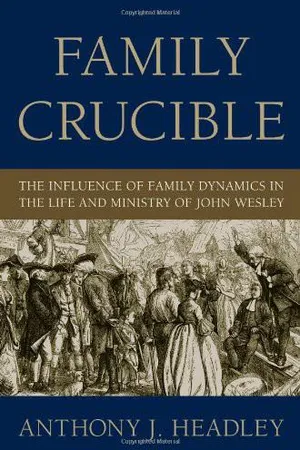
Family Crucible
The Influence of Family Dynamics in the Life and Ministry of John Wesley
- 188 pages
- English
- ePUB (mobile friendly)
- Available on iOS & Android
eBook - ePub
Family Crucible
The Influence of Family Dynamics in the Life and Ministry of John Wesley
About this book
This book explores the life and ministry of John Wesley from the perspective of Murray Bowen's Extended Family Systems Theory and to a lesser extent from Alfred Adler's concept of family constellation. Throughout the book, the author uses concepts drawn from these theories to explore significant historical and pivotal events in the life of John Wesley. Beginning with family events prior to his birth, the author also explores his early family constellation, influential themes, factors shaping his ministry, and various relational issues, including his relationships with Sophy Hopkey, Grace Murray, and his marriage to Mary Vazeille. It concludes by drawing lessons from Wesley's life pertinent to today's ministers.
Information
Topic
Theology & ReligionSubtopic
Historical Biographieschapter 1
Two Lenses for Understanding the Wesley Family
A Tragic Family Story
She reputedly possessed a rare combination of brilliance and beauty.
They resided side by side in stunning measure in this tall, graceful woman. For a woman of her time, she received an exceptionally good education. She possessed rare skill in writing and poetry and even published a few literary pieces in a reputable magazine. Radiant in beauty, she naturally attracted many ardent and persistent suitors for her fair hand. Alas! For his favorite and most brilliant daughter, none of these proved good enough for her father, a country parson in a rather rustic, out of the way village. He rejected one suitor after another, until the desperate daughter feared she would never find an appropriate husband. Then along came a suitor who at least matched her in brilliance. This perceived equal, who swept her off her feet, was, as is recorded in many accounts, a lawyer, though some debate this.1 Fearing interference and another lost suitor because of her father’s actions, she agreed to run away with him.
They resided side by side in stunning measure in this tall, graceful woman. For a woman of her time, she received an exceptionally good education. She possessed rare skill in writing and poetry and even published a few literary pieces in a reputable magazine. Radiant in beauty, she naturally attracted many ardent and persistent suitors for her fair hand. Alas! For his favorite and most brilliant daughter, none of these proved good enough for her father, a country parson in a rather rustic, out of the way village. He rejected one suitor after another, until the desperate daughter feared she would never find an appropriate husband. Then along came a suitor who at least matched her in brilliance. This perceived equal, who swept her off her feet, was, as is recorded in many accounts, a lawyer, though some debate this.1 Fearing interference and another lost suitor because of her father’s actions, she agreed to run away with him.
The lawyer seemed sincere. In fact, he promised marriage. The day before the proposed marriage, he lured her into bed and then callously deserted her before legally consummating the marriage, though he had done so carnally. To whom would she now turn? To compound the problem, she discovered she was pregnant, though still single—a shameful condition for any woman, especially for one of her background. She had nowhere to go. In hopeful desperation, she returned home only to face the fury of a father who felt betrayed by his favorite daughter. Forgiveness from him would not come, even though she pleaded for it. What’s more, just about everyone in the family, including her mother, turned against her. She felt alone, confused, and betrayed, not only by her deceiving suitor but also by the family who ought to have forgiven and succored her during her hour of greatest need.
In order to cover the shame of this family known for their religious rectitude and its prominent standing in the community, her father did what she had deeply desired long before her elopement. He forged a relationship with a willing suitor. And what a brute of a man he chose! No education, no culture, no breeding! But at least he was a man, though some might have heatedly debated this assessment. Speedily, the irate father forced her into a marriage with this brutish fellow. Life would be hard from hereafter! And it was! Her husband, addicted to alcohol, abused her terribly through much of their marriage. What’s more, some five months after her marriage to this clod, she gave birth to her treacherous lover’s daughter, but the child soon died. Her grief was unbounded! And yet, she longed to finally receive her father’s forgiveness and to that end, she wrote him a desperate letter, pleading for his forgiveness and reconciliation:
Should God give and take away another (child), I can never escape the thought that my father’s intercession might have prevailed against His wrath, which I shall then take to be also manifest. Forgive me, sir . . . But as you planted my matrimonial bliss so you cannot run away from my prayers when I beseech you to water it with a little kindness. My brothers will report to you what they have seen of my way of life and my daily struggle to redeem the past. But I have come to a point where I feel your forgiveness to be necessary to me. I beseech you then not to withhold it.2
The letter fell on deaf ears! Is there one more recalcitrant, less forgiving, and more stubbornly obstinate than a wounded, prideful father? No! He would not forgive her. And forgive her he did not. Several years after his death, her mother changed her attitude towards her daughter. By that time, most, if not all, of her siblings also reconciled with her. In fact, one of her brothers actually supported her from the very beginning of her ordeal and had chided his father publicly in sermons on universal charity and rash judgment3. Though pointed, his rebuke did little to promote remorse and forgiveness in the obstinate father. For the rest of her life, this brilliant and beautiful, yet humbled, daughter would bear the scars and wounds of this episode. The wounds seared more deeply and excruciatingly by the fact that her father went to his grave and never forgave her.
The broad details of this story actually happened. But the script was not borrowed from a daytime soap opera, even though it easily could have been. In fact, this is the story of Hetty Wesley, the beautiful and talented daughter of that venerable Rector of Epworth, Samuel Wesley. Moreover, the one who preached the sermon against his father’s actions was his son, and the subject of this book, John Wesley. The story illustrates for us the power of family dynamics to shape human lives in powerful and sometimes even negative ways. The family forms a crucible, a God-given vessel where human lives are honed and refined, sometimes for the better and sometimes for the worse. In this repository, powerful forces converge and churn together. These forces include long-held family traditions, legacies and myths, and persistent family patterns, swirling together to shape lives placed in this cauldron. Other factors outside the internal dynamics of family life also shape individual lives. These include the confluence of macro factors within the society—economic, political, and socio-cultural—which creates powerful forces, and likewise shapes personal identity.
This shaping of individuals forms the theme of this book. Although I began with the story of Hetty, this book is not about her, but rather, it is about her famous brother, John. I have chosen to tell her story in brief as a purposeful introduction to the Wesley family and to undergird the role of family dynamics. Hetty’s experience carries within it some of the implicit principles and concepts, which I will discuss in this chapter and, indeed, across the entire book. I will use her story in this chapter to briefly illustrate some of the concepts presented. In the rest of the book, these concepts will be more specifically applied to John Wesley.
As theoretical lens through which to view the Wesley family, I will primarily borrow concepts from two theorists. The first is one of my favorites, Alfred Adler. From him I will utilize the concept of the family constellation as well as the role of early recollections. I will also draw heavily from Murray Bowen and concepts discussed in his Extended Family Systems approach. Throughout this initial chapter, I will use Hetty’s story to illustrate some of the concepts discussed. In so doing, I trust it will provide a basis for the reader to more easily understand the applications to the life and ministry of John Wesley.
Alfred Adler and the Formative Influence of Family
Alfred Adler was a contemporary of Sigmund Freud and, at one time, was a part of his group, the Vienna Psychoanalytic Society. Many persons have erroneously identified him as a pupil of Freud, although he was a theorist in his own right. Contrary to these opinions, Freud invited Adler to join his society after he had written two defenses of Freud’s theories.4 In my opinion, Adler serves as a more important figure for psychology and the therapeutic field than Freud because of the sheer number of approaches his theory has spawned. For example, in Adler’s thought we find a precursor to cognitive approaches to therapy, especially evident in his concepts of the lifestyle and basic mistakes. The former term refers to a cognitive map which gives rise to a particular approach and direction to life. In basic mistakes, defined as errors one associates with truth, one can discern cognitive errors, which can prove troublesome. Beyond these emphases, one can also find elements, which mirror humanistic approaches. This appears in his emphasis on meaning, choice, and responsibility. Moreover, in his approach one finds embedded and implicit systems thinking about the nature of humans and their life in families. Adler himself had been greatly shaped by his family life and experiences, having grown up with rickets. One professional informed his father he was fit only to be a cobbler, but Adler defied this assessment and became a medical doctor and psychological theorist. Unfortunately, Adler does not receive enough respect. In fact, I have often termed him the Rodney Dangerfield of psychology, because he gets no respect: Many persons borrow from his embryonic thoughts without giving him credit as the source of their ideas.
Adler emphasized the role of family in the development of one’s ide...
Table of contents
- Title Page
- Acknowledgements
- Introduction
- Chapter 1: Two Lenses for Understanding the Wesley Family
- Chapter 2: The World of the Wesleys
- Chapter 3: Traumatic Events in the Wesley Family Prior to John’s Birth
- Chapter 4: Wesley’s Early Recollections and Family Context
- Chapter 5: Multigenerational Transmission Process in the Wesley Family: Recurring Vocational Themes
- Chapter 6: Relational Patterns in the Wesley Family
- Chapter 7: Family Marriage Patterns and the Influence on John Wesley’s Intimate Relationships
- Chapter 8: Lessons in Life and Ministry from the Life of John Wesley
- Bibliography
Trusted by 375,005 students
Access to over 1.5 million titles for a fair monthly price.
Study more efficiently using our study tools.
Frequently asked questions
Yes, you can cancel anytime from the Subscription tab in your account settings on the Perlego website. Your subscription will stay active until the end of your current billing period. Learn how to cancel your subscription
No, books cannot be downloaded as external files, such as PDFs, for use outside of Perlego. However, you can download books within the Perlego app for offline reading on mobile or tablet. Learn how to download books offline
Perlego offers two plans: Essential and Complete
- Essential is ideal for learners and professionals who enjoy exploring a wide range of subjects. Access the Essential Library with 800,000+ trusted titles and best-sellers across business, personal growth, and the humanities. Includes unlimited reading time and Standard Read Aloud voice.
- Complete: Perfect for advanced learners and researchers needing full, unrestricted access. Unlock 1.5M+ books across hundreds of subjects, including academic and specialized titles. The Complete Plan also includes advanced features like Premium Read Aloud and Research Assistant.
We are an online textbook subscription service, where you can get access to an entire online library for less than the price of a single book per month. With over 1.5 million books across 990+ topics, we’ve got you covered! Learn about our mission
Look out for the read-aloud symbol on your next book to see if you can listen to it. The read-aloud tool reads text aloud for you, highlighting the text as it is being read. You can pause it, speed it up and slow it down. Learn more about Read Aloud
Yes! You can use the Perlego app on both iOS and Android devices to read anytime, anywhere — even offline. Perfect for commutes or when you’re on the go.
Please note we cannot support devices running on iOS 13 and Android 7 or earlier. Learn more about using the app
Please note we cannot support devices running on iOS 13 and Android 7 or earlier. Learn more about using the app
Yes, you can access Family Crucible by Anthony J. Headley in PDF and/or ePUB format, as well as other popular books in Theology & Religion & Historical Biographies. We have over 1.5 million books available in our catalogue for you to explore.