- 118 pages
- English
- ePUB (mobile friendly)
- Available on iOS & Android
eBook - ePub
About this book
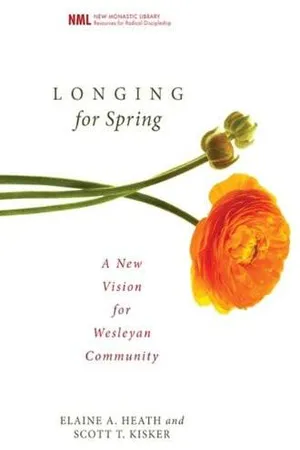
Delving into the widespread, contemporary longing for a more serious and communal experience of Christianity, this book provides important theoretical underpinnings and casts a vision for a new monasticism within the Wesleyan tradition. Elaine Heath and Scott Kisker call for the planting of neo-monastic churches which embody the Wesleyan vision of holiness in postmodern contexts. This book also points toward some vital shifts that are necessary in theological education in order to equip pastors to lead such communities. Longing for Spring helps Wesleyans of all stripes understand the theory and praxis necessary for planting neo-monastic communities as a new model of the church that is particularly important in the postmodern context. The authors write in an engaging, conversational style that is conversant with postmodern culture, yet thoroughly informed by critical research. Heath and Kisker boldly challenge the imagination of the church, both within and beyond Wesleyan traditions, to consider the possibility of revitalizing the church through the new monasticism.
Information
Subtopic
Ministère chrétienone
Our Stories
Introduction
This is a book about something new that is afoot in the United Methodist Church, something holy, God-breathed, and fresh, yet grounded in the ancient ways. Like many other mainline and evangelical Christians, Methodists are beginning to ask probing questions about mission and ecclesiology. Especially among young adults we are hearing people express a desire to engage in rigorous spiritual formation coupled with a life of bi-vocational ministry. Increasing numbers of young seminarians are not planning to go into traditional ordained ministry tracks, but they are passionate about being in ministry to the poor, to disadvantaged children, to the homeless, and the like. In the manner of John and Charles Wesley, these Methodists are interested in leaving familiar confines in order to live their faith in community with those who will not come to the buildings we call “the church.” They are eager to see renewal in the United Methodist Church, and willing to help bring that about. Some of these Methodists are organized into groups such as The New Methodists and the UMC Young Clergy group.1
This grass-roots phenomenon that is emerging around the United States has been called “the new monasticism” but really, as you shall see, it is a lot like early Methodism. In the first Appendix in this book you will find a survey of most of the recent books that cover new monasticism. For now, suffice to say that the new “monks” are women and men of all ages, married and single, some with families. They are of diverse racial, ethnic, and denominational backgrounds, and theologically left, right, and center. Rather than being identified for doctrinal commitments, they are known for a disciplined life of prayer and servanthood, especially in the “abandoned places of empire” (more about that later). Many of the new monks practice “the three R’s” first articulated by John Perkins of the Christian Community Development Association (CCDA): Reconciliation, relocation, and redistribution.2 That is, the new monks live in a stance of radical hospitality. They live and work in ways that cultivate racial reconciliation, relocation to abandoned places of empire, and redistribution of material possessions for the well being of the community. The degree of the three R’s varies from one community to the next.
While most of the new monasticism has emerged outside of the United Methodist Church, increasing numbers of United Methodists are experiencing a sense of call to live and serve in this form of community. Because virtually all the emphases of the new monasticism are consistent with early Methodist vision and mission, we believe that like early Methodism, the new monasticism is a holiness movement.
Our interest in new monasticism has come from our own journeys as well as from the research, writing, and teaching we have done in our work as professors of evangelism at two United Methodist seminaries—Perkins School of Theology (Dallas, TX) and Wesley Theological Seminary (Washington, DC). We are both ordained as Elders in the United Methodist Church.
We decided to write this book in a semi-autobiographical manner, integrating some of the stories of our spiritual journeys with the narrative of monasticism, Methodism, and the rise of new monasticism in the United Methodist Church. We wrote chapters 1 and 6 together. Scott wrote chapters 2 and 3, and Elaine wrote chapters 4, 5, the appendices, and the discussion questions. Our prayer is that this little volume will provide inspiration and hope to those who are longing for a new day for the church, and will help shape our readers’ imagination toward creating dynamic new expressions of Wesleyan community.
Elaine’s Story
My decision began seven days after the death of my beloved friend,3 Betty. She died on a Sunday at 7:30 in the morning. I cannot begin to tell you how much my life changed because of her. There were a thousand reasons why my life should not have amounted to anything. When I met Betty more than two decades ago, I was searching for freedom and healing, haunted with ghosts of violence from childhood. I felt my life had been hijacked, that my real self had gone underground. I hate to say it but the church had done a lot to keep me stuck. I had been indoctrinated to patriarchy, drained of life. I was like so many women in the church today whose gifts and strength are suppressed out of fear, women who are told they are proud or rebellious when they think for themselves or ask critical questions of the church, women who are told to submit to their husbands even if those husbands are violent. Then I met Betty and everything changed.
Betty was a prophet and an apostle, a church planter, a mystic, a feminist, a lover of Jesus Christ and his church. She was tall and beautiful, with high cheekbones and a broad smile that reminded me of Sophia Loren. Her large brown eyes told the story of a soul who had traveled hard roads of suffering. Compassion streamed from her heart. As Betty grew older her beauty did not fade but deepened slowly into the burnished glory of autumn. At eighty she was like the trees in Mary Oliver’s poem, a pillar of translucent fire.4
Eventually I heard God’s call to ministry because of her. Betty’s love and integrity as a Christian helped me to put my hands to the plow and ask Jesus to bring the duct tape so I wouldn’t change my mind. Betty taught me to pray, to believe, to take risks, to buck the system, to be equal to men, to tell the truth, to exegete the Bible, to dance for God, to enjoy good food, to expand my horizons, to see Jesus in neighborhood kids, to hear the birds, to meditate, to rest. She taught me not to be afraid anymore. She took me by the hand and led me home to God and along the way I came home to me. She gave me Sabbath.
Betty was more Wesleyan than most Methodists I have known, although she was never a member of the United Methodist Church. What I mean is that her theology was consistent with good Wesleyan theology, with its focus on grace and holiness and the centrality of the love of God. Betty lived what we Methodists think of as the Wesleyan connection between vital piety and social justice.5 For her evangelism was a lifestyle of mercy and prophetic courage. It was a matter of thinking, speaking, and doing the Good News while finding solidarity with the oppressed and marginalized around her.6 She ministered to prostitutes and university professors, and everyone in between. These expressions of the love of God and neighbor were all carried out in the context of Christian community.
Over her lifetime Betty’s journey had included time with Mennonites, Baptists, and Pentecostals. She had many friends among the Anglo-Catholics. Amidst all of them she was powerful in her spirituality, prayer, discernment, and Bible teaching. She was mostly evangelical according to the meaning of that label thirty years ago. But her inner freedom as a woman and her confidence in God’s call were problematic to patriarchal, evangelical tribes. Like John Wesley, Betty was a person “of one book.” The evangelicals liked that. They were worried, though, about Betty’s love for the Christian mystics.7 Of course the mainliners liked her a lot because of the mystics and her feminism, but the centrality of the cross in her theology was a challenge to them. The fact is that Betty was ahead of her time. She was neither liberal nor conservative. She was probably what we now call “emergent” or “missional.” But she considered herself simply a Christian.
At the time that I first met Betty she served on a large church staff as the pastor of counseling and discipleship. They hired her for this position because she excelled in developing small groups for spiritual formation and healing, for spiritual direction in common, and equipping leaders for this kind of work. She was sought out by people of a staggering array of religious backgrounds, both Christian and non-Christian, for spiritual counsel. She loved them all and helped many to find peace in Christ. Betty had actually been ordained by the denomination of that church, which was no small feat for a woman, but she looked at her ordination with a certain detachment, knowing that God had called her as a young girl and that she would live her call with or without the approval of an institution. She was like the Beguines that way, or Hildegard von Bingen.
Betty should have been labeled the pastor of redemption, or let’s try this one, the pastor who teaches with authority and not as the scribes and Pharisees, because that is exactly what she was. For the last fifteen years of her life Betty led a small house church and helped little ragtag groups of disciples form house churches elsewhere, that she neither managed nor tried to control. She did not believe in coddling people. Somehow on a very modest income she and her husband Fred, who at one time had been a labor union organizer, traveled to other countries where they had been invited to encourage and equip house churches. On February 11, 2007, she breathed her last praise to Jesus in this life, and now she is there with Fred and the rest of the great cloud, rooting for us from the other side.
Something about Betty’s death launched my decision. I took our wet bar and turned it into an altar. I know Methodists don’t have bars, but our house came with one, and what are you going to do? Every morning that week I put something different on it to celebrate Betty: Trinity shaped irises to represent her life in God, an Ebenezer of stones from Lake Huron for all her answered prayers, a photo of the two of us where we are squinting into the sun on a bad hair day, a fountain with water pouring over a small white stone. I kept thinking about the river of life and the trees with healing for the nations.
In the center of the sanctified bar there was a Scripture verse that I wrote out when I told Betty about my call. I have kept it in view for daily reflection in my kitchen for the past twenty-five years since I wrote it. Betty had thrown back her head and laughed hard when I came to her after two weeks of fear and trembling and wondering if I was losing my mind, because the idea of my being called was so ridiculous. By then I knew you never knew what to expect with her, so I just waited for her to stop laughing. Wiping little tears of joy from her eyes she said, “Oh Elaine, I saw it years ago when I first met you. I saw it and wrote about it in my journal but I never told you, because you needed to hear it for yourself.” That’s how Betty operated. She really did “have the patience of a saint.” Well, this is the text. You’ll notice I took the language of the evangelical NIV translation and rather daringly changed it to be more inclusive, a bold move for me in those days.
Therefore my dear ones, stand firm. Let nothing move you. Always give yourself fully to the work of the Lord, because you know that your labor in the Lord is not in vain. (1 Cor 15:58)
When I met Betty I barely had a high school diploma. Since those early days of friendship I went on to earn a bachelor’s degree in English, an MDiv, and a PhD in theology. Today I am an elder in the United Methodist Church.8 I have served as a pastor in four United Methodist congregations and now teach evangelism at Perkins School of Theology. Jesus really did use that duct tape. I could not have ventured forth from Betty’s sheltering friendship into fifteen years of higher education and through Himalayan obstacles, if the call had not been very, very clear. Joining the United Methodist Church has been part of answering that call.
Yet there is something about the church as I have practiced it all these years that can only be described as a club. What Betty’s death led me to do, is to quit the club. I do not mean I am leaving the United Methodist Church, although the thought has occurred to me at times. But there are alien priorities in our midst, anomalies that contradict the soul of our tradition. Here is one small example.
When I went to meet the pastor parish relations committee prior to being appointed to one of the churches I served, I came away with the strange knowledge that what that church wanted from their next pastor more than good preaching, pastoral care, the development of children’s ministry or just someone who could write a decent bulletin, was a pastor who would live in their parsonage. That was really and truly their top priority. The last pastor, for a number of reasons hadn’t been able to live in the parsonage. If a pastor would live in the parsonage, they reasoned, giving would increase, the kids who had graduated from high school and left church would come back, and everyone would contribute more stuff ...
Table of contents
- Longing for spring
- Acknowledgments
- Foreword
- Chapter 1: Our Stories
- Chapter 2: Early Stories of Intentional Community and Church Renewal
- Chapter 3: Protestant Models of Intentional Community
- Chapter 4: What the New Methodists Want
- Chapter 5: Spring
- Chapter 6: Reports from the Horizon
- Appendix A
- Appendix B
- Appendix C
- Bibliography
Trusted by 375,005 students
Access to over 1.5 million titles for a fair monthly price.
Study more efficiently using our study tools.
Frequently asked questions
Yes, you can cancel anytime from the Subscription tab in your account settings on the Perlego website. Your subscription will stay active until the end of your current billing period. Learn how to cancel your subscription
No, books cannot be downloaded as external files, such as PDFs, for use outside of Perlego. However, you can download books within the Perlego app for offline reading on mobile or tablet. Learn how to download books offline
Perlego offers two plans: Essential and Complete
- Essential is ideal for learners and professionals who enjoy exploring a wide range of subjects. Access the Essential Library with 800,000+ trusted titles and best-sellers across business, personal growth, and the humanities. Includes unlimited reading time and Standard Read Aloud voice.
- Complete: Perfect for advanced learners and researchers needing full, unrestricted access. Unlock 1.5M+ books across hundreds of subjects, including academic and specialized titles. The Complete Plan also includes advanced features like Premium Read Aloud and Research Assistant.
We are an online textbook subscription service, where you can get access to an entire online library for less than the price of a single book per month. With over 1.5 million books across 990+ topics, we’ve got you covered! Learn about our mission
Look out for the read-aloud symbol on your next book to see if you can listen to it. The read-aloud tool reads text aloud for you, highlighting the text as it is being read. You can pause it, speed it up and slow it down. Learn more about Read Aloud
Yes! You can use the Perlego app on both iOS and Android devices to read anytime, anywhere — even offline. Perfect for commutes or when you’re on the go.
Please note we cannot support devices running on iOS 13 and Android 7 or earlier. Learn more about using the app
Please note we cannot support devices running on iOS 13 and Android 7 or earlier. Learn more about using the app
Yes, you can access Longing for Spring by Elaine A. Heath,Scott Kisker in PDF and/or ePUB format, as well as other popular books in Théologie et religion & Ministère chrétien. We have over 1.5 million books available in our catalogue for you to explore.