- 312 pages
- English
- ePUB (mobile friendly)
- Available on iOS & Android
eBook - ePub
About this book
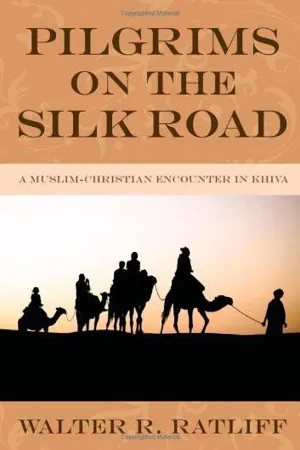
They were seeking religious freedom and the Second Coming of Christ in Central Asia. They found themselves in the care of a Muslim king. During the 1880s, Mennonites from Russia made a treacherous journey to the Silk Road kingdom of Khiva. Both Uzbek and Mennonite history seemed to set the stage for ongoing religious and ethnic discord. Yet their story became an example of friendship and cooperation between Muslims and Christians.
Pilgrims on the Silk Road challenges conventional wisdom about the trek to Central Asia and the settlement of Ak Metchet. It shows how the story, long associated with failed End Times prophecies, is being a recast in light of new evidence. Pilgrims highlights the role of Ak Metchet as a refuge for those fleeing Soviet oppression, and the continuing influence of the episode more than twelve decades later.
Information
Topic
Theology & ReligionSubtopic
Christian Church1
The Russians Are Coming
As an Afghan slave owned by the khan, Muhammad Murad often missed running with the other boys who roamed the dusty streets of Khiva.1 In the spring of 1840, free Uzbek children flew kites in the southern breezes that warmed the ancient city. The boys had a special trick. They would attach a line of catgut from one end of their box kite to another and stretch it tight. The kites would stay aloft for days.2 Wind vibrated the catgut, producing a melancholy hum throughout the city day and night.3
The sounds of urban life echoed from the high mud walls surrounding the Ichan Kala, or inner city. Two-wheeled carts called arbas wound their way through Khiva’s streets carrying everything from firewood to fruit. The adobe houses were the same warm beige as the local soil.
Khiva’s architecture in the 1840s was a hodgepodge of stunning monuments to its Islamic heritage next to the humble shabbiness of buildings used for daily life. The city’s many madrassas, or Muslim theology schools, were adorned with glazed brick tiles forming geometric patterns that would puzzle artists and mathematicians into the twenty-first century. Their grand archways pointed to the heavens. The intricate mosaics reflected the majesty and complexity of the God they worshipped.
The call to prayer poured into the desert city five times per day.
“Allahu Akbar,” shouted the muezzins. “Ash-hadu an hadu an la ilaha illallah.”
Everyday shelters of adobe and wattle-and-daub rested alongside the magnificent madrassas and minarets. As the sacred architecture reached toward heaven, the temporal homes and business seemed to be melting back to the earth. Rooflines sagged. Mud plaster washed away. Brown water drained in the streets.
In Khiva’s single masonry bazaar, merchants and customers haggled over the price of fruit, textiles, meats and other goods. Nearby, an auctioneer hailed the qualities of his Russian and Persian slaves to prospective buyers.
As the khan’s slave, Muhammad Murad would regularly hear conversations among Khan Allah Quli’s ministers about the kingdom’s inner workings. Through these conversations, he learned about taxes, culture and conflicts with neighboring Bukhara. Occasionally, he overheard rumors of war and rebellion among the Yomud Turkoman. Raw intelligence and his close relationship to the khan would one day help make him the most powerful man in the kingdom.
More than two thousand miles away, in a small Prussian village near the Baltic Sea, two-year-old Claas Epp Jr. played with his siblings as his father managed the village affairs. Claas Epp Sr. was a serious man with a mind toward civil and economic matters.4 He had a high respect for Prussian authorities and wielded a great deal of influence among both Mennonites and the German rulers of the region. Epp was mayor of his home village of Fürstenwerder. Mennonites had been living and worshipping in this village for seven decades by the time his son, Claas Epp Jr., was born. They remained free of military conscription, a central part of their faith. They were also free to speak and teach in their own language, and largely conduct their own affairs as they saw fit.
Fürstenwerder was one of many towns on the Vistula Delta that Mennonites called home. The first Mennonites came to the Danzig area nearly three hundred years before Claas Epp Jr. was born. They arrived well within the lifetime of Menno Simons, the most prominent leader of the Anabaptist movement.5 The village had its share of religious tensions between the Catholics, Lutherans and Mennonites. Though Mennonite communities were closed to outsiders in many ways, cycles of conflict and cooperation with those of other faiths recurred throughout their history.
In terms of culture, religion and family status, Muhammad Murad and Claas Epp Jr. could not be further apart. Yet, in a generation, they would find their fortunes intertwined in Murad’s remote Muslim kingdom.
Around the time of Claas Epp Jr.’s birth, Khiva’s boldness toward the Russian empire was nearing its peak. These escalating tensions would help shape both Murad and Claas Epp’s destinies.
In the late 1830s, Khiva’s khan attempted a type of blackmail against Russian caravans carrying trade goods through Central Asia. Khan Allah Quli forced caravans to pass through his kingdom on their way to the wealthier neighboring state of Bukhara, or risk being attacked and plundered.6
Russia considered trade along the Silk Road important to its economy. Yet the Central Asian khanates were a recurring source of trouble. Attacks on Russian trade caravans often carried the blessing of Khiva’s khans.
Then there was the issue of slavery. For centuries, Russian citizens were abducted and sold as slaves in Khiva’s bazaar. Russian fishermen on the Caspian Sea were particularly vulnerable to kidnapping. The unfortunate Russian citizen taken into slavery was doomed to spend the rest of his or her life in hard labor under an Uzbek master. A strong Russian man was valued at the Khivan equivalent of three hundred rubles, with Russian women and male slaves of other nationalities, including Persians, fetching half that price.7
The case of a fisherman named Konstantin Provov Bubnov was a typical one. Bubnov, age forty, and nine others from the town of Astrakhan were away at sea for a day and a half when they were attacked on September 12, 1830. In the middle of the night, Kirghiz slavers overtook their boat. The fishermen tried to defend themselves. One of Bubnov’s comrades was killed.
After capturing the boat, the Kirghiz grounded it on a sandbar and threw the crew’s bounty overboard: two thousand three hundred sturgeon and nearly four thousand pounds of caviar. After disposing of their fishing gear, they set the boat on fire. The Kirghiz took them to one of their villages on shore and into a life of captivity.
Bubnov spent a month and a half as property of a Kirghiz leader. He was eventually sold to a Khivan for the equivalent of four hundred rubles and five khalat robes. He remained in the wealthy Khivan’s household for nine years. He only saw one of his fellows again, and only for a brief time. The rest had been sold to other Khivans or sent to the slave markets in Bukhara. Like most Russian slaves, he spent his years doing heavy labor.8
By 1830, the Russian government estimated that two hundred Russians were kidnapped and sold into slavery in Khiva every year. The czar offered a reward of three thousand rubles to any trader who would repatriate a Russian slave. Khiva’s khan countered with a death sentence for any trader who took up the Russian offer. Slaves who attempted to flee would lose their nose and ears for their first offense and be executed on a pike for a subsequent attempt. For those who managed to escape, a thousand miles of sand peopled by hostile tribes awaited them on the path home.
The khan ignored official pleas to end the slave trade, and Khiva remained a refuge for fugitive slave traders wanted by the Russian government. The czar’s government devised a plan to hold Khivan merchants hostage until the demands of the Russian government were satisfied.
On August 28, 1836, just as a number of Khivan caravans were about to leave Orenburg and Astrakhan, an order was issued to detain all Khivan citizens in Russian cities. Nearly six hundred Khivan merchants, their camels already loaded with 1.4 million rubles in goods for the long march southward, were sent to Russian prisons, guard houses and unoccupied government buildings.9
At first, Khan Allah Quli refused to negotiate, demanding that the merchants be released before he would consider a dialogue. The two governments remained deadlocked until September 27, 1837. On that day, a message arrived from the khan agreeing to release the slaves held captive in Khiva.
The Russians were overjoyed. They quickly prepared for the arrival of hundreds of their countrymen who had been held in captivity for so long. The expected caravan with the Khivan envoy and the Russian captives arrived the following November 30. On that date, the entire population of Orenburg gathered to meet them in the marketplace.
The result was anticlimactic. The khan had released only twenty-five Russian slaves. Even so, the former slaves were greeted warmly. The Russian merchants prepared a banquet for them. The clergy anointed them with holy oil. The twenty-five were home, but hundreds of their fellows remained in captivity in Khiva.
The khan’s plan was to slowly release a few prisoners at a time as he built up an alliance with his neighboring rival, Bukhara. However, the emir of Bukhara spurned Khiva’s o...
Table of contents
- Pilgrims on the Silk Road
- List of Illustrations
- Acknowledgments
- Introduction
- Chapter 1: The Russians Are Coming
- Chapter 2: The Farmer, the Baron, and the Bey
- Chapter 3: The Fall of Khiva
- Chapter 4: Seeds of Migration
- Chapter 5: The Pilgrim’s Call
- Chapter 6: Twelve Stones from the Jordan
- Chapter 7: Ebenezer
- Chapter 8: The Ride to Khiva
- Chapter 9: The Redemption of Johann Drake
- Chapter 10: The Rise and Fall of Claas Epp Jr.
- Chapter 11: Revolution
- Chapter 12: The Last Oasis
- Chapter 13: Epilogue
- Appendix A
- Appendix B
- Appendix C
- Bibliography
Trusted by 375,005 students
Access to over 1.5 million titles for a fair monthly price.
Study more efficiently using our study tools.
Frequently asked questions
Yes, you can cancel anytime from the Subscription tab in your account settings on the Perlego website. Your subscription will stay active until the end of your current billing period. Learn how to cancel your subscription
No, books cannot be downloaded as external files, such as PDFs, for use outside of Perlego. However, you can download books within the Perlego app for offline reading on mobile or tablet. Learn how to download books offline
Perlego offers two plans: Essential and Complete
- Essential is ideal for learners and professionals who enjoy exploring a wide range of subjects. Access the Essential Library with 800,000+ trusted titles and best-sellers across business, personal growth, and the humanities. Includes unlimited reading time and Standard Read Aloud voice.
- Complete: Perfect for advanced learners and researchers needing full, unrestricted access. Unlock 1.5M+ books across hundreds of subjects, including academic and specialized titles. The Complete Plan also includes advanced features like Premium Read Aloud and Research Assistant.
We are an online textbook subscription service, where you can get access to an entire online library for less than the price of a single book per month. With over 1.5 million books across 990+ topics, we’ve got you covered! Learn about our mission
Look out for the read-aloud symbol on your next book to see if you can listen to it. The read-aloud tool reads text aloud for you, highlighting the text as it is being read. You can pause it, speed it up and slow it down. Learn more about Read Aloud
Yes! You can use the Perlego app on both iOS and Android devices to read anytime, anywhere — even offline. Perfect for commutes or when you’re on the go.
Please note we cannot support devices running on iOS 13 and Android 7 or earlier. Learn more about using the app
Please note we cannot support devices running on iOS 13 and Android 7 or earlier. Learn more about using the app
Yes, you can access Pilgrims on the Silk Road by Walter R. Ratliff in PDF and/or ePUB format, as well as other popular books in Theology & Religion & Christian Church. We have over 1.5 million books available in our catalogue for you to explore.