- 340 pages
- English
- ePUB (mobile friendly)
- Available on iOS & Android
eBook - ePub
About this book
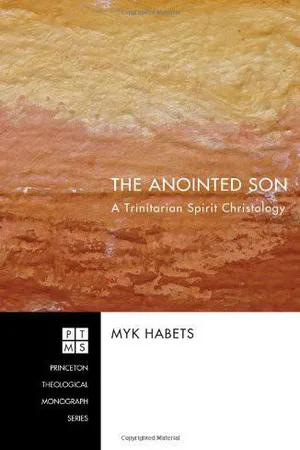
Spirit Christology complements Logos Christology in the same way in which Christ and the Spirit are mutually constitutive. Or at least this should be the case. The history of Christian thought shows that Logos Christology has dominated, resulting in both an eclipse of Trinitarian doctrine and a diminution of pneumatology. Recently there have been calls to reclaim a theology of the Third Article in order to present a Trinitarian theology that is faithful to Scripture, the Great Tradition, and one that is existentially viable. While studies examine various aspects of Spirit Christology there has yet to appear a work that introduces the doctrine, examines the various mutually exclusive proposals, and offers a constructive trinitarian proposal. The present work does just this, introducing the constituent features of a Spirit Christology that is Trinitarian, orthodox, and contemporary. The current work proposes a model of Spirit Christology that complements rather than replaces Logos Christology and does so in a robustly Trinitarian framework. Within contemporary theology a pneumatically oriented approach to Christology is being advanced across denominational and traditional lines. Those wanting to navigate their way through the many competing proposals for a Third Article theology will find a comprehensive map here.
Information
Topic
Theology & ReligionSubtopic
Christian Church1
Spirit Christology
Awaiting the Promise
Setting Christology in a pneumatic framework is a clear and challenging mandate of present-day theology. Barth’s own christological achievement, however, serves as a warning that it will be no easy task.
—Philip J. Rosato
If one finally adds that we receive also the Gospel only through the Paraclete, then one could with good reason not merely open the entire dogmatics with pneumatology, but even make the Work of the Spirit the theme of the whole.
—Werner Elert
I personally think that a theology of the Spirit might be all right after AD 2000, but now we are still too close to the eighteenth and nineteenth centuries. It is still too difficult to distinguish between God’s Spirit and man’s spirit.
—Karl Barth (1963)
Nobody has all the answers—I certainly do not. But one way to make progress is to look at issues in a new way and enter into conversation. Theology does not depend on any single theologian. Truth will yield its secrets to the body of Christ if we will listen to God and to one another humbly, accepting correction.
—Clark H. Pinnock
In his chapter entitled “Concluding Unscientific Postscript on Schleiermacher,” Barth reflected on his own Christological programme and made the astounding comment that all his theological investigations could have been pursued via a theology of the third article. In his words:
What I have already intimated here and there to good friends, would be the possibility of a theology of the third article, in other words, a theology predominantly and decisively of the Holy Spirit. Everything which needs to be said, considered, and believed about God the Father and God the Son in an understanding of the first and second articles might be shown and illuminated in its foundations through God the Holy Spirit, the vinculum pacis inter Patrem et Filium.1
Barth wrote these words in his Göttingen lectures of 1923/24. The great christocentrist was advocating the possibility of a thorough Spirit Christology that would complement the dominant Logos Christology2: a Christological programme pursued from a Trinitarian perspective, highlighting the mutual relations between the Son and the Spirit in the incarnation. Many have directly or indirectly followed Barth’s suggestion. Eastern Orthodox, Roman Catholic, and Protestant theologians are taking up the challenge to incorporate Trinitarian doctrine into all of the various loci of theology. Within contemporary theology a pneumatically oriented approach to Christology is being advanced across denominational and traditional lines. The present study is one such proposal towards the recovery of Spirit Christology in such a Trinitarian context.
As we enter a new chronological era—the twenty-first century—and all the changes that come with it, we are also entering a new era in theology. At the forefront of this shift has been the doctrine of the Trinity. It is not my intent to trace the development of theological thought in detail, but what theologians affirm today is that Trinitarian studies have revolutionised the content of our theology. Instead of being the superfluous post-script of a systematic theology, the doctrine of the Trinity now holds pride of place at the forefront of most major theological textbooks—a trend which I applaud. But just as other theological innovations resulted in a mature elucidation of Christian faith, so the glut of Trinitarian studies seems to me to be entering into a new, mature phase. That phase may be characterised as the emergence of truly systematic constructive theology in which the doctrines of
theology proper, Christology and pneumatology, all within a Trinitarian structure, are informing and articulating new models of both the Trinity itself, and of the three constitutive elements.3 This in part is illustrated by Yves Congar, the well respected Roman Catholic theologian of the Holy Spirit who began the introduction to his work The Word and the Spirit with the assertion, “If I were to draw but one conclusion from the whole of my work on the Holy Spirit, I would express it in these words: no Christology without pneumatology and no pneumatology without Christology.”4 This study draws out the implications of this axiom, in an attempt to redefine both Christology and pneumatology, and ultimately our conceptions or models of the Trinity.
theology proper, Christology and pneumatology, all within a Trinitarian structure, are informing and articulating new models of both the Trinity itself, and of the three constitutive elements.3 This in part is illustrated by Yves Congar, the well respected Roman Catholic theologian of the Holy Spirit who began the introduction to his work The Word and the Spirit with the assertion, “If I were to draw but one conclusion from the whole of my work on the Holy Spirit, I would express it in these words: no Christology without pneumatology and no pneumatology without Christology.”4 This study draws out the implications of this axiom, in an attempt to redefine both Christology and pneumatology, and ultimately our conceptions or models of the Trinity.
The current work is borne out of an abiding conviction that all theology is Trinitarian and, more specifically, that theology ought to maintain the integrity of Jesus and Spirit, not Jesus versus Spirit. One way to advance our understanding of Trinitarian theology is to examine more closely the reciprocal relations between Jesus and Spirit. Christopher Schwöbel makes the comment that Christology is in a crisis at present. In fact he goes so far as to say that “Modern Christology and the description Christology in crisis are almost equivalents.”5 In order to remedy this crisis we cannot simply return to past orthodox constructions nor can we afford to leave them behind. Rather, the tightrope of theological traditionalism and modernism will have to be walked carefully. One of the best ways to do this is through reclaiming a Trinitarian account of Spirit Christology. I take up the challenge issued by Philip Rosato when he wrote “setting Christology in a pneumatic framework is a clear and challenging mandate of present-day theology.”6 He also serves a warning that it will be no easy task. What Rosato is calling for is seminal works in what has come to be known as Spirit Christology. This book is my contribution.
Spirit Christology is not a precisely definable Christological construction. It is interdisciplinary and, as such, complex. For that reason no one monograph will be sufficient to exhaustively present its case. The best that can be achieved is the delineation of its constituent parts and that is why one of the aims of this book is to recover a Spirit Christology. Even the title of this doctrine is disputed as it goes by the name: “Spirit-Christology,”7 “Spirit-oriented Christology,”8 “pneumatological or pneumatologically oriented Christology,”9 and “Pneuma-sarx Christology.”10 For the sake of brevity and clarity I employ the title “Spirit Christology.”
More germane to the study than the terms employed is the meaning conveyed. In contemporary theology the term Spirit Christology ranges in meaning from the most comprehensive form, which posits Spirit as the divine element in the person of Jesus Christ, to the more narrow sense in which we are using it for the reciprocal relationship between the Spirit and Jesus. In the former case, the displacement of Logos Christology can be seen as a proposal to reach an alternative metaphysical understanding of the operation of divinity in Jesus, one that abandons the Chalcedonian definition of one person in two natures in preference for a Christology of “inspiration.” In so doing, the identity between Spirit and Logos works to revise the concept of Logos from a pre-existent divine person, to that of a cosmic principle of reason or order and emphasises a more functional notion of Logos as God’s activity in the world. This model of Spirit Christology is considered unorthodox and has been consistently rejected by evangelical theologians. The proposals and reasons for its insufficiency will be examined in chapter 5.
The model of Spirit Christology advocated here is one that seeks to articulate the relationship between the “person” of the Holy Spirit and the “person” of the Son, both in the incarnation and in the work of redemption including the intra-Trinitarian relations. By using the word “person” I presume fidelity with Nicene and Chalcedonian orthodoxy of three persons in one Trinitarian being, and in the case of Christ, two natures in one person. Hence, this model of Spirit Christology attempts to inform Christology with an equally important and central pneumatology, while at the same time enriching the integrity of the doctrine of the Trinity.
Spirit Christology is a Christological construction formulated from a Spirit-oriented direction. It is a Christology which recognises that its dynamism must proceed from a robust pneumatology. Spirit Christology has enjoyed a renaissance in recent theological efforts among both Protestant and Roman Catholic scholars. However, Spirit Christology may proceed in a number of directions. Two of these pathways may be broadly identified as either “Trinitarian” or “post-Trinitarian.” The latter option is merely an early heresy reaffirmed in modern times—adoptionism. I shall be arguing for the former, an orthodox Trinitarianism. This accounts for the subtitle of this book, “A Trinitarian Spirit Christology.”
Because Spirit and Jesus are intimately related we would do violence to split them apart either in our conceptions or our theology. I propose Spirit Christology as a complementary Christological model, not a substitute for the dominant Logos Christology of traditional or classical Christological construction. It is my belief that a Spirit Christology will enhance the older model, adding a much needed pneumatological element. Spirit Christology focuses theological reflection on the role of the Holy Spirit in Christology proper. It seeks to understand both who Christ is and what Christ has done from the perspective of the Holy Spirit.
What is new and distinctive in Spirit Christology is that, on the level of theological construction and doctrinal interpretation, it proposes that the relationship between Jesus and God and the role of Christ in redemption cannot be fully understood unless there is an explicitly pneumatological dimension. In other words, the relationship between Jesus and the Spirit is as important to conveying the truth of the christological mystery with its soteriological consequences as that of Jesus and the Word.11
Like all theologies a Spirit Christology is extrapolated from just one set of data and fulfils one methodological function. Spirit Christology relativizes the tendency to set up one theology as absolute, the only way of understanding, in this case, Christology. It is for that reason that I advocate multiple perspectives in theology, specifically the complementary nature of Spirit Christology with the existing Logos Christology of the classical Western tradition.
Given the complex nature of a doctrine of Spirit Christology it cannot be expected to answer every Christological or Trinitarian question that could be raised. It seeks to inform on a much broader scale than traditional systematic theological constructs. For instance, in traditional theology we have tended to separate the treatments of the identity and mission of Christ. A Spirit Christology argues that this is an artificial distinction and treats of them both together where possible, as in the New Testament. Also the very name “Spirit Christology” implies that both Christo...
Table of contents
- Title Page
- Acknowledgments
- Chapter 1: Spirit Christology
- Chapter 2: Understanding Jesus
- Chapter 3: Logos and Spirit
- Chapter 4: Interpreting the Evidence
- Chapter 5: Explaining Jesus
- Chapter 6: And Then There Were Three
- Chapter 7: “Justified by the Spirit”?
- Chapter 8: Receiving the Promise
- Bibliography
Trusted by 375,005 students
Access to over 1.5 million titles for a fair monthly price.
Study more efficiently using our study tools.
Frequently asked questions
Yes, you can cancel anytime from the Subscription tab in your account settings on the Perlego website. Your subscription will stay active until the end of your current billing period. Learn how to cancel your subscription
No, books cannot be downloaded as external files, such as PDFs, for use outside of Perlego. However, you can download books within the Perlego app for offline reading on mobile or tablet. Learn how to download books offline
Perlego offers two plans: Essential and Complete
- Essential is ideal for learners and professionals who enjoy exploring a wide range of subjects. Access the Essential Library with 800,000+ trusted titles and best-sellers across business, personal growth, and the humanities. Includes unlimited reading time and Standard Read Aloud voice.
- Complete: Perfect for advanced learners and researchers needing full, unrestricted access. Unlock 1.5M+ books across hundreds of subjects, including academic and specialized titles. The Complete Plan also includes advanced features like Premium Read Aloud and Research Assistant.
We are an online textbook subscription service, where you can get access to an entire online library for less than the price of a single book per month. With over 1.5 million books across 990+ topics, we’ve got you covered! Learn about our mission
Look out for the read-aloud symbol on your next book to see if you can listen to it. The read-aloud tool reads text aloud for you, highlighting the text as it is being read. You can pause it, speed it up and slow it down. Learn more about Read Aloud
Yes! You can use the Perlego app on both iOS and Android devices to read anytime, anywhere — even offline. Perfect for commutes or when you’re on the go.
Please note we cannot support devices running on iOS 13 and Android 7 or earlier. Learn more about using the app
Please note we cannot support devices running on iOS 13 and Android 7 or earlier. Learn more about using the app
Yes, you can access The Anointed Son by Myk Habets in PDF and/or ePUB format, as well as other popular books in Theology & Religion & Christian Church. We have over 1.5 million books available in our catalogue for you to explore.