- 144 pages
- English
- ePUB (mobile friendly)
- Available on iOS & Android
eBook - ePub
About this book
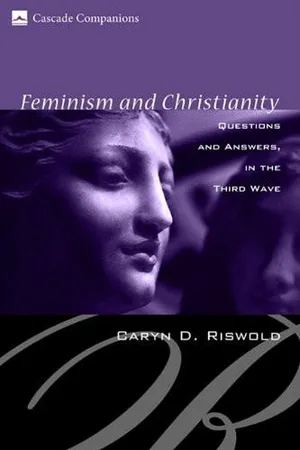
Why should feminists care about Christianity? Why should Christians care about feminism? In Feminism and Christianity Riswold presents a collection of concise answers to basic questions like these in order to generate discussion about how the two can challenge each other and can even work together in the twenty-first century. Situated firmly in the third wave of feminist activism and scholarship as well as in contemporary Christian theology, Riswold addresses issues such as race, class, gender, and sexuality with an affirmation of tradition alongside a push for change. This book is an opportunity for Christians to gain a fuller understanding of feminism, moving beyond stereotypes and assumptions and into history and contemporary society. Simultaneously this book is an opportunity for feminists to understand the ongoing relevance of a religion whose social power and core commitments can contribute to a vision of a just human community.
Information
Topic
Theology & ReligionSubtopic
Christian Churchone
Feminist Questions of Christianity
Feminists are often suspicious of Christianity and have a lot of questions about a religion led by men that worships a male God. In what way can this religion be good for women and men who are interested in an equal humanity? History provides many examples of the ways that Christianity has served to support and justify patriarchal ideas like wifely submission and women’s second-class status. With the weight of this evidence, feminists wonder why they should continue to care about Christianity. Perhaps it is only another patriarchal institution that needs to be dismantled.
The questions in this section capture this critical attitude toward Christianity, and the answers provide some information about the religion in a way that takes the questions seriously, often recognizing where the suspicions are well grounded. Some of the influence that feminism has already had on Christianity is discussed, and attention is paid to the real ways that Christianity has been good for many women. In addition, the questions and answers in this section account for the fact that a global Christianity exists today in a deeply connected, multifaith world.
The answers in this section do not presume to defend Christianity at every point, but they do presume that Christianity is something worth paying attention to, and worth challenging and reforming. Feminists have rarely backed down from a challenge, and engaging with Christianity is one of them that the third wave is ready to face.
1.1 Why Should Feminists Care about Christianity?
Feminists should care about Christianity because it is simultaneously a religion with an egalitarian vision that has been and should continue to be liberating for women, and because it has been a major institution of patriarchy that remains a pervasive cultural force needing criticism. The first two waves of feminism demonstrated how various institutions of patriarchy promoted injustice and inequality especially for women, and they helped bring about positive change in many of them. The work of criticizing the negative elements of Christianity while uncovering its positive legacy must continue today with third-wave feminist insights and strategies.
One reason that feminists should care about Christian-ity is that it impacts women’s lives in a significant way. It was during the second wave of feminism that activists and scholars began turning their attention to religion in a more sustained and sophisticated way than the suffragists had in the previous century. In the United States, this meant paying particular attention to Christianity. Early feminist theological works challenging the church as well as its ideas were written by Valerie Saiving and Mary Daly. Saiving offered the first critique of basic Christian ideas about sin, while Daly mounted a serious case against the Catholic Church for its treatment of women throughout history. They saw that like government, education, and the professional world, religion was a powerful tool of patriarchy that needed challenge and reform.
Because Christianity is a religion that helps perpetuate patriarchy, whether or not a woman participates in a religious community, whether or not she is religious at all, religion affects her life because it shapes society. In any society, the dominance of one religion necessarily affects the culture and the laws that impact everyone. Despite the legal separation of church and state that defines religious freedom in the United States, Christianity is a dominant cultural force: every president to date has been a Christian; the vast majority of Supreme Court justices to date have been Christian; about 77 percent of the American public calls itself Christian.1 This is one reason why, whether religious or not, feminists need to engage in the critical examination necessary to understand Christianity.
Effects of this cultural dominance of Christianity are seen in several events from recent years: Controversy erupted in several states when pharmacists refused to fill prescriptions for emergency contraception, written by medical doctors, on the claim that it violated their religious beliefs against contraception and/or abortion. Much of the anti-choice and anti-abortion activism in America has its roots in Christian communities; the 2008 election saw the passage of Proposition 8 in California, which revoked the right of gay and lesbian Americans in that state to marry. This resulted in widespread protests and demonstrations targeting Mormons and evangelical Christian churches, groups who publically support outlawing gay marriage and who helped fund the Proposition 8 campaign. These examples show what many feminists consider to be the negative, sexist, and homophobic legacy of Christianity. Because it is a patriarchal institution, in practice as well as in its belief, that supports legal and political maneuvers to limits on rights based on gender, it necessarily commands attention from feminists. But that is not the only reason.
Feminists should care about Christianity because it provides life and spiritual sustenance for many women. This has been true from the days that Jesus talked with, healed, and dined with women, and it is still true today. Feminist biblical scholars like Elisabeth Schüssler Fiorenza help Christians more fully understand the relevance of Jesus’ own actions with regard to women. She suggests that there were feminist impulses within Judaism that Jesus amplified in his teaching and ministry. Scholars of the Pauline literature show some of the egalitarian impulses of that early Christian community, and how they were sidelined as the church grew and gained power into the fourth century. The inclusion of commendations and greetings for women like Phoebe (“minister of the church”), Prisca (“who work[s] with me in Christ Jesus”), and Junia (“prominent among the apostles”) at the conclusion of Paul’s letter to the Romans (Romans 16:1, 3, 7), for example, suggests a gender ideology different from what many see in texts from
1 Timothy and Ephesians that restrict women’s public and teaching authority. Patriarchy ultimately defined the institution of Christianity due in no small measure to the cultural and philosophical influences of the society in which it emerged and took formal shape. Historians like Karen Torjesen, however, have meticulously shown how traditions such as women priests were in fact part of Christianity from the beginning.
1 Timothy and Ephesians that restrict women’s public and teaching authority. Patriarchy ultimately defined the institution of Christianity due in no small measure to the cultural and philosophical influences of the society in which it emerged and took formal shape. Historians like Karen Torjesen, however, have meticulously shown how traditions such as women priests were in fact part of Christianity from the beginning.
Beyond the early formative years and texts of Christianity, women’s voices show how the religion continued to provide a source of life and liberation even as patriarchy took an entrenched hold on it. Medieval women mystics and martyrs give powerful testimony to the way visions of God and Jesus sustained them throughout their lives. Julian of Norwich’s intimate descriptions of the Mother Jesus and Catherine of Siena’s passionate engagement with the politics of the thirteenth-century church provide models of women who seized their voice because of their religious experiences. Surviving narratives from slaves in the American historical record reveal further how biblical stories like the exodus provided the spark of hope that God was on the side of the enslaved, how Jesus was seen as the one who suffered like they did, and that there was liberation and new life awaiting them.
If there is something good in Christianity, which legions of women and men throughout history and in the world today suggest, then feminist scholars have reason to pay attention to it. If there continues to be something problematic in the religion, which legions of critics and scholars suggest, then feminists have an obligation to engage it critically. This obligation includes bringing the most serious critical feminist tools to bear on Christian beliefs and practices. This can contribute to chipping away the patriarchal mantle and liberating a core message that early on declared that ethnicity, sex, and status do not ultimately determine one’s fate: “There is no longer Jew or Greek, there is no longer slave or free, there is no longer male and female; for all of you are one in Christ Jesus” (Galatians 3:28). This fundamental Christian belief is that everyone has access to salvation through grace and faith. The idea that can be embraced by feminism here is the preservation and affirmation of the equal humanity of all people regardless of gender, race, or class.
Christianity in the twenty-first century and feminism in the third wave share a world with increasingly complicated social and spiritual problems. If contemporary feminists are concerned about the many factors that shape women’s and men’s lives today—like race, class, gender, sexuality, age, ability, and education level—then religion must also be addressed as one of these factors. Third-wave feminists have learned from and widely embraced many social and political strategies of previous generations. The attention that Christianity and its theology received throughout the second wave needs to be revitalized with new insights about the complexities of human life. Feminists in the third wave have a responsibility to rearticulate the criticisms of Christianity for those who have not yet fully understood them, as well as an opportunity to reshape theology for a world confronting new social and political challenges: more than a billion people living in poverty worldwide, a climate changing around us dramatically, a faltering global economy whose failure disproportionately affects the poorest among us, and proliferating international conflicts. Feminism can continue to show how religions like Christianity have been part of the problem and must become part of the solution.
Feminism should reform Christianity to establish and maintain women’s equal humanity while confronting the ways that patriarchy continues to maintain male dominance over women.
Suggested Reading
Elizabeth A. Clark and Herbert Richardson, editors. Women and Religion: The Original Sourcebook of Women in Christian Thought. 1996.
Mary Daly. The Church and the Second Sex. 1968.
Elisabeth Schüssler Fiorenza. In Memory of Her: A Feminist Theological Reconstruction of Christian Origins. 1983.
Karen Jo Torjesen. When Women Were Priests: Women’s Leadership in the Early Church and the Scandal of their Subordination in the Rise of Christianity. 1993.
1.2 How Has Christianity Been a Problem
for Women?
for Women?
Feminist criticism of Christianity looks at its history, its social and political influence, and its theology for the ways that it has harmed women. In fact, as is the case with several social institutions, Christianity has been both the problem and the solution in the lives of many women. By understanding in more detail key aspects of Christianity, feminists can understand the complicated legacy that it presents for women and men today. The sexist and even violent legacy of Christianity must be named, challenged, and changed. This is precisely where feminists are among those most important to reorienting the religion toward justice.
A brief look into the history of Christianity shows how its view of women sits at the root of much social and theological sexism. Tertullian, while instructing women and m...
Table of contents
- Feminism and Christianity
- Acknowledgments
- Introduction
- Chapter 1: Feminist Questions of Christianity
- Chapter 2: Christian Questions of Feminism
- Conclusion
- Questions and Answers
- Bibliography
Trusted by 375,005 students
Access to over 1.5 million titles for a fair monthly price.
Study more efficiently using our study tools.
Frequently asked questions
Yes, you can cancel anytime from the Subscription tab in your account settings on the Perlego website. Your subscription will stay active until the end of your current billing period. Learn how to cancel your subscription
No, books cannot be downloaded as external files, such as PDFs, for use outside of Perlego. However, you can download books within the Perlego app for offline reading on mobile or tablet. Learn how to download books offline
Perlego offers two plans: Essential and Complete
- Essential is ideal for learners and professionals who enjoy exploring a wide range of subjects. Access the Essential Library with 800,000+ trusted titles and best-sellers across business, personal growth, and the humanities. Includes unlimited reading time and Standard Read Aloud voice.
- Complete: Perfect for advanced learners and researchers needing full, unrestricted access. Unlock 1.5M+ books across hundreds of subjects, including academic and specialized titles. The Complete Plan also includes advanced features like Premium Read Aloud and Research Assistant.
We are an online textbook subscription service, where you can get access to an entire online library for less than the price of a single book per month. With over 1.5 million books across 990+ topics, we’ve got you covered! Learn about our mission
Look out for the read-aloud symbol on your next book to see if you can listen to it. The read-aloud tool reads text aloud for you, highlighting the text as it is being read. You can pause it, speed it up and slow it down. Learn more about Read Aloud
Yes! You can use the Perlego app on both iOS and Android devices to read anytime, anywhere — even offline. Perfect for commutes or when you’re on the go.
Please note we cannot support devices running on iOS 13 and Android 7 or earlier. Learn more about using the app
Please note we cannot support devices running on iOS 13 and Android 7 or earlier. Learn more about using the app
Yes, you can access Feminism and Christianity by Caryn D. Riswold in PDF and/or ePUB format, as well as other popular books in Theology & Religion & Christian Church. We have over 1.5 million books available in our catalogue for you to explore.