- 220 pages
- English
- ePUB (mobile friendly)
- Available on iOS & Android
eBook - ePub
About this book
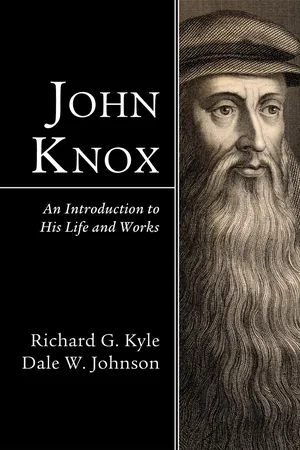
While the Reformed tradition originated with Huldrych Zwingli and was more fully developed with John Calvin, it was John Knox who made significant contributions to this movement as it unfolded in Scotland. John Knox: An Introduction to His Life and Works traces the life and thought of John Knox in a succinct and readable way. While a number of biographies tell the story of the famous Scottish reformer, professors Kyle and Johnson take the reader in a different direction, offering an interpretation of his writings. They take a chronological approach to his works--leading the reader through his early years, his exile, and his return to Scotland--allowing them to speak for themselves, an approach that also tells the story of Knox's life and ideas.
Information
Topic
Theology & ReligionSubtopic
Christian Theology1
The Man and His Times
Revolutionary or servant of God? Thundering prophet or consummate politician? Nasty old man or spiritual pastor? Ardently loved or passionately despised? Will the real John Knox please stand up? John Knox indeed was a complex and contradictory figure. To be sure, he displayed several faces and wore many hats.
The Scottish reformer, therefore, has been the subject of many interpretations—some wildly different. Knox was a controversial figure in his day. And he continues to be so down to the present. He has been both loved and hated by his contemporaries and historians through the centuries. No sixteenth-century reformer has aroused such a range of emotions and opinions. Few people have taken a neutral stance in regard to John Knox.
These differing opinions largely concern several related questions: What was Knox’s role or vocation? How did he perform this role or vocation? What kind of person was John Knox? How important was he to the Scottish Reformation? Historians have expressed different views regarding Knox’s role or vocation—prophet, pastor, preacher, reformer, statesman, revolutionary, and more.1 Actually, most modern scholars have focused on two aspects of one general subject: Knox’s political ideas, especially his theory of resistance, and his attitudes toward female rulers.2
In respect to evaluating Knox, W. Stanford Reid divided the reformer into three camps: his supporters, his opponents, and those in the middle.3 Knox’s advocates have seen him as the “right man for the right time in Scotland.” Some of these admirers see little fault in Knox. In their eyes, Knox has no warts and may have even been “St. John.”4
But the Scottish reformer has had his fierce opponents—both in his day and today. In his time, of course, the leading Catholics denounced him. So did the more secular Protestants who opposed his program. In our day, some biographers and historians have criticized Knox’s attitude toward Queen Mary, his outlook regarding female rulers, his advocacy of violence, or minimized his role in the Scottish Reformation.5 The film Mary Queen of Scots portrays Knox as a strange man with a long black beard who jumps out from behind a bush and berates the queen. “The image of John Knox as a cross between Ian Paisley and the Ayatollah Khomeini” seems to be “lodged in the popular mind,” says Stewart Lamont.6
Fortunately, some observers have taken the middle ground. They do not go overboard in either their praise or condemnation of Knox. Instead, they have sought a measure of objectivity. They regard Knox as a leading figure in the Scottish Reformation, but not the only force. There would have been a reformation without Knox. Still, he helped chart its course. Some observers in this camp have even become somewhat indifferent toward the Scottish reformer.7
Whether one views Knox positively or negatively, he certainly pursued his vocation with great vigor. His vocation was to preach the gospel, not to be a writer nor an ecclesiastical organizer or official. His main duty in life was, as he expressed it frequently, “to blow my master’s trumpet.” He saw himself as a preaching, rather than a writing, prophet proclaiming the gospel of God’s grace in Jesus Christ: “For considering myself rather called by God to instruct the ignorant, comfort the sorrowful, confirm the weak, and rebuke the proud by lively voice in these most corrupt days, then to compose books for the age to come . . . .”8
Knox expressed his vocation in three overlapping roles—preacher, pastor, and prophet. He served as the pastor or minister of congregations in Scotland, England, and the Continent. Unlike our time, the minister’s primary function was to preach God’s Word. Thus the roles of pastor and preacher must be regarded as inseparable. As a minister, however, Knox did more than preach. He pastored or shepherded the flock, instructing and comforting them in their trials and tribulations. Still, when Knox preached, he often thundered like an Old Testament prophet—rebuking the proud and corrupt by a lively voice. His vocation focused on individuals, congregations, and entire nations. When attempting to reform religion on the national level, Knox often adopted the role and rhetoric of an Old Testament prophet.
In working out his vocation as a prophet, Knox can legitimately be seen as a revolutionary, a political figure, and the reformer of religion on a national level. But he also functioned as a pastor. And in doing so, a softer, more caring John Knox emerged. He could, of course, roar like a lion from the pulpit, denouncing both individual and corporate sins. But when performing his pastoral functions and dealing with individual problems, a gentler John Knox came to the forefront—not the bluebeard that many have portrayed him to be.
THE EUROPE OF JOHN KNOX
Knox did not blow his master’s trumpet in a vacuum. He bellowed his sermons against the background and culture of his day. His denunciation of Catholicism must be seen in the context of the larger events—especially the perception of corruption in the Catholic Church and the ongoing Protestant Reformation. Knox wrote his treatises and letters in response to specific situations and problems, often persecution and moral lapses. Such writings were not abstract theological treatises. He offered counseling and spiritual advice to individuals with specific problems—usually issues encountered by first generation Protestants. What’s more, his prophetic role must be seen against the backdrop of European events. Protestantism and Catholicism were locked in a cosmic struggle, and Knox saw himself on God’s side pitted against the forces of Satan.
Political Factors
As the sixteenth century dawned, Europe stood on the brink of fundamental political change. The medieval, feudal world dominated by the papacy and the Holy Roman Empire came under challenge. To the south and east, Christian Europe faced a hostile Islamic power. But to the west, the discovery of the New World presented many new opportunities—plus a few challenges. All of this was occurring as the Reformation shattered the religious unity of Europe, dividing it into two antagonistic camps.
In such goings on, the major players were Spain, France, England, the papacy, and the Holy Roman Empire. Spain had extensive colonies in the New World and tremendous possibilities for trade and the acquisition of wealth. As yet, England and France possessed no colonies. So they sought to finance their wars and expansion elsewhere—usually from the coffers of the mercantile class. Traditionally weak rulers sat as the Holy Roman Emperor. But when Charles I of Spain became Emperor Charles V (1516–1556), circumstances changed. Charles created a huge power bloc, which ranged from the Netherlands and the German states to Spain. With the help of the Pope, Charles threatened to corner the French.
Sixteenth-century Europe witnessed constant warfare. To a large extent, these conflicts stemmed from the incessant rivalry between the Hapsburgs, who ruled Spain and the Holy Roman Empire, and the Valois, the ruling family of France. For the most part, England and Scotland stood on the sideline as such conflicts transpired. But when they did enter the fray, they usually did so according to their old alliances. Because of its age-old conflicts with France, England normally sided with Spain. Conversely, fear of England often drove the Scots into the arms of the French—the so-called “auld alliance.”
Marriage between these royal houses created new alliances and served to complicate these dynastic rivalries. In 1509, Henry VIII of England (1509–1547) married Catherine of Aragon, thus cementing a union with Spain, the Emperor, and the pope against France. The French countered with their own blood alliances. Mary of Guise married James V of Scotland (1513–1542). The daughter of Henry II of France united with the Spanish royal line; their son Francis I (1559–1560) married Mary Queen of Scots, the daughter of James V and Mary of Guise. Scotland stood on the perimeter of European society. Still, such marriage alliances pushed Scotland into the European power game—sometimes as a key player but more often as a pawn.
As the century wore on, religious conflicts compounded these dynastic tensions. By the 1550s, Europe stood on the brink of the period of terrible religious wars. The forces of the Counter Reformation were on the march, threatening to engulf Protestantism. All of this produced an apocalyptic atmosphere. Violence and conflict were in the air and could be detected in the writings of many reformers, including John Knox.
In all of these events, Scotland and John Knox would play a role—a development that was not obvious at the start of the sixteenth century. At this time, Scotland was a poor, primitive, and remote part of Christendom. Political motives drove the developments of the Scottish Reformation. From James I to James V, the Stewart kings and the great nobles constantly struggled for power. Scotland still lived under feudal anarchy. In the 100 years prior to the birth of John Knox, every king of Scotland had met his death by violence. Only one had been as old as 15 at accession, and none survived beyond the age of 42. Without a doubt, royal power was weak. Both the king and nobility administered such order and discipline as existed. Many vassals considered the lord, not the king, as their sovereign. Both justice and military organization were feudal, contributing to the complexity and instability of society.
By the reign of James V (1513–1542), the conflict between crown and nobility began to have religious implications. King James attempted to assert royal authority. In doing so, he alienated many of his temporal lords, thus forcing him to turn to the ecclesiastical lords for support. This alliance produced two results. First, hostilities developed between factions of the nobility and the church leaders who were acquiring power. Second, some of the estr...
Table of contents
- Title Page
- Preface
- Chapter 1: The Man and His Times
- Chapter 2: The Mind of John Knox
- Chapter 3: The Reformer in Training (1547–1554)
- Chapter 4: The Exile Years:The Education of a Reformer (1554–1556)
- Chapter 5: The Outburst Against Idolatrous Rulers (1556–1559)
- Chapter 6: Confronting the Anabaptists and Defending Predestination (1557–1560)
- Chapter 7: History Through the Eyes of John Knox (1559–1571)
- Chapter 8: Knox in Zion:The Reformation in Scotland (1559–1572)
- Chapter 9: Views of Knox: Extreme Makeover
- Bibliography
Trusted by 375,005 students
Access to over 1.5 million titles for a fair monthly price.
Study more efficiently using our study tools.
Frequently asked questions
Yes, you can cancel anytime from the Subscription tab in your account settings on the Perlego website. Your subscription will stay active until the end of your current billing period. Learn how to cancel your subscription
No, books cannot be downloaded as external files, such as PDFs, for use outside of Perlego. However, you can download books within the Perlego app for offline reading on mobile or tablet. Learn how to download books offline
Perlego offers two plans: Essential and Complete
- Essential is ideal for learners and professionals who enjoy exploring a wide range of subjects. Access the Essential Library with 800,000+ trusted titles and best-sellers across business, personal growth, and the humanities. Includes unlimited reading time and Standard Read Aloud voice.
- Complete: Perfect for advanced learners and researchers needing full, unrestricted access. Unlock 1.5M+ books across hundreds of subjects, including academic and specialized titles. The Complete Plan also includes advanced features like Premium Read Aloud and Research Assistant.
We are an online textbook subscription service, where you can get access to an entire online library for less than the price of a single book per month. With over 1.5 million books across 990+ topics, we’ve got you covered! Learn about our mission
Look out for the read-aloud symbol on your next book to see if you can listen to it. The read-aloud tool reads text aloud for you, highlighting the text as it is being read. You can pause it, speed it up and slow it down. Learn more about Read Aloud
Yes! You can use the Perlego app on both iOS and Android devices to read anytime, anywhere — even offline. Perfect for commutes or when you’re on the go.
Please note we cannot support devices running on iOS 13 and Android 7 or earlier. Learn more about using the app
Please note we cannot support devices running on iOS 13 and Android 7 or earlier. Learn more about using the app
Yes, you can access John Knox by Richard G. Kyle,Dale W. Johnson in PDF and/or ePUB format, as well as other popular books in Theology & Religion & Christian Theology. We have over 1.5 million books available in our catalogue for you to explore.