- 238 pages
- English
- ePUB (mobile friendly)
- Available on iOS & Android
eBook - ePub
About this book
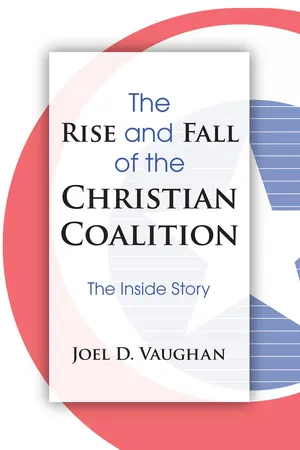
Christian Coalition experienced a meteoric rise in American politics in the 1990s only to see its profile and impact vanish into embarrassing irrelevancy at the end of the decade, leaving many to ask, "Whatever happened to the Christian Coalition?"
Joel Vaughan offers a behind-the-scenes look at the Christian Coalition, once the pre-eminent, conservative grassroots political organization in America. Working closely with founder Pat Robertson, President Don Hodel, and wunderkind Executive Director Ralph Reed, the author reveals in a captivating manner the factors that caused the rapid growth of this astonishingly successful organization, and the internal strife that led to its tragic and rapid decline.
Containing useful insights for leaders about organizational dynamics and grassroots movements of any kind, The Rise and Fall of the Christian Coalition shows how people of faith can become more effective at making their voice heard in local, state, and national elections, as well as many obstacles and ambitions to avoid.
Gilbert and Sullivan wrote a song about a young man who went to work for the British Admiralty and "polished up the handles so carefully" that he became ruler of Queen Victoria's Navy. Joel Vaughan rose from volunteer to Deputy Field Director and, ultimately, to the dual positions of Assistant to the President and Director of Administration. He brings an insider's intimate knowledge of the explosive growth and the ultimate crisis in leadership of Christian Coalition.
Full of behind-the-scenes anecdotes and revelations, this book is a "must read" for every person interested in American politics who wants a better idea of the pro-family movement and its foremost organization, as well as those interested in the Do's and Don'ts of running a nonprofit organization.
Information
1
A Presidential Campaign Story
Bush vs. McCain vs. Robertson*
The field for the Republican Party’s nomination for president in 2000 was crowded to say the least. Texas Governor George W. Bush and publisher Steve Forbes fought closely for the early spending battle, and were joined by a host of others, including former Vice President Dan Quayle, former Cabinet secretary Elizabeth Dole, television commentator Pat Buchanan, former Tennessee Governor Lamar Alexander, U.S. Senator Orrin Hatch of Utah, former UN ambassador Alan Keyes, and former Family Research Council head Gary Bauer. These candidates competed in the attention-getting Ames (Iowa) Straw Poll in August, 1999, before the primaries and caucuses were to begin the following January. Bush won the straw poll by garnering 31 percent of the votes, defeating Forbes by ten percentage points and Dole by seventeen, with the also-rans scoring in single digits.
One candidate who decided to skip the Iowa straw poll was Arizona U.S. Senator and Viet Nam war hero John McCain, who lay low early on, foregoing campaigning for the official Iowa caucuses the following January, which were won by Bush, followed by Forbes, Keyes, Bauer, McCain, and Hatch in that order, with the rest having dropped out by the time the caucuses rolled around.
McCain, however, roared back to a resounding win in the next big contest, the New Hampshire primary, picking up the most of that state’s delegates to the July 31–August 3 Republican National Convention in Philadelphia. Bush came in second in New Hampshire, and within a few weeks, only he and McCain were left as viable candidates, the others dropping out. From the time the modern primary process began until the 2000 primaries, no Republican, and only one Democrat, Bill Clinton, had been elected president without winning the first-in-the-nation New Hampshire primary. Therefore, McCain’s win made him quite formidable.
Bush bounced back strong from New Hampshire, winning the South Carolina primary on February 18. South Carolina, in the Bible belt with its conservative voting patterns, had promised to be a “firewall” for Bush after losing New Hampshire. Four years earlier, strong support from Christian voters in general—and alleged support by the Christian Coalition in particular—had provided similar fortification for the eventual 1996 GOP nominee, Senator Bob Dole of Kansas, over Pat Buchanan.
Conventional wisdom said that if Bush won South Carolina in 2000, he would likely win the rest of the Southern states two weeks later, putting a virtual end to McCain’s candidacy. But McCain pulled off an upset win in Michigan only three days after losing in South Carolina, which made it an entirely new ballgame, toppling Bush’s momentum and leaving him struggling to hold on to the title of frontrunner. McCain’s post-Michigan euphoria was short-lived, however, as on March 9 he announced the suspension of his campaign, admitting that Bush had won the battle for the nomination.
Why did it all fall apart for McCain so quickly in 2000? For the answer, we must look to the Commonwealth of Virginia, Tuesday, February 29, where just one week after his victory in Michigan, McCain’s campaign was dealt a death knell, with the candidate himself inflicting the fatal blow. With McCain grabbing the momentum by winning New Hampshire and Michigan, the outcome of the Virginia primary would have a much weightier effect on the entire process than could have been imagined when Republican leaders in the Commonwealth voted to abandon their customary practice of voting for a presidential nominee through a caucus system. A speech by Senator McCain on the eve of the vote in Virginia provided added drama and proved to be the turning point in the entire Republican presidential nomination, when he traveled to the resort city of Virginia Beach for a rally at a local high school. There he chose to make a very personal attack on a particular and prominent Virginia Beach resident, Christian broadcaster and Christian Coalition founder Pat Robertson, as well as on the Reverend Jerry Falwell, whose base was just a few hours up U.S. Highway 460 in Lynchburg.
Just as Virginia had been the birthplace of the land that would become the United States almost 400 years earlier, it also was the birthplace of the modern Christian conservative political movement. Falwell, founder of the Moral Majority, had been the most prominent leader nationally of religious conservative voters in the decade of the 1980s, and Robertson, with his own presidential campaign in 1988 and his founding of the Christian Coalition the following year, had been his successor. Before the Virginia primary, Greg Mueller, a spokesman for numerous conservative candidates and causes, told the Chicago Tribune, “The Christian conservative movement is one that Pat Robertson has built by and large.”1
Mueller’s statement discounted somewhat the enormous contributions of other Christian leaders, men such as Falwell, Dr. James Dobson, and Florida pastor Dr. D. James Kennedy, along with women like Phyllis Schlafly and Beverly LaHaye, each founding a grassroots organization of their own. But whereas Falwell got Christians off their couches and into the voting booths in the early to mid 1980s, and Dobson, to the halls of Congress through his calls for activism on his Focus on the Family daily radio broadcast, it was Robertson who, with his 1988 presidential candidacy and, later, the Christian Coalition, transformed them into precinct workers and party leaders, and trained them to run for office themselves, many of whom did so to great success.
McCain’s 2000 diatribe against Falwell and, particularly, against Robertson was a shot heard round the political world and was trumpeted in Robertson’s hometown newspaper, The Virginian-Pilot, the next day: “Neither party should be defined by pandering to the outer reaches of American politics and the agents of intolerance, whether they be Louis Farrakhan or Al Sharpton on the left, or Pat Robertson and Jerry Falwell on the right,” McCain said, adding that he represented “the Republican Party of Ronald Reagan, not Pat Robertson.”2 As McCain spoke, he smiled like the cat about to swallow the canary and gave an oddly timed “thumbs-up” signal that he seemed to think the crowd was waiting for. Even after suspending his campaign, he was unrepentant, telling CNN’s Larry King, “I would not change a word.”3
McCain’s tactics in Virginia were very surprising to most—although if headlines were his goal, he certainly got them. Pundits felt McCain’s words were targeted for an impact beyond Virginia; that his strategy was to forfeit to some extent the votes of conservative Christians in Virginia in order to court moderate voters in upcoming primary states like New York. And some were almost giddy. Boston Globe writer David Nyhan wrote that McCain’s speech in Virginia Beach possibly set the stage for bigger things: “It was the highest stakes speech of the campaign to date, and with it John McCain carved out a slot in our nation’s political history, never mind what happens with election results.”4
Robertson had done his part, to say the least, in provoking McCain’s ire in primary states leading up to Virginia, having authorized thousands of automated calls featuring a recorded message from him to his own supporters in Michigan, and making personal phone calls into South Carolina to Christian Coalition supporters and others across the state. The Michigan calls raised the most dust, becoming the topic of political talk shows before and after the vote was held, due to the fact that Robertson severely criticized McCain campaign chairman and former U.S. Senator Warren Rudman, who had made what Robertson felt were degrading and bigoted remarks about religious conservative voters.
Two days before the Virginia primary, the Chicago Tribune reported, “[T]he most visible figure of the Christian [R]ight made his presence felt in the South Carolina and Michigan primaries on behalf of Bush.”5 On a Sunday news program a few weeks earlier, Robertson said that if McCain won the GOP nomination, the Christian Coalition might refrain from distributing its voter guides in November. Although, McCain likely would not have cared if the voter guides had not gone out, considering that a campaign finance reform bill he cosponsored at the time, along with Democrat Senator Russ Feingold of Wisconsin, would inhibit citizen groups from representing their members in the public square. The “McCain-Feingold” bill—later passed and signed into law as the Bipartisan Campaign Reform Act of 2002†—was an assault on the First Amendment guarantee of freedom of speech, in this case, political speech. If Senator McCain endangered Christian Coalition’s voter education programs, would nominee McCain be any friendlier? And what about President McCain?
Conservative pundit Tucker Carlson, who rode on McCain’s campaign bus, the Straight Talk Express, wrote an article for The Weekly Standard stating that on the campaign trail in 2000 McCain used Democrat jargon in referring to the Christian Right as the “extreme right” and to a particular group of Christians in South Carolina as the “bunch of idiots.”6 Not incidentally, McCain was the only Republican candidate who turned down the invitation to address Christian Coalition’s annual Road to Victory conference the year prior to the primaries. Carlson also offered an explanation of McCain’s attack on Falwell and Robertson. Evidently, McCain blamed Christian activists with spreading rumors of his wife’s alleged drug addiction.
As for the Virginia Beach speech, McCain’s willingness to pick a fight with a lion in his own part of the jungle may have resulted because he believed his support among Christians to be stronger than it was. Just days before the South Carolina primary he had landed the endorsement of another prominent leader of Christian conservatives, recent drop-out candidate Gary Bauer, which sent strong signals that McCain was making an all-out attempt at swiping away the votes of religious conservatives from Bush, who had been endorsed by Robertson and had hired former Christian Coalition Executive Director Ralph Reed as one of his consultants.
Bauer’s motives possibly were more personal, as he may have sought to distance himself from Robertson and Reed. Earlier, Robertson had been somewhat critical of Bauer’s candidacy, even saying that Bauer, when asked by Robertson in a private meeting, could not state his reasons for running.7 And there was a history of a sibling-like rivalry between Bauer and Reed, at a time leaders of the two most prominent religious conservative political organizations, who often competed for media attention.
During CNN’s Inside Politics’ coverage of Bauer’s endorsement of McCain, Tucker Carlson said that Bauer had been telling people that he thought both Robertson and Reed had been too critical of McCain’s record.8 The same evening, Bauer appeared on two successive MSNBC television talk shows, and on each he warned that his endorsement of McCain would not necessarily bring Christians into the camp. “People don’t care who Gary Bauer supports. They don’t care who Pat Robertson or Ralph Reed support,”9 he said, in what seemed to be a veiled instruction to Christian voters that the endorsements of Robertson and Reed did not mean that they, likewise, should go with Bush.
Grassroots activists were quite displeased with Bauer’s endorsement of McCain. According to a receptionist at Christian Coalition, on the day Bauer endorsed McCain phones at the Coalition’s Ch...
Table of contents
- Title Page
- Introduction
- Chapter 1: A Presidential Campaign Story
- Chapter 2: A New Face in Town
- Chapter 3: Never Say Never
- Chapter 4: Who Do You Trust?
- Chapter 5: 10,000 New Members a Week
- Chapter 6: The File’s for Ollie
- Chapter 7: A Place at the Table
- Chapter 8: The Right Hand of God
- Chapter 9: For Such a Time as This
- Chapter 10: Transition
- Chapter 11: Welcome to Arkansas
- Chapter 12: Washington Comes to Chesapeake
- Chapter 13: Farewell
- Chapter 14: Holding It All Together
- Chapter 15: Say It Ain’t So
- Chapter 16: Designing Women Meets The West Wing
- Chapter 17: Getting Sicker
- Chapter 18: Toto, We’re Not in Chesapeake Anymore
- Epilogue: The Legacy
- Notes
- Acknowledgments
- About the Author
Trusted by 375,005 students
Access to over 1.5 million titles for a fair monthly price.
Study more efficiently using our study tools.
Frequently asked questions
Yes, you can cancel anytime from the Subscription tab in your account settings on the Perlego website. Your subscription will stay active until the end of your current billing period. Learn how to cancel your subscription
No, books cannot be downloaded as external files, such as PDFs, for use outside of Perlego. However, you can download books within the Perlego app for offline reading on mobile or tablet. Learn how to download books offline
Perlego offers two plans: Essential and Complete
- Essential is ideal for learners and professionals who enjoy exploring a wide range of subjects. Access the Essential Library with 800,000+ trusted titles and best-sellers across business, personal growth, and the humanities. Includes unlimited reading time and Standard Read Aloud voice.
- Complete: Perfect for advanced learners and researchers needing full, unrestricted access. Unlock 1.5M+ books across hundreds of subjects, including academic and specialized titles. The Complete Plan also includes advanced features like Premium Read Aloud and Research Assistant.
We are an online textbook subscription service, where you can get access to an entire online library for less than the price of a single book per month. With over 1.5 million books across 990+ topics, we’ve got you covered! Learn about our mission
Look out for the read-aloud symbol on your next book to see if you can listen to it. The read-aloud tool reads text aloud for you, highlighting the text as it is being read. You can pause it, speed it up and slow it down. Learn more about Read Aloud
Yes! You can use the Perlego app on both iOS and Android devices to read anytime, anywhere — even offline. Perfect for commutes or when you’re on the go.
Please note we cannot support devices running on iOS 13 and Android 7 or earlier. Learn more about using the app
Please note we cannot support devices running on iOS 13 and Android 7 or earlier. Learn more about using the app
Yes, you can access The Rise and Fall of the Christian Coalition by Joel D. Vaughan in PDF and/or ePUB format, as well as other popular books in Social Sciences & World History. We have over 1.5 million books available in our catalogue for you to explore.