- 200 pages
- English
- ePUB (mobile friendly)
- Available on iOS & Android
eBook - ePub
About this book
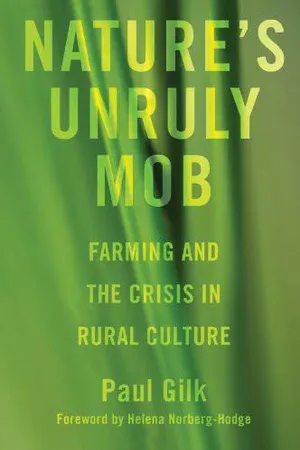
Growing up in the mostly wooded rural countryside of northern Wisconsin, in the decades immediately after the Second World War, meant immersion in cultural transformation. An economy of subsistence and self-provisioning was rapidly becoming industrialized and commercial. The culture of the local and small-scale was being overpowered by the metropolitan and large-scale.
This experience provided the practical groundedness for exploring the decline and even the demise of small-scale farming, not just in northern Wisconsin, but as an example and illustration of how industrialization and globalization undermine local rural culture everywhere. Linked with an ecological critique that asserts the unsustainability of globalized industrialism, the exploration into the meaning of rural culture took on larger significance, especially when seen in relation to the collapse of all prior civilizations. In addition, the investigation into the origins of civilization revealed the predatory relationship civilization developed in regard to agriculture and rural life. The rampant globalization of civilization results in the destitution and impoverishment of agrarian culture.
The question then becomes whether civilization has finally achieved the technical mastery by which to protect and extend itself permanently or whether its complexity only assures a more catastrophic collapse or whether civilization may learn to be flexible enough to merge with an essentially noncivilized folk culture to create a new cultural sensibility that enhances the best of both worlds. This is the question the entire world is now facing. Weapons of mass destruction, climate change, and peak oil all combine the force a resolution to this dilemma.
Information
1
Organic Intelligence
As business, industry, technology, and science have expanded in this country, rural culture has contracted both in quality and in bulk. And, as the westward progression of white settlements proliferated and accelerated, many new communities were formed with little or no reference to the lay of the land, to walking trails or footpaths, or even to roadways created for the ease of horse-drawn vehicles. Not only were roads laid out by straight line and geometric grid, whole towns and even cities were by-products of railroad routes or highways.
Considered historically, this change in settlement formation is big enough to deserve the name “transformation.” Almost always in the past (the exceptions may lie in civilizations like ancient Rome’s), human settlement was a far slower and ecologically more intimate process. Everywhere, in the folk dimension, settlement was saturated by familiarity with nature and embedded in culture; but the new American settlements were increasingly the products (or by-products) of power policies enacted by civilized governance with massively accrued industrial capital dominating nature with a new magnitude of arrogant “resource” presumption and scorning culture as the effeminate preoccupation of insecure personalities. Indeed, rural culture is still considered an anachronism, a vestige or mere footprint of the past. Its crooked footpaths are to be superseded by the efficiency of sidewalks and the solidity of cement.
This conviction of the irrelevancy of rural culture is so normative in industrial ideology, and the condition of rural culture so debilitated, that partisans of rural life have an extremely difficult task in simply bringing the issue of rural decay into public awareness. As cities enlarged, the countryside shrank in importance. It’s hard to think about things for which we have no thought. But rural culture must not be utterly dismembered; we need clear and decisive analysis as to its meaning, function, and validity.
In the following pages, I shall try to give expression to a bundle of ideas, values, insights, and beliefs related to the dangers inherent in the deterioration of rural culture. Though sometimes rude of manner and rough in expression, these essays represent an effort by a concerned citizen and a worried partisan of rural culture to shepherd an unruly flock of convictions toward a more complete understanding. Some issues can be readily named: the current industrial ideology of overproduction with its advertising “industry” geared toward a constantly increasing consumption of all marketable commodities; the tremendous shrinkage of agricultural society and the decimation of an integrated and relatively independent rural culture with its own folk traditions, crafts, tools, dance, music, and art; the industrialization of agricultural methods; the expansion of suburban lifestyles; endless urban sprawl with its highways, automobiles, gas stations, motels, and fast-food chains; an intensified preoccupation with the young, especially in regard to educational curricula bent on maximizing industrial science; the lowest possible denominator of entertainment via television (the democratic ideal of a cultural “melting pot” reduced to technological absurdity); human relationships trivialized as personnel within bureaucratic organizations in which one’s time, energy, and even one’s identity belong to impersonal bureaucratic forces; the absence of deep and sustaining friendships and communal vitality; a military-corporate partnership so entangled with the overall economy, as well as with the supposedly free universities, that its maintenance and expansion are seen as key and essential factors in continued industrial development and economic growth; a war machine of infantile masculine fantasy geared to Mutually Assured Destruction (MAD) and, more recently, to the illusion of a “protective shield” (Star Wars); and a psychotherapy that, finally catching up to the political theories of John Locke, preaches contract as the basis of interpersonal conduct.
Given the depth and intensity of these conditions and crises, it would be foolhardy to propose precise blueprints for how things ought to be. But if one takes the time and trouble to look for them, it’s possible to find guidelines for a more peaceful and convivial world. Some of these guidelines can be found within, in the form of intuitions and esthetic judgments; some can be found without, in spiritual teachings and literary traditions. Any society that lived within real ethical boundaries and followed actual environmental limits would be far healthier, more beautiful, and more genuinely stable than our society presently is or perhaps ever was.
Blueprints and organizational charts are out of place in our envisioning a liveable future. The “good life” does not emerge from practiced technique but, rather, from ethical committedness and ecological sensitivity. The late philosopher Baker Brownell, friend and associate of Frank Lloyd Wright and author of The Human Community, focused repeatedly on the need for the restoration of rural community. This is what Brownell said:
[C]ommunity cannot be manufactured. It cannot be built like a house. Though intelligence is needed to maintain it, the community itself comes, like life, without machinery or artifice. For the community is not formulated for power, profit, wages or production. It is the integrity of living.
This integrity may not be deliberately planned. Planning can only improve the conditions under which communities may exist. It may be necessary to their survival. But the community is not this planning. Life under wholesome conditions has a way of assembling itself in a coherent pattern. It has what may be called organic intelligence . . .1
As we attempt to discover the nature of the wholesome conditions to which Brownell alludes, hoping to arrive at some specific answers, we can begin by realizing that small-scale village life, based on subsistence agriculture and handicrafts, has been the cultural root and stabilizing force within the history of civilization. This understanding has been elaborated upon by such thinkers as Martin Buber in his Paths in Utopia, E. F. Schumacher in Small is Beautiful, and Lewis Mumford in The City in History. In these books, one finds similar observations on the destructive power of excessive centralized control. Their primary answer to the problems created by excessive centralization is social, political, economic, and cultural decentralization—and decentralization is an empty term unless it implies the restoration of rural coherence.
All this merely sums up. Believing these principles to be true does not, in and of itself, create a liveable society. But a commitment to these principles can help bring about clarity of purpose. It helps one sort through the rubbish can of ideas. Principles are not, as Brownell recognized, the mental machinery out of which community can be fabricated. Community cannot be contrived or invented, as he rightfully insists. Community comes “like life, without machinery or artifice.”
II
There are two radically different perspectives in regard to our immediate future, and the choice one makes between them is heavily determined by one’s belief or disbelief in the promises of the industrial economy, science, and technology. The first alternative is that civilization, short of major alterations, is in for unprecedented turmoil; the second is that technology is firmly in command and that science will find a way out of any and all predicaments, even including the depletion of crude oil and the warming of Earth.
It’s increasingly evident, however, that if science finds ways to maintain some semblance of industrial growth (by bringing yet more nuclear power plants on line, for instance), that will in no way address or resolve the fundamental problems of our age. For our root difficulties—the lack of coherent rural culture, uncontrolled urban sprawl, rapacious consumption, limitless industrialization, excessive regimentation in school and factory, indiscriminate use of chemicals, military overkill—are themselves the products of an inappropriate reliance on economic novelty, science, and technology as substitutes for cultural wisdom, spiritual humility, and social democracy. Another increase in energy production and commodity consumption will only aggravate the already explosive problems. Global warming is now a household term and peak oil is becoming one. It may be technically possible for “cities” to be placed in orbit in the twenty-first century, or for colonies to be established on the moon or elsewhere. But these futuristic scenarios, too, are no solution; they only add to and distract from the main difficulties. When Ronald Reagan said “Where we’re going we won’t need roads,” it was hard to know whether he was talking about space travel or dystopian collapse. Until we have demonstrated both a willingness and an ability to live peacefully and ecologically on this planet, we have no right to spread our violence, confusion, and disorder throughout the solar system.
Civilization, lured by a fantasy of immortality and crazed by the mirage of progress, slips further and further from its evolutionary and historical roots. The roots of civilization—broad-scale, decentralized rural culture and folk community—have been pulled out of the ground by modern industrial civilization and beaten into commodity-intensive obedience. Our great contradiction is precisely that social stability and ecological coherence must be based on just such rootedness as civilization, especially industrial civilization, has sought to exterminate. In working for cultural renewal and the reconstruction of the countryside, we must be aware that we are struggling directly against the primary thrust of industrial civilization. Science and statistical economics may find ways to keep international capitalism grinding along; but it will grind on only at the price of environmental degradation and social desiccation. The political wreckage of society and the economic devastation of Earth must eventually stop. Earth and human nature cannot sustain such prolonged degradation, such intense disgrace. Most seriously, we are faced with the deployment of real weapons whose use could kill all of us and leave Earth a charred, radioactive, and burnt-out planet: Sigmund Freud’s “death instinct” proven beyond the shadow of a doubt. The more dependent we become on the technocratic system, the more we are captivated by its promises and allurements, the more it replaces common culture, the more difficult it is to change in a truly positive manner and the more likely the system’s breakdown will result in unparalleled destruction, carnage, and chaos. Despite a growing uneasiness among many of us regarding pollution, environmental damage, urban sprawl, an underpopulated countryside, and military intervention on behalf of an economic ideology that falsely parades itself as conserve-ative, the official commitment to industrial growth, and to the required energy consumption by which to promote that growth, remains unchanged.
One thread that links our present industrial affluence to our growing international hostility is energy: a boundless consuming gluttony of oil and electricity that hyperactivates our economy, our foreign policy, and our personal lives. The whole industrial world, with the United States leading the way, is high on energy. The remark by the late E. F. Schumacher, in his Small is Beautiful, that our “present consumer society is like a drug addict” is both succinct and substantially correct.2 The possibility that our “drug” might be cut off by economic collapse or radically reduced by ecological exhaustion or military catastrophe raises our alarm and intensifies our hostility—although it might be said that the real drug, for most people, is not energy addiction per se but consumer habituation. Our task, and it is no small one, is to squarely face our destructive comfort addictions and take the necessary (if also painful) steps to get off the hook. Habit creates its own justification; and as our present system enervates common culture, so we have been taught to despise the past and to fear serious and productive cooperation. Thus we stand ethically incapacitated and morally numb in the midst of pressing need. Our envisioning of a democratic and ecologically sound future is, therefore, both an urgent and a concrete task, although we must not let such envisionings become mere idyllic daydreams, pleasant but powerless.
It is customary, when writing about urgent social, economic, and political dilemmas, to let in an unexpected ray of light, to be quietly optimistic, to suggest that our “leaders” will wake up in time, that a little more education will provide the solution. Such optimism relieves one of personal responsibility; it helps us sleep better at night; it suggests that those who know (or who should know) will act, in the end, wisely and well. This is an optimism in which we can no longer indulge. The renewal of cultural values is a grassroots struggle or it is nothing at all. Civilization tends to be identified with its leaders and heroes; but those who promise to advance its progress must first pass, in our electoral system, through the ideological filters of the corporate elite, thus becoming dependent on their financial largesse and bound to their economic interests. To wait for officially sanctioned leadership is to wait for the tomorrow that never comes. We need a new political force from the grassroots, a coalition that will lay the compelling issues on the line, compose a clear and coherent platform, and offer its own candidates for public office. The most promising constituencies are those that go by the names “Green” and “Rainbow.” But such a political force must be built on the strength of local communities and networks, and on the growing participation of those previously uninvolved people for whom politics seems merely the hyperactive pastime of the overly educated unemployed.I
Neither “major” political party in the United States offers a structural alternative to industrial capitalism. As the “opposing” parties staked out their positions prior to the 1984 elections, for instance, both Republicans and Democrats attempted to outbid each other, as always, in the promotion of high-technology progress. If Republicans stand for Research and Democrats for Development, we need a political gathering that represents something more significant than capitalist R&D. Walter Mondale went so far, as he announced his candidacy for the office of President, to say that “Science must teach us the future.” Such a pronouncement raises intellectual pandering to the level of political program.
III
Let us listen to a wiser voice speaking on the subject of science. The author is the late Swiss psychiatrist Carl G. Jung. The following passage comes from a book, recorded and edited by Aniela Jaffe, entitled Memories, Dreams, Reflections:
Our souls as well as our bodies are composed of individual elements which were already present in the ranks of our ancestors. The ‘newness’ in the individual psyche is an endlessly varied recombination of age-old components. Body and soul therefore have an intensely historical character and find no proper place in what is new, in things that have just come into being. That is to say, our ancestral components are only partly at home in such things. We are very far from having finished completely with the Middle Ages, classical antiquity, and primitivity, as our modern psyches pretend. Nevertheless, we have plunged down a cataract of progress which sweeps us on into the future with ever wilder violence the farther it takes us from our roots. Once the past has been breached, it is usually annihilated, and there is no stopping the forward motion. But it is precisely the loss of connection with the past, our uprootedness, which has given rise to the ‘discontents’ of civilization and to such a flurry and haste that we live more in the future and its chimerical promises of a golden age than in the present, with which our whole evolutionary background has not yet caught up. We rush impetuously into novelty, driven by a mounting sense of insufficiency, dissatisfaction, and restlessness. We no longer live on what we have, but on promises, no longer in the light of the present day, but in the darkness of the future, which, we expect, will at last bring the proper sunrise. We refuse to recognize that everything better is purchased at the price of something wor...
Table of contents
- Title Page
- Acknowledgments
- Foreword
- Introduction
- Chapter 1: Organic Intelligence
- Chapter 2: Nature’s Unruly Mob
- Chapter 3: Roots
- Chapter 4: Rivals to the Hearth
- Chapter 5: Loose Aggregations
- Chapter 6: Putting Our Minds Together
- Chapter 7: The Educator’s Engine
- Chapter 8: Technical Autonomy
- Chapter 9: The Industry of Religion
- Chapter 10: Redemption of the Past
- Chapter 11: Urbanitis
- Chapter 12: Industrial Agriculture
- Chapter 13: Immeasurable Concepts
- Chapter 14: Threshold of Overextension
- Chapter 15: Ned Ludd and the Grain of Science
- Chapter 16: A Proper Balance
- Chapter 17: Lost Trail or a New Age
- Bibliography
Trusted by 375,005 students
Access to over 1.5 million titles for a fair monthly price.
Study more efficiently using our study tools.
Frequently asked questions
Yes, you can cancel anytime from the Subscription tab in your account settings on the Perlego website. Your subscription will stay active until the end of your current billing period. Learn how to cancel your subscription
No, books cannot be downloaded as external files, such as PDFs, for use outside of Perlego. However, you can download books within the Perlego app for offline reading on mobile or tablet. Learn how to download books offline
Perlego offers two plans: Essential and Complete
- Essential is ideal for learners and professionals who enjoy exploring a wide range of subjects. Access the Essential Library with 800,000+ trusted titles and best-sellers across business, personal growth, and the humanities. Includes unlimited reading time and Standard Read Aloud voice.
- Complete: Perfect for advanced learners and researchers needing full, unrestricted access. Unlock 1.5M+ books across hundreds of subjects, including academic and specialized titles. The Complete Plan also includes advanced features like Premium Read Aloud and Research Assistant.
We are an online textbook subscription service, where you can get access to an entire online library for less than the price of a single book per month. With over 1.5 million books across 990+ topics, we’ve got you covered! Learn about our mission
Look out for the read-aloud symbol on your next book to see if you can listen to it. The read-aloud tool reads text aloud for you, highlighting the text as it is being read. You can pause it, speed it up and slow it down. Learn more about Read Aloud
Yes! You can use the Perlego app on both iOS and Android devices to read anytime, anywhere — even offline. Perfect for commutes or when you’re on the go.
Please note we cannot support devices running on iOS 13 and Android 7 or earlier. Learn more about using the app
Please note we cannot support devices running on iOS 13 and Android 7 or earlier. Learn more about using the app
Yes, you can access Nature's Unruly Mob by Paul Gilk in PDF and/or ePUB format, as well as other popular books in Social Sciences & African American Studies. We have over 1.5 million books available in our catalogue for you to explore.