eBook - ePub
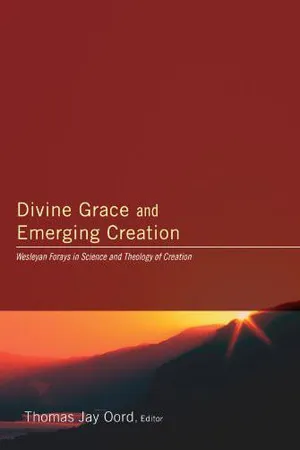
Divine Grace and Emerging Creation
Wesleyan Forays in Science and Theology of Creation
- 244 pages
- English
- ePUB (mobile friendly)
- Available on iOS & Android
eBook - ePub
Divine Grace and Emerging Creation
Wesleyan Forays in Science and Theology of Creation
About this book
Wesleyans and Wesleyan theology have long been interested in the sciences. John Wesley kept abreast of scientific developments in his own day, and he engaged science in his theological construction. Divine Grace and Emerging Creation offers explorations by contemporary scholars into the themes and issues pertinent to contemporary science and Wesleyan Theology.
In addition to groundbreaking research by leading Wesleyan theologians, Jurgen Moltmann contributes an essay. Moltmann's work derives from his keynote address at the joint Wesleyan Theological Society and Society for Pentecostal Studies meeting on science and theology at Duke University.
Other contributions address key contemporary themes in theology and science, including evolution, ecology, neurology, emergence theory, intelligent design, scientific and theological method, and biblical cosmology. John Wesley's own approach to science, explored by many contributors, offers insights for how two of humanity's central concerns--science and theology--can now be understood in fruitful and complementary ways.
Information
Topic
Theology & ReligionSubtopic
Christian Church1
John Wesley’s Precedent for Theological Engagement with the Natural Sciences
Randy L. Maddox
Reflection on the implications of the study of nature for Christian teaching spans the history of the church. This reflection increasingly took on the tone of debate with the transitions marking the “modern” age in Western culture. However, this age also fostered periodic efforts to reframe the interchange between science and religious faith into constructive dialogue, seeking to deepen understanding of their differences and heighten appreciation for their areas of resonance. The last two decades have witnessed a vigorous effort at such “science and religion dialogue.”1
While the current dialogue has yielded many insights, it has been hampered by the tendency to construe “religion” too abstractly. At the most extreme, religion is viewed as a human trait that is assumed to be expressed in all religious traditions. In reality, as the other religious traditions have protested, this supposed generic trait typically reflected convictions of the religions of the Middle East (Judaism, Christianity, and Islam). As such, the most helpful recent studies have begun to pay attention to how the focus of concern about current scientific claims and practices may differ between major world religions.
But the problematic impact of abstraction finds expression as well within major religions. In particular, the range of variance in evaluating scientific claims and practices can be as wide between alternative theological camps within Christianity as it is between Christians and other religious or secular stances. If we hope to increase mutual understanding and cooperation among Christians in their engagement with the natural sciences, we need to pay more attention to the relevant characteristic and/or distinctive convictions and concerns of the major theological traditions within the Christian church. My purpose in this essay is to start a conversation about this topic within the Wesleyan tradition. I attempt this by probing John Wesley’s engagement with the study of nature in his day, watching for the convictions and concerns that emerge, and suggesting their relevance for our own setting.
Historical Perspective for Engaging Wesley’s Precedent
Few would question that John Wesley might provide an instructive precedent for reflections on spiritual formation practices at the outset of the twenty-first century. Turning to Wesley for insights about constructive theological engagement with the natural sciences in our day is a much less obvious proposal. To understand why this is the case, and yet why a small—but growing—number of scholars are embracing the latter project, it will be helpful to begin with some historical perspective.
Early Influential Dismissals
The proposal that one might want to consider Wesley when looking for insights about constructive theological engagement with the natural sciences would have astonished Sir Leslie Stephen, author of a two-volume History of English Thought in the Eighteenth Century published in 1876. Writing nearly a century after Wesley’s death, Stephen assured his readers that “we already find in Wesley the aversion to scientific reasoning which has become characteristic [in Stephen’s day] of orthodox theologians.”2 Andrew Dickson White echoed this evaluation twenty years later in his (in)famous History of the Warfare of Science with Theology in Christendom, citing Wesley several times as an influential proponent of beliefs that stifled the emergence of modern science.3 For both writers, the leading indictment against Wesley was his openness to demonic causes of affliction and the possibility of witches, closely intertwined with his corollary providential accounts of events like earthquakes and his expectation of miraculous healing. Also highlighted by White was Wesley’s ascription to the Genesis account of creation, where animals are portrayed as naturally domesticated to humans and all death results from human sin, assumptions that conflict directly with the Darwinian model of evolution.4
The most significant problem with these influential earlier dismissals of Wesley’s precedent for engaging the natural sciences is that they rely mainly on secondary sources and passing comments in Wesley’s Sermons and Journal. As a result, they provide little sense of the scope of Wesley’s engagement with the natural sciences—or “natural philosophy” as it was pursued in his day. In 1763, Wesley published for the benefit of his Methodist preachers and people A Survey of the Wisdom of God in Creation; or, A Compendium of Natural Philosophy, a two-volume work distilling his reading of several book-length works as well as extracts from the Philosophical Transactions of the Royal Society and other journals. By its third edition in 1777, this Survey had grown into a five-volume collection. To increase its availability to his followers, Wesley serialized excerpts from the Survey in his monthly Arminian Magazine, beginning in 1781. In addition to this broad ranging work, Wesley also published The Desideratum; or, Electricity Made Plain and Useful (1760) and a number of independent short pieces on topics in natural philosophy in the Arminian Magazine. This breadth of material surely qualifies Wesley for consideration as a precedent for theological engagement with science topics, particularly among the various branches of his ecclesial offspring.
Problematic Idealized Appeals
One must be aware of Wesley’s broader work to understand the earliest positive appeals to his precedent in engaging the natural sciences, which were contemporaneous with White’s dismissal—and equally problematic. In 1893, William Harrison Mills gave a lecture titled “John Wesley an Evolutionist” at the Chit-Chat Club in San Francisco. The lecture was circulated as a booklet and a summary was published in Popular Science Monthly the following year.5 Sparked by Mills, James W. Lee enlightened readers of the Southern Magazine the same year that “the founder of Methodism wrote out the whole theory of evolution and the origin of species . . . eighty-four years before Mr. Darwin published his celebrated work upon the same subject.”6 The main difference between Darwin and Wesley, according to Lee, concerned causation—what Darwin attributed to natural selection and survival of the fittest, Wesley attributed to the will of God.
Both Mills and Lee assumed their contention would be surprising, even to Methodists, because so few were familiar with Wesley’s Survey of the Wisdom of God. They based their argument on extracts from the Survey, particularly from volume 4, which offers a sketch of the “gradual progression of beings” that climaxes:
By what degrees does nature raise herself up to man? How will she rectify this head, that is always inclined towards the earth? How change these paws into flexible arms? What method will she make use of to transfor...
Table of contents
- Title Page
- Introduction
- Chapter 1: John Wesley’s Precedent for Theological Engagement with the Natural Sciences
- Chapter 2: John Wesley’s Vision of Science in the Service of Christ
- Chapter 3: Degrees of Certainty in John Wesley’s Natural Philosophy
- Chapter 4: Mystery and Humility in John Wesley’s Narrative Ecology
- Chapter 5: Sighs, Signs, and Significance
- Chapter 6: The Consonance of Wesleyan Theology and Modern Science
- Chapter 7: How the Discoveries of Science and Archaeology Shift Interpretations of Genesis
- Chapter 8: Rooting Evolution in Grace
- Chapter 9: On Giving Intelligent Design Theorists What They Say They Want
- Chapter 10: Attachment, Spiritual Formation, and Wesleyan Communities
- Contributors
Trusted by 375,005 students
Access to over 1.5 million titles for a fair monthly price.
Study more efficiently using our study tools.
Frequently asked questions
Yes, you can cancel anytime from the Subscription tab in your account settings on the Perlego website. Your subscription will stay active until the end of your current billing period. Learn how to cancel your subscription
No, books cannot be downloaded as external files, such as PDFs, for use outside of Perlego. However, you can download books within the Perlego app for offline reading on mobile or tablet. Learn how to download books offline
Perlego offers two plans: Essential and Complete
- Essential is ideal for learners and professionals who enjoy exploring a wide range of subjects. Access the Essential Library with 800,000+ trusted titles and best-sellers across business, personal growth, and the humanities. Includes unlimited reading time and Standard Read Aloud voice.
- Complete: Perfect for advanced learners and researchers needing full, unrestricted access. Unlock 1.5M+ books across hundreds of subjects, including academic and specialized titles. The Complete Plan also includes advanced features like Premium Read Aloud and Research Assistant.
We are an online textbook subscription service, where you can get access to an entire online library for less than the price of a single book per month. With over 1.5 million books across 990+ topics, we’ve got you covered! Learn about our mission
Look out for the read-aloud symbol on your next book to see if you can listen to it. The read-aloud tool reads text aloud for you, highlighting the text as it is being read. You can pause it, speed it up and slow it down. Learn more about Read Aloud
Yes! You can use the Perlego app on both iOS and Android devices to read anytime, anywhere — even offline. Perfect for commutes or when you’re on the go.
Please note we cannot support devices running on iOS 13 and Android 7 or earlier. Learn more about using the app
Please note we cannot support devices running on iOS 13 and Android 7 or earlier. Learn more about using the app
Yes, you can access Divine Grace and Emerging Creation by Thomas Jay Oord, Oord in PDF and/or ePUB format, as well as other popular books in Theology & Religion & Christian Church. We have over 1.5 million books available in our catalogue for you to explore.