eBook - ePub
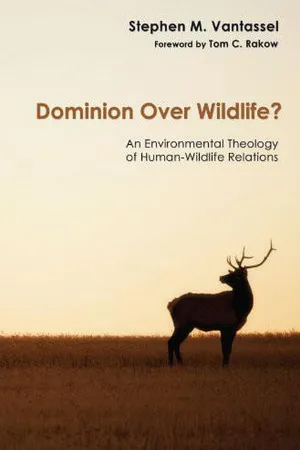
Dominion over Wildlife?
An Environmental Theology of Human-Wildlife Relations
- 232 pages
- English
- ePUB (mobile friendly)
- Available on iOS & Android
eBook - ePub
About this book
For centuries Christians believed that God granted humanity dominion over the animal kingdom, meaning that we had a moral right to kill, manage, and eat animals including wildlife. Recently, however, environmental and animal rights activists have assaulted this traditional perspective. They argue that dominion as expressed in meat eating and hunting has resulted in species extinction and environmental degradation. Christian Animal Rights (CAR) activists suggest that the church must reevaluate its traditional beliefs in light of the fact that God's original creation was free of human on animal violence. God, they argue, did not want man's dominion to be expressed through trapping, killing, and eating of animals. These violent activities only came about after the Fall, as God condescended to our hardness of heart. CAR activists point to Christ's sacrificial work of reconciliation as a model for modern Christian behavior: as Christ sacrificed for us, we should avoid eating meat and hunting as ways we can participate in Christ's non-violent work of reconciling creation to himself.
In this book, Stephen Vantassel investigates the biblical, ethical, and scientific arguments employed by the CAR movement concerning human-wildlife relations. In this regard, the book engages in practical theology by addressing several important questions: How should Christians treat our wildlife neighbors? Has the Church been wrong in its understanding of human dominion? Does God want Christians to avoid hunting, trapping, fishing, and adopt a vegetarian lifestyle? This book provides answers to these questions by detailing a theology the author calls, "Shepherdism."
Information
Topic
Theology & ReligionSubtopic
Christian Church 1
Dominionism Under Fire
Introduction
For almost 2,000 years, Western Christians held that humans had the moral right to utilize creation, including animals, for their own purposes.1 They could have summarized their understanding of humanity’s place in creation in a manner generally consistent with that found in chapter 2, article 7 of the 1995 edition of the Catechism of the Roman Catholic Church.2 The section entitled, “Respect for the integrity of creation” says,
“2415 The seventh commandment enjoins respect for the integrity of creation. Animals, like plants and inanimate beings, are by nature destined for the common good of past, present, and future humanity.[194] Use of the mineral, vegetable, and animal resources of the universe cannot be divorced from respect for moral imperatives. Man’s dominion over inanimate and other living beings granted by the Creator is not absolute; it is limited by concern for the quality of life of his neighbor, including generations to come; it requires a religious respect for the integrity of creation.[195]
2416 Animals are God’s creatures. He surrounds them with his providential care. By their mere existence they bless him and give him glory.[196] Thus men owe them kindness. We should recall the gentleness with which saints like St. Francis of Assisi or St. Philip Neri treated animals.
2417 God entrusted animals to the stewardship of those whom he created in his own image.[197] Hence it is legitimate to use animals for food and clothing. They may be domesticated to help man in his work and leisure. Medical and scientific experimentation on animals is a morally acceptable practice, if it remains within reasonable limits and contributes to caring for or saving human lives.
2418 It is contrary to human dignity to cause animals to suffer or die needlessly. It is likewise unworthy to spend money on them that should as a priority go to the relief of human misery. One can love animals; one should not direct to them the affection due only to persons.”3
The essential elements of this doctrine, called Dominionism,4 holds that humanity has a superior status in creation, and that this status provides a moral basis for humans to wield power over nature, and to compel it to serve human needs and interests. In other words, Dominionism 5 views the cosmos in a hierarchical way, in that humanity’s distinctiveness morally justifies human treatment of non-human creation in a manner categorically different than would be done within the human family.
The belief by Dominionists (those who adhere to Dominionism) that the non-human world should serve human interests has been ridiculed as anthropocentric/homocentric. With the non-human world in effect humanity’s workshop, Dominionism was also characterized as having an instrumentalist, if not a mechanistic, view of creation. Following the example of Bacon and Newton, Dominionists were accused of believing: 1. that the non-human world was to be studied, dissected, and controlled; 2. that animals were morally equivalent to trees and rocks in that all were subject to natural laws; and 3. creation was valuable not in and of itself, but only in relationship to its usefulness to human interests.6
Although non-Christians certainly held a similar view in practice,7 if not in theory, the Western Church, influenced by Aquinas,8 adopted Dominionism as dogma for several reasons. First, Genesis 1:26–8 led her to conclude that God granted mankind authority over the animals, and, by implication, over the rest of creation. In a time and culture familiar with notions of kingship and monarchy, she would readily understand the passage’s use of kingly language as including humanity’s authority over an animal’s life and death, building cities, mining minerals, and other activities that extracted resources from the earth. Second, history, mediated through cultural tradition and textual sources, revealed that humans have extracted the earth’s resources for millennia. More importantly, Holy Scripture was replete with examples of people, later called Saints, who ate and killed animals, cut down forests, and built cities, for centuries. Scripture even records that Jesus Christ Himself, cooked a fish breakfast for His disciples on the shores of Galilee after His resurrection (Jn 21:9ff). Finally, Christians believed, along with non-Christians,9 that Nature herself taught the superiority of humanity. Humans were of a higher order than beasts, plants, and inanimate objects (cf. Gen 1:26ff).10 Humans, either by design or by accident, were the masters of the world. This traditional view became so entrenched that Church leaders spanning the centuries could assert it with little fear of being contradicted or stirring controversy.11
Today, however, Dominionism is under siege. Ginger Louder, adjunct biology professor at Purdue University and Sierra Club member said, in a recent newswire article on religion and the environment that a religious view that supports domination over the environment caters to the egoism of humans. She made the connection to Scripture more explicit by saying, “Genesis 1:27–28 is a comforting thought for many people because we’re given a mandate to dominate. We feel that we have the right to do whatever we want to. We feel that we’re in control.”12
Louder was not alone in her criticism. For in the same article, Rev. Dennis McCarty of the Unitarian Universalist Congregation of Columbus also rejected the notion of humanity’s right to dominate the environment. He condemned the belief that humans “. . .are the monarchs of the ecosystem in which we live; we have been given dominion over it by a greater power.” He believed that, “This adversarial relationship with nature has governed our attitude toward it right up to the present day, hardening our sense of entitlement in the process.” McCarty preferred the Asian understanding of human-nature relations, which exhibits a reduced sense of ownership saying, “Eastern religious traditions have a strong feeling of kinship with the land . . . The earth itself is seen as a source of strength and power.”
It would be wrong to think that the criticism of Dominionism simply hails from non-Christians. In 1976, Anglican priest and theologian Andrew Linzey published Animal Rights: A Christian Assessment of Man’s Treatment of Animals 13 where he decried Christianity’s lack of concern for animals and called for a realignment of its view concerning animals. Linzey claimed that Christianity justified humanity’s continued use, consumption, and exploitation of animals on the hierarchal and anthropocentric bias handed down by Aristotle, Aquinas, and Descartes. Linzey argued that if Christians would only read the Bible with a critical awareness of our past anthropocentric bias, we would recognize how misguided was Aquinas’ belief that humans had no direct duties to animals, as Scripture portrays humanity as creation’s partner, not its master.
Linzey’s reading of Scriptural narrative, which is echoed by many other Christian Animal Rights (CAR) activists,14 can be summarized as follows: In the beginning, God established non-violent harmony between animals and humans. Both were vegetarian and sustained themselves without killing each other. Human sinfulness broke that harmony and spawned violence, which flourished until God brought it to an end by sending a great flood. The Noahic Covenant’s allowance to eat meat was in fact a concession made by God to slow the inevitable growth of violence (particularly human versus human). The idea being that if humans could express their violence against animals (i.e. eating meat), they would be less inclined to exhibit violence against each other. Meat eating was to be a sort of emotional pressure release valve to channel our violent tendencies away from murder and war.15 However, God still showed His true desire to protect animals by instituting rules to limit humanity’s violence of animals. These rules, such as the prohibition against eating blood, Kosher laws, Sabbath regulations, and others, were instituted to direct humanity’s vision to the coming harmony in the Messianic age as foreseen by Isaiah (Isa 11:1–17).
Since Christ died to reconcile all creation (including animals), disciples of Christ should embrace vegetarianism as part of a broader ministry of reconciliation. God wants peace on earth, which cannot include the human exploitation and consumption of God’s animal creation. Linzey asserted that humanity’s violence against animals is representative of its violence against the earth. Hunting, trapping, cattle production, and other consumptive uses of animals violate God’s law, cause animal suffering, and damage the environment. In contrast, vegetarianism/veganism is “violence free” and better for the environment. It is just one small step that people can take toward establishing the harmony God wants us to have. Linzey argued that it is patently inconsistent for the Church to continue to offer tacit or explicit approval to bull fighting, trapping, and eating animals, while claiming that animals were created by God and consequently have value independent of human needs and wants16 Therefore, the Church, in a spirit of “penitence” should correct this failure.17 In brief, Linzey believed that this animal-friendly interpretation made better sense of...
Table of contents
- Dominion over Wildlife?
- Acknowledgments
- Terminology
- Permissions
- Abbreviations
- List of Figures
- Foreword
- Introduction
- 1: Dominionism Under Fire
- 2: The CAR Movement’s Argument from Old Testament Scripture Part 1
- 3: The CAR Movement’s Argument from Old Testament Scripture Part 2
- 4: The CAR Movement’s Argument from New Testament Scripture
- 5: The CAR Movement’s Argument from Ethics
- 6: The CAR Movement’s Argument from Science: The Case Study of Coyote Trapping
- 7: Summary Assessment of the CAR Movement’s Position
- 8: Shepherdism: A Biblically Grounded Ethic for Human-Wildlife Relations1
- Appendix
- Bibliography
- Scripture Index
Trusted by 375,005 students
Access to over 1.5 million titles for a fair monthly price.
Study more efficiently using our study tools.
Frequently asked questions
Yes, you can cancel anytime from the Subscription tab in your account settings on the Perlego website. Your subscription will stay active until the end of your current billing period. Learn how to cancel your subscription
No, books cannot be downloaded as external files, such as PDFs, for use outside of Perlego. However, you can download books within the Perlego app for offline reading on mobile or tablet. Learn how to download books offline
Perlego offers two plans: Essential and Complete
- Essential is ideal for learners and professionals who enjoy exploring a wide range of subjects. Access the Essential Library with 800,000+ trusted titles and best-sellers across business, personal growth, and the humanities. Includes unlimited reading time and Standard Read Aloud voice.
- Complete: Perfect for advanced learners and researchers needing full, unrestricted access. Unlock 1.5M+ books across hundreds of subjects, including academic and specialized titles. The Complete Plan also includes advanced features like Premium Read Aloud and Research Assistant.
We are an online textbook subscription service, where you can get access to an entire online library for less than the price of a single book per month. With over 1.5 million books across 990+ topics, we’ve got you covered! Learn about our mission
Look out for the read-aloud symbol on your next book to see if you can listen to it. The read-aloud tool reads text aloud for you, highlighting the text as it is being read. You can pause it, speed it up and slow it down. Learn more about Read Aloud
Yes! You can use the Perlego app on both iOS and Android devices to read anytime, anywhere — even offline. Perfect for commutes or when you’re on the go.
Please note we cannot support devices running on iOS 13 and Android 7 or earlier. Learn more about using the app
Please note we cannot support devices running on iOS 13 and Android 7 or earlier. Learn more about using the app
Yes, you can access Dominion over Wildlife? by Stephen M. Vantassel in PDF and/or ePUB format, as well as other popular books in Theology & Religion & Christian Church. We have over 1.5 million books available in our catalogue for you to explore.