eBook - ePub
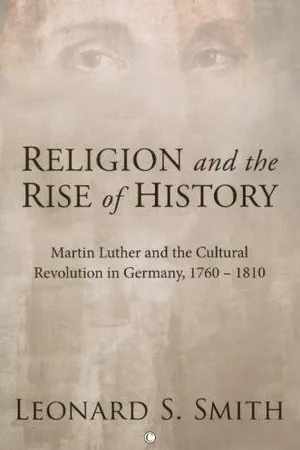
Religion and the Rise of History
Martin Luther and the Cultural Revolution in Germany, 1760-1810
- 306 pages
- English
- ePUB (mobile friendly)
- Available on iOS & Android
eBook - ePub
Religion and the Rise of History
Martin Luther and the Cultural Revolution in Germany, 1760-1810
About this book
As a historical inquiry and synthesis, this intellectual history is the first study to apply the ideal-type or model-building methodology of Otto Hintze (1861-1940) to Western historical thought or to what R. G. Collingwood called "The Idea of History," for it contains succinct and useful models for seeing and teaching classical, Christian, and modern professional historiography.
Religion and the Rise of History is also the first work to suggest that, in addition to his well-known paradoxical, simul, and/or "at-the-same-time" way of thinking and viewing life, Martin Luther also held to a way that was deeply incarnational, dynamic, and/or "in-with-and-under." This dual vision and "a Lutheran ethos" strongly influenced Leibniz, Hamann, and Herder, and was therefore a matter of considerable significance for the rise of a distinctly modern form of historical consciousness (commonly called "historicism") in Protestant Germany.
Smith's essay suggests a new time period for the formative age of modern German thought, culture, and education: "The Cultural Revolution in Germany." This age began in the early 1760s and culminated in 1810 with the founding of the University of Berlin, the first fully "modern" and "modernizing" university.
This university first became the recognized center for the study of history, however, through the work of Leopold von Ranke (1795-1886). Here the story shows how a young Ranke derived his individualizing way of thinking and viewing life mainly from Luther, how his life-work is the best example in Western literature of the rise of history from a calling to a profession, and how the three-way discussion between Troeltsch, Meinecke, and Hintze concerning the nature of modern historical thought was of central importance for the reorientation of Western social-historical thought in the twentieth century.
Information
Topic
Theology & ReligionSubtopic
Christian Theologyone
A Typology of Classical and Christian Historiography
The description of the individual psycho-physical life-unit [Lebenseinheit] is biography. . . . The progress and destiny of the human will is here apprehended in its dignity as an end in itself. The biographer should intuit people sub specie aeterni, as he feels himself in those moments when everything standing between him and divinity seems a superficial diversion and when he feels himself to be as close to the starry heavens as to any part of the earth. Thus biography represents the most fundamental fact clearly, fully, and in its reality.1
—Wilhelm Dilthey
With analogies one must compare entire stages of development and not just momentary, contemporary conditions.2
—Otto Hintze
History can have as its possible object everything dealing with human culture in relation to a perception of time. The concept of the individual totality is, of course, crucial to determining an object of historical study; and I would suggest that the only decisive criterion is its comprehensibility as a life-unit [Lebenseinheit]. The defining of objects of historical study is, in my opinion, an act of intuitive, not rational, thought. The historian’s thinking here is not logical but analogical. The concept of the individual totality underlies this analogical thinking.3
—Otto Hintze
the problem
In 1927, Otto Hintze published an article in the Historische Zeitschrift called “Troeltsch and the Problems of Historicism: Critical Studies,” an essay that was one of the most significant contributions to the idea of history by a professional historian during the twentieth century. Four of Hintze’s contributions in this essay, apparent in the quotation cited directly above, were (1) his distinction between “actual” and “possible” objects of history, (2) his very inclusive and important statement concerning the “possible object of history,” (3) his assertion that historical thinking is basically analogical, and (4) his declaration that “the concept of the individual totality underlies this analogical thinking.” Since each of these ideas was conceived by the most broadly trained, “Aristotelian” (form-thinking), and “Kantian” (analytical) mind among professional historians in Germany in the first third of the twentieth century, it is strange that these ideas have not received greater attention by scholars in or outside of Germany.
If one believes, however, that each of these ideas is helpful for understanding the nature of modern historical thought, what difference could this make in one’s understanding of the idea of history from the time of Herodotus? This is the first major aspect of the problem behind this chapter, and this book as a whole.
One of the ways in which Otto Hintze’s third ideal type, a model of the modern Western state,4 was the most advanced methodologically was that here he presented—as succinctly as he could—four characteristics that together composed the type.5 One of the most useful parts of R. G. Collingwood’s The Idea of History is the section where he presented, as succinctly as he could, four characteristics of Christian historiography.
As a result of many years of using (1) Hintze’s three ideal types to teach Western institutional development in the context of a world-civilizations course and in various courses in modern European history, and (2) his definition and view of historicism to teach the idea of history within a year-long interdisciplinary, and great-books course dealing with Western history, literature, philosophy, and religion,6 five basic questions arose in my mind: (1) Could one apply Hintze’s ideal-type methodology to the study of Western historiography? (2) Could one use his third ideal type as the chief model in this endeavor? (3) Could one use Collingwood’s four characteristics of Christian historiography as one of the three main types, which together would constitute a complete typology of Western historical thought? (4) Could one develop four basic and matching characteristics to form a model of classical historiography of Greece and Rome and a model of “modern” historiography? And, most of all, (5) could the three models and the typology of Western historical thought that I developed and used for many years in my classes be useful for other teachers and for the discipline as a whole?7 These five questions together form the second main aspect of the problem behind this chapter, and together they are a major aspect of this historical inquiry as a whole.
classical historiography of greece and rome
In the opening paragraph of the essay “Wesen und Wandlung des modernen Staats” or “The Nature and Transformation of the Modern State” (1931), Otto Hintze suggested that when an historian creates a “pictorial conception” or an “intuitive [anschauliche] abstraction” known as an ideal type, he singles out certain basic characteristics and presents them in as pure a form as possible. These characteristics are then formed into a whole that can be used to orient oneself in the confusing abundance of historical phenomena.8
When one looks at the development of Western historiography since the time of Herodotus, “the father of history,” one can see three main stages of development, three main periods for the idea of history, and three main types of historical writing: (1) classical historiography of ancient Greece and Rome, (2) Christian historiography from the time of St. Augustine to the Enlightenment and the time and work of Voltaire, and (3) modern professional historiography since the time of the founding of the University of Berlin (1810) and the work of Barthold Georg Niebuhr (1776–1831) and Leopold von Ranke. The chief purpose behind this chapter, however, is to present a sketch of the idea of history in the West from the time of Herodotus to the time of Voltaire through two historical ideal types or models: a model of classical historiography of Greece and Rome, and a model of Christian historiography to the Enlightenment.
As an intuitive abstraction, as a historical ideal type or model, and as a stage in the development of Western historical thought, Greco-Roman historiography was
1. epic because wars and politics were the proper subject of this new kind of prose epic, and because Greek and Roman historians emphasized the greatness of events and heroes rather than their individuality and uniqueness;
2. humanistic because Herodotus created a way of seeing and presenting human events juxtaposed in time in a way that made sense, and because in contrast to the mythopoeic literature prior to Herodotus and in contrast to the theocentric historiography of the Christian epoch, Greek and Roman historians were concerned not with the actions of gods and humans but with “what men have done”;
3. rational because the word historia was a Greek word that meant “research, inquiry, investigation,” or “establishing the truth,” and because the main concern of Greek and Roman historians was to investigate the meaning and coherence of events in terms of the purposeful action of statesmen, military leaders, and other influential men;
4. didactic because after Thucydides, history came to be regarded as a branch of rhetoric and as an art that provided good examples to follow and bad examples to avoid; and because it was taught in schools only for the purpose of providing rhetorical examples9 and not for the purpose of showing how things came to be.
For the ancient Greeks, Homer was the poet par excellence, and the Iliad and Odyssey were their history. The mythopoios or poet was literally a “mythmaker,” and originally a myth was a story with no implication as to its veracity or probability. For the ancient Greeks, the poet was the historian, the philosopher, and the educator; for the poet “knew,” the poet possessed wisdom (sophia), and the poet was the teacher.10
In the sixth century BCE, however, the poet’s exclusive position as guardian of truth, knowledge, and wisdom was challenged by the early Greek philosophers, who sought to understand and to explain how everything in this orderly world or cosmos was derived from certain basic or eternal substances. Beside the wisdom of Homer and the poets, these philosophers or “lovers of wisdom” discovered a new kind of wisdom no longer dependent upon divine revelation or poetic charm. Truth was now something to be determined by rational processes of thought, for they had discovered the abstract idea of truth,11 or what some philosophy teachers love to call “Truth with a capital T.” The idea of abstract truth was a necessary preliminary to the idea of historical truth established by Herodotus and Thucydides in the fifth century BCE.12
When Herodotus (ca. 495–425 BCE13) wrote the story of the Persian invasions of Greece, he created a new kind of epic, a prose epic. Both his purpose ...
Table of contents
- Religion and the Rise of History
- Preface
- Abbreviations
- Chapter 1: A Typology of Classical and Christian Historiography
- Chapter 2: Martin Luther and the Foundations of a Lutheran Ethos
- Chapter 3: Two Forerunners of the Cultural Revolution in Germany and Modern Historical Thought: Leibniz and Chladenius
- Chapter 4: The Cultural Revolution in Germany and the Rise of a New Historical Consciousness, 1760–1810
- Chapter 5: From a Holy Hieroglyph to a Wissenschaft Alone: History as a Calling and a Profession from Ranke to Hintze
- Conclusion
- Bibliography
- Name Index
Trusted by 375,005 students
Access to over 1.5 million titles for a fair monthly price.
Study more efficiently using our study tools.
Frequently asked questions
Yes, you can cancel anytime from the Subscription tab in your account settings on the Perlego website. Your subscription will stay active until the end of your current billing period. Learn how to cancel your subscription
No, books cannot be downloaded as external files, such as PDFs, for use outside of Perlego. However, you can download books within the Perlego app for offline reading on mobile or tablet. Learn how to download books offline
Perlego offers two plans: Essential and Complete
- Essential is ideal for learners and professionals who enjoy exploring a wide range of subjects. Access the Essential Library with 800,000+ trusted titles and best-sellers across business, personal growth, and the humanities. Includes unlimited reading time and Standard Read Aloud voice.
- Complete: Perfect for advanced learners and researchers needing full, unrestricted access. Unlock 1.5M+ books across hundreds of subjects, including academic and specialized titles. The Complete Plan also includes advanced features like Premium Read Aloud and Research Assistant.
We are an online textbook subscription service, where you can get access to an entire online library for less than the price of a single book per month. With over 1.5 million books across 990+ topics, we’ve got you covered! Learn about our mission
Look out for the read-aloud symbol on your next book to see if you can listen to it. The read-aloud tool reads text aloud for you, highlighting the text as it is being read. You can pause it, speed it up and slow it down. Learn more about Read Aloud
Yes! You can use the Perlego app on both iOS and Android devices to read anytime, anywhere — even offline. Perfect for commutes or when you’re on the go.
Please note we cannot support devices running on iOS 13 and Android 7 or earlier. Learn more about using the app
Please note we cannot support devices running on iOS 13 and Android 7 or earlier. Learn more about using the app
Yes, you can access Religion and the Rise of History by Leonard S. Smith in PDF and/or ePUB format, as well as other popular books in Theology & Religion & Christian Theology. We have over 1.5 million books available in our catalogue for you to explore.