- 93 pages
- English
- ePUB (mobile friendly)
- Available on iOS & Android
eBook - ePub
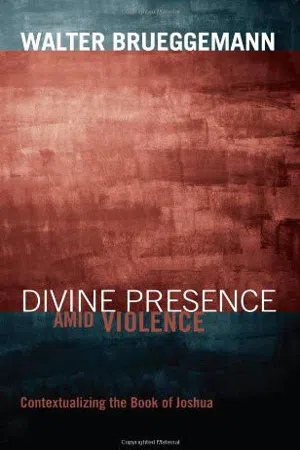
About this book
"To pursue the matter of "revelation in context," I will address an exceedingly difficult text in the Old Testament, Joshua 11. The reason for taking up this text is to deal with the often asked and troublesome question: What shall we do with all the violence and bloody war that is done in the Old Testament in the name of Yahweh? The question reflects a sense that these texts of violence are at least an embarrassment, are morally repulsive, and are theologically problematic in the Bible, not because they are violent, but because this is violence either in the name of or at the hand of Yahweh." -from chapter 2
Information
Topic
Theology & ReligionSubtopic
Biblical Studies1 Revelation, Interpretation, and Method
Two methods of Scripture interpretation that emerged in the late twentieth century are important for the relation between revelation and interpretation. I want to consider both of these methods in relation to the revelatory character of the text.
The first of these methods is sociology—or more broadly, social-scientific criticism: this includes especially macrosociology and cultural anthropology.1 It has become apparent that much historical-critical study has focused on the question of facticity to so large an extent that it has bracketed out questions of social process, social interest, and social possibility. A number of studies have made use of tools of social analysis to ask about the social intention and social function of a text in relation to the community and the situation upon which the text impinges.2 Among the more important of these studies are:
• Norman K. Gottwald on the early period,3
• James W. Flanagan on David,4
• Robert R. Wilson and Thomas W. Overholt on the prophets,5
• Paul D. Hanson on the later exilic and post-exilic periods,6
• Jon L. Berquist on the Persian era,7
• Carol Meyers on women in ancient Israel,8
• Lester L. Grabbe on “religious specialists.”9
A programmatic formula for such an enterprise is that it is a “materialist” reading,10 a phrase Gottwald would accept for his work, but perhaps some of the others mentioned would not. A “materialist reading” suggests that the text cannot be separated from the social processes out of which it emerged. The text also is a product of the community. The community that generates the text is engaged in production of the text, and the community that reads it is engaged in consumption of the text, so that the text needs to be discussed according to processes of production and consumption.11 In what follows, I will want to consider a materialist reading of a text, as an attempt to appropriate its revelatory claim. The text as product for consumption suggests the operation of intentionality and interest in the shaping of the text.
The second emerging method that will be useful for us is literary analysis. Literary analysis seeks to take the text on its own terms as an offer of meaning, as an exercise in creative imagination to construct a world that does not exist apart from the literary act of the text.12 The nuances of the text are not simply imaginative literary moves, but are acts of world-making that create and evoke an alternative world available only through this text. The authoritative voices in such a method are
• Paul Ricoeur, from the perspective of hermeneutics13
• Amos Wilder, from the perspective of rhetoric.14
In Old Testament studies, among the more effective efforts at analyses of literature as “making worlds” are those of:
• David Gunn15
• David J. A. Clines16
• Phyllis Trible17
• Robert Alter18
• Meir Sternberg.19
This literary approach seeks to receive the world offered in the text, even if that world is distant from and incongruent with our own. Thus the text is not a report on a world “out there,” but is an offer of another world that is evoked in and precisely by the text. The text “reveals” a world that would not be disclosed apart from this text. This view suggests that the alternative to the world of this text is not an objective world out there, but it is another “evoked world” from another text,20 albeit a text that may be invisible and unrecognized by us. We are always choosing between texts, and the interpretive act is to see the ways in which the world disclosed in this text is a compelling “sense-making” world.21 Literary analysis assumes that the text is not a one-dimensional statement, but is an offer of a world that has an interiority, in which the text is not a monolithic voice, but is a conversation out of which comes a new world.
When one puts the social-scientific and literary methods together in a common interpretive act,22 it is clear that the voices in the text may speak and be heard and interpreted in various ways. Some voices may be shrill, arid, domineering; some may be willingly quiet; some may be silenced and defeated. It is, nonetheless, the entire conversation in the text that discloses an alternative world for us. Thus Scripture as revelation is not a flat, obvious offer of a conclusion, but it is an ongoing conversation that evokes, invites, and offers. It is the process of the text itself, in which each interpretive generation participates, that is the truth of revelation. Such an interaction is not a contextless activity but the context is kept open and freshly available, depending on the social commitments of the interpreter and the sense-making conversations heard in the act of interpretation. In this strange interpretive process, we dare to claim and confess that God’s fresh word and new truth are mediated and made available to us.
It will be clear from the foregoing that my assumption is that there are no “innocent” readings of Scripture, and surely there are no “innocent” formations of Scripture. This is not to reduce the witness or interpretation of Scripture to vested interest, but it is to insist that every faithful witness and interpretation is to some extent filtered through and impinged upon by the interpreter. One way of recognizing that “truth” is impacted by “power” is to see that every text is a carrier of interest that voices truth from a certain perspective. Of course the generic name for that reality is “ideology,” even though the term itself is more than a little problematic. On the one hand “ideology” is a gift from Karl Marx, who proposed that articulations of truth from above are characteristically done in bad faith, because they reflect particular interests, and characteristically seek to disguise that interest in language that deceives. Freud, of course, went further with his perception of the ways in which human persons have the power to self-deceive. On the other hand, a much more benign notion of ideology is fostered by the anthropologist Clifford Geertz, who understands the term to refer to any sense-making account of reality, so that it need not necessarily be an articulation of bad faith or deceit.23 In that usage the term “ideology” serves as a synonym for elemental social conviction, or even t...
Table of contents
- Divine Presence amid Violence
- Introduction
- 1 Revelation, Interpretation, and Method
- 2 Discerning Revelation from God
- 3 Divine Permit
- 4 Revelation in Ancient Context
- 5 Revelation and Canonical Reading
- 6 Yahweh versus Horse and Chariot
- 7 Despite Chariots of Iron
- Bibliography
Trusted by 375,005 students
Access to over 1.5 million titles for a fair monthly price.
Study more efficiently using our study tools.
Frequently asked questions
Yes, you can cancel anytime from the Subscription tab in your account settings on the Perlego website. Your subscription will stay active until the end of your current billing period. Learn how to cancel your subscription
No, books cannot be downloaded as external files, such as PDFs, for use outside of Perlego. However, you can download books within the Perlego app for offline reading on mobile or tablet. Learn how to download books offline
Perlego offers two plans: Essential and Complete
- Essential is ideal for learners and professionals who enjoy exploring a wide range of subjects. Access the Essential Library with 800,000+ trusted titles and best-sellers across business, personal growth, and the humanities. Includes unlimited reading time and Standard Read Aloud voice.
- Complete: Perfect for advanced learners and researchers needing full, unrestricted access. Unlock 1.5M+ books across hundreds of subjects, including academic and specialized titles. The Complete Plan also includes advanced features like Premium Read Aloud and Research Assistant.
We are an online textbook subscription service, where you can get access to an entire online library for less than the price of a single book per month. With over 1.5 million books across 990+ topics, we’ve got you covered! Learn about our mission
Look out for the read-aloud symbol on your next book to see if you can listen to it. The read-aloud tool reads text aloud for you, highlighting the text as it is being read. You can pause it, speed it up and slow it down. Learn more about Read Aloud
Yes! You can use the Perlego app on both iOS and Android devices to read anytime, anywhere — even offline. Perfect for commutes or when you’re on the go.
Please note we cannot support devices running on iOS 13 and Android 7 or earlier. Learn more about using the app
Please note we cannot support devices running on iOS 13 and Android 7 or earlier. Learn more about using the app
Yes, you can access Divine Presence amid Violence by Walter Brueggemann in PDF and/or ePUB format, as well as other popular books in Theology & Religion & Biblical Studies. We have over 1.5 million books available in our catalogue for you to explore.