eBook - ePub
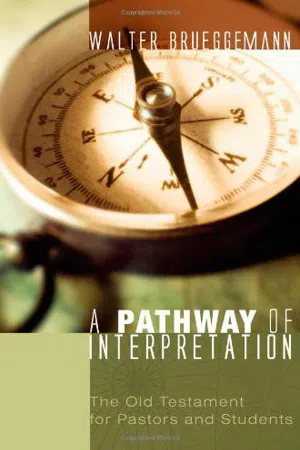
A Pathway of Interpretation
The Old Testament for Pastors and Students
- 180 pages
- English
- ePUB (mobile friendly)
- Available on iOS & Android
eBook - ePub
About this book
Writing with the pastor and student in mind, Walter Brueggemann provides guidance for interpreting Old Testament texts. He offers both advice for the interpreter as well as examples of working with different sorts of passages: from narratives, prophecies, and Psalms. He also demonstrates how to work thematically, drawing together threads from different traditions. His goal is to work through the rhetoric of these passages to reach toward theological interpretation. These investigations indicate Brueggemann's conviction that the process of moving from text to interpretive outcome is an artistic enterprise that can be learned and practiced.
Information
chapter 1
Introduction: That the World May Be Redescribed
We study the Bible in the church and we argue about it. We
read it in church and dutifully call it “The Word of the Lord.” We respond to the reading with equal dutifulness, “Thanks be to God.” But we do not reflect much on what we are doing and, I suggest, much of the time we are not attentive to the reading itself. In what follows in these essays I want to consider what we are doing when we read the Bible and how we read in order to accomplish what we think we are doing.
read it in church and dutifully call it “The Word of the Lord.” We respond to the reading with equal dutifulness, “Thanks be to God.” But we do not reflect much on what we are doing and, I suggest, much of the time we are not attentive to the reading itself. In what follows in these essays I want to consider what we are doing when we read the Bible and how we read in order to accomplish what we think we are doing.
A Network of Symbols
The Bible is not ever read or studied in a vacuum. It is always read and studied and heard in a particular social context and in a particular cultural environment that teems with symbolization. The package of dominant symbols that define the social, cultural context of Bible reading we may call a “world,” if we understand that “world” means a network of symbols and gestures that order and legitimate social power in a particular way.
We may take it as a fact that a “world” as a network of symbols is not a “given,” but it is always a carefully constructed social fabric that intends to shape and exhibit social reality in one way rather than in many other ways that are available.1 Thus a dominant “world” is an intentional advocacy that establishes assumptions, procedures, and goals for the management of social power. Peter Berger and Thomas Luckmann have rightly spoken of “the social construction of reality,” for they, like every other social scientist, are acutely aware that what is easily taken as a given is in fact a construction, even if persuasively done, even if accomplished surreptitiously.2 In the ancient world of the Bible, the dominant life-world was constructed and managed from centers of royal imperial power or from centers of tribal authority. In each case the center of power created a fabric of narrative memory that offered a viable tradition and identification that made it possible for people to place themselves in a legitimate social environment. The great centers of socioeconomic, political, and military power depend upon the great temple liturgies that enacted deeply rooted myths to create and manage social reality.3 We may take it that the Jerusalem establishment of David and Solomon are a pale but intentional reflection of the great practice of liturgy-myth that offered a world that certified Jerusalem power and the creator God YHWH who legitimated that urban power. As counteroffer, the tradition of the Mosaic covenant at Sinai provided an alternative grounding with a more radical social ethic rooted in the will of YHWH, the steadfast God of covenant.4 These two offers of a “world” of YHWH lived in some tension with each other, the Jerusalem offer of coherence and security, the Sinai offer of neighborly obedience. The text, in its canonical, liturgical, storytelling practice created and continues to create a life-world that places YHWH as the key character in that imagined world.
Intentional Advocacy
As the ancient world was constituted with intentional advocacy, so our contemporary world is likewise constructed with intentional advocacy. While we may differ on detail and nuance, the main lines of that construction seem obvious. We in the United States live in a world that champions U.S. exceptionalism.5 From that it follows that the United States, as the last superpower, does good in the world, so that its military adventurism is for the advancement of freedom. That military adventurism which amounts to nothing less than a National Security State is in the service of controlling the global economy in order to supply unlimited consumer goods in a culture of insatiable luxury.6 That world is constructed through government propaganda, market advertising, and technological manipulation that seek to contain and preempt all questions of “value.” This constructed world is a delicate combination of aggressive secular cynicism, coupled with a veneer of religious legitimacy, so that raw power is nicely matched to passionate religious conviction.7 In this socially constructed world, the great gaps between rich and poor and the institutional maintenance of injustice are kept carefully hidden and off the public agenda by mantras about “opportunity” and “freedom.” In recent time we have recovered a great deal of data about the enslaving force of racial, ethnic, sexual violence that has remained hidden in the maintenance of a privileged socioeconomic hegemony. And most recently, the failure of both an independent judiciary and a critical press has caused this dominant construal of reality to go unchecked and unchallenged.
This world may be delineated as a ruthless savage contest for control that works violence beneath the surface of democratic mantras and religious legitimation. Thus the dominant description of reality lives at some distance from the facts on the ground. It is in that cultural milieu that the contemporary church in the United States reads Scripture. It is in that environment that the pastor says, “The Word of the Lord,” and the congregation responds, “Thanks be to God.” The study and reading and hearing of Scripture go on among both the victims of that demanding life-world and the beneficiaries of that life-world. And we are left to ask, What are we doing when we read Scripture?
Subversion and Sub-version
I propose that what we are doing in Scripture study, reading, and hearing is that we are redescribing the world, that is, constructing it alternatively.8 The “re” in “redescription” means that the church is restless with the current, dominant description of reality because that description does not square with the facts on the ground. Thus every time the church takes up Scripture, it undertakes a serious challenge to dominant characterizations of our social world. It dares to propose an alternative reading of the world, an alternative version that is in fact a sub-version that rests beneath the dominant version in a less aggressive mode.9 That alternative reading of reality—alternative version, “sub” version—by its very nature, intends to subvert dominant readings of reality. That redescription subverts the dominant description of reality on three grounds.
First, Scripture intends to call things by their right names (see Isa 5:20). While Scripture has its own share of ideological distortion, it is not committed to any of our current distortions, not beguiled by any of our propaganda, not taken in by any of our current euphemisms.10 It is true that the church has its own long history of beguilement and its long tradition of biblical interpretation whereby we have signed on for the beguilements. But in principle the Bible is a book that invites truth-telling. Nowhere is this clearer than in the prophetic poetry that is unimpressed with dominant modes of power. But the prophetic poetry, the most evident form of sub-version, is not isolated in Scripture, but has allies in the Torah commandments, in the wisdom teaching, and in the Psalms of lament. All these texts move against conventional certitudes and become advocates for transformation. Consequently, they functioned as exposés of failed worlds. One cannot read or hear such texts without having some immediate sense that these texts that redescribe the ancient world in which they were first uttered, at the same time redescribe the world in which we listen. Scripture alerts us to the awareness that the world is not as it is said to be. The reading of Scripture as redescription is a summons to re-see the world faithfully and honestly, and so to disengage from consensus-distorted description.
Second, Scripture sees worldly data within a very different frame of reference; as a result the data is interpreted differently. When the human data of society is read through the lens of market ideology, what happens is that “people” disappear into profit margins, market development, and stock options. But of course Scripture refuses such interpretive reductions. When one reads the same social data in a framework of the neighborly Torah of Sinai, then amid economic development, military adventurism, and an abundance of commodity goods, one sees neighbors who are exploited and devalued. The redescription of reality offered by the Bible retains the sense that the world community of human persons—as well as trees and squirrels and radishes and whales—constitute a community of solidarity and shared responsibility. Once that frame of reference is recognized, the data of the world must, perforce, be engaged differently.
But after calling things by their right names and paying attention to an alter...
Table of contents
- a pathway of interpretation
- Acknowledgments
- Preface
- Chapter 1—Introduction: That the World May Be Redescribed
- Chapter 2—Setting the Stage: The Church’s Task of Interpretation
- Chapter 3—Steps in Interpretation: Jeremiah 5:14–17 as Example
- Chapter 4—Four Characters, a Grudge, and the Place of God: Genesis 50:15–21
- Chapter 5—From Problem to Resolution in Four Scenes: First Samuel 1
- Chapter 6—Truthful Witnesses, Capacity for the Future, and Responsibility: Isaiah 43, Habakkuk 3, Psalm 44
- Chapter 7—The Absence of God: Texts that Refuse to Be Explained Away
- Chapter 8—Concerning Secondary Resources
- Chapter 9—Conclusion: Interpretive Outcomes
- A Classified Reading List
- Bibliography
- Scripture Index
Trusted by 375,005 students
Access to over 1.5 million titles for a fair monthly price.
Study more efficiently using our study tools.
Frequently asked questions
Yes, you can cancel anytime from the Subscription tab in your account settings on the Perlego website. Your subscription will stay active until the end of your current billing period. Learn how to cancel your subscription
No, books cannot be downloaded as external files, such as PDFs, for use outside of Perlego. However, you can download books within the Perlego app for offline reading on mobile or tablet. Learn how to download books offline
Perlego offers two plans: Essential and Complete
- Essential is ideal for learners and professionals who enjoy exploring a wide range of subjects. Access the Essential Library with 800,000+ trusted titles and best-sellers across business, personal growth, and the humanities. Includes unlimited reading time and Standard Read Aloud voice.
- Complete: Perfect for advanced learners and researchers needing full, unrestricted access. Unlock 1.5M+ books across hundreds of subjects, including academic and specialized titles. The Complete Plan also includes advanced features like Premium Read Aloud and Research Assistant.
We are an online textbook subscription service, where you can get access to an entire online library for less than the price of a single book per month. With over 1.5 million books across 990+ topics, we’ve got you covered! Learn about our mission
Look out for the read-aloud symbol on your next book to see if you can listen to it. The read-aloud tool reads text aloud for you, highlighting the text as it is being read. You can pause it, speed it up and slow it down. Learn more about Read Aloud
Yes! You can use the Perlego app on both iOS and Android devices to read anytime, anywhere — even offline. Perfect for commutes or when you’re on the go.
Please note we cannot support devices running on iOS 13 and Android 7 or earlier. Learn more about using the app
Please note we cannot support devices running on iOS 13 and Android 7 or earlier. Learn more about using the app
Yes, you can access A Pathway of Interpretation by Walter Brueggemann in PDF and/or ePUB format, as well as other popular books in Theology & Religion & Biblical Criticism & Interpretation. We have over 1.5 million books available in our catalogue for you to explore.