eBook - ePub
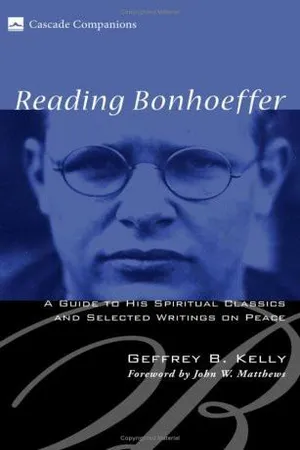
Reading Bonhoeffer
A Guide to His Spiritual Classics and Selected Writings on Peace
- 198 pages
- English
- ePUB (mobile friendly)
- Available on iOS & Android
eBook - ePub
About this book
Dorothee Soelle once wrote, "Dietrich Bonhoeffer is the one German theologian who will lead us into the third millennium." As we near the end of the first decade of this third millennium, Bonhoeffer continues to inspire new generations as a spiritual guide for their actions on behalf of peace and social justice. This book by Geffrey Kelly provides a critical analysis and reading guide to two of the spiritual classics that are now available in new translations through Fortress Press. Reading Bonhoeffer offers a running commentary of each segment of these popular texts along with discussion questions suitable for the university and seminary classroom as well as parish adult education programs. In a final section of the book, Kelly excerpts and analyzes three significant texts by Bonhoeffer on the need for world peace against the rising militarism and continued glorification of war in Germany and other European nations.
Information
Topic
Teologia e religioneSubtopic
Teologia cristianaone
Dietrich Bonhoeffer: A Biographical Sketch
Introduction: Bonhoeffer’s Place in History
Few people would have ever predicted during his growing-up years in Berlin that Dietrich Bonhoeffer would become part of a political conspiracy aimed at killing the head of state, or a martyr honored around the world for his heroic witness against the murderous ideology of Nazism. In recalling his friendship with Bonhoeffer, Bishop George Bell of Chichester remarked that Bonhoeffer was a moral force for a new Germany. He also reflected on Bonhoeffer’s farewell message, delivered through fellow prisoner, the British intelligence officer Captain Payne Best: “I believe in the principle of our universal Christian brotherhood which rises above all national interest.”1 Christian faith, not political expediency, had driven Pastor Bonhoeffer into the German resistance movement and the attempt to assassinate Adolf Hitler and overthrow the Nazi government. Together with other leading members of the conspiracy against Hitler, Bonhoeffer was hanged by the S.S. at the Flossenbürg Death Camp on April 9, 1945, in the waning days of World War II. The cannons of General Patton’s army could be heard in the distance. Three weeks later Hitler would commit suicide and the war would be over.
Bonhoeffer was only thirty-nine years old at his death, his influence on the church in Germany seemingly at an end. Yet today, some sixty-three years later, people are still inspired by his Letters and Papers from Prison, and especially by his spiritual classics, Discipleship and Life Together—books that continue to challenge Christians and their churches to follow in the way of Jesus Christ and to resist the national idolatries that masquerade as expressions of Christian faith. In many ways, Bonhoeffer has been even more influential after his martyrdom than he ever was in his brief teaching and preaching career before his participation in the German resistance movement.
Dietrich Bonhoeffer has often been considered a theologian ahead of his time who had pointed his writings to a new phase in Christian thinking that involves a serious questioning of several traditional presuppositions of religion and faith. Many of the original expressions associated with Bonhoeffer, such as “cheap grace” and “costly grace,” the “world-come-of-age,” “worldly Christianity,” “nonreligious Christianity,” the “non-religious interpretation of religious concepts,” “Jesus the man for others,” have become thought-provoking bywords in theology today. Bonhoeffer’s prison letters encouraged Christians to reassess the value systems of a nation plunged into the idolatrous nationalism and ruthless militarism that, in effect, denied Jesus Christ and his gospel teachings. Nazi Germany had become engaged in blatant racism, persecution of the so-called “Untermenschen” (those declared to be of less than human worth), and murder of the innocent. Its leaders seemed impervious to human rights while paying homage to their new gods of blood and battle; just war theory had been reduced to an antiquarian idea that they could trim to suit their own aims of world domination. Bonhoeffer’s writings remind Christians of their duty to live responsibly, and to courageously oppose, through whole-hearted actions on behalf of the victims, governmentally structured malevolence. Part of the continued fascination with Bonhoeffer stems from the fact that his own life and heroic death are a witness to the sincerity of his teaching. Of few theologians can it be claimed that their lives are fully congruent with their faith and their faith alone, not some secular ideology, acknowledged as the inspiring force behind their religious writings. From prison, Bonhoeffer formulated what to him was the main question that determined the depth of one’s faith: “What do we really believe? I mean, believe in such a way that we stake our lives on it?”2
Bonhoeffer was born in Breslau, now part of Poland, on February 6, 1906. He was the fourth son and sixth child (his twin sister Sabine was born only moments later) of Paula von Hase, daughter of Karl-Alfred von Hase, preacher at the court of Kaiser Wilhelm II, and Karl Bonhoeffer, a famous doctor of psychiatry, professor at Berlin University, and director of the psychiatric and neurological clinic at the Charity Hospital attached to the university.
Berlin University and Internship in Barcelona
At Berlin University young Bonhoeffer came under the influence of the distinguished church historian, Adolf von Harnack, and the Luther scholar, Karl Holl. To the dismay of von Harnack, who regarded him as a potentially great church historian able one day to step onto his own podium, Bonhoeffer instead steered his scholarly energies to dogmatics, where his main interests lay in the allied fields of Christology and Ecclesiology. His doctoral dissertation, Sanctorum Communio (The Communion of Saints), completed in 1927, was hailed by Karl Barth as a “theological miracle.”3 Bonhoeffer was only twenty-one years old at the time.
In this dissertation Bonhoeffer describes the church in a memorable phrase: “Christ existing as church community.”4 The uniqueness of Bonhoeffer’s thesis lay in his attempt to harness social philosophy to the chariot of ecclesiology, hence his sub-title: “A Theological Study of the Sociology of the Church.” Published as a book in 1930, Sanctorum Communio reflects a spiritual search that would remain a central concern of Bonhoeffer until the end of his life—namely, to discover the concrete Christian community in which the life of following Christ takes shape. Time and again he would criticize the churches that had seemingly sold their soul to the Nazi ideology. If the church is a “communion of saints,” that communion can exist nowhere else but in the congregation of sinners who experience God’s graciousness in word, sacrament, and the special gift of being enabled to live for each other. God becomes tangible in the Christian community, where human beings are graced by God and shaped by Jesus Christ into a communion of loving people making visible Christ’s incarnate presence as the risen Lord.
Not yet at the minimum age for “orders,” and in need of practical experience to prepare for his eventual ordination to the ministry, Bonhoeffer interrupted his academic career to accept an appointment in Barcelona, Spain, as assistant curate in a parish tending to the spiritual needs of the German business community. Bonhoeffer’s ministry there coincided with the initial shock waves of the great depression. Parish life in Barcelona gave Bonhoeffer his first grim encounter with poverty and stirred him to become a source of hope to those who had lost their means of livelihood. A sermon and a conference from that period urge his parishioners to recognize Christ in the faces of the grubby poor and to ponder the way Christianity teaches the everlasting value of those whom society might castigate as worthless. In Bonhoeffer’s words: “Christianity preaches the unending worth of the apparently worthless and the unending worthlessness of what is apparently so valuable. The weak shall be made strong through God and the dying shall live.”5
Back in Germany, Bonhoeffer turned his attention to the completion of the “second dissertation” required for him to obtain an academic appointment to the university faculty. Published in 1931, Act and Being is an in-depth contrast of how revelation, considered as “being,” takes place within the Christian community through Christ’s continued incarnate presence. But Bonhoeffer also depicts revelation as the “act” of God’s eternal word interrupting a person’s life in a direct, transcendental way—intervening, often when least expected, to free that person from the narcissistic tendency to turn in on oneself. It seems clear that, throughout the intersecting analyses of this book, Bonhoeffer wishes to avoid what he saw so blatantly done in church and theology: reducing God to a heavenly double of oneself and God’s presence in community to some self-deceiving idolatry whose sole aim was to control God through authoritarian claims of inerrant biblicism or infallible institutionalism. It is clear, too, that Bonhoeffer rejected notions of God’s abstract transcendence that place God in heavenly aloofness from creatures. “God is free,” he wrote, “not from human beings but for them. Christ is the Word of God’s freedom.”6
His Year in the United States at Union Theological Seminary
Having secured his academic appointment to the university, Bonhoeffer now decided to accept a Sloan Fellowship that offered him the opportunity to travel to the United States for an additional year of studies at Union Theological Seminary in New York City. This year at Union would have an impact beyond the courses he followed. Trying to explain what had happened to him to alter his outlook, Bonhoeffer, in two memorable letters, says simply that he had become a Christian. “I was quite pleased with myself,” he wrote. “Then the Bible, and in particular the Sermon on the Mount, freed me from that. Since then everything has changed. . . . It was a great liberation. It became clear to me that the life of a servant of Jesus Christ must belong to the church, and step by step it became plainer to me how far that must go.”7 The effect on Bonhoeffer of his close friendships at Union soon became obvious to his family, friends, and students back in Berlin.
Through a black seminarian from Alabama, the Reverend Franklin Fisher, Bonhoeffer experienced firsthand the oppressive racism endured by the black community of Harlem. He also reveled in the caring community and joyful liturgies these people had created for themselves, even in the midst of the great depression’s crushing poverty. He spent nearly every Sunday and several evenings with the people of Harlem’s Abyssinian Baptist Church. Admiring their life-affirming church services and enchanted by their soulful spirituals, he took recordings of these spirituals back to Germany to play for his students and seminarians. He spoke to them often of the racial injustice that had falsified the boasts of freedom and justice in America.8 In 1931 he believed that there was nothing analogous to America’s racial injustice in Germany. By 1933, however, it was clear to him that Germany’s Jews were even worse off than America’s blacks.
Gradually, under the influence of another friend, the French pacifist Jean Lasserre, Bonhoeffer came to grips with the tendency of nations to resort to violent solutions, even war, to “solve” their political problems. He came to realize that the dehumanization of the enemy and the hardening of soldiers’ hearts to the horror of killing other human beings and of unleashing weapons of destruction against innocent civilians were blatant contradictions of the teachings of Jesus Christ. Lasserre himself recalled that Bonhoeffer began himself to speak passionately about their peace concerns in a way that marked Bonhoeffer as having turned a corner in his attitude toward the evils of war and the need for all Christians to embrace Christ’s peace on a troubled earth. Bonhoeffer did, indeed, become a consistent opponent of Germany’s rearmament and its madcap march toward war throughout the 1930s.9
A third friendship, that of Paul Lehmann, had an additional impact on Bonhoeffer’s sensitivities then developing through Union Theological Seminary. Paul and his wife Marian became his “American family.” Their apartment at Union was perennially available for conv...
Table of contents
- Reading Bonhoeffer
- Foreword
- Preface
- Chapter 1: Dietrich Bonhoeffer: A Biographical Sketch
- Chapter 2: On Reading Bonhoeffer’s Spiritual Classic, Discipleship
- Chapter 3: Life Together: Bonhoeffer on Christian Community
- Chapter 4: Selected Writings on Peace: An Ecumenical Conference and Two Sermons
- Bibliography*
Trusted by 375,005 students
Access to over 1.5 million titles for a fair monthly price.
Study more efficiently using our study tools.
Frequently asked questions
Yes, you can cancel anytime from the Subscription tab in your account settings on the Perlego website. Your subscription will stay active until the end of your current billing period. Learn how to cancel your subscription
No, books cannot be downloaded as external files, such as PDFs, for use outside of Perlego. However, you can download books within the Perlego app for offline reading on mobile or tablet. Learn how to download books offline
Perlego offers two plans: Essential and Complete
- Essential is ideal for learners and professionals who enjoy exploring a wide range of subjects. Access the Essential Library with 800,000+ trusted titles and best-sellers across business, personal growth, and the humanities. Includes unlimited reading time and Standard Read Aloud voice.
- Complete: Perfect for advanced learners and researchers needing full, unrestricted access. Unlock 1.5M+ books across hundreds of subjects, including academic and specialized titles. The Complete Plan also includes advanced features like Premium Read Aloud and Research Assistant.
We are an online textbook subscription service, where you can get access to an entire online library for less than the price of a single book per month. With over 1.5 million books across 990+ topics, we’ve got you covered! Learn about our mission
Look out for the read-aloud symbol on your next book to see if you can listen to it. The read-aloud tool reads text aloud for you, highlighting the text as it is being read. You can pause it, speed it up and slow it down. Learn more about Read Aloud
Yes! You can use the Perlego app on both iOS and Android devices to read anytime, anywhere — even offline. Perfect for commutes or when you’re on the go.
Please note we cannot support devices running on iOS 13 and Android 7 or earlier. Learn more about using the app
Please note we cannot support devices running on iOS 13 and Android 7 or earlier. Learn more about using the app
Yes, you can access Reading Bonhoeffer by Geffrey B. Kelly in PDF and/or ePUB format, as well as other popular books in Teologia e religione & Teologia cristiana. We have over 1.5 million books available in our catalogue for you to explore.