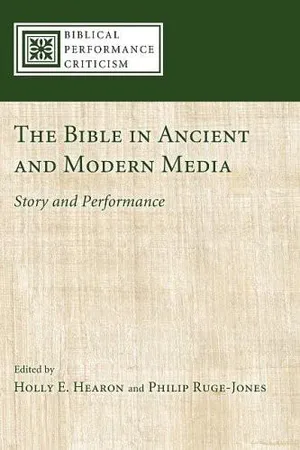
eBook - ePub
The Bible in Ancient and Modern Media
Story and Performance
- 200 pages
- English
- ePUB (mobile friendly)
- Available on iOS & Android
eBook - ePub
The Bible in Ancient and Modern Media
Story and Performance
About this book
This cutting-edge volume has been brought together in honor of Thomas Boomershine, author, scholar, storyteller, innovator. The particular occasion inviting this recognition of his work is the twenty-fifth anniversary of the Society of Biblical Literature's section on The Bible in Ancient and Modern Media (BAMM), which Tom was instrumental in founding. For two and half decades this program unit has provided scholars with opportunities to explore and experience biblical material in media other than silent print, including both oral and multimedia electronic performances. This book explores many, though by no means all, of the issues lifted up in those sessions over the years.
Contributors
A. K. M. Adam
Adam Gilbert Bartholomew
Arthur J. Dewey
Dennis Dewey
Joanna Dewey
Robert M. Fowler
Holly E. Hearon
David Rhoads
Philip Ruge-Jones
Whitney T. Shiner
Marti J. Steussy
Richard W. Swanson
Information
1
Why Everything We Know about the Bible Is Wrong
Lessons from the Media History of the Bible
Robert M. Fowler
The first Bible I ever owned was given to me fifty years ago by my grandparents, back home in Kansas, on Easter Sunday 1958. Although I have not used it seriously in decades, it still sits on a shelf in my study. When I take it down now and open it, I see my grandmother’s handwriting, filling the blank lines on the “Presented To” page conveniently provided by the publisher inside the front cover: “Presented To: Bobby Fowler, By: Grandma and Grandpa Fowler, Date: Easter, April 6, 1958.” This Bible is a King James Bible (first published in 1611), a red-letter edition (all the words of Jesus, from Matthew through Revelation, printed in red ink), and small in size (approximately 4 ½” x 6 ½”). It is handsomely bound in black leather, and it once had a zipper with which to enclose the pages for protection. The zipper is now broken, and the black leather has lost much of its suppleness, but its once strong, intoxicating aroma still lingers faintly. My name (a more formal “Robert Fowler”) is imprinted in gold on the front cover. The Old Testament takes up 800 pages of fine print, and the New Testament, 246 pages.
I would hardly have known at the age of seven that this Bible is definitely a Protestant Bible: containing 66 books, it lacks the books of the Apocrypha that would be found in a Roman Catholic or Eastern Orthodox Bible. For years I carried this Bible to Sunday School and church, and this was the Bible I read in my first fumbling efforts at Bible reading. However, I never fell in love with the strange, archaic wording of the King James Version, and as soon as I was introduced to modern translations (such as the Revised Standard Version), I was happy to make the leap to Bibles that were more easily understood. Indeed, my most vivid memory of the contents of my first Bible is of its colorful illustrations, not its words. My Bible was published by the World Publishing Company, Cleveland, Ohio, which made no impression upon me years ago in Kansas, but which strikes me as ironic today, since I have spent most of my career teaching at a liberal arts college in a Cleveland suburb. Apparently, a Bible printed in Cleveland started me on a path that eventually led me, from the farm in Kansas, to teaching college Bible courses minutes away from where my first Bible was printed.
What did the experience of handling (e.g., carrying to church, zipping and unzipping, smelling the rich aroma of the leather, etc.), to say nothing of the experience of opening and reading this Bible (or just looking at its pictures and my grandmother’s inscription), teach me about the Bible? What impressions were left upon me, and upon countless other readers of the Bible, by repeated encounters with printed Bibles such as my beloved KJV? Here are some of the lessons, both explicit and implicit, that I learned:
1. The Bible is a written, indeed, a printed book.
2. The Bible is a single book, completely enclosed between two covers.
3. The Bible was written for me. (My family and my Sunday School teachers urged me to read my Bible and to apply it to my life—suggesting it was intended for me. It is written in my language, English, although the English of the King James Bible is strange and hard to understand. And my Bible has my name imprinted on the front cover—it was obviously intended for me!)
4. The contents of the Bible are fixed, unchanging, frozen in amber, forever.
5. The Bible is “the Word of God.” (I never found this claim made explicitly anywhere in the Bible, but it was an impression I received from the claims made about the Bible in Sunday school classrooms and in worship services. Also, all those words of Jesus in red ink really impressed me.)
I will suggest in this essay that for the last five hundred years, ever since Johann Gutenberg’s invention of the printing press in the 1450s, lessons such as these have been shaped largely by the fact that we were reading, not just the Bible, but a printed Bible. Holding in our hands and doing the countless things we do with a printed Bible engrains lessons within us of which we are typically not aware. However, the history of the Bible goes back 2500 years before Gutenberg, to at least 1000 BCE. The oldest contents of both the Hebrew Bible and New Testament were communicated orally, exclusively, without benefit of writing. Then, even when biblical books began to be written on parchment or papyrus, few people could afford to own them, few people could read them, and most people would have still experienced biblical material as live oral/aural (=speaking/hearing) performance. It was only when the printing press was invented that people could begin to imagine owning their own Bible and being able to learn to read it and heed it for themselves. This is what I am getting at in my brash title, “Why Everything We Know About the Bible is Wrong.” Because we have been reading the Bible in print for 500 years, we naturally assume that that is the way people have always experienced the Bible. But that is not the case: for 2500 years prior to Gutenberg, most people experienced the Bible either through oral/aural performance or in the form of unique and rare handwritten manuscripts. If we want to understand how the contents of the Bible were first experienced and understood by ancient Jews and Christians, then we need to gain an understanding of the media history of the Bible prior to Gutenberg.1
For the sake of convenience, the history of communication media can be divided into four eras:2
1. Oral/Aural Communication
2. Manuscript Communication
3. Print Communication
4. Electronic Communication
Oral/Aural Communication
It is impossible to tell how long humans have had the physical capability and the cultural inclination to engage in oral communication. Estimates made by paleoanthropologists vary from 50,000 years to several million years.3 Since writing was only invented a few thousand years ago, this means that for most of human history on planet Earth, humans have communicated by the spoken word only. Even after writing was invented, oral/aural communication continued to be the primary means of communication for most people. For thousands of years, literacy was limited to an elite, privileged few, and even today the most literate and bookish of persons will typically use spoken language throughout the course of a day. Writing has never completely replaced speaking and never will. However, once writing was invented, it began a slow, steady march toward eventual dominance over speech, if not in practice, then at least in theory. Fair or not, many persons in modernity have harbored a prejudice in favor of written language over spoken language. Like many of our other current attitudes toward communication media, such prejudice probably arises from our five centuries of experience with the printed book.
Anthropologists and other researchers learned a great deal about oral/aural cultures in the twentieth century, often from investigating cultures where oral/aural communication had remained the dominant means of communication, in spite of thousands of years of writing. For example, Milman Parry and Albert Lord studied oral storytelling in Yugoslavia in the 1930s, uncovering striking similarities between those 20th century oral performances and what we can infer about oral performances in the ancient world, such as Homer’s performances of the epic poems known as the Iliad and the Odyssey.4 While we do not have space here to discuss the various characteristics of oral/aural culture,5 we must note one especially important characteristic. In spite of the cultural conservatism of many oral/aural cultures, their practice of oral communication is at the same time open, flexible, and fluid. To put it sharply, in an oral culture typically no two performances of a story are ever identical. It is taken for granted that the oral storyteller will vary his or her language in response to the needs of the moment, responding to the particular time, place, and audience. Exact, precise repetition of words is what a person from print culture might hope for or expect, but that is because the printing press (or its electronic descendents, such as the photocopying machine) allows us to reproduce printed marks on paper endlessly, with exactitude and precision. People in an oral/aural culture, by contrast, expect and invariably receive from the oral storyteller a slightly (or greatly!) different story every time a story is told. Whereas a deeply literate person might compose a story, memorize it, and perform it as faithfully as possible to the original text, in an oral/aural culture there is no such thing as an “original” composition that is memorized and then repeated verbatim. Rather, each performance of a story is itself a unique, new composition.
The Oral/Aural Bible
What might it mean to speak of “the Bible” in the historical era of exclusive oral/aural communication? We do not know how much of the Bible originated as spoken word only—probably much more than we imagine. It has long been suspected that such foundational material as the legends of Genesis and the parables of Jesus originated as oral storytelling. Only with the passage of time—centuries, in the case of Genesis, and decades, in the case of the parables of Jesus—did these narratives find their way into written form. It is rather amazing to modern, printed-book–literate folk to contemplate that, as far we know, Jesus never wrote a word of his teaching, nor did he ever command anyone else to do so. Ancient oral/
aural peoples were comfortable enough with the spoken word to get by with it for vast ages of human history. Even after the Israelite scribes had been writing for a millennium, a teacher such as Jesus was perfectly comfortable operating in a purely oral/aural mode.
aural peoples were comfortable enough with the spoken word to get by with it for vast ages of human history. Even after the Israelite scribes had been writing for a millennium, a teacher such as Jesus was perfectly comfortable operating in a purely oral/aural mode.
It is a controversial claim, and impossible to demonstrate conclusively, but maybe Jesus did not write down his teachings because he could not—perhaps he could neither read nor write.6 Does that suggestion
offend us? Do we bristle at the thought of an “illiterate” Jesus?7 If so, why? After all, the passages in the gospels that might be cited to make the case that Jesus was literate are few and far between. Granted, ...
offend us? Do we bristle at the thought of an “illiterate” Jesus?7 If so, why? After all, the passages in the gospels that might be cited to make the case that Jesus was literate are few and far between. Granted, ...
Table of contents
- The Bible in Ancient and Modern Media
- Contributors
- Preface
- Introduction
- Chapter 1: Why Everything We Know about the Bible Is Wrong
- Part 1: Story and Performance in the Ancient World
- Part 2: Story and Performance in the Modern World
- Epilogue
- Selected Bibliography
Trusted by 375,005 students
Access to over 1.5 million titles for a fair monthly price.
Study more efficiently using our study tools.
Frequently asked questions
Yes, you can cancel anytime from the Subscription tab in your account settings on the Perlego website. Your subscription will stay active until the end of your current billing period. Learn how to cancel your subscription
No, books cannot be downloaded as external files, such as PDFs, for use outside of Perlego. However, you can download books within the Perlego app for offline reading on mobile or tablet. Learn how to download books offline
Perlego offers two plans: Essential and Complete
- Essential is ideal for learners and professionals who enjoy exploring a wide range of subjects. Access the Essential Library with 800,000+ trusted titles and best-sellers across business, personal growth, and the humanities. Includes unlimited reading time and Standard Read Aloud voice.
- Complete: Perfect for advanced learners and researchers needing full, unrestricted access. Unlock 1.5M+ books across hundreds of subjects, including academic and specialized titles. The Complete Plan also includes advanced features like Premium Read Aloud and Research Assistant.
We are an online textbook subscription service, where you can get access to an entire online library for less than the price of a single book per month. With over 1.5 million books across 990+ topics, we’ve got you covered! Learn about our mission
Look out for the read-aloud symbol on your next book to see if you can listen to it. The read-aloud tool reads text aloud for you, highlighting the text as it is being read. You can pause it, speed it up and slow it down. Learn more about Read Aloud
Yes! You can use the Perlego app on both iOS and Android devices to read anytime, anywhere — even offline. Perfect for commutes or when you’re on the go.
Please note we cannot support devices running on iOS 13 and Android 7 or earlier. Learn more about using the app
Please note we cannot support devices running on iOS 13 and Android 7 or earlier. Learn more about using the app
Yes, you can access The Bible in Ancient and Modern Media by Holly Hearon,Philip Ruge-Jones, Hearon, Ruge-Jones in PDF and/or ePUB format, as well as other popular books in Theology & Religion & Biblical Criticism & Interpretation. We have over 1.5 million books available in our catalogue for you to explore.