- 222 pages
- English
- ePUB (mobile friendly)
- Available on iOS & Android
eBook - ePub
About this book
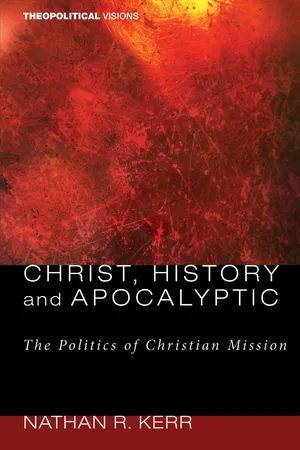
This book offers a comprehensive reflection on what it means that Christians claim that "Jesus is Lord" by engaging in a defense of Christian apocalyptic as the criterion for evaluating the "truth" of history and of history's relation to the transcendent political reality that theology calls "the Kingdom of God." The heart of this work comprises an original genealogical analysis of twentieth-century theological encounters with the modern historicist problematic through a series of critical engagements with the work of Ernst Troeltsch, Karl Barth, Stanley Hauerwas, and John Howard Yoder. Bringing these thinkers into conversation at key points with the work of Walter Benjamin, Carl Schmitt, John Milbank, and Michel de Certeau, among others, this genealogy analyzes and exposes the ideologically "Constantinian" assumptions shared by both modern "liberal" and contemporary "post-liberal" accounts of Christian "politics" and "mission." On the basis of a rereading of John Howard Yoder's place within this genealogy, the author outlines an alternative "apocalyptic historicism," which conceives the work of Christian politics as a mode of subversive, missionary encounter between church and world. The result is a profoundly original vision of history that at once calls for and is empowered by a Christian apocalyptic politics, in which the ideologically reductionist concerns for political effectiveness and productivity are surpassed by way of a missionary praxis of subversion and liberation rooted in liturgy and doxology.
Information
Topic
Theology & ReligionSubtopic
Christian Church1
Introduction
The Question
The question which prompts the following essay is this: what mode of thinking about history and the historical character of human action renders the ‘truth’ of the earliest and most straightforward Christian confession, that of Jesus Christ’s ‘lordship’ – kurios Iesous – for our world today? By confessing that ‘Jesus is Lord’, Christians thereby confess that in Christ’s life, death, and resurrection we are confronted not only with the definitive disclosure of God in history but also by the fact that, as such, Jesus of Nazareth in his very historicity is the one in whom we are to discern the locus of the meaning, or ‘truth’, of history. Only as we refuse to grant history a status or meaning apart from the interruptive event of Christ’s cross and resurrection, and only as this event itself perpetually conditions history as the site of the apocalyptic arrival and inauguration of God’s coming reign, can the confession that ‘Jesus is Lord’ be considered true for us today. Hence the title proper of this work: Christ, History and Apocalyptic.
The subtitle of this work, however, The Politics of Christian Mission, signals a refusal to grant that either this confession or the truth of Christ’s lordship for history are in any sense merely parochial matters, as a matter of ‘the church’s’ intra-ecclesial (or, ecclesiocentric) constitution vis-à-vis ‘the world’. As the truth of history, Christ’s lordship is neither a privilege nor a possession, but rather a political and missional vocation. In the most straightforward sense, this vocation is political insofar as the apocalyptic inbreaking occurs as a uniquely sovereign act. From the very beginning, the confession of Christ’s lordship meant nothing less than that Jesus Christ, having suffered rejection on the cross at the hands of the powers and principalities of history, had been raised up by God as victorious over those powers.
And yet, as the author of Hebrews so clearly affirms, Jesus is uniquely the apostolos, the one who is sent into the world, precisely in order that he might give himself to the world for the sake of the world’s own transformation – the world’s own freedom from the powers. As a matter of such transformation, the inbreaking of God’s reign is made real and available only as a way of life, a concrete practice, a mode of historic action, which ‘way of life’, ‘practice’, and ‘action’ constitutively and fundamentally concur as this world’s conversion. Furthermore, if the church itself is to be understood as the gathering of that people whose very existence is to be a sign and a parable of the incursion of God’s coming reign into this evil age that is passing away, then this missionary vocation must be considered equally constitutive of ecclesia. The ‘church’ only ever exists, ecclesia only ever ‘is’, as the occurrence of a people which, like Jesus himself, is sent into the world, a people whose very life is the gift of participation in this world’s liberation and transformation. Thus, this essay arises out of a deep conviction that what is now needed in Christian theology is an account of Christian ‘politics’ which is rooted firmly in a conception of ‘the church’ – ecclesia – that is irreducibly and constitutively missionary.
In short, the ultimate aim of this work is to seek out and to expound a vision of history that at once calls for and is empowered by an apocalyptic politics of mission.
Modernity and the Historicist Problematic
This work thus amounts to a defence of Christian apocalyptic as a mode of taking seriously the intrinsically political character of the church’s mission. However, to take up such an inquiry today, under the pressures of late modernity, does not allow us to select our starting point. The complexities of what Charles Taylor calls ‘the modern identity’1 do not leave us free simply to frame our hypothesis concerning Christian apocalyptic and then to proceed as if such a project were not itself conditioned and determined at least in part by our awareness of the fact that ‘living in history’ is a peculiarly modern sentiment. As is well known, the edifice upon which the modern identity is constructed is thoroughly historical: the pervasiveness and inescapability of ‘the historical’ is a reality which, within the modern ethos, comes finally to be recognized as universally valid.2
Furthermore, as Pierre Manent has shown, the belief that ‘all is historical’ and ‘history is irreversible’ achieves with modernity for the first time the status of a political authority.3 Particularly since Hegel, but even as far back as Montesquieu, it has been assumed that genuine political sovereignty – the freedom of Absolute Spirit – must engender itself, and must itself be engendered, by and through the processes of historical and institutional development. True freedom – ‘liberty’ – can be achieved only as the result of these processes.4 The ‘authority of history’ thus assumes a politically ideological function: history becomes the artifice which produces, and thus protects and encourages, the endurance of that institution which alone guarantees the attainment of freedom: the nation state. ‘History’ has itself come to be recognized as ‘sovereign’. Humanity’s very freedom assumes the sovereignty of the historical process, a sovereignty which itself requires, and includes, nothing from beyond or outside its own immanent circulation.
Given these assumptions, the status of Christian apocalyptic, which stresses that, in a singular historical event, God has acted to inaugurate the reign of God by making real and present an eschatologically perfect love in the middle of history, has – to say the least – been something of a contended issue in modern theological thought. For apocalyptic calls into question the very presuppositions of modern philosophical historicism: it challenges the many explanations of history as an immanental, self-contained sphere of contingent yet analogous happenings, which are nonetheless related in the intrahistorical development towards a single unified telos; its unabashed insistence upon singularity troubles the universalist aspirations of modern religious thought. Where history is seen as a universal nexus of distinct yet analogously related events which are relativized in their absoluteness by way of reference to a shared telos, then to portray Jesus of Nazareth as a unique, unsubstitutable event of the inbreaking of God’s eschatological kingdom within history becomes incomprehensible. It thereby becomes necessary to relativize claims to Christ’s absoluteness by submitting Jesus of Nazareth to the rigorous canons of modern historical reason and by assessing his significance as it arises from within the rational structures of historical development itself. So it is that we have learned to ‘translate’ apocalyptic into categories comprehensible to the modern mind. We have learned to historicize apocalyptic itself, to circumscribe it within the thought-world of a distant day, to demythologize and then to reconceptualize it as a way of fitting it into our own historical, intellectual, and political categories.
Of course, I have indulged here in something of a sweeping historical generalization. The modern ‘historicist problematic’ is much more difficult when one begins to look at the details, and we shall indeed make recourse to these details as this study progresses. Nevertheless, suffice it to say at this point that, in what follows, I seek to commend Christian apocalyptic as a way not of evading but rather of confronting and taking seriously the several difficulties that history and modern historical inquiry pose for Christian faith, at the levels especially of Christology, eschatology, and Christian mission. In what follows, I shall not be concerned with whether there is an easy way to assert the universality, uniqueness, or absoluteness of Christianity in such a manner as to keep Jesus Christ, or for that matter anything about the faith, elevated above the waves of historicity. I shall rather insist, with Lessing, that we still yet reside on the near side of that wide ditch that separates the contingencies of history from the universal truths of reason.5 That we can remain awash in our historicity and yet proclaim that ‘Jesus is Lord’ thereby confirms theology in its original condition: praise of God rooted in the fact that God has come to this side of the ditch, that God has chosen to confront us in a localizable, contingent, and singular historical event, and that this event itself frees us in our own localizable, contingent, and singular histories to participate in the coming reign of God.
What this study interrogates, then, is the difference between two contrasting theological ‘historicisms’:
1 that which assumes the modern historical consciousness, for which the relativities of history give way to a universalizing tendency by which talk of eschatology and the Kingdom of God comes unhinged from the singular historicity of Jesus Christ and attains an ideological-critical function, as a way of navigating the unresolved tension between the relativities of a historical immanentism and the intrahistorical development towards a rational, subjectively, and universally realized telos;
2 that of a renewed Christian apocalypticism which maintains that here, on this side of the ditch, our only hope is to remain immovably fixed alongside Christ in his irreducible singularity because, with this singular history of a Nazarene rabbi crucified under Pontius Pilate, our own singular histories and our openness to (and participation in) the coming reign of God uniquely coincide.
Constantinianism and Ideology
Of crucial importance to this work will be the argument that not only do the assumptions of modern historicism play an important ideological-critical function within modern political thought but also that this has important implications for how one conceives of the socio-political dimensions of the Christian existence. In the course of this argument, I shall draw heavily upon John Howard Yoder’s analysis of the ‘Constantinian’ nature of modern historical reason and its correlative politics of ‘effectiveness’. It will thus prove helpful at the outset to define what Yoder means by ‘Constantinianism’, as it is a term that will appear with some frequency, as well as with some shifting nuances, throughout what follows. The point of this summary of Constantinianism is not necessarily to vindicate Yoder’s analysis, nor is it to hedge my own constructive proposal for the politics of Christian mission on the authority of Yoder’s own anti-Constantinian stance. My point is to foreground the sense in which ‘Constantinianism’ loosely names a certain set of ideologically bound theological assumptions that perennially recur as ongoing temptations to Christian socio-political thought. In fact, the nature of this temptatio...
Table of contents
- Title Page
- Preface
- Acknowledgements
- Guide to Abbreviations
- Errata
- Chapter 1: Introduction
- Chapter 2: Ernst Troeltsch: The Triumph of Ideology and the Eclipse of Apocalyptic
- Chapter 3: Karl Barth: Foundations for an Apocalyptic Christology
- Chapter 4: Stanley Hauerwas: Apocalyptic, Narrative Ecclesiology, and ‘The Limits of Anti-Constantinianism’
- Chapter 5: John Howard Yoder: The Singularity of Jesus and the Apocalypticization of History
- Chapter 6: Towards an Apocalyptic Politics of Mission
Trusted by 375,005 students
Access to over 1.5 million titles for a fair monthly price.
Study more efficiently using our study tools.
Frequently asked questions
Yes, you can cancel anytime from the Subscription tab in your account settings on the Perlego website. Your subscription will stay active until the end of your current billing period. Learn how to cancel your subscription
No, books cannot be downloaded as external files, such as PDFs, for use outside of Perlego. However, you can download books within the Perlego app for offline reading on mobile or tablet. Learn how to download books offline
Perlego offers two plans: Essential and Complete
- Essential is ideal for learners and professionals who enjoy exploring a wide range of subjects. Access the Essential Library with 800,000+ trusted titles and best-sellers across business, personal growth, and the humanities. Includes unlimited reading time and Standard Read Aloud voice.
- Complete: Perfect for advanced learners and researchers needing full, unrestricted access. Unlock 1.5M+ books across hundreds of subjects, including academic and specialized titles. The Complete Plan also includes advanced features like Premium Read Aloud and Research Assistant.
We are an online textbook subscription service, where you can get access to an entire online library for less than the price of a single book per month. With over 1.5 million books across 990+ topics, we’ve got you covered! Learn about our mission
Look out for the read-aloud symbol on your next book to see if you can listen to it. The read-aloud tool reads text aloud for you, highlighting the text as it is being read. You can pause it, speed it up and slow it down. Learn more about Read Aloud
Yes! You can use the Perlego app on both iOS and Android devices to read anytime, anywhere — even offline. Perfect for commutes or when you’re on the go.
Please note we cannot support devices running on iOS 13 and Android 7 or earlier. Learn more about using the app
Please note we cannot support devices running on iOS 13 and Android 7 or earlier. Learn more about using the app
Yes, you can access Christ, History and Apocalyptic by Nathan R. Kerr in PDF and/or ePUB format, as well as other popular books in Theology & Religion & Christian Church. We have over 1.5 million books available in our catalogue for you to explore.